5
Muscles
3
Joints
1
Organs
2
Mental
Anantasana
अनन्तासन
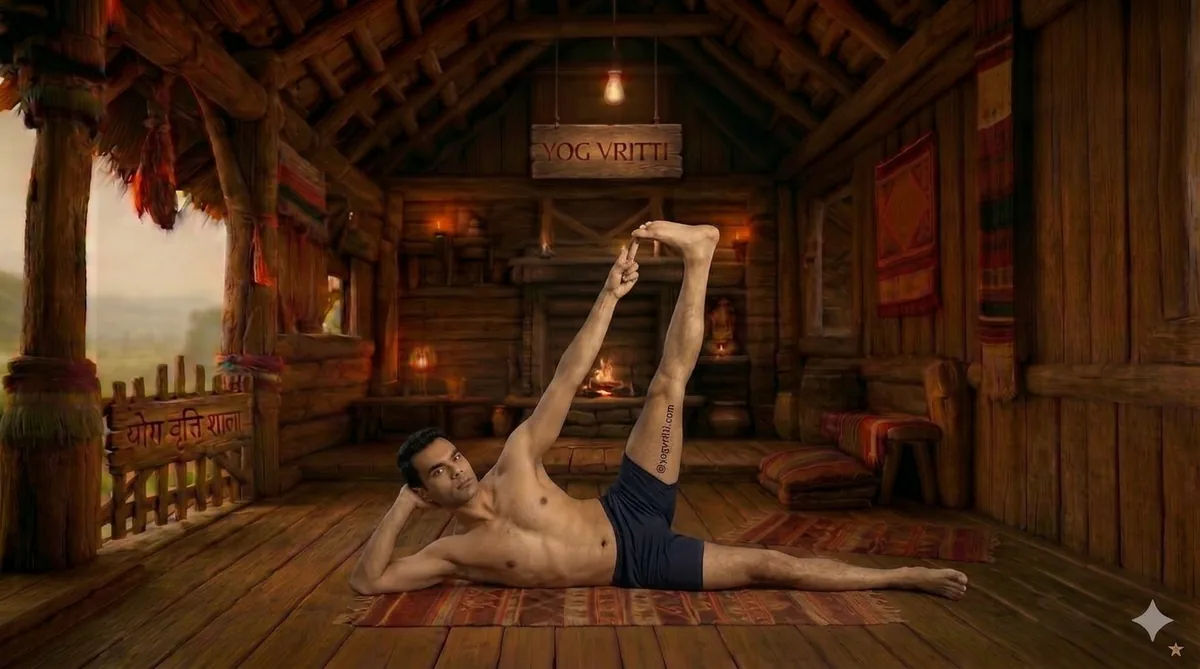
Anantasana, the Side-Lying Leg Raise, is a powerful intermediate pose that profoundly stretches the entire posterior chain of the raised leg, particularly the hamstrings and hip adductors, while demanding significant core and lateral stability from the torso. This supine variation, practiced on the side, grounds the lower body while opening the upper leg, cultivating both steadiness (sthira) and lightness in the limbs. It's a therapeutic gem, especially for addressing lower back stiffness and sciatica, as it systematically lengthens key muscle groups that often contribute to these conditions. For a teacher, it offers a deep exploration of alignment, balance, and the subtle energetic opening in the pelvis and lower spine, making it invaluable for improving overall flexibility and body awareness.
Sleeping Vishnu Pose, also called Side-Reclining Leg Lift is a classical yoga posture. Its Sanskrit name Anantasana translates word-for-word as: Ananta (Infinite (Name of Vishnu)) · Asana (Pose). In this posture, the body releases into the support of the floor, allowing gravity to assist. The posture works to lengthen the hamstrings, engage the obliques and engage the core. Strengthens core and obliques. Improves balance on side. It is particularly valued for easing sciatic discomfort and developing greater flexibility. Suitable for intermediate practitioners with foundational yoga experience, it is a calming cool-down, particularly beneficial for beginners. A strap can be used to make the posture more accessible and support correct alignment. Practitioners with neck pain and shoulder injury should approach with care or consult a qualified teacher.
Helps with
Muscles Worked
Hamstrings
[Biceps femoris, Semitendinosus, Semimembranosus]
The long muscles running along the back of your thighs (hamstrings) on the raised leg get a deep, sustained release here—not a forced stretch but a patient unwinding.
As you hold the pose and breathe, the nervous system gradually allows these muscles to let go of years of tension stored from sitting and stress.
In yogic understanding, this releases apana vayu—the downward-moving energy—allowing a feeling of groundedness and ease in the lower body.
Regular practice progressively lengthens this posterior chain, directly reducing the pull on the lower back and alleviating sciatica.
Hip Adductors
[Adductor longus, magnus, brevis, Gracilis, Pectineus]
The muscles of the inner thigh (hip adductors) on the raised leg experience a profound lengthening, especially as the leg is drawn towards the midline.
This stretch creates vital space across the pelvic floor and inner groin, often an area of chronic tightness.
Energetically, releasing these muscles helps to free the flow of prana through the first and second chakras, fostering a sense of openness and fluidity in the hips.
This increased flexibility in the inner thighs contributes significantly to overall hip mobility and comfort.
Obliques
[External and Internal Obliques]
The side abdominal muscles (obliques) on both sides of the torso are actively engaged to stabilize the trunk and prevent rolling forward or backward.
This deep muscular engagement creates a strong, supportive corset around the lumbar spine, protecting it from strain.
From a yogic perspective, this cultivation of core strength builds inner fire (agni) and a sense of centeredness, allowing the practitioner to feel securely rooted even in a challenging asymmetrical pose.
Consistent practice enhances postural integrity and spinal health.
Transversus Abdominis
[Transversus Abdominis]
The deepest layer of your abdominal wall (transversus abdominis) is continuously active, drawing inward to maintain a neutral spine and prevent the lower back from arching or collapsing.
This subtle, intelligent engagement provides crucial support for the lumbar spine, creating a stable foundation for the raised leg.
In terms of prana, this deep core activation helps to lift and contain the vital energy in the lower abdomen, promoting a sense of inner strength and stability that radiates throughout the entire posture.
Gluteus Medius and Minimus
[Gluteus Medius, Gluteus Minimus]
On the bottom leg, the side hip muscles (gluteus medius and minimus) are continuously active, preventing the pelvis from sinking or collapsing into the floor.
This creates a stable base from which the top leg can extend and lift, ensuring that the stretch is effective and safe.
This intelligent engagement of the supporting hip fosters a sense of groundedness and steadiness (sthira) in the lower body, allowing the practitioner to explore the outer edges of their flexibility with confidence and control.
Joints Mobilized
Hip Joint (raised leg)
mobilizingThe ball-and-socket joint of the raised leg (acetabulofemoral joint) is actively mobilized through a combination of flexion, abduction, and then extension as the leg lifts.
This movement gently lubricates the joint and encourages a greater range of motion within the hip capsule.
By creating more space and freedom in the hip, this pose releases physical and energetic blockages often held in the pelvis, leading to a feeling of lightness and increased mobility in daily activities.
Regular practice can significantly improve hip health and flexibility.
Sacroiliac Joint (SI joint)
stabilizingThe junction where your spine meets your pelvis (sacroiliac joint) is gently stabilized by the grounded nature of the bottom hip and the intelligent engagement of the core muscles.
This side-lying position, with one leg extended and the other active, helps to reduce shear forces across the SI joint, which can be a source of discomfort for many.
The pose encourages a sense of integration and security in the pelvic girdle, promoting relief from SI joint dysfunction and fostering a more unified lower body.
Lumbar Spine
stabilizingThe lower back (lumbar spine) is held in a neutral, elongated position through the active engagement of the core musculature, preventing any excessive arching or rounding.
This stabilization protects the delicate lumbar vertebrae and discs, while the lengthening of the hamstrings reduces tension that often pulls on the lower back.
This creates a sense of spaciousness and support along the lumbar curve, allowing for a healthy flow of prana through the central energetic channel and reducing instances of general back pain.
Organ & System Benefits
Abdominal Organs
Lying on the side in Anantasana provides a gentle, uneven compression and massage to the abdominal organs, particularly on the lower side.
This subtle pressure can stimulate peristalsis, encouraging healthy digestion and elimination.
From a yogic perspective, this gentle internal massage supports the digestive fire (agni), enhancing the body's ability to process nutrients and eliminate toxins, leading to a feeling of greater vitality and inner cleanliness.
Nervous System
The sustained stretch and the requirement for focused balance in Anantasana naturally down-regulate the nervous system, shifting it from a sympathetic (fight-or-flight) to a parasympathetic (rest-and-digest) state.
The steady, rhythmic breath encouraged by the stable torso further enhances this calming effect, reducing physiological stress markers.
This conscious relaxation helps to quiet the fluctuations of the mind (chitta vritti), promoting a profound sense of inner peace and equilibrium.
Anantasana significantly enhances proprioception, which is your body's ability to sense its position and movement in space.
The precise alignment required to balance on your side while lifting one leg demands heightened awareness of subtle shifts in weight and muscle engagement.
This refined kinesthetic sense not only improves physical coordination but also cultivates a deeper, more embodied presence, bringing the mind fully into the experience of the body.
Mental & Emotional
Holding Anantasana demands sustained mental focus and concentration (dharana), as the mind must be fully present to maintain balance and alignment.
This single-pointed attention helps to quiet the incessant chatter of the mind, drawing awareness inward and away from external distractions.
The practice cultivates a powerful sense of mental discipline and clarity, teaching the practitioner how to direct their attention with precision and cultivate inner stillness.
The challenge of maintaining stability in Anantasana, especially with the deep stretch, cultivates patience and a sense of surrender to the body's current capabilities.
It teaches us to release the need to force or strain, encouraging a gentle, persistent effort (abhyasa) without attachment to outcome.
This fosters a profound sense of acceptance and non-violence (ahimsa) towards oneself, leading to greater mental resilience and emotional equanimity.
Because of Its Shape
balance
Anantasana is fundamentally a balancing pose, requiring precise alignment and active engagement of deep core and hip stabilizers to prevent toppling.
This constant micro-adjustment strengthens the intrinsic muscles responsible for postural control and significantly enhances overall proprioception.
The cultivation of physical steadiness (sthira) in this pose directly translates to mental and emotional stability, helping practitioners find their center amidst life's challenges.
As a significant hip opener, Anantasana deeply stretches the hamstrings and hip adductors of the raised leg, increasing flexibility and range of motion in the hip joint.
This action systematically releases stored tension in the pelvic region, an area often burdened by emotional and physical stress.
Energetically, opening the hips allows for a freer flow of prana through the lower chakras, promoting a sense of release, creativity, and emotional freedom.
The side-lying nature of Anantasana uniquely challenges and strengthens the lateral stabilizing muscles of the trunk and hips, including the obliques and gluteus medius.
This engagement creates a strong, integrated core that supports the spine from all sides, improving overall postural health and preventing imbalances.
This cultivation of lateral strength fosters a sense of resilience and adaptability, allowing the body to move with greater ease and stability in all directions.
Fascial Lines
In Anantasana, the entire posterior fascial chain of the raised leg, encompassing the hamstrings, calves, and even the plantar fascia of the foot, receives a deep and sustained release.
Simultaneously, the lateral fascial line of the body, from the outer ankle up through the IT band and obliques, is engaged to stabilize the torso.
This intelligent unwinding and activation of the fascial web helps to release long-held patterns of tension and rigidity, particularly those contributing to lower back pain and stiffness.
Releasing these fascial restrictions is understood in yoga as opening the subtle energy channels (nadis), allowing prana to flow more freely and restore vitality.
Breathing & Respiratory
The stable, grounded position of the torso in Anantasana naturally encourages deep, diaphragmatic breathing.
While the lower side of the abdomen experiences gentle compression, the upper side and the back of the rib cage are free to expand fully with each inhalation.
This allows for a deeper, more complete exhalation, which is crucial for calming the nervous system.
This pose is perfectly suited for cultivating Ujjayi breath, as the stability of the body supports a focused, audible breath that deepens concentration and draws the mind inward, enhancing the meditative quality of the practice.
Anatomical Caution
Teachers should guide students to be extremely mindful of the bottom shoulder and hip, ensuring they are comfortably supported and not bearing excessive pressure.
For students experiencing acute sciatica, it is imperative to approach the pose with great care, only raising the leg to a pain-free range, and perhaps keeping the knee bent.
Always prioritize maintaining a stable, neutral spine and a grounded foundation in the lower body and core over the height of the raised leg to protect the delicate structures of the lower back and pelvis.