5
Muscles
4
Joints
1
Organs
2
Mental
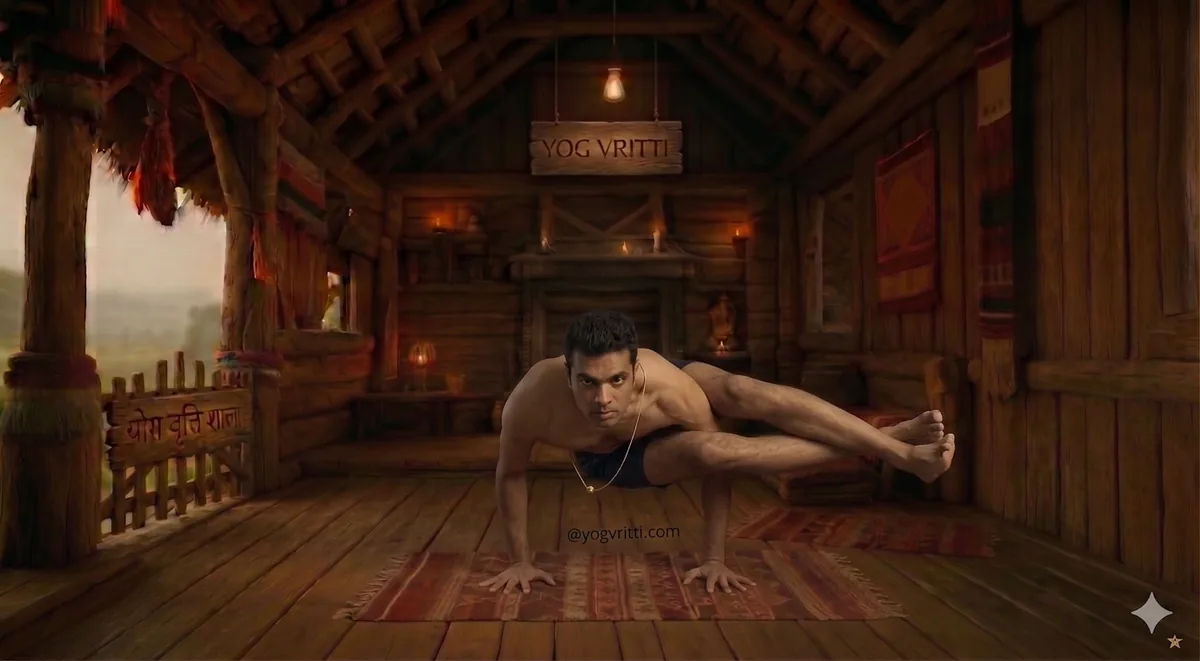
Astavakrasana
अष्टवक्रासन
Astavakrasana, the Eight-Angle Pose, is a dynamic arm balance that demands profound core strength and focused awareness, lifting the entire body off the earth. It intricately weaves together strengthening of the arm and shoulder girdle (upper appendicular chain) with deep activation of the abdominal muscles (core stabilizers), all while requiring a unique opening and stabilization in the hips. This challenging asana cultivates unwavering mental focus and inner fortitude, helping practitioners transcend perceived limitations and experience a profound sense of lightness and mastery over their physical and energetic self. It is a powerful practice for building both physical integrity and spiritual resilience, embodying the strength of the inner warrior.
Eight-Angle Pose, also called Astavakrasana is a classical yoga posture. Its Sanskrit name Astavakrasana translates word-for-word as: Ashta (Eight) · Vakra (Crooked / Twisted) · Asana (Pose). In this posture, the body grounds through the sit bones while the spine rises tall. The posture works to engage the core, open and strengthen the shoulders and strengthen the wrists. Develops twist in arm balance. Improves wrist strength. It is particularly valued for building full-body strength. Suitable for advanced practitioners with developed body awareness, it is a meaningful addition to any practice. Practitioners with wrist injury and shoulder injury should approach with care or consult a qualified teacher.
Helps with
Muscles Worked
Core (Obliques & Transversus Abdominis)
Obliquus externus abdominis, Obliquus internus abdominis, Transversus abdominis
These deep abdominal muscles, located on the sides and front of your trunk, are profoundly engaged to stabilize the spine and lift the legs in Astavakrasana.
They work synergistically to create the necessary twisting action and maintain the integrity of your center, preventing undue strain on the lower back.
This strong activation helps to 'seal' the central channel, awakening manipura chakra and cultivating inner fire, which translates to a feeling of power and self-discipline.
Regular practice here builds a powerful girdle of support around the lumbar spine.
Triceps Brachii
Triceps brachii
Running along the back of your upper arm, the triceps are powerfully contracting to extend your elbows and lift your body weight off the floor.
This sustained isometric contraction is crucial for creating the necessary leverage and height in the pose, directly supporting the entire upper body.
Through this action, we cultivate arm strength that translates to a feeling of stability and self-support, embodying the capacity to hold ourselves up in challenging situations both on and off the mat.
This strengthens the posterior chain of the arm.
Deltoids (Shoulders)
Deltoideus
The large, rounded muscles capping your shoulders, the deltoids, particularly the anterior and medial heads, are highly active in lifting and stabilizing the shoulder joint.
They work in concert with the rotator cuff muscles to maintain the integrity of the glenohumeral joint, preventing collapse and allowing for the powerful lift.
This integrated shoulder action builds a sense of broadness and openness across the chest, inviting a feeling of courage and expansion in the upper body.
It enhances shoulder stability and strength in a challenging position.
Forearm Flexors & Extensors (Wrists)
Flexor carpi radialis, Flexor carpi ulnaris, Extensor carpi radialis longus/brevis, Extensor carpi ulnaris
These muscles in your forearms are intensely engaged to create a stable base through your hands and wrists, allowing you to grip the floor and bear your body weight.
The constant feedback through the palms and fingers enhances proprioception, sharpening your connection to the earth and your own internal balance.
This grounding through the hands helps to channel energy upward, creating a strong foundation from which to lift and extend, fostering a sense of rooted strength.
This also directly strengthens the muscles vital for wrist health and grip.
Hip Adductors (Inner Thighs)
Adductor longus, Adductor brevis, Adductor magnus, Gracilis, Pectineus
The muscles along your inner thighs are actively squeezing the supporting arm, providing crucial stability and leverage for the legs to lift and extend.
This strong adduction helps to 'lock in' the connection between the legs and the arm, creating a unified block of strength.
Through this integrated action, we feel a deep sense of connection and control in the lower body, allowing for a more effortless extension and a feeling of grounded lightness.
This action also brings awareness and strength to a often-underused muscle group.
Joints Mobilized
Shoulder Girdle (Glenohumeral & Scapulothoracic)
stabilizingThe shoulder joint (glenohumeral) undergoes significant stabilization as it bears the body's weight, while the shoulder blade (scapula) engages to support this action on the rib cage (scapulothoracic joint).
This intricate dance between stability and mobility in the shoulder girdle is vital for preventing injury and building robust upper body strength.
Regular, mindful practice here cultivates a broadness across the upper back, releasing tension and allowing for a freer flow of energy through the heart space.
It enhances the dynamic stability of the entire shoulder complex.
Elbow Joint (Humeroulnar & Humeroradial)
weight bearingThe elbow joint remains in strong extension, with the triceps actively working to maintain this straightened position against gravity.
This sustained extension builds resilience in the joint and surrounding connective tissues, teaching the body to bear weight efficiently without hyperextension.
The strength developed here contributes to a feeling of unwavering support in the arms, allowing the practitioner to feel more self-reliant and capable.
This mindful engagement protects the integrity of the elbow joint over time.
Wrist Joint (Radiocarpal & Ulnocarpal)
weight bearingThe wrist joints are actively weight-bearing, requiring strength and stability from the forearm muscles to prevent hyperextension or collapse.
The careful distribution of weight across the palms and fingers is key to protecting these smaller joints and distributing pressure evenly.
This mindful engagement strengthens the foundation of the pose, enhancing the energetic connection to the earth and fostering a sense of balanced support throughout the entire arm.
It builds intrinsic strength and awareness in the often-vulnerable wrists.
Hip Joint (Coxal Joint)
mobilizingThe hip joints are uniquely articulated: one hip is deeply flexed and externally rotated, wrapping around the arm, while the other is abducted and possibly internally rotated as it extends to the side.
This complex positioning mobilizes the hip capsule in multiple directions, enhancing range of motion and flexibility in the entire pelvic region.
This intricate hip work releases stagnant energy (apana vayu) from the pelvis, promoting a sense of freedom and ease in the lower body.
It cultivates both strength and flexibility in the deep hip rotators and flexors.
Organ & System Benefits
Abdominal Organs (Digestive & Excretory System)
The intense core engagement and gentle twisting action in Astavakrasana create a mild compression and release cycle for the abdominal organs.
This internal massage, particularly for the liver, spleen, and intestines, stimulates blood flow and aids in the detoxification process.
Energetically, this stokes the agni (digestive fire) in the solar plexus, enhancing vitality and promoting a feeling of internal cleansing and renewal.
This gentle internal stimulation supports healthy organ function over time.
Nervous System
The intense focus and precise balance required for Astavakrasana draw the mind inward, naturally inducing a state of pratyahara, or withdrawal of the senses.
As the body learns to hold this complex shape, the sympathetic nervous system is initially activated for strength, but the sustained hold and controlled breath then allow the parasympathetic system to gently engage, promoting calm.
This deep concentration calms the fluctuations of the mind (chitta vritti), leading to a profound sense of presence and mental clarity, training the nervous system to perform under pressure.
The proprioceptive feedback from the hands, core, and hips, constantly communicating with the brain, enhances body awareness and neural pathways.
This intricate sensory input refines our motor control and coordination, building confidence in our physical capabilities and sharpening our internal map of the body.
Energetically, this heightened awareness helps to awaken the subtle body, making us more attuned to the flow of prana within and fostering a deeper mind-body connection.
Mental & Emotional
Astavakrasana demands unwavering concentration and a willingness to step beyond perceived limitations, fostering immense mental fortitude and courage.
Overcoming the initial challenges of this advanced pose builds resilience, teaching us to approach difficulties with determination and a calm, focused mind.
This process cultivates a deep sense of self-trust and inner strength, empowering the practitioner to face life's challenges with greater equanimity and an unshakeable inner resolve.
The act of lifting the body off the ground and holding a complex balance shifts perspective, encouraging a sense of playfulness and lightheartedness even amidst intense effort.
This mental agility, combined with the physical discipline, trains the mind to remain steady and present, cultivating dharana (concentration) and preparing the ground for deeper states of meditation.
It teaches us that with dedicated practice, seemingly impossible feats become achievable, fostering a growth mindset.
Because of Its Shape
balance
As an arm balance, Astavakrasana cultivates profound physical stability by strengthening the entire upper body and core, while simultaneously demanding acute mental focus.
The body learns to find its center of gravity in a new configuration, building neuromuscular intelligence and coordination.
From a yogic perspective, mastering balance teaches us to remain steady amidst external fluctuations, bringing equanimity to the mind and a sense of grounded lightness to the spirit, fostering inner harmony.
This pose incorporates a unique spinal twist, particularly in the thoracic and lumbar regions, which enhances the mobility and suppleness of the vertebral column.
The twisting action, combined with core strength, helps to detoxify the body by stimulating circulation to the abdominal organs and promoting the release of stagnant energy.
Yogically, twists are purifying, helping to clear energetic blockages and foster a sense of internal lightness and renewed vitality, promoting spinal health.
Astavakrasana provides a unique and deep opening for the hip joints, particularly the front leg which wraps around the arm in a combination of intense flexion, abduction, and external rotation.
This complex articulation mobilizes the hip capsule and lengthens the deep hip rotators and adductors, enhancing flexibility and releasing deep-seated tension.
From a yogic perspective, opening the hips is often associated with releasing emotional baggage and stored trauma, fostering a sense of emotional freedom and grounding in the lower body.
Fascial Lines
Astavakrasana deeply engages and lengthens various fascial lines, particularly the Deep Front Line and the Spiral Lines, as the body twists, compresses, and extends.
The continuous web of connective tissue running from the inner thighs, through the core, and up to the shoulders is activated and stretched, enhancing inter-muscular communication and overall body integrity.
This release in the fascial network helps to free restrictions, allowing for a more fluid movement of prana and a greater sense of spaciousness within the body, beyond just muscle lengthening, promoting integrated movement.
Breathing & Respiratory
In Astavakrasana, the deep core engagement and slight compression of the abdomen naturally encourage a more refined and controlled Ujjayi breath, primarily in the upper chest and sides of the ribs.
While deep diaphragmatic breathing might be somewhat restricted, the challenge encourages a steady, even flow of breath, which is crucial for maintaining stability and focus.
This conscious, rhythmic breathing helps to regulate the nervous system, channeling prana efficiently and maintaining mental composure throughout the demanding hold of the pose, deepening the connection to the internal rhythm.
Anatomical Caution
Teachers must emphasize careful wrist and shoulder preparation before attempting Astavakrasana, as these joints bear significant weight and require robust strength and stability to avoid injury.
Pay close attention to students with wrist pain, carpal tunnel syndrome, or rotator cuff issues, offering modifications or alternative poses to prevent strain.
Always prioritize alignment and core engagement over achieving the full expression of the pose, guiding students to listen to their bodies and avoid forcing.