5
Muscles
5
Joints
3
Organs
3
Mental
Bharmanasana (Table top pose)
भरमानासन
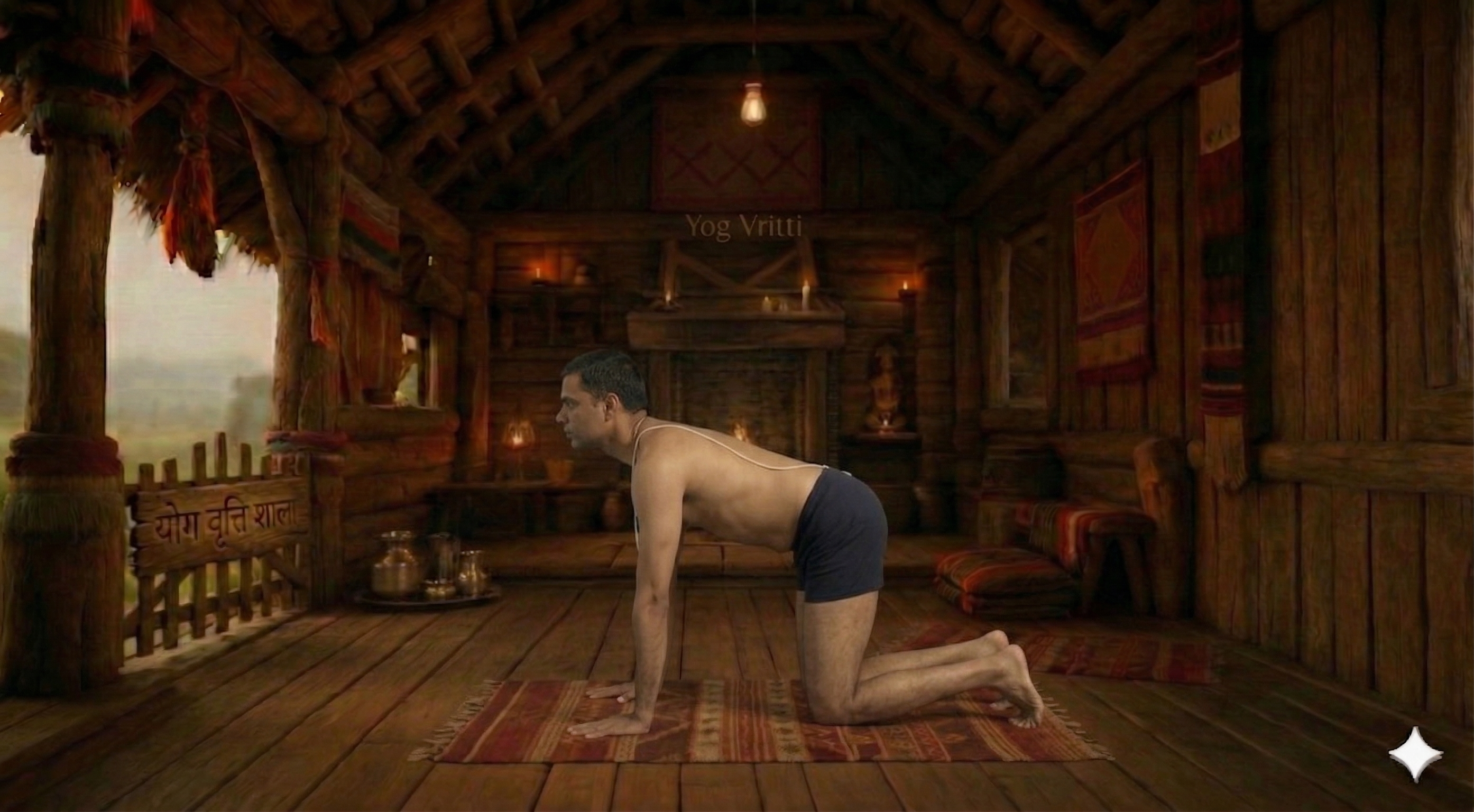
Bharmanasana, the Table Top Pose, is a profound foundational asana that cultivates stability and intelligent alignment throughout the entire body. It establishes a neutral spine supported by an engaged core, while simultaneously strengthening the shoulder girdle and stabilizing the hips. Energetically, it is deeply grounding and centering, allowing for a balanced distribution of prana and a heightened sense of bodily awareness. For any practitioner or teacher, mastering this pose is invaluable, as it unlocks the potential for grace and strength in countless subsequent asanas, transforming the body into a stable and responsive vessel. It teaches the quiet power of integrated strength and conscious presence.
Tabletop Pose, also called Bharmanasana is a classical yoga posture. Its Sanskrit name Bharmanasana (Table top pose) translates word-for-word as: Bharman (Supporting / Bearing) · Asana (Tabletop Pose). Beginning from a kneeling position, the practitioner aligns the body with precision and intentional breath. The posture works to engage the core, strengthen and extend the back and tone the arms. Strengthens the wrists, arms, and core. Improves body awareness and proprioception. It is particularly valued for improving overall posture and building full-body strength. Suitable for beginners and regular practitioners alike, it is an excellent warm-up, particularly beneficial for beginners and seniors. A blanket and wall can be used to make the posture more accessible and support correct alignment. Practitioners with wrist injury and knee injury should approach with care or consult a qualified teacher.
Helps with
Muscles Worked
Core muscles
[Transversus Abdominis, Multifidus, Internal Obliques]
Deep within your abdomen, wrapping like a corset, the transversus abdominis and the small multifidus muscles along your spine activate subtly in Bharmanasana.
This engagement creates an internal girdle, supporting the lumbar spine and preventing it from collapsing or arching excessively.
You'll feel a gentle lift from the pelvic floor, drawing energy inward and upward (uddiyana bandha) to create a sense of inner containment and strength.
This foundational stability protects the back and prepares the core for all dynamic movements, allowing prana to be held and directed.
Shoulder Stabilizers
[Serratus Anterior, Rotator Cuff muscles (Supraspinatus, Infraspinatus, Teres Minor, Subscapularis)]
The muscles around your shoulder blades, particularly the serratus anterior, become active here, drawing the shoulder blades away from the spine and broad across the back.
This action prevents the shoulders from collapsing towards the ears and creates a firm base for the arms.
You'll feel a sense of broadening across your collarbones and a subtle lift through the chest, allowing prana to flow freely into the upper chest and heart space.
This intelligent engagement protects the delicate shoulder joint and teaches proper weight distribution through the arms.
Spinal Extensors
[Erector Spinae group (Iliocostalis, Longissimus, Spinalis)]
Running along either side of your spine, the erector spinae muscles work to maintain the natural curves of your back without creating tension or compression.
In Bharmanasana, they subtly engage to keep the spine long and neutral, countering the pull of gravity.
This gentle activation allows for space between each vertebra, facilitating the healthy flow of cerebrospinal fluid and maintaining the vitality of the central nervous system.
You experience a sense of uprightness and ease in the torso, a quiet strength that supports the integrity of your central axis.
Gluteal Muscles
[Gluteus Medius, Gluteus Minimus]
The gluteus medius and minimus, located on the outer sides of your hips, gently engage to stabilize the pelvis and prevent it from swaying or tucking.
This subtle activation ensures that the hips remain directly over the knees, establishing a balanced foundation for the lower body.
You'll feel a sense of groundedness and stability in your lower torso, allowing for a steady foundation from which to extend or move.
This intelligent engagement protects the sacroiliac joint and promotes healthy hip alignment, channeling apana vayu downward for stability.
Forearm Muscles
[Flexor and Extensor Carpi muscles]
The muscles in your forearms, both flexors and extensors, work actively to support your body weight through your hands and wrists.
By pressing firmly through all ten fingertips and distributing weight evenly across the palms, you strengthen these often-underused muscles.
This engagement creates a stable base, preventing undue strain on the wrist joints and awakening awareness in the hands, which are vital instruments for connection and action (karma indriyas).
You'll feel a deep sense of connection to the earth, channeling the grounding energy (prithvi tattva) directly through your palms.
Joints Mobilized
Wrists
weight bearingThe radiocarpal and intercarpal joints of the wrists bear significant weight in Bharmanasana, requiring intelligent engagement to prevent strain.
By spreading the fingers wide and pressing down through the base of the index finger and thumb, you distribute the load effectively, strengthening the surrounding musculature.
This mindful engagement protects the delicate carpal bones and ligaments, fostering resilience and mobility.
Regular practice builds strength and awareness, transforming the wrists into stable yet supple supports, rather than vulnerable points.
Shoulders
stabilizingThe glenohumeral joints of the shoulders are actively stabilized in this pose, with the head of the arm bone (humerus) drawing gently into the shoulder socket.
This action, supported by the rotator cuff muscles, prevents the shoulders from collapsing or shrugging.
You'll feel a sense of integrity and spaciousness in the shoulder girdle, allowing for broader movement and a release of tension often held around the neck and upper back.
This stability cultivates a sense of openness and ease, facilitating the free flow of prana to the heart and lungs.
Spine
decompressingThe vertebral joints of the entire spine are gently decompressed as you find a neutral alignment in Bharmanasana, with the natural curves of the cervical, thoracic, and lumbar regions maintained.
This neutral position creates optimal space between the vertebrae, encouraging healthy disc hydration and nerve function.
You experience a profound sense of length and ease along your central axis, allowing the subtle energy (sushumna nadi) to flow unobstructed.
This fosters a quiet strength and awareness of the spinal column as the central channel of vitality.
Hips
stabilizingThe acetabulofemoral joints of the hips are held in a neutral, weight-bearing position, directly stacked over the knees.
This stable alignment encourages the deep hip rotators to engage subtly, creating a sense of centeredness in the pelvis.
You'll feel a firm yet yielding foundation in your lower body, allowing for a release of unnecessary tension in the groin and inner thighs.
This stability translates into greater freedom and balance in walking and standing, cultivating a sense of groundedness and ease in daily movement.
Knees
weight bearingThe tibiofemoral and patellofemoral joints of the knees bear significant weight in Bharmanasana, making intelligent padding crucial for comfort and protection.
When aligned directly under the hips, the weight is distributed through the shin bones (tibias) rather than directly onto the kneecaps.
This mindful support protects the menisci and ligaments, fostering strength and resilience in these complex joints.
You'll feel a stable connection to the earth through your shins and knees, allowing for a sense of rootedness that extends through the lower body.
Organ & System Benefits
Abdominal Organs
In Bharmanasana, the gentle engagement of the core muscles provides a subtle, supportive compression to the abdominal organs, including the stomach, intestines, and liver.
This internal massage encourages healthy circulation and peristalsis, aiding digestion and elimination.
You'll experience a sense of inner containment and warmth in the belly, fostering the balanced flow of samana vayu, the energy that governs digestion and assimilation.
This subtle internal action contributes to overall vitality and well-being.
Lungs and Diaphragm
With the spine in a neutral, elongated position, the diaphragm has optimal space to move freely, allowing for full and uninhibited breathing.
The lungs can expand fully in all directions—anterior, posterior, and lateral—maximizing oxygen intake and carbon dioxide release.
You'll feel a natural deepening of the breath, bringing a calming effect on the nervous system and a sense of spaciousness in the chest.
This optimal respiratory function enhances vitality and promotes a quiet, focused state of mind.
Spinal Cord and Nerves
By establishing a neutral and decompressed spine, Bharmanasana creates optimal conditions for the health of the spinal cord and the numerous nerves that exit between the vertebrae.
This reduction of compression allows for unobstructed nerve signal transmission between the brain and the rest of the body.
You experience a sense of clarity and ease throughout your nervous system, promoting efficient communication and reducing subtle energetic blockages (granthi).
This foundational alignment supports the entire energetic and physiological infrastructure of the body.
Nervous System
This pose is profoundly grounding, immediately shifting the nervous system towards a more parasympathetic state.
As you establish a stable connection through your hands and knees, the tactile input provides a sense of security, signaling safety to the brain.
This calms the fight-or-flight response, reducing the release of stress hormones like cortisol and adrenaline.
You'll feel a noticeable reduction in mental chatter (chitta vritti) and a greater sense of inner peace and presence, allowing for deeper self-awareness.
The emphasis on finding a neutral spine and distributing weight evenly cultivates proprioception, your body's awareness of its position in space.
This heightened sensory input helps to integrate the body-mind connection, bringing you more fully into the present moment.
As you refine these subtle adjustments, the nervous system becomes more efficient in coordinating movement and maintaining balance.
This enhanced body awareness translates into greater stability and confidence not only in other asanas but also in daily life.
The steady, conscious breath that naturally arises in Bharmanasana directly influences the vagus nerve, stimulating the parasympathetic nervous system.
This deep, diaphragmatic breathing slows the heart rate and lowers blood pressure, counteracting the effects of chronic stress.
You experience a profound sense of inner quiet and centeredness, allowing the mind to settle and the body to release held tension.
This cultivation of mindful breathing is a powerful tool for regulating emotions and fostering inner calm.
Mental & Emotional
Bharmanasana cultivates a deep sense of presence and focus, drawing the mind away from external distractions and inward towards the body's subtle sensations.
As you meticulously align your wrists, shoulders, knees, and hips, you engage in a form of active meditation, sharpening your concentration (dharana).
This practice teaches patience and precision, fostering a mental discipline that extends beyond the mat into all aspects of life.
The stability and grounding inherent in this pose translate directly into mental fortitude and emotional balance.
By creating a firm foundation in your physical body, you build a corresponding sense of inner resilience and steadiness in your mind.
This helps to counteract feelings of anxiety or overwhelm, promoting a sense of calm and self-assurance.
You learn to find your anchor even amidst life's challenges, cultivating a quiet strength that is deeply empowering.
This foundational pose encourages a mindful exploration of your own structure and alignment, fostering a non-judgmental awareness of your body's current state.
It is a practice in self-acceptance and gentle inquiry, moving beyond superficial appearances to understand your deeper physical and energetic patterns.
This introspective quality supports pratyahara, the withdrawal of the senses, allowing you to connect more deeply with your inner wisdom and intuition.
Because of Its Shape
kneeling
The kneeling position in Bharmanasana immediately grounds the practitioner, connecting the lower body firmly to the earth.
This contact provides abundant tactile feedback, stabilizing the pelvis and lower spine.
Energetically, it activates the Muladhara (Root) Chakra, fostering a sense of security, stability, and belonging.
This deep rootedness allows for a feeling of safety and prepares the body to build upward strength with confidence.
Being on all fours distributes body weight across four points of contact, reducing the load on any single joint while strengthening the entire kinetic chain.
This shape engages the core and spinal stabilizers, teaching the body to maintain a neutral alignment against gravity.
It cultivates a primal connection to our mammalian nature, fostering an intuitive awareness of balance and movement.
This foundational position is crucial for developing integrated strength and coordination, which are vital for more complex asanas.
Fascial Lines
In Bharmanasana, the entire fascial net is gently engaged and integrated, particularly the deep front line and the superficial back line, as well as the arm lines.
As you press through your hands and shins while lengthening the spine, you create a balanced tension throughout the myofascial slings, hydrating the connective tissue.
This intelligent engagement helps to release chronic restrictions, allowing for greater fluidity and range of motion.
Energetically, it helps to open subtle channels (nadis), facilitating the unrestricted flow of prana throughout the body and releasing held emotional patterns.
Breathing & Respiratory
The neutral spinal alignment in Bharmanasana naturally facilitates a full, three-dimensional diaphragmatic breath, unrestricted by spinal compression or excessive muscular tension.
This encourages a deep inhalation that expands the rib cage laterally and posteriorly, followed by a complete exhalation that gently draws the navel towards the spine.
This rhythmic, unforced breath is a natural preparation for pranayama, cultivating a calm mind and a balanced nervous system.
It teaches the practitioner to link movement with breath, laying the groundwork for more advanced breath control practices.
Anatomical Caution
Teachers should be especially mindful of students with wrist or knee sensitivities in Bharmanasana.
Encourage the use of a folded blanket under the knees for cushioning and a rolled blanket or wedge under the palms to alleviate pressure on the wrists if discomfort arises.
Also, guide students to avoid hyperextending the elbows and to maintain a neutral neck alignment, preventing unnecessary strain on these vulnerable joints.
The goal is to build strength and awareness, not to push into pain.