5
Muscles
4
Joints
1
Organs
2
Mental
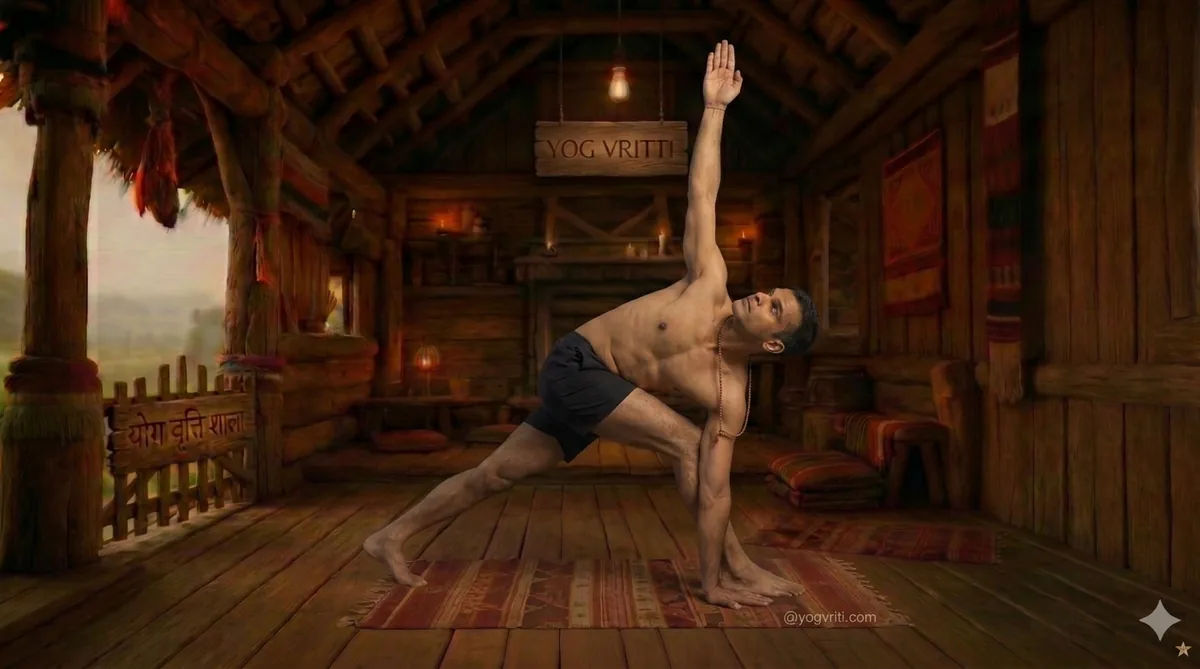
Parivrtta Trikonasana Variation
परिवृत्त त्रिकोणासन भिन्नता
This variation of Revolved Triangle Pose invites a profound deepening of the core connection and spinal rotation by extending the top arm forward, parallel to the floor. This seemingly subtle shift creates a significantly longer lever, profoundly challenging the body's balance and demanding an intensified engagement from the entire core musculature to sustain the twist and lift the torso. It is chosen to build exceptional core strength, enhance proprioception, and cultivate a more integrated, active spinal rotation. Revolved Triangle Pose (Parivrtta Trikonasana) is a powerful standing twist that deeply challenges and refines the entire body. It demands stability from the legs and core while simultaneously inviting profound rotation through the spine, creating both strength and flexibility. Energetically, it grounds the practitioner through strong leg engagement while simultaneously lifting and expanding the torso, promoting a feeling of inner spaciousness and mental clarity. This pose is invaluable for cultivating balance, improving posture, and stimulating internal organs, making it a cornerstone for holistic well-being in an Iyengar practice.
Revolved Triangle Pose Variation, also called Twisted Triangle Variation is a classical yoga posture. Its Sanskrit name Parivrtta Trikonasana Variation translates word-for-word as: Parivrtta (Revolved) · Tri (Three) · Kona (Angle) · Asana (Pose). From a standing position, the body roots firmly through the feet while the spine extends upward. The posture works to lengthen the hamstrings, activate the glutes and engage the obliques. Stretches the hamstrings and hips. Improves spinal flexibility. It is particularly valued for building full-body strength and developing greater flexibility. Suitable for intermediate practitioners with foundational yoga experience, it is a meaningful addition to any practice, particularly beneficial for athletes and runners. A block can be used to make the posture more accessible and support correct alignment. Practitioners with back pain and sciatica should approach with care or consult a qualified teacher.
Helps with
What This Variation Changes
The block's function remains consistent for the bottom hand, offering stable support and facilitating a long, uncompressed spine. However, the most significant positional change is the top arm extending forward, which profoundly shifts the body's center of gravity. This creates a longer lever, demanding a far greater active engagement from the core to maintain equilibrium and intensify the spinal twist, requiring more muscular effort to lift and broaden the chest while stabilizing the pelvis.
Muscles Worked
Hamstrings
[Biceps femoris, Semitendinosus, Semimembranosus]
The powerful muscles along the back of your front thigh (hamstrings) are asked to lengthen deeply here, not through force, but with sustained, intelligent extension from the hip.
As you maintain a straight front leg and hinge forward, these muscles release chronic tightness, often a legacy of sitting and habitual postures.
This unwinding creates a profound sense of spaciousness and grounding in the legs, allowing apana vayu to flow freely and root you more deeply into the earth.
Regular practice progressively lengthens this posterior chain, directly reducing the pull on the lower back and improving overall flexibility.
Glutes
[Gluteus maximus, Gluteus medius, Gluteus minimus]
The muscles of your buttocks (gluteus maximus and medius) are actively engaged in the front leg to stabilize the hip joint and assist in the internal rotation of the back leg.
This deep muscular activation provides a stable foundation for the twist, preventing undue strain on the knee and lower back.
By rooting through the glutes, you establish a firm connection to the earth, creating a sense of unwavering stability that allows the upper body to twist freely.
This grounding energy helps to calm the mind and focus your awareness within the pose.
Core muscles
The general 'Core muscles' now experience a significantly heightened demand for both stabilization and active rotation.
The forward extension of the arm creates a much longer lever, requiring the entire corset of core muscles – including the transversus abdominis, rectus abdominis, and particularly the obliques – to work synergistically to prevent the torso from collapsing or losing its alignment.
This variation transforms the core engagement from a foundational support to a dynamic, active force driving and maintaining the twist.
Spinal Rotators
While always active in the root pose, the Spinal Rotators are now called upon with much greater intensity and precision due to the increased leverage from the forward-reaching arm.
These deep muscles, including multifidus and rotatores, must work harder to actively initiate and sustain the spinal rotation against gravity, preventing any collapse or loss of length in the torso.
This sustained, isometric contraction is crucial for maintaining the integrity and fluidity of the spine throughout this deeper, more demanding twist.
Obliques
Obliquus externus abdominis, Obliquus internus abdominis
The obliques are specifically recruited with profound intensity in this variation, becoming primary drivers and stabilizers of the deeper spinal rotation.
The external oblique on the side of the front leg works synergistically with the internal oblique on the side of the back leg to actively initiate and sustain the twist, resisting the increased gravitational pull of the forward-extended arm.
This heightened engagement not only strengthens these crucial muscles but also refines their ability to stabilize the lumbar spine and pelvis, preventing any unwanted lateral sway or compression during the pose.
Joints Mobilized
Hip Joints
rotating | stabilizing | weight bearingThe ball-and-socket joints of your hips are deeply engaged; the front hip is in flexion and internal rotation, while the back hip is in extension and external rotation, creating a stable foundation.
This differential rotation requires intelligent muscular effort to maintain alignment and prevent locking the joint, especially in the front leg.
By understanding how to root through the legs and stabilize the pelvis, you protect these vital joints, enhance their range of motion, and cultivate a sense of groundedness from the base of the spine.
Consistent practice improves hip mobility and pelvic stability, essential for everyday movement and preventing lower back issues.
Spine
rotating | mobilizing | decompressingThe vertebral column undergoes a profound and multi-segmental rotation, particularly in the thoracic (mid-back) region, creating space between the vertebrae.
As you lengthen the spine upwards and then rotate, you gently decompress the intervertebral discs, encouraging nutrient flow and promoting spinal health.
This intelligent twisting action releases stiffness along the entire spinal column, enhancing the flow of prana and fostering a feeling of lightness and freedom in the torso.
Regular practice improves spinal mobility, reduces back pain, and cultivates a more upright, confident posture.
Knee Joints
stabilizingThe knee joints, particularly the front knee, require careful attention to remain stable and protected in this pose.
The front leg must be strong and straight, with the quadriceps (thigh muscles) actively engaged to lift the kneecap and prevent hyperextension.
This mindful engagement ensures the knee is stacked safely over the ankle, preventing any lateral strain or twisting at the joint itself.
By cultivating strength and awareness in the legs, you protect these crucial hinge joints, building a stable foundation that supports the entire structure of the pose and prevents injury.
Shoulder Joints
mobilizing | openingThe shoulder joints are actively engaged, with the bottom arm pressing down into the block or floor for support, and the top arm reaching powerfully upwards, creating an expansive opening across the chest.
This action mobilizes the glenohumeral joint (shoulder joint) and scapulae (shoulder blades), improving range of motion and releasing tension held in the upper back and neck.
The open chest and upward reach cultivate a sense of lightness and freedom, allowing for deeper breathing and opening the anahata chakra (heart center), fostering feelings of courage and compassion.
Organ & System Benefits
Abdominal Organs (Digestive System)
This deep twisting action provides a gentle yet profound compression and then release to the internal organs of your abdomen, particularly the digestive system.
Imagine a subtle 'wringing out' effect, which then allows a fresh surge of oxygenated blood to flow through these vital areas when you release the twist.
This internal massage stimulates peristalsis and enhances digestive fire (agni), leading to better elimination and a lighter, more energetic feeling within the core.
Regular practice can alleviate sluggishness, improve nutrient absorption, and contribute to overall gut health and vitality.
Nervous System
The intense focus required to maintain balance and alignment in Parivrtta Trikonasana acts as a powerful anchor for the mind, drawing your attention inward and away from external distractions.
This sustained concentration helps to quiet the fluctuations of the mind (chitta vritti), promoting a state of calm alertness.
By stabilizing the body and breath in this challenging pose, you actively engage the parasympathetic nervous system, reducing the physiological symptoms of stress and anxiety.
The deep twist also helps to regulate vata dosha, bringing a sense of groundedness and mental equilibrium.
The controlled, steady breath cultivated within the twist directly influences the nervous system, acting as a bridge between the physical and subtle body.
Although the twist might initially restrict the breath, the conscious effort to breathe deeply and smoothly sends signals of safety and calm to the brain.
This deliberate breathing practice helps to release stored tension in the diaphragm and intercostal muscles, further activating the vagus nerve and promoting a profound sense of relaxation and inner peace.
Over time, this practice trains the nervous system to remain steady and resilient even in challenging situations.
Mental & Emotional
The precise alignment and sustained effort required in Revolved Triangle Pose demand intense concentration, cultivating the yogic principle of Dharana (focused attention).
As you meticulously adjust each part of your body and synchronize it with your breath, the mind becomes fully absorbed in the present moment, leaving no room for distraction or rumination.
This mental discipline strengthens your ability to focus, enhancing clarity and mental fortitude, which extends beyond the mat into daily life.
It's a practice in unwavering presence.
Successfully navigating the physical challenge and balance demands of this pose cultivates mental resilience and a quiet confidence.
Overcoming the initial discomfort or wobbles builds a strong inner resolve, teaching you to stay with difficulty without succumbing to frustration.
This process of steady effort and eventual mastery fosters a sense of accomplishment and inner strength, helping to alleviate anxiety and self-doubt.
The act of twisting and opening also encourages a shift in perspective, allowing you to approach problems with a fresh, clearer mind.
Because of Its Shape
twist
Twisting poses like Parivrtta Trikonasana are profound for spinal health, promoting mobility and releasing tension segment by segment along the vertebral column.
This rotational movement gently massages the muscles surrounding the spine, increasing circulation and enhancing the flexibility of the spinal ligaments and discs.
Energetically, twists are believed to cleanse and purify the subtle energy channels (nadis), stimulating the manipura chakra and fostering a sense of inner fire and transformation.
They help to wring out stagnant energy, leaving you feeling refreshed and invigorated.
As a standing pose, Revolved Triangle builds immense strength and stability in the legs and core, grounding the practitioner firmly to the earth.
The strong engagement of the leg muscles (quadriceps, hamstrings, glutes) roots you deeply, creating a sense of unwavering foundation.
This connection to the earth helps to balance apana vayu, bringing a feeling of security and reducing mental scatteredness.
The stable base allows the upper body to find freedom and expansiveness, creating a beautiful interplay between grounding and upliftment.
The balancing aspect of this pose is not just physical but deeply mental, requiring acute proprioception and focused awareness to maintain equilibrium.
As you learn to find your center amidst the twist and extension, your brain and body communicate more efficiently, improving coordination and spatial awareness.
This cultivation of balance translates into greater mental steadiness and emotional equilibrium, teaching you to find calm and stability even amidst life's challenges.
It hones your ability to stay present and centered.
Fascial Lines
In Parivrtta Trikonasana, the intricate web of connective tissue (fascia) throughout the body is profoundly stretched and released, particularly along the Superficial Back Line and the Spiral Line.
As you lengthen the front leg and twist the torso, these fascial chains, which connect everything from your feet to your head, are unwound and hydrated.
This deep release helps to unglue adhesions and improve the fluidity of movement, allowing for a more integrated and less restricted physical experience.
Energetically, freeing the fascia helps to open channels for prana to flow unimpeded, releasing long-held patterns of tension and emotional blockages.
Breathing & Respiratory
The deep twist of Parivrtta Trikonasana naturally compresses the side of the torso, challenging the breath and requiring a heightened awareness to maintain smooth, steady inhalations and exhalations.
This compression encourages a more focused and intentional breath, often inviting a longer, more complete exhalation to release stagnant air and impurities.
This conscious breathing within a restricted space trains the intercostal muscles, improving lung capacity and efficiency over time.
Practitioners often find that Ujjayi breath, with its gentle audible quality, becomes a powerful tool here, deepening the internal massage and enhancing the purifying effects of the twist.
Anatomical Caution
This variation significantly increases the challenge to balance and core strength, making it crucial to prioritize spinal length over twist depth to avoid compression in the lower back.
Students must ensure strong, grounded leg engagement to prevent undue strain on the sacrum.
The increased leverage also demands mindful breath awareness, as forcing the twist without sufficient core support can restrict the breath rather than expand it.