4
Muscles
3
Joints
2
Organs
2
Mental
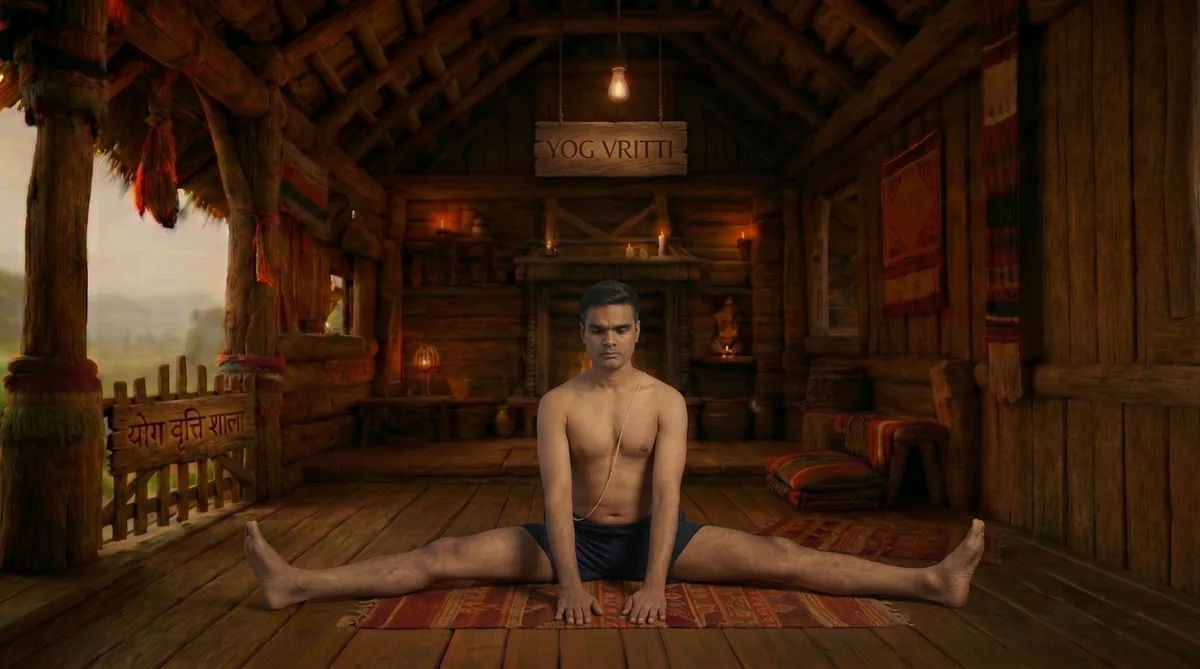
Samakonasana
समकोणासन
Samakonasana, the Side Split, is a profound expression of openness and surrender, a testament to the body's incredible capacity for flexibility when approached with intelligence and patience. This advanced asana meticulously lengthens the entire inner leg and posterior chain, demanding an exquisite balance of strength and release in the hip adductors and hamstrings. Energetically, it is a deeply grounding and liberating pose, inviting practitioners to release long-held physical and emotional tension from the pelvis and lower body. For a dedicated yogi, it is not merely a physical feat but a journey into the depths of self-awareness, cultivating equanimity amidst intensity and profound bodily freedom.
Equal Angle Pose, also called Straddle Splits is a classical yoga posture. Its Sanskrit name Samakonasana translates word-for-word as: Sama (Equal) · Kona (Angle) · Asana (Pose). From a standing position, the body roots firmly through the feet while the spine extends upward. The posture works to lengthen the hamstrings. Opens groin completely. Develops patience. It is particularly valued for developing greater flexibility. Suitable for advanced practitioners with developed body awareness, it is a meaningful addition to any practice. A block and blanket can be used to make the posture more accessible and support correct alignment. Practitioners with groin injury and hamstring injury should approach with care or consult a qualified teacher.
Helps with
Muscles Worked
Hip Adductors
[Adductor longus, brevis, magnus, pectineus, gracilis]
These powerful muscles run along your inner thighs, connecting your pelvis to your leg bones.
In Samakonasana, they undergo an extreme, sustained lengthening, which can feel intensely challenging, yet incredibly liberating.
Anatomically, this stretch targets the muscle belly and its attachments, improving elasticity and range of motion at the hip joint.
From a yogic perspective, releasing tension here can unlock creativity and emotional fluidity, as this area is often a repository for fear and insecurity.
Hamstrings
[Biceps femoris, semitendinosus, semimembranosus]
Running along the back of your thighs from your sitting bones to just below your knees, these muscles are intensely stretched in a straddle.
This deep, sustained traction helps to decompress the lumbar spine by releasing the pull on the pelvis, which often tilts posteriorly due to tight hamstrings.
Yogically, this lengthening of the posterior chain promotes a sense of grounding and stability, allowing apana vayu, the downward-moving energy, to flow freely, fostering a feeling of calm and rootedness.
Quadriceps
[Rectus femoris, vastus lateralis, medialis, intermedius]
The large muscle group at the front of your thighs must be actively engaged to extend your knees fully in this pose.
This isometric contraction helps protect the knee joint by stabilizing the patella and preventing hyperextension, ensuring the stretch remains focused on the hamstrings and adductors.
This intelligent engagement cultivates firmness (sthira) in the legs, translating to a mental quality of steadfastness and focused intention.
Gluteus Medius and Minimus
[Gluteus medius, minimus]
Located on the outer sides of your hips, these muscles are crucial for stabilizing the pelvis and assisting with hip abduction and external rotation.
In Samakonasana, they work subtly to support the deep external rotation required, preventing excessive strain on the inner groin and helping to keep the pelvis level.
This subtle yet vital engagement brings awareness to the intelligent action required even in extreme flexibility, fostering a sense of integrated strength and stability throughout the hip complex.
Joints Mobilized
Hip Joint
mobilizingThis ball-and-socket joint, where your thigh bone meets your pelvis, is the primary focus of mobilization in Samakonasana.
The pose demands extreme abduction and external rotation, significantly increasing the range of motion in these planes over time.
Mechanically, it helps to hydrate the joint capsule and cartilage, improving nutrient supply and reducing stiffness.
Yogically, this deep opening can release 'stuck' energy in the pelvic region, promoting a sense of freedom and emotional release.
Sacroiliac (SI) Joint
stabilizingLocated at the base of your spine where the sacrum meets the ilium, this joint connects your spine to your pelvis and requires careful attention in deep hip openers.
While the primary action is hip mobilization, the SI joint must remain stable and neutral to prevent strain or discomfort.
Proper engagement of the core and gluteal muscles helps to stabilize this crucial joint, preventing excessive shearing forces.
Maintaining awareness here cultivates a deeper understanding of pelvic stability, fostering a sense of groundedness and protection for the lower back.
Knee Joint
stabilizingYour knee joint, the hinge connecting your thigh bone to your shin bone, should be fully extended in Samakonasana, but never hyperextended.
Activating your quadriceps muscles helps to lift the kneecaps and protect the ligaments and menisci, ensuring the stretch is received safely by the hamstrings.
This conscious engagement brings awareness to the integrity of the lower limbs, promoting strength and resilience, and preventing the tendency to collapse into the joint, which can lead to long-term issues.
Organ & System Benefits
Pelvic Organs
The deep opening in the groin and inner thighs creates more space in the pelvic bowl, gently compressing and then releasing the organs housed there, such as the reproductive and urinary systems.
This action encourages fresh blood flow to the entire region upon release, helping to alleviate congestion and stagnation.
From a yogic perspective, this increased circulation can awaken the energy of the Muladhara and Svadhisthana chakras, fostering vitality and a sense of primal connection.
Abdominal Organs
As you deepen into Samakonasana, especially if you fold forward, there's a gentle compression of the lower abdominal organs, including parts of the digestive tract.
This subtle internal massage can stimulate peristalsis, aiding digestion and promoting healthy elimination.
This internal cleansing action, known as 'kriya' in some yogic traditions, supports the body's natural detoxification processes, contributing to overall well-being and a lighter, clearer feeling in the gut.
Nervous System
Samakonasana, with its intense demand for surrender and sustained holding, can initially trigger a sympathetic (fight-or-flight) response, but with mindful breathing, it guides the nervous system towards a parasympathetic (rest and digest) state.
This transition from initial tension to eventual release calms the mind and body, reducing the chronic physiological effects of stress.
The deep release in the hips, often a storage site for emotional tension, can lead to a profound sense of relief and a quietening of mental chatter (chitta vritti).
The extreme stretch in this pose sharpens proprioception, your body's sense of its position in space, and interoception, your awareness of internal bodily sensations.
This heightened sensory input brings you intensely into the present moment, drawing your awareness away from external distractions.
This focused internal attention is a foundational practice for dharana (concentration) and pratyahara (withdrawal of the senses), cultivating deep self-awareness and mental clarity.
Mental & Emotional
Confronting the physical intensity of Samakonasana demands immense patience and a willingness to surrender to the present moment, releasing the mind's tendency to force or judge.
This practice of enduring discomfort with equanimity builds mental resilience and teaches the profound lesson of non-attachment (vairagya) to outcomes.
It strengthens your capacity to remain steady (sthira) and at ease (sukham) even in challenging circumstances, a core tenet of Patanjali's Yoga Sutras.
Achieving Samakonasana, or even progressing deeper into it, requires overcoming deeply ingrained mental limitations and self-doubt.
The physical breakthrough often mirrors a mental one, building confidence and a sense of accomplishment that extends beyond the mat.
This process helps to dismantle old samskaras (mental patterns) of perceived limitations, fostering a belief in one's own potential for growth and transformation, both physically and psychologically.
Because of Its Shape
hip opener
As a profound hip opener, Samakonasana targets the entire inner thigh and groin region, releasing deep-seated tension that often accumulates from prolonged sitting or emotional stress.
This extensive lengthening of the adductor muscles and connective tissues significantly increases the range of motion in the hip joint, improving overall mobility and flexibility.
Yogically, opening the hips is often linked to releasing emotional blockages and fostering a sense of freedom, creativity, and flow in one's life.
While seemingly a pose of extreme openness, Samakonasana also cultivates immense grounding and stability through its wide, firm connection to the earth.
The broad base of support allows for a deep sense of rootedness, even as the body expands into space.
This physical grounding translates to an energetic sense of security and presence, connecting the practitioner to the elemental force of the earth and stabilizing the Muladhara Chakra.
Fascial Lines
Samakonasana profoundly engages the fascial network, particularly the Deep Front Line and the Superficial Back Line, as well as the Lateral Line and Spiral Line.
This extreme stretch helps to release stiffness and restrictions within these intricate connective tissue pathways, improving overall body elasticity and fluidity.
By lengthening these fascial chains, we are not just stretching muscles but also opening energetic channels (nadis), allowing prana to flow more freely and releasing stored physical and emotional patterns.
Breathing & Respiratory
Due to the intensity of Samakonasana, the breath may initially become shallow or held, but with conscious effort, it becomes a powerful tool for deepening the pose and calming the nervous system.
The wide-open hips create space in the lower abdomen, inviting deep diaphragmatic breathing that massages the internal organs and extends the exhalation.
Practicing Ujjayi pranayama here creates internal heat (tapas) and focuses the mind, allowing the body to gradually soften and surrender more deeply into the stretch.
Anatomical Caution
Teachers must emphasize listening to the body and never forcing this pose, especially with cold muscles.
Pay close attention to the knees, ensuring they are fully extended but not hyperextended, and that the kneecaps are lifted to protect the joint.
Also, be mindful of the sacroiliac joint; students should maintain core engagement and a neutral pelvis to avoid strain in the lower back, ensuring the stretch remains safely in the hips and hamstrings.