5
Muscles
3
Joints
1
Organs
2
Mental
Skandasana
स्कन्दासन
Skandasana is a profound standing pose that meticulously opens the often-tight hip adductors and hamstrings while simultaneously building resilient strength in the bent leg's quadriceps and glutes. This deep lateral lunge cultivates a remarkable blend of flexibility and unwavering stability, inviting a sense of spaciousness within the pelvis and a grounded connection to the earth. By precisely engaging and releasing key muscle chains, practitioners can unwind deep-seated physical and energetic tension, fostering greater freedom of movement and emotional fluidity. For the seasoned teacher, understanding its layered effects allows for guidance that transforms physical challenge into profound self-awareness and inner strength. It is a powerful practice for cultivating both physical prowess and a deeply centered mind.
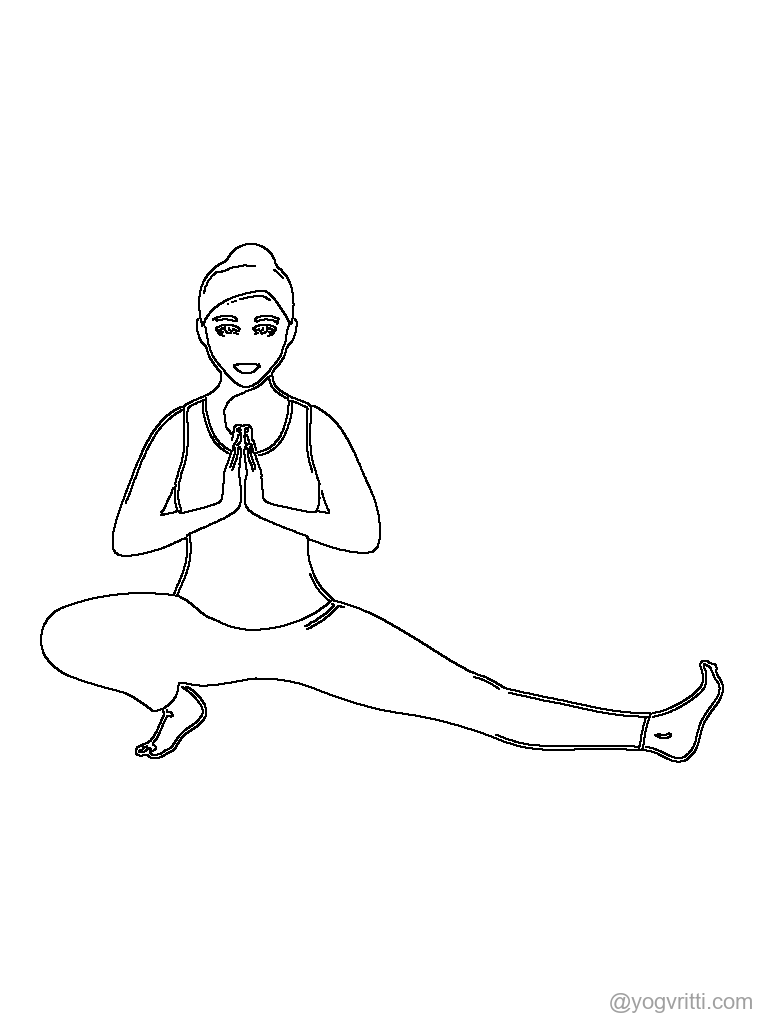
Side Lunge Pose, also called Skandasana is a classical yoga posture. Its Sanskrit name Skandasana translates word-for-word as: Skanda (God of War) · Asana (Pose). From a standing position, the body roots firmly through the feet while the spine extends upward. The posture works to strengthen the quadriceps, lengthen the hamstrings and activate the glutes. Strengthens quadriceps and glutes of the bent leg. Opens the hips and improves lateral flexibility. It is particularly valued for developing greater flexibility. Suitable for intermediate practitioners with foundational yoga experience, it is an excellent warm-up, particularly beneficial for athletes and runners. A block can be used to make the posture more accessible and support correct alignment. Practitioners with groin injury and knee injury should approach with care or consult a qualified teacher.
Helps with
Muscles Worked
Inner thigh muscles
[Adductor longus, magnus, brevis, gracilis, pectineus]
These muscles run along the inside of your thighs, connecting your pelvis to your inner knee and upper shin.
In Skandasana, the inner thigh muscles of the straight leg undergo a significant, sustained stretch, particularly the gracilis and adductor magnus, lengthening their fibers through eccentric loading.
This release not only improves hip mobility and flexibility but also helps to unwind chronic groin tension, which in yogic philosophy, is often associated with a constricted root chakra (Muladhara) and feelings of insecurity or ungroundedness.
Hamstrings
[Biceps femoris, Semitendinosus, Semimembranosus]
The hamstrings, located at the back of the thighs from your sitting bones to just below the knee, receive a deep, active stretch in the straight leg.
This action helps to elongate these often-tight muscles, which commonly contribute to lower back tension and restrict full hip flexion.
Energetically, releasing the hamstrings helps to free the flow of apana vayu, the downward-moving energy, promoting a sense of groundedness and allowing for the release of stagnant energy in the pelvic region.
Front thigh muscles
[Rectus femoris, Vastus lateralis, medialis, intermedius]
In the bent leg, the quadriceps muscles on the front of the thigh are powerfully engaged, working eccentrically to control the deep lunge and protect the knee joint.
This sustained activation builds strength and endurance in the thigh, creating a stable and resilient foundation for the pose.
In the straight leg, the quadriceps are actively engaged to lift the kneecap, ensuring the leg remains strong and extended, which cultivates a sense of steady determination and focused energy.
Buttock muscles
[Gluteus maximus, medius, minimus]
The gluteal muscles, particularly the gluteus maximus and medius, in the bent leg are strongly engaged to support the hip and initiate external rotation, preventing the knee from collapsing inward.
This activation helps stabilize the pelvis and sacrum, providing a sense of power and rootedness in the lower body.
Strengthening these crucial muscles contributes to better hip function, improved gait, and a feeling of grounded confidence, allowing for a firmer connection to the earth element and greater stability in movement.
Calf muscles
[Gastrocnemius, Soleus]
In the straight leg, especially if the heel remains grounded, the calf muscles running from behind the knee to the heel receive a subtle but important stretch.
This action helps to lengthen the posterior chain of the leg and improve ankle flexibility, which is crucial for overall lower body mobility.
In the bent leg, the calves are active to stabilize the ankle and foot, ensuring a firm foundation and promoting a feeling of being firmly planted and present in the moment.
Joints Mobilized
Hip joints
mobilizingSkandasana deeply mobilizes both hip joints, with one hip in strong flexion, abduction, and external rotation (bent leg) and the other in adduction and extension (straight leg).
This asymmetrical action increases the range of motion within the acetabulofemoral joint, releasing stiffness and improving circulation around the hip capsule.
From a yogic perspective, this profound hip opening helps release emotional blockages often stored in the hips, inviting a greater sense of freedom and emotional fluidity in one's being.
Knee joints
weight bearingThe knee joint of the bent leg is under significant weight-bearing load and deep flexion, requiring robust engagement of the surrounding quadriceps and hamstring muscles to protect the joint's integrity.
Simultaneously, the straight leg's knee is extended and stabilized, emphasizing proper alignment to prevent hyperextension.
This careful balance of strength and extension educates the practitioner in mindful knee protection, fostering deep proprioceptive awareness and building confidence in movement without fear of injury.
Ankle joints
mobilizingThe ankle of the bent leg undergoes strong dorsiflexion, while the straight leg's ankle can be in dorsiflexion (if the heel is down) or plantarflexion (if the foot is on the ball).
This varied action helps to mobilize the talocrural and subtalar joints, improving overall ankle flexibility and stability.
A stable and mobile ankle provides a firm foundation for all standing poses, connecting us more deeply to the earth and enhancing our sense of balance and security in life.
Organ & System Benefits
Abdominal Organs
In Skandasana, the deep lunge creates a gentle compression on one side of the lower abdomen while lengthening the other, providing a subtle internal massage.
This action can stimulate peristalsis and improve circulation to the digestive organs, aiding in detoxification and more efficient nutrient absorption.
Yogically, this gentle compression and release helps to balance Samana Vayu, the energy responsible for assimilation and digestion, promoting a feeling of internal harmony and vitality throughout the core.
Nervous System
The profound stretch and stability required in Skandasana demand a focused and steady mind, naturally drawing attention inward and quieting mental chatter.
This sustained engagement encourages a shift from the sympathetic (fight-or-flight) to the parasympathetic (rest-and-digest) nervous system.
As the body learns to relax into the intensity with breath, a deep sense of calm pervades, releasing stored physical and emotional tension and fostering inner peace.
The deep hip opening in Skandasana can be intensely stimulating, but by consciously softening the breath and allowing the exhale to lengthen, we directly influence the vagus nerve, which is a key regulator of the nervous system.
This helps to downregulate the stress response, reducing feelings of anxiety and promoting a state of profound relaxation.
Over time, this practice teaches the body and mind to find stillness and ease even in challenging situations, building remarkable resilience.
Mental & Emotional
Skandasana cultivates immense mental fortitude and unwavering concentration, as maintaining precise alignment in such a deep lunge requires focused presence and a steady gaze (drishti).
The challenge of the pose demands that the mind stay anchored in the present moment, practicing a form of pratyahara (withdrawal of senses) from external distractions.
This deep mental engagement strengthens the ability to sustain attention and observe internal sensations without judgment, fostering clarity.
The act of deeply opening the hips can often bring to the surface old emotions or deeply held patterns of resistance, as the hips are a common storage site for unexpressed feelings.
By consciously breathing through the intensity and choosing to soften rather than brace, practitioners develop emotional resilience and the capacity to meet discomfort with equanimity.
This process fosters a sense of inner liberation, allowing one to move through life with greater openness, adaptability, and emotional freedom.
Because of Its Shape
standing
As a standing pose, Skandasana builds a strong foundation, connecting us deeply to the earth and cultivating unwavering stability throughout the lower body.
It strengthens the legs and core, improving overall balance and posture, which translates into greater confidence and presence in daily life.
Energetically, standing poses ground the root chakra (Muladhara), fostering a profound sense of security, belonging, and inner steadiness.
Skandasana is a powerful lateral bend for the lower body, stretching the inner line of one leg and compressing the outer line of the other, creating a dynamic interplay of extension and flexion.
This action significantly increases flexibility in the adductor muscles and associated fascia, while also creating space and mobility through the pelvis.
This unique lateral movement helps to release tension along the sides of the body, promoting a feeling of openness and freedom in the entire hip girdle.
This pose is a profound hip opener, specifically targeting the adductors and hamstrings of the straight leg while deeply flexing and externally rotating the hip of the bent leg.
It works to increase the range of motion in the hip joints, releasing both physical and energetic blockages often stored in the pelvis and sacrum.
This deep release can bring a sense of emotional liberation, a freer flow of creative energy (Svadhisthana Chakra), and a greater capacity for self-expression.
Fascial Lines
Skandasana provides a deep, intelligent release along the entire medial (inner) fascial line of the straight leg, extending from the inner ankle, through the adductors, and into the pelvic floor.
Simultaneously, it engages and strengthens the lateral (outer) line of the bent leg, creating a dynamic interplay of lengthening and strengthening across the body's fascial web.
This comprehensive fascial stretch helps to unwind chronic tightness that restricts movement and energy flow, allowing for greater fluidity, vitality, and an uninhibited sense of space throughout the body's connective tissue matrix.
Breathing & Respiratory
The depth and intensity of Skandasana naturally encourage a slow, rhythmic breath, particularly a longer, more expansive exhalation as the body settles into the stretch and intense sensation.
This deep, conscious breathing helps to calm the nervous system and allows the practitioner to find ease within the challenge, making the pose more sustainable and meditative.
Practicing Ujjayi breath in this pose can deepen the internal heat and focus, facilitating a more profound release in the hips and inner thighs, and allowing prana to move more freely and purposefully throughout the body.
Anatomical Caution
Teachers must guide students to listen closely to their knees and hips, ensuring that the bent knee tracks directly over the ankle and does not collapse inward, which can strain ligaments.
Students with existing knee or hip injuries should approach this pose with extreme caution, possibly using a block under the sitting bone or hands for support to reduce intensity.
The goal is a deep, intelligent opening, not a forced one, always honoring the body's current limits and respecting its wisdom.