5
Muscles
4
Joints
2
Organs
2
Mental
Tree Pose
वृक्षासन
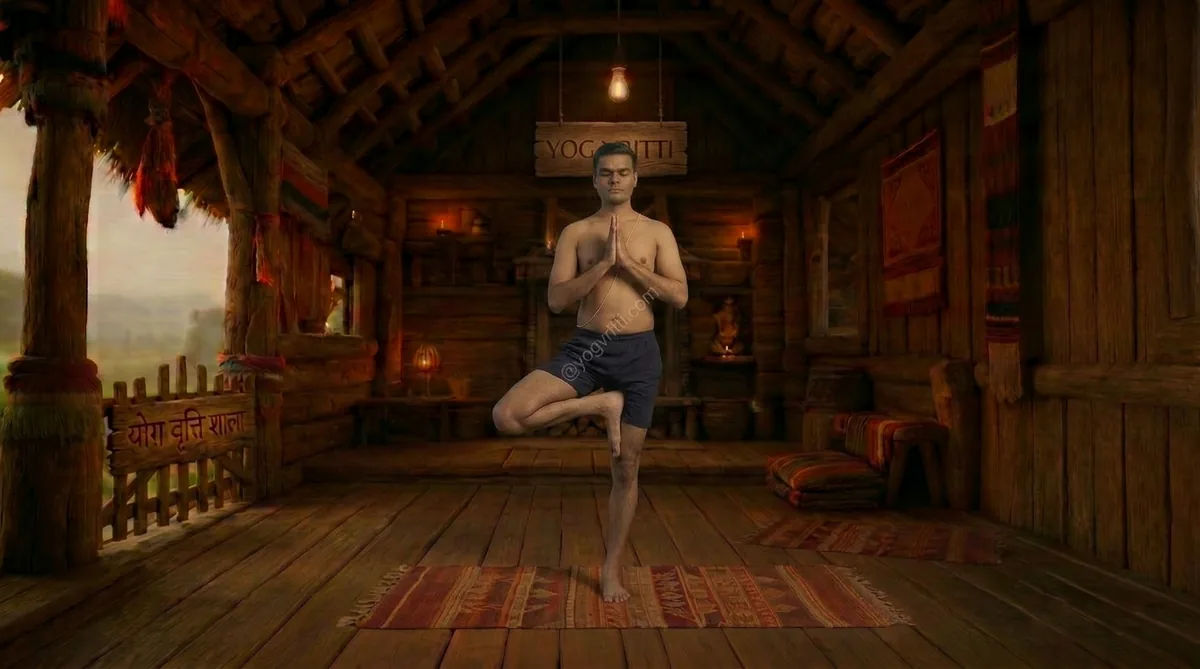
Tree Pose, or Vrksasana, is a foundational standing balance asana that profoundly cultivates stability, focus, and inner equilibrium. It deeply engages and strengthens the intricate network of muscles in the standing leg, core, and ankles, simultaneously promoting a sense of rootedness and upward elongation. Through its unique blend of physical challenge and mental stillness, this pose helps to integrate the physical body with the subtle energetic currents, making it invaluable for developing both physical poise and mental clarity. Teachers will find it a powerful tool for teaching proprioception, concentration (Dharana), and the art of finding stillness amidst movement. It truly embodies the yogic principle of Sthira Sukham Asanam – steady and comfortable in the posture.
Tree Pose, also called Vrksasana is a classical yoga posture in the Iyengar tradition. From a standing position, the body roots firmly through the feet while the spine extends upward. The posture works to strengthen the quadriceps, activate the glutes and engage the core. Strengthens legs and core. Increases focus and concentration. Suitable for beginners and regular practitioners alike, it is a meaningful addition to any practice, particularly beneficial for beginners and seniors. A wall can be used to make the posture more accessible and support correct alignment. Practitioners with ankle injury and insomnia should approach with care or consult a qualified teacher.
Muscles Worked
Quadriceps
[Rectus Femoris, Vastus Lateralis, Vastus Medialis, Vastus Intermedius]
The large muscles at the front of your standing thigh (quadriceps) are actively engaged to maintain knee stability and support your body's weight.
They work concentrically to subtly extend the knee, providing a firm foundation without locking the joint.
This engagement brings a sense of power and solidity to the standing leg, embodying the earth element and enhancing our feeling of groundedness.
Over time, this consistent isometric work builds endurance and strength, translating into more confident movement in daily life.
Glutes (Medius & Minimus)
[Gluteus Medius, Gluteus Minimus]
The smaller, deeper gluteal muscles on the side of your standing hip (gluteus medius and minimus) are crucial for stabilizing the pelvis and preventing it from tilting.
They work to abduct the thigh, subtly pulling the standing leg towards the midline to keep the hip stacked over the ankle.
This constant, subtle adjustment refines your proprioception and strengthens the often-underutilized muscles responsible for lateral stability.
Energetically, this engagement helps root the lower body, allowing the spine to lengthen upward with greater ease and spaciousness.
Core Muscles
[Transversus Abdominis, Obliques, Erector Spinae]
The deep muscles of your abdomen and back (transversus abdominis, obliques, and erector spinae) form a cylinder of support around your torso, creating a stable base for the spine.
They engage subtly to prevent swaying and maintain the natural curves of the spine, lifting the rib cage away from the pelvis.
This internal support fosters a feeling of lightness and lift through the upper body, allowing breath to flow more freely and promoting a sense of inner strength and self-reliance.
Consistent engagement here translates into improved posture and reduced spinal strain.
Ankle Stabilizers
[Peroneals, Tibialis Anterior, Tibialis Posterior]
The muscles surrounding your standing ankle and foot (peroneals, tibialis anterior, and posterior) are in constant, delicate communication with the ground, making micro-adjustments to maintain balance.
They respond to subtle shifts in your center of gravity, preventing the ankle from rolling inward or outward.
This continuous feedback loop sharpens your body awareness and refines your connection to the earth beneath you, fostering a deep sense of presence and mental alertness.
Strengthening these muscles provides a stable foundation for all standing poses and daily activities.
Adductors
[Adductor Longus, Brevis, Magnus, Pectineus, Gracilis]
In the lifted leg, the inner thigh muscles (adductors) engage isometrically as you press your foot firmly into the standing thigh.
This action creates a reciprocal push-and-pull, where the foot presses into the thigh and the thigh presses back into the foot, intensifying the core engagement.
This energetic connection through the midline of the body helps to unify the pose, drawing the energy (prana) inward and upward.
It cultivates a sense of integration and helps to stabilize the pelvis, preventing it from twisting or collapsing.
Joints Mobilized
Ankle Joint
weight bearingThe ankle joint of the standing leg (talocrural and subtalar joints) bears the entire body's weight, requiring constant, subtle adjustments for balance.
The intricate network of ligaments and muscles around the ankle works to maintain stability, preventing excessive inversion or eversion.
This continuous micro-mobilization enhances joint proprioception and strengthens the surrounding soft tissues, leading to greater stability and less susceptibility to sprains.
Over time, practitioners experience increased confidence in their footing and a more grounded connection to the earth.
Knee Joint
stabilizingThe knee joint of the standing leg (tibiofemoral joint) is held in a state of active, yet soft, extension, avoiding hyperextension or locking.
The quadriceps and hamstrings co-contract to create a stable support system for the femur and tibia, protecting the joint's delicate structures.
This intelligent engagement cultivates strength around the knee without placing undue stress on the ligaments, fostering a sense of intelligent support.
The lifted knee is in flexion and external rotation, which gently mobilizes the joint and its surrounding tissues.
Hip Joint
stabilizingThe hip joint of the standing leg (coxofemoral joint) is deeply engaged in stabilizing the pelvis and aligning the leg directly beneath the torso.
The gluteal muscles work to prevent lateral sway, creating a strong foundation.
The lifted hip, on the other hand, is in external rotation and abduction, which gently opens the hip capsule and lengthens the inner thigh muscles.
This dual action brings both stability to the foundation and a subtle opening to the lifted side, promoting greater freedom and range of motion in the hips over time, releasing stored tension (apana vayu).
Spine
stabilizingThe entire spinal column is actively engaged in maintaining length and alignment, from the tailbone to the crown of the head.
The deep core muscles support the natural curves of the spine, preventing compression and promoting decompression of the vertebral discs.
This creates a feeling of spaciousness and lightness throughout the torso, allowing energy to flow unimpeded along the central channel (sushumna nadi).
Regular practice helps to counteract the effects of gravity and poor posture, fostering a taller, more confident stance and reducing back discomfort.
Organ & System Benefits
Abdominal Organs
While not a deep compression or twist, the gentle engagement of the core muscles in Vrksasana provides a subtle lift and support to the abdominal organs.
This engagement helps to maintain their optimal position and function, promoting healthy digestion and elimination.
The upward lift of the torso also creates space in the abdominal cavity, encouraging a more expansive breath and improving circulation to these vital organs, which can contribute to a sense of lightness and vitality (prana) in the lower abdomen.
Circulatory System
As a standing pose, Vrksasana requires the heart and circulatory system to work against gravity to pump blood efficiently to the upper body and brain.
This gentle challenge strengthens the cardiovascular system over time, improving overall circulation.
The act of balancing also enhances micro-circulation in the feet and ankles, bringing fresh oxygenated blood to these often-neglected areas.
This improved blood flow revitalizes the body, contributing to increased energy levels and a feeling of alertness and well-being.
Nervous System
Vrksasana immediately engages the proprioceptive system, as the brain constantly processes feedback from the muscles and joints to maintain balance.
This heightened sensory awareness shifts attention away from external distractions and anchors the mind in the present moment, calming the 'chitta vritti' or mental fluctuations.
The steady focus required to hold the pose, combined with a rhythmic breath, encourages a transition from the sympathetic 'fight or flight' response to the parasympathetic 'rest and digest' state.
This fosters a profound sense of tranquility and mental clarity, making the pose a moving meditation.
The sustained effort in balancing also helps to integrate the right and left hemispheres of the brain, as both sides are actively involved in coordinating movement and maintaining equilibrium.
This cross-lateral activation can enhance cognitive function, improve coordination, and bring a greater sense of wholeness and integration within the self.
The mental stillness cultivated in the pose allows for deeper self-reflection and a more profound connection to one's inner wisdom, strengthening the 'buddhi' or intellect.
Mental & Emotional
This pose is a powerful practice in cultivating 'dharana' or concentration, as the mind must remain singularly focused on maintaining balance, preventing it from wandering into past regrets or future anxieties.
The physical act of holding a steady stance directly mirrors the mental effort required to steady the mind, offering immediate feedback on one's internal state.
This sustained mental engagement builds resilience and patience, teaching the practitioner to remain calm and centered even when faced with minor wobbles or challenges.
Vrksasana fosters a profound sense of groundedness and inner peace, as the connection to the earth through the standing foot becomes a metaphor for our stability in life.
The upward lift of the body, while rooted, cultivates a sense of aspiration and inner growth, connecting to the 'prana vayu' moving upwards.
Over time, students learn to find their internal equilibrium, translating this physical poise into mental fortitude and a greater capacity to navigate life's inevitable imbalances with grace and equanimity.
Because of Its Shape
balance
Balancing poses like Vrksasana significantly enhance proprioception, which is the body's ability to sense its position and movement in space without looking.
The constant micro-adjustments required to stay upright refine the communication between the brain, muscles, and joints.
This heightened body awareness not only improves physical coordination but also sharpens mental focus, drawing the practitioner into a deeper state of presence and mindfulness, essential for 'pratyahara' or sense withdrawal.
The act of balancing cultivates profound mental stillness and concentration, as the mind must remain singularly focused on the task at hand, quieting the incessant chatter (chitta vritti).
This sustained attention builds mental discipline and patience, teaching practitioners to embrace small wobbles as opportunities for growth rather than failures.
Energetically, finding balance helps to harmonize the ida and pingala nadis, leading to a sense of inner equilibrium and calm.
Fascial Lines
In Vrksasana, the fascial lines are intricately engaged to create both stability and spaciousness.
The Superficial Back Line subtly lengthens as you extend through the crown of the head, while the Deep Front Line engages through the core to create internal support and lift.
The Spiral Line is activated to stabilize the standing leg and pelvis, integrating the entire body's structure.
This intelligent engagement helps to release chronic tension patterns held within the fascial web, creating more fluidity and energetic flow (prana) throughout the body, fostering a feeling of being more integrated and 'unbound'.
Breathing & Respiratory
In Vrksasana, the upright and elongated posture naturally encourages a deeper and more expansive breath, particularly into the sides and back of the rib cage.
The stability of the core allows the diaphragm to descend more fully, promoting diaphragmatic breathing which is inherently calming to the nervous system.
A steady, rhythmic breath becomes an anchor for balance, and practicing Ujjayi breath here can deepen concentration and internal awareness, transforming the physical challenge into a meditative experience.
This intentional breathing enhances the flow of prana, supporting both physical stability and mental tranquility.
Anatomical Caution
Teachers should guide students to be mindful of their knee joints, particularly in the lifted leg.
Avoid placing the foot directly on the knee; instead, position it above or below the knee to protect the delicate ligaments.
For those with ankle instability or balance challenges, encourage the use of a wall for support, allowing them to build strength and confidence gradually.
Remind students to honor their body's current capacity and to avoid forcing the pose, emphasizing stability and comfort over depth.