6
Muscles
4
Joints
3
Organs
2
Mental
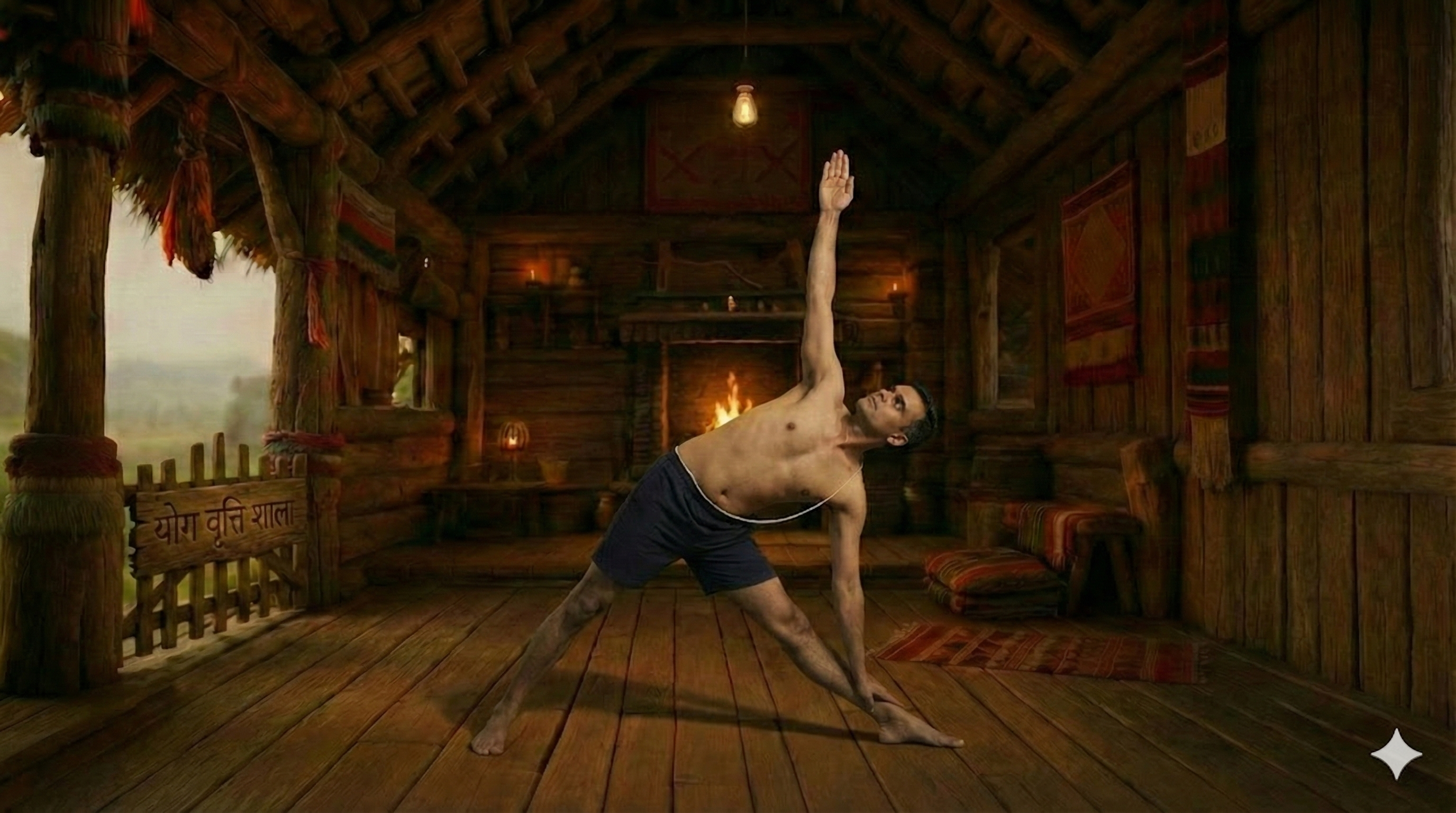
Trikonasana
त्रिकोणासन
Trikonasana, the Triangle Pose, is a cornerstone standing posture that meticulously sculpts the body into a series of triangles, grounding the lower body while expanding the upper. It simultaneously lengthens the inner thighs and hamstrings, strengthens the core obliques, and mobilizes the spine laterally, creating a profound sense of stability and spaciousness. This pose cultivates not just physical flexibility and strength but also mental focus and energetic balance, teaching the practitioner to find ease and expansion from a deeply rooted foundation. It’s invaluable for developing body awareness, refining alignment, and experiencing the liberating qualities of prana moving freely.
Triangle Pose, also called Trikonasana is a classical yoga posture. Its Sanskrit name Trikonasana translates word-for-word as: Tri (Three) · Kona (Angle) · Asana (Pose). In this posture, the body roots firmly through the feet while the spine extends upward. The posture works to release tension in the hips, engage the core and strengthen and extend the back. Opens the hips, groins, and chest. Develops lateral spinal flexibility. It is particularly valued for developing greater flexibility and improving overall posture. Suitable for beginners and regular practitioners alike, it is an excellent warm-up, particularly beneficial for beginners and desk workers. A block and wall can be used to make the posture more accessible and support correct alignment. Practitioners with back pain and migraine should approach with care or consult a qualified teacher.
Helps with
Muscles Worked
Inner Thighs
Adductors (Adductor longus, magnus, brevis, pectineus, gracilis)
The powerful muscles on the inside of your front thigh (adductors) are deeply engaged here, experiencing a sustained lengthening as you extend laterally, opening the often-tight groin region.
This release of accumulated tension can significantly improve hip mobility and pelvic stability, which is crucial for balanced walking and standing.
Energetically, this opening allows for a freer flow of apana vayu, promoting a sense of groundedness and release from the base of the pelvis, fostering ease in the lower body.
Hamstrings
Biceps femoris, Semitendinosus, Semimembranosus
The strong muscles running along the back of your front thigh (hamstrings) experience a profound, intelligent lengthening in Trikonasana, especially when the front leg is straight without locking the knee.
This mindful extension gradually releases chronic tightness often stemming from prolonged sitting, contributing significantly to spinal health by reducing posterior pelvic tilt.
From a yogic perspective, this unwinding helps to clear blockages in the energetic pathways of the leg, promoting a feeling of lightness and ease in the entire lower body, which is crucial for balanced standing.
Gluteus Medius & Minimus
Gluteus Medius, Gluteus Minimus
These crucial muscles on the outer side of your hips (gluteus medius and minimus) are actively engaged in both legs, working tirelessly to stabilize the pelvis and prevent the front hip from collapsing forward or backward.
By rooting the outer edges of the feet and lifting through the inner arches, you activate these stabilizers, creating a firm foundation for the pose.
This engagement cultivates a sense of unwavering stability and control in the hips, translating to a feeling of inner strength and confidence that radiates throughout the entire posture.
Obliques
External and Internal Obliques
Your side abdominal muscles (obliques) are intricately involved in Trikonasana, with the obliques on the bottom side lengthening to facilitate the lateral stretch of the torso, while those on the top side engage to lift and rotate the chest open.
This dynamic interplay creates spinal length and prevents the torso from collapsing forward, maintaining the integrity of the pose in one plane.
This intelligent core engagement fosters a sense of energetic lift and expansion through the side body, allowing for deeper breaths and a feeling of spaciousness in the heart.
Spinal Erectors
Erector Spinae group
The muscles running along either side of your spine (erector spinae) are actively lengthening and stabilizing, particularly in the thoracic and lumbar regions, to maintain a straight, extended spine rather than allowing it to round or collapse.
This sustained engagement helps to decompress the intervertebral discs and creates space between the vertebrae, promoting spinal health and flexibility.
Energetically, this lengthening supports the upward flow of prana along the sushumna nadi, fostering clarity and an upright, confident posture both on and off the mat.
Quadriceps
Rectus Femoris, Vastus Lateralis, Medialis, Intermedius
The powerful muscles on the front of your thighs (quadriceps) are dynamically engaged in both legs, drawing the kneecaps up and firming the thighs to protect the knee joints and establish a strong foundation.
This activation prevents hyperextension of the knees and ensures that the leg bones are stable and aligned, allowing for deeper stretches elsewhere in the pose.
This intelligent engagement brings a feeling of rootedness and active participation in the posture, channeling apana vayu downwards for a profound sense of stability and connection to the earth.
Joints Mobilized
Hips
mobilizing | stabilizingThe hip joints (coxal joints) are simultaneously mobilized and stabilized in Trikonasana, with the front hip often experiencing a degree of external rotation and abduction, while the back hip remains more neutral or slightly internally rotated.
This asymmetrical action helps to increase the range of motion in the hips while also strengthening the surrounding musculature, improving overall hip health and stability.
The release of tension in the hip region often correlates with emotional release, allowing for a greater sense of freedom and openness in the pelvic bowl and lower energy centers.
Knees
stabilizingThe knee joints (tibiofemoral joints) are primarily stabilized in Trikonasana through the active engagement of the quadriceps, which lift the kneecaps and prevent hyperextension, especially in the front leg.
This mindful activation protects the ligaments and cartilage of the knee, promoting longevity and strength in the joint.
By learning to engage the muscles around the knee without locking the joint, practitioners cultivate a keen awareness of intelligent alignment, fostering a sense of secure foundation that supports the entire structure of the pose and prevents future injury.
Spine
mobilizing (lateral flexion, extension)The spine (vertebral column), particularly the lumbar and thoracic regions, undergoes a profound lateral flexion in Trikonasana while simultaneously maintaining axial extension, creating length and space between each vertebra.
This action decompresses the spinal discs, improves spinal fluid circulation, and encourages greater flexibility in the side body, which is often neglected in daily movement.
The increased mobility and space in the spine facilitate a smoother flow of prana, enhancing vitality and promoting a feeling of lightness and freedom throughout the entire central channel of the body.
Shoulders
mobilizing (abduction, external rotation of top arm)The shoulder joints (glenohumeral joints) are mobilized, especially the top arm which is typically extended upwards, involving abduction and external rotation to open the chest and broaden the collarbones.
This action releases tension in the shoulders and upper back, improving posture and increasing the capacity of the lungs for deeper breathing.
Opening the chest in this manner is deeply connected to an open heart chakra, fostering feelings of courage, compassion, and an expansive sense of self, allowing energy to flow more freely through the upper body.
Organ & System Benefits
Kidneys/Adrenals
In Trikonasana, the kidneys and adrenal glands experience a gentle compression on the side of the torso that is moving downwards, and a corresponding stretch on the upward-facing side.
This subtle action helps to stimulate circulation around these vital organs, aiding in detoxification and supporting their function in regulating stress hormones and fluid balance.
Energetically, this gentle compression and release can help to alleviate stagnation, promoting a sense of vitality and reducing feelings of fatigue or overwhelm, bringing balance to the body's energetic reserves.
Digestive Organs
The various digestive organs, including the intestines, liver, and spleen, receive a gentle internal massage and stimulation in Trikonasana due to the lateral flexion of the torso.
The compression on one side and expansion on the other helps to improve blood flow to these organs, encouraging peristalsis and aiding in the elimination of waste.
From a yogic perspective, this internal cleansing helps to stoke Agni, the digestive fire, promoting efficient digestion and absorption of nutrients, which in turn boosts overall energy and well-being.
Lungs
Trikonasana significantly impacts the lungs by creating expansive space in the rib cage on the upward-facing side of the torso, allowing for a deeper and fuller inhalation.
While the downward side experiences a gentle compression, the overall effect is an enhanced capacity for breath, particularly in the often-restricted lateral lobes of the lungs.
This increased breath capacity (pranayama) allows for greater intake of prana, vital life force, leading to increased vitality, reduced anxiety, and a profound sense of calm and mental clarity.
Nervous System
Trikonasana's grounding foundation in the legs combined with the expansive opening of the chest creates a unique balance for the nervous system, often leading to a sense of calm alertness.
The steady gaze (drishti) and the stable base help to quiet the restless fluctuations of the mind (chitta vritti), drawing awareness inward and fostering a state of mindful presence.
This sustained focus, supported by deep, even breathing, gently shifts the autonomic nervous system towards a parasympathetic dominance, reducing stress and promoting a feeling of inner peace.
The challenge of maintaining equilibrium in Trikonasana, especially as the body extends laterally, hones proprioception — the body's awareness of its position in space — thereby refining the nervous system's sensory input.
As the practitioner learns to balance effort and ease, the nervous system becomes more efficient at coordinating movement and stability.
This refined bodily awareness translates into greater mental clarity and a reduced sense of anxiety, as the mind becomes less scattered and more rooted in the present moment.
Mental & Emotional
Trikonasana cultivates a profound sense of mental stability and expansion, mirroring the physical qualities of the pose.
The groundedness in the legs helps to anchor the mind, reducing mental chatter and fostering a feeling of inner steadiness (sthira).
Simultaneously, the open chest and broad gaze encourage an expansive outlook, inviting a sense of courage and openness to new perspectives, moving beyond the confines of habitual thought patterns.
The precise alignment required in Trikonasana demands focused attention (dharana), drawing the mind away from external distractions and into the intricate sensations within the body.
This sustained concentration builds mental discipline and clarity, creating a meditative quality within the posture itself.
As the body finds its optimal alignment, the mind often follows suit, experiencing a sense of order, balance, and quiet confidence that extends beyond the mat.
Because of Its Shape
lateral bend
Lateral bends, like Trikonasana, intricately stretch and strengthen the entire side body, from the outer edges of the feet to the fingertips.
This action creates much-needed space between the ribs and vertebrae, decompressing the spine and improving its flexibility in a plane often neglected in daily life.
Energetically, lateral bends open the side channels of the subtle body, allowing prana to flow more freely, which can release stored tension and promote a feeling of lightness and fluidity throughout the torso.
Fascial Lines
The intricate web of connective tissue known as fascia is profoundly engaged and released in Trikonasana, particularly along the lateral lines of the body, extending from the outer foot, up the outer leg, across the hip, and along the side of the torso and arm.
This sustained stretch helps to unwind fascial restrictions that can limit flexibility and contribute to chronic pain, creating a sense of increased space and freedom of movement.
By patiently stretching these fascial lines, we not only improve physical mobility but also release held energetic patterns, allowing prana to flow more smoothly through the body's energetic channels.
Breathing & Respiratory
Trikonasana naturally encourages a deeper, more expansive breath, particularly in the lateral aspects of the rib cage on the upward-facing side.
The open chest and extended side body create increased space for the lungs to expand, facilitating a fuller inhalation and a more complete exhalation.
This natural expansion makes it an excellent pose for practicing Ujjayi breath, as the steady, audible breath enhances focus and helps to sustain the pose with greater ease and stability, invigorating the body with fresh prana and calming the mind.
Anatomical Caution
Teachers should guide students to approach Trikonasana with mindful awareness, especially regarding the knees and lower back.
Ensure the front knee is not locked or hyperextended; instead, encourage a micro-bend and active engagement of the quadriceps.
For students with lower back pain or disc issues, emphasize maintaining a long spine without collapsing forward or twisting excessively, perhaps using a block for support, as improper alignment can strain the lumbar spine or SI joint.