5
Muscles
4
Joints
2
Organs
3
Mental
Trivikramasana
त्रिविक्रमासन
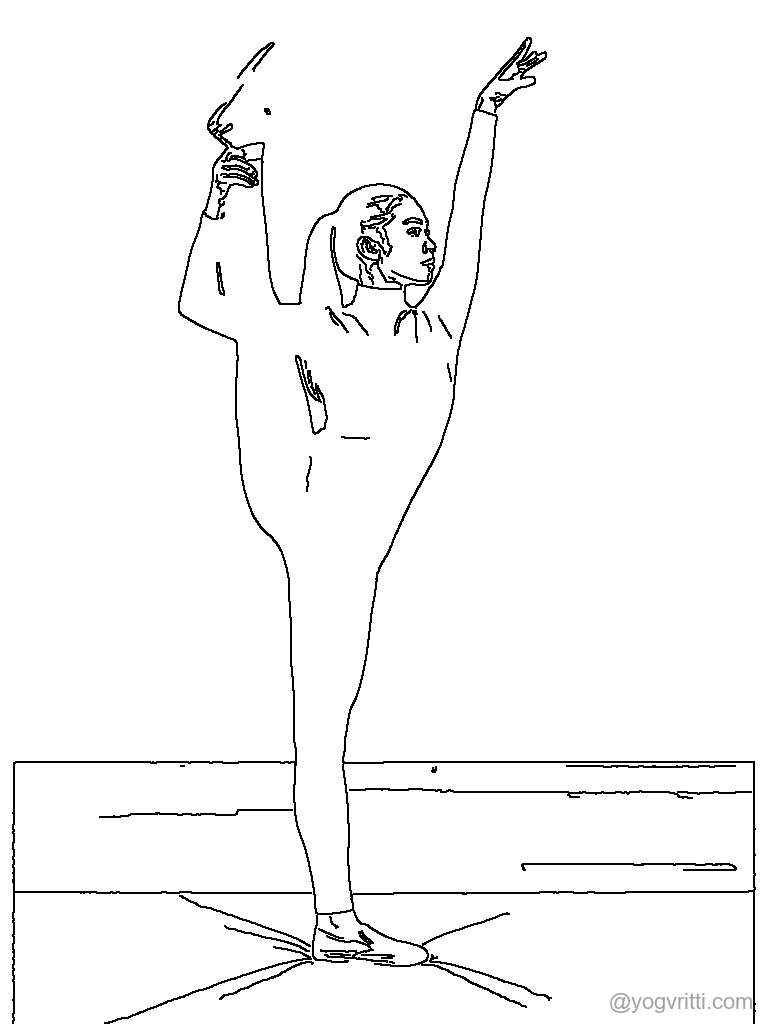
Trivikramasana is a profound standing split that challenges and cultivates extreme flexibility and balance, demanding both strength and surrender. It involves deep lengthening of the hamstrings, inner thighs, and gluteals, while simultaneously strengthening the standing leg and core to maintain an unwavering foundation. Energetically, it's an expansive pose that lifts the gaze, opens the energetic channels in the lower body, and cultivates a sense of lightness and fierce determination. Teachers will appreciate its capacity to refine body awareness, foster unwavering steadiness (sthira), and promote intelligent surrender (sukham) within an advanced posture, offering a transformative experience for dedicated practitioners.
Three Steps Pose, also called Trivikramasana is a classical yoga posture. Its Sanskrit name Trivikramasana translates word-for-word as: Tri (Three) · Vikrama (Strides / Steps) · Asana (Pose). From a standing position, the body roots firmly through the feet while the spine extends upward. The posture works to lengthen the hamstrings, stretch the hip flexors and strengthen the quadriceps. Standing balance mastery. Full body integration. It is particularly valued for developing greater flexibility. Suitable for advanced practitioners with developed body awareness, it is a meaningful addition to any practice. A strap can be used to make the posture more accessible and support correct alignment. Practitioners with hamstring injury and hip injury should approach with care or consult a qualified teacher.
Helps with
Muscles Worked
Hamstrings
[Biceps femoris, Semitendinosus, Semimembranosus]
These powerful muscles at the back of the lifted thigh undergo an intense, sustained stretch, extending from the sitting bone to just below the knee.
This deep lengthening isn't about forcing, but about patiently coaxing the muscle fibers to release their ingrained tightness, often accumulated from prolonged sitting.
From a yogic perspective, this unwinding helps to free apana vayu, facilitating a downward flow of energy and relieving stiffness that can impede the flow of prana in the lower limbs.
Hip Flexors
[Iliopsoas, Rectus Femoris]
The muscles at the front of the standing hip (iliopsoas and rectus femoris) are actively engaged to maintain the stability of the pelvis, while the hip flexors of the lifted leg are eccentrically lengthening to allow the leg to rise high, yet also concentrically contracting to hold it there.
This dynamic interplay helps to release chronic tension often held deep within the core, which can compress the lower spine.
Energetically, freeing the hip flexors can unlock emotional blockages, promoting a sense of freedom and openness in the pelvic bowl.
Quadriceps
[Rectus Femoris, Vastus Lateralis, Vastus Medialis, Vastus Intermedius]
In the standing leg, the quadriceps are powerfully engaged, straightening the knee and anchoring the limb firmly to the earth, creating a strong foundation for the entire posture.
Simultaneously, the quadriceps of the lifted leg are actively engaged in eccentric lengthening to allow for the full extension of the knee, creating space and preventing hyperextension.
This dual action cultivates both stability and intelligent release, bringing a feeling of strength and focused intention to the lower body.
Core Muscles
[Transversus Abdominis, Obliques, Rectus Abdominis, Erector Spinae]
The entire abdominal wall and deep spinal muscles work synergistically to stabilize the pelvis and spine, preventing any unwanted twisting or collapsing of the torso.
This deep engagement of the core creates a central axis of support, allowing the limbs to extend freely from a grounded center.
From a yogic perspective, a strong and stable core supports the upward flow of udana vayu, fostering confidence and internal fortitude, crucial for such an expansive pose.
Gluteal Muscles
[Gluteus Maximus, Medius, Minimus]
The gluteal muscles of the standing leg are actively engaged to externally rotate and stabilize the hip, providing a solid base for the entire posture.
Simultaneously, the gluteus maximus of the lifted leg undergoes significant lengthening, especially if the leg is actively lifted and the hip is in deep flexion.
This engagement and release help to open the outer hip, releasing deep-seated tension and improving overall hip mobility, which can feel incredibly liberating and grounding.
Joints Mobilized
Hip Joint
mobilizingThe lifted hip joint experiences extreme flexion and abduction, actively mobilizing the joint capsule and encouraging a greater range of motion within the ball-and-socket structure.
Meanwhile, the standing hip joint is powerfully stabilized, bearing the body's weight and maintaining alignment.
This dynamic interplay cultivates both profound flexibility and unwavering stability, allowing prana to flow more freely through the pelvic region, releasing stiffness and promoting a feeling of openness and ease.
Knee Joint
extensionBoth knee joints are in full extension: the standing knee is strongly extended and stabilized, crucial for maintaining balance, while the lifted knee is also extended, allowing for maximum leg length.
The careful engagement of the quadriceps prevents hyperextension, ensuring healthy articulation.
This focused extension helps to strengthen the ligaments and muscles around the knee, promoting stability and reducing vulnerability to strain, enhancing a feeling of firm grounding.
Ankle Joint
stabilizingThe ankle of the standing foot is actively engaged to provide a stable foundation, sensing subtle shifts in balance and making continuous micro-adjustments to keep the body upright.
The muscles around the ankle (peroneals, tibialis anterior/posterior) work intensely to maintain this steadiness.
This constant engagement sharpens proprioception and deepens the connection to the earth, fostering a profound sense of rootedness and mental focus, essential for advanced balancing.
Sacroiliac (SI) Joint
stabilizingThis joint, where the sacrum meets the ilium, is actively stabilized by the deep core and gluteal muscles to protect the lower back from undue strain during the deep hip flexion.
Maintaining a neutral pelvis is paramount to prevent shearing forces and ensure the safety of this critical junction.
This conscious stabilization helps to alleviate common lower back issues by promoting optimal alignment and distributing forces evenly, bringing a sense of structural integrity and safety to the foundation of the spine.
Organ & System Benefits
Abdominal Organs
The deep engagement of the core muscles and the upright posture create a subtle lift and gentle compression on the abdominal organs (such as the intestines, liver, and spleen).
This can stimulate circulation in the digestive tract, encouraging healthy peristalsis and detoxification processes.
From a yogic perspective, this internal massage helps to stoke Agni, the digestive fire, leading to improved assimilation of nutrients and a feeling of lightness and vitality in the belly.
Heart and Lungs
While not an inversion, the upright and expansive nature of Trivikramasana allows for an open chest and unrestricted breathing, especially if the upper body remains long and lifted.
This encourages deeper diaphragmatic breathing, which in turn enhances oxygen uptake and circulation throughout the body.
The open chest fosters a sense of courage and spaciousness, allowing the heart chakra (Anahata) to expand, promoting emotional release and a feeling of openness.
Nervous System
The intense focus required to maintain balance in Trivikramasana immediately draws the mind inward, quieting the incessant chatter (chitta vritti).
This sustained concentration on a single point (dharana) shifts the nervous system away from sympathetic arousal, promoting a profound sense of calm presence.
The body's intricate dance of stability and extension creates a feedback loop that soothes and centers the mind, fostering mental clarity.
The deep stretching in the hamstrings and inner thighs, when approached with patience and breath, signals safety to the nervous system, encouraging a 'rest and digest' response (parasympathetic activation).
This release of long-held tension in the connective tissues sends signals to the brain that it's safe to relax, releasing physical and emotional holding patterns.
This cultivates a deep sense of surrender and ease, despite the intensity of the pose, allowing for deeper energetic release.
The cultivation of balance in such an advanced posture sharpens proprioception and interoception, heightening the body's awareness of itself in space.
This enhanced sensory feedback refines the nervous system's ability to coordinate complex movements and maintain equilibrium, not just physically but also mentally.
It brings a profound sense of being grounded and present, fostering mental clarity and a quiet confidence that translates off the mat.
Mental & Emotional
Trivikramasana demands unwavering focus and mental fortitude, cultivating the yogic principle of dharana, or one-pointed concentration.
The challenge of balancing on one leg while extending the other requires the mind to be fully present, drawing attention away from external distractions and internal anxieties.
This intense engagement builds mental resilience and the capacity for sustained, calm attention, which is invaluable in daily life.
This advanced pose instills a profound sense of accomplishment and self-mastery, especially as one progresses in flexibility and balance.
Overcoming the perceived limitations of the body and mind in such a demanding posture cultivates courage (virya) and a deep sense of inner strength.
It teaches patience and persistence, reinforcing the belief that with consistent effort, seemingly impossible feats become achievable, fostering a growth mindset.
The expansive nature of lifting one leg high towards the sky, combined with the open chest, can evoke a feeling of liberation and emotional release.
As physical barriers are overcome, mental and emotional blockages often begin to dissolve, fostering a sense of openness and surrender to the moment.
This journey from limitation to expansion can be deeply transformative, encouraging a broader perspective on life's challenges and fostering a sense of inner freedom.
Because of Its Shape
standing
Standing poses build strength and stability in the legs and core, rooting the practitioner firmly to the earth through the standing foot.
This physical grounding translates into mental steadiness and a profound sense of presence, cultivating the quality of sthira (steadiness) in both body and mind.
It helps to energize the lower chakras, creating a strong, unshakeable foundation from which to expand and grow.
Balancing poses like Trivikramasana acutely refine proprioception and interoception, enhancing the body's exquisite awareness of its position in space.
This constant, subtle adjustment of muscles and joints strengthens the nervous system's ability to maintain equilibrium, improving coordination and agility.
The intense mental focus required for balance cultivates dharana, calming the fluctuations of the mind and fostering a deep sense of inner quiet and centeredness.
This pose offers an extreme and symmetrical opening of the hip joint, deeply stretching the hamstrings, adductors (inner thighs), and gluteal muscles of the lifted leg.
Physically, it significantly increases the range of motion in the hips, which is crucial for spinal health, agility, and ease of movement in daily life.
Energetically, hip openers are believed to release stored emotions and tension, particularly in the root (Muladhara) and sacral (Svadhisthana) chakras, promoting a sense of freedom and emotional fluidity.
Fascial Lines
In Trivikramasana, the entire posterior fascial line of the lifted leg, from the sole of the foot up through the calf, hamstrings, and into the sacrum, receives a profound and sustained lengthening.
Simultaneously, the adductor fascial lines (inner thighs) are intensely stretched, creating space in the pelvic region.
This broad, intelligent release in the myofascial network helps to decompress the joints and free up restrictions that can limit movement and perpetuate pain throughout the body.
Yogically, this unwinding of the fascial web releases deep-seated patterns of holding, allowing prana to flow unimpeded and restoring the body's natural elasticity and energetic vibrancy.
Breathing & Respiratory
The intense physical demand and balancing act in Trivikramasana initially challenge the breath, often leading to shallow, restricted breathing as the body tenses.
However, with consistent practice and mental focus, the pose encourages a deep, steady diaphragmatic breath, especially on the exhalation, to facilitate release in the hamstrings and inner thighs.
This conscious lengthening of the exhale helps to activate the parasympathetic nervous system, allowing the body to surrender into the stretch and find ease.
Pranayama practices like Ujjayi, with its gentle restriction, can be particularly beneficial here, helping to maintain a calm and steady internal rhythm amidst the external challenge, deepening the yogic experience.
Anatomical Caution
Teachers must exercise extreme caution with Trivikramasana, especially regarding the sacroiliac joint and hamstrings.
Students with any history of hamstring tears, lower back instability, or SI joint dysfunction should approach this pose with great care, using props extensively, and prioritizing a neutral pelvis over maximal height.
It's crucial to emphasize listening to the body and never forcing the stretch, as this pose demands a careful balance of intelligent effort and profound surrender to avoid injury.