4
Muscles
3
Joints
2
Organs
2
Mental
Goddess Pose
उत्कट कोणासन
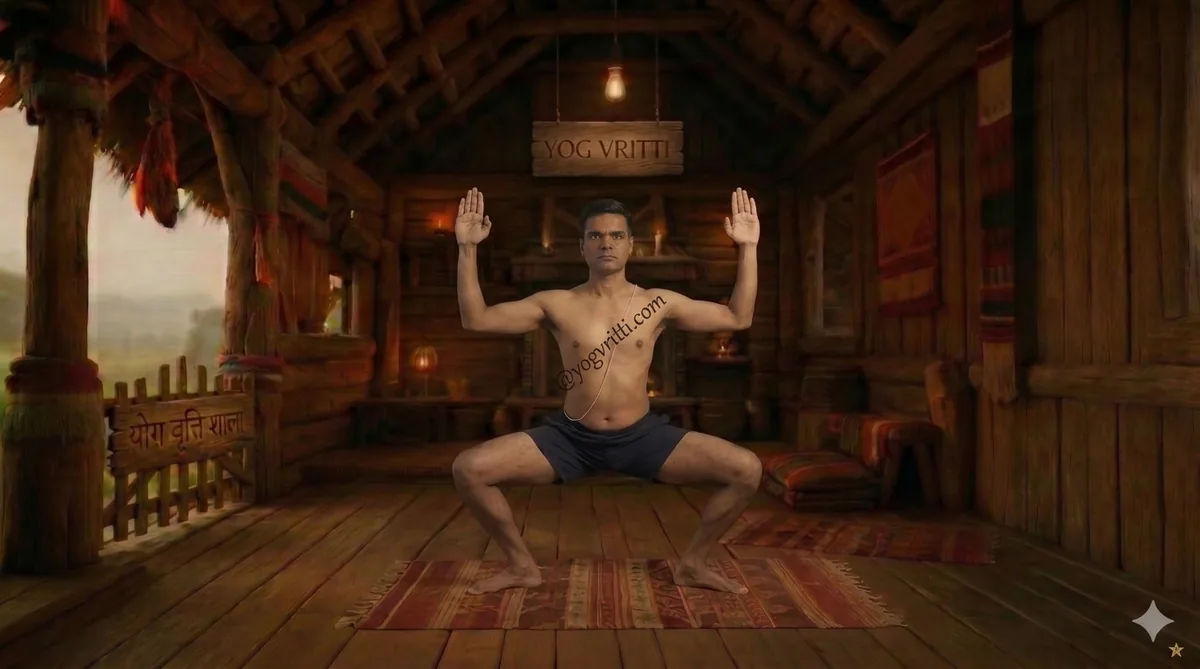
Utkata Konasana, or Goddess Pose, is a powerful standing squat that deeply grounds the practitioner while building immense strength and stability in the lower body. It skillfully integrates a wide stance with external hip rotation, engaging the quadriceps, glutes, and core to cultivate unwavering power and endurance. This pose is a profound hip opener, releasing tension in the inner thighs and pelvic region, which energetically frees the flow of prana and promotes emotional balance. Through its challenging yet stable form, it cultivates tapas (inner fire) and a deep sense of rootedness, empowering students to stand firm both on and off the mat.
Goddess Pose, also called Star Pose is a classical yoga posture whose Sanskrit roots break down as: Utkata (Fierce) · Kona (Angle) · Asana (Pose). From a standing position, the body roots firmly through the feet while the spine extends upward. The posture works to strengthen the quadriceps, activate the glutes and engage the core. Opens hips and inner thighs. Improves balance and posture. It is particularly valued for building full-body strength and developing greater flexibility. Suitable for beginners and regular practitioners alike, it is an excellent warm-up, particularly beneficial for beginners and prenatal. Practitioners with knee injury and hip injury should approach with care or consult a qualified teacher.
Helps with
Muscles Worked
Quadriceps
[Rectus femoris, vastus lateralis, vastus medialis, vastus intermedius]
The large muscles on the front of your thighs (quadriceps) engage in a powerful isometric contraction to hold the deep squat, building significant strength and endurance.
This sustained work cultivates heat and stamina, not just physically but mentally, teaching the body and mind to remain steady under challenge.
The isometric strength developed here directly supports knee stability and prepares the legs for more advanced standing postures, fostering a sense of unwavering power from the ground up.
Glutes
[Gluteus maximus, gluteus medius, gluteus minimus]
The muscles of your buttocks (glutes) are actively engaged to externally rotate the thighs and stabilize the pelvis, preventing the knees from collapsing inward.
This deep activation supports the integrity of the hip joints and helps maintain an upright posture, creating a sense of lift from the base of the spine.
Energetically, this grounding engagement channels apana vayu downwards, promoting a strong connection to the earth and a feeling of inner security.
Hip Adductors
[Adductor longus, adductor magnus, adductor brevis, gracilis, pectineus]
The muscles along your inner thighs (hip adductors) experience a sustained, gentle lengthening as the hips move into deep external rotation and abduction.
While lengthening, they also subtly engage to protect the inner thigh fascia from overstretching, creating a balanced action.
This mindful opening helps to release chronic tension often held in the groin and inner thighs, promoting flexibility and a sense of spaciousness in the pelvic region, which can free up emotional blockages and enhance creative energy.
Core Muscles
[Transverse abdominis, obliques, rectus abdominis, multifidus, erector spinae]
The deep muscles that wrap around your torso and spine (core muscles) engage subtly to support the lumbar spine and maintain an upright, lifted torso.
This internal bracing prevents the lower back from arching excessively or rounding, protecting the vertebral column.
The gentle activation creates a sense of energetic lift and centeredness, allowing the breath to flow more freely and fostering a feeling of inner stability that extends beyond the physical posture.
Joints Mobilized
Hip Joints
mobilizingThe ball-and-socket joints of the hips (coxal joints) are profoundly mobilized in Goddess Pose, moving into deep external rotation and abduction.
This action increases the range of motion within the joint capsule and strengthens the surrounding musculature, enhancing overall hip health and flexibility.
The sustained opening in the hips can release physical and emotional stiffness, fostering a sense of freedom and fluidity in movement and emotional expression.
Knee Joints
weight bearingThe knee joints (tibiofemoral joints) bear significant weight in this squat, requiring precise alignment where the knees track directly over the ankles.
This mindful engagement strengthens the quadriceps and surrounding ligaments, building resilience and stability in the joint.
This precise attention to alignment teaches discernment and proprioception, ensuring that the energetic flow is balanced and protective, preventing strain and promoting long-term joint health.
Ankle Joints
stabilizingThe ankle joints (talocrural joints) provide the essential foundation for this wide-legged stance, distributing the body's weight evenly through the feet.
This grounding action strengthens the muscles of the lower legs and feet, enhancing balance and proprioception.
A strong, stable connection to the earth through the ankles and feet fosters a deep sense of security and presence, rooting the practice and bringing a feeling of unwavering stability.
Organ & System Benefits
Pelvic Organs
The deep squat position of Utkata Konasana creates a gentle yet effective compression and release within the pelvic bowl, stimulating circulation to the reproductive and excretory organs.
This increased blood flow helps to tone the pelvic floor muscles and supports the healthy functioning of these vital systems.
Energetically, this pose awakens and balances the root (Muladhara) and sacral (Svadhisthana) chakras, promoting vitality, grounding, and creative expression.
Abdominal Organs
The mild internal pressure generated by the engaged core and the squat itself provides a gentle massage to the abdominal organs, including the intestines and stomach.
This subtle stimulation can aid in digestion by encouraging peristalsis and improving overall gut health.
The warmth generated in the core supports agni, the digestive fire, leading to a feeling of inner purification and sustained energy throughout the body.
Nervous System
The sustained isometric hold in the legs, coupled with focused, rhythmic breathing, encourages a shift from the sympathetic (fight-or-flight) to the parasympathetic (rest-and-digest) nervous system.
While initially challenging, learning to breathe deeply through the effort teaches the body to adapt and find ease amidst intensity, reducing overall stress response.
This cultivation of resilience allows practitioners to meet discomfort with equanimity, fostering a deeper sense of inner calm and nervous system regulation.
Holding Utkata Konasana with conscious attention to alignment and breath creates a powerful anchor for the mind, drawing awareness inward and away from external distractions.
The physical demands of the pose help to channel and dissipate excess mental energy, effectively quieting the constant chatter of the mind (chitta vritti).
This focused presence not only grounds the practitioner in the present moment but also cultivates a profound sense of mental clarity and an enhanced ability to concentrate.
Mental & Emotional
The inherent challenge of Goddess Pose, particularly the commitment to a sustained hold, is a potent practice for building mental fortitude and willpower, known as tapas.
By consciously choosing to remain present and breathe through physical intensity, practitioners learn to transcend perceived limitations and develop inner resilience.
This cultivation of mental strength empowers individuals to approach life's obstacles with greater determination, unwavering focus, and a profound sense of self-belief.
Utkata Konasana inherently fosters a deep sense of grounding and stability, connecting the practitioner profoundly to the earth's energy through a wide, rooted stance.
This stable foundation helps to alleviate feelings of anxiety, scatteredness, or restlessness, promoting a feeling of being firmly planted and secure in one's own body.
This cultivation of sthira (steadiness) and sukha (ease) within the pose translates into a more balanced and centered mental state, reducing agitation and inviting a profound sense of inner peace.
Because of Its Shape
standing
As a standing pose, Utkata Konasana fundamentally grounds the practitioner, establishing a deep connection to the earth's supportive energy.
It builds remarkable strength and endurance in the entire lower body and core, serving as a foundational posture that stabilizes and prepares the body for more complex asanas.
This physical rooting translates into a profound sense of stability and security, effectively calming a restless mind and fostering an inner resilience that extends beyond the mat.
The wide-legged stance combined with deep external rotation of the hips makes this pose an exceptional hip opener, specifically targeting the inner thighs and groin.
It gently yet effectively releases chronic tension in the adductor muscles and the intricate web of connective tissues surrounding the hip joints, significantly improving flexibility and range of motion.
Energetically, opening the hips is understood to release stored emotions and facilitate a free flow of prana in the pelvic region, enhancing creativity and promoting emotional balance.
Fascial Lines
The wide-legged squat with external rotation in Goddess Pose creates a sustained stretch and engagement across several fascial lines, particularly the deep front line, the adductor lines, and the spiral lines that wrap around the hips and inner thighs.
This mindful engagement helps to release chronic stiffness and improve the elasticity of the dense connective tissues in the pelvic girdle and lower limbs.
By addressing these fascial restrictions, we not only enhance physical mobility but also open energetic pathways, allowing prana to flow more freely, releasing held patterns, and deepening overall body awareness and fluidity.
Breathing & Respiratory
The upright torso and open chest in Utkata Konasana create ample space for the diaphragm to move uninhibitedly, naturally encouraging deep and expansive diaphragmatic breathing.
While the physical exertion might initially lead to shorter breaths, conscious effort to deepen the inhalation and lengthen the exhalation can transform the experience.
This rhythmic, controlled breathing calms the nervous system and infuses the body with vital prana, making the pose more sustainable and transforming physical effort into a meditative experience that deeply connects breath to movement and stillness.
Anatomical Caution
Teachers must meticulously observe students' knee alignment, ensuring the knees track precisely over the ankles and do not collapse inward or splay excessively, which can strain ligaments.
For individuals with existing knee issues or hip discomfort, advise a shallower squat or suggest placing a block between the thighs to encourage adductor engagement and provide support.
Always emphasize the importance of listening to one's body and never pushing into pain, particularly in the delicate areas of the hips and knees.