4
Muscles
3
Joints
2
Organs
2
Mental
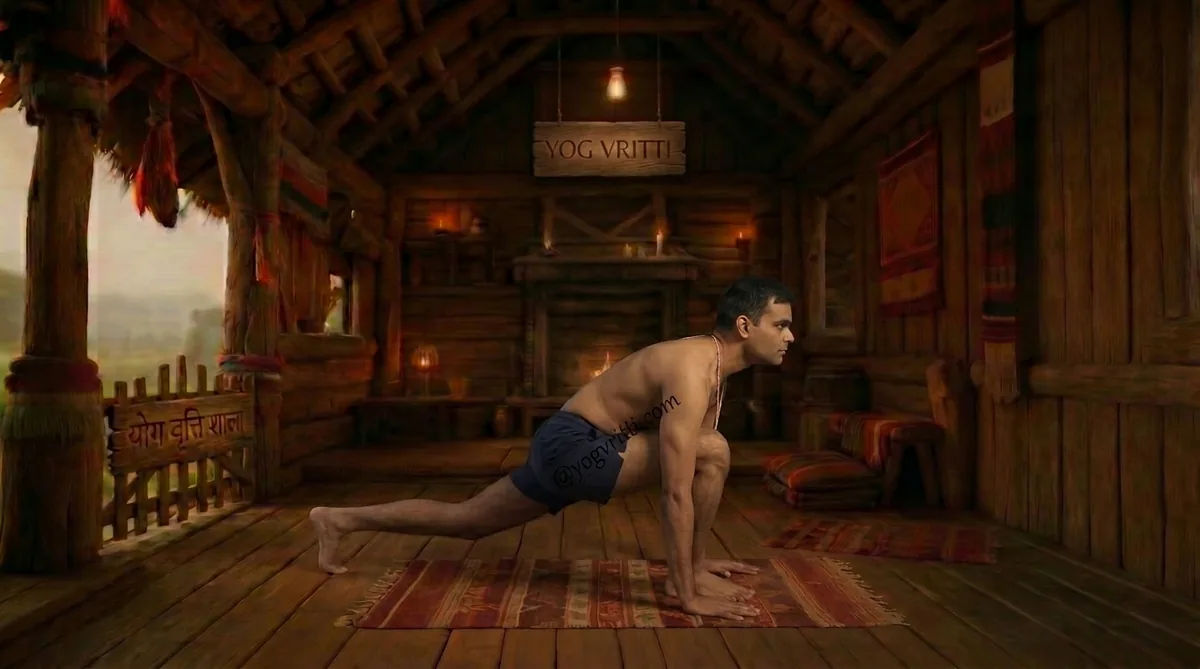
Lizard Pose
उत्तान प्रिष्ठासन
Utthan Pristhasana, or Lizard Pose, is a profound hip opener that deeply targets the often-tight inner thighs and front of the hips, bringing a sense of release and expansion to the lower body. Anatomically, it lengthens the hip flexors and adductors while building strength and stability in the core and grounding leg. Energetically, this deep forward bend and hip opening cultivates introspection and releases stored emotional tension, allowing prana to flow more freely through the pelvic region. For teachers, understanding its nuances allows for precise guidance, helping students unlock greater freedom and ease in their hips and overall being, fostering both physical flexibility and inner calm.
Lizard Pose, also called Low Lunge Lizard is a classical yoga posture whose Sanskrit roots break down as: Utthan (Rising) · Pristha (Back / Lizard) · Asana (Pose). From a standing position, the body roots firmly through the feet while the spine extends upward. The posture works to stretch the hip flexors, lengthen the hamstrings and strengthen the quadriceps. Opens groin and inner thigh. Prepares for splits. It is particularly valued for developing greater flexibility. Suitable for intermediate practitioners with foundational yoga experience, it is an excellent warm-up, particularly beneficial for athletes and runners. A block can be used to make the posture more accessible and support correct alignment. Practitioners with groin injury and knee injury should approach with care or consult a qualified teacher.
Helps with
Muscles Worked
Hip Flexors
[Psoas Major, Iliacus]
These deep muscles run from your lower spine and inner pelvis across the front of your hip joint to the inner thigh bone.
In Lizard Pose, as your pelvis moves forward and down relative to the back leg, these muscles are subjected to a sustained, lengthening stretch.
This action helps to release chronic tightness often accumulated from prolonged sitting, improving the natural alignment of the lumbar spine.
From a yogic perspective, releasing the psoas can free up the flow of apana vayu in the lower abdomen, promoting a sense of ease and reducing agitation.
Adductors
[Adductor Magnus, Adductor Longus, Adductor Brevis, Pectineus, Gracilis]
Located along the inside of your thighs, these muscles draw your legs towards the midline.
In Lizard Pose, with the front knee splayed out slightly and the torso sinking between the arms, these muscles experience a significant, passive stretch.
This targeted lengthening helps to increase internal rotation capacity in the hip and improves overall flexibility in the groin, which is often a site of deep-seated tension.
Releasing these inner pathways can feel incredibly liberating, allowing for a more open and uninhibited flow of energy through the root chakra.
Hamstrings
[Biceps Femoris, Semitendinosus, Semimembranosus]
The hamstrings run along the back of your thighs, connecting your sitting bones to your lower leg bones.
In the front leg, as you sink deeper and potentially bring your forearms to the floor, the stretch on the hamstrings intensifies, particularly if the knee is kept relatively stacked over the ankle.
For the back leg, if the knee is lifted, the hamstrings are engaged to help extend the leg.
This dual action of lengthening and potential activation helps to balance flexibility and strength, promoting a more resilient posterior chain.
Yogically, this engagement and release grounds the practitioner, connecting them more deeply to the earth.
Quadriceps
[Rectus Femoris, Vastus Lateralis, Vastus Medialis, Vastus Intermedius]
The quadriceps are the large muscle group on the front of your thighs.
In the back leg, if the knee is lifted, the rectus femoris (which crosses the hip joint) is lengthened as the hip extends, while the other quads work to straighten and stabilize the knee.
For the front leg, the quadriceps engage subtly to stabilize the knee, preventing it from collapsing inwards or outwards.
This active engagement in the front leg, combined with a deep stretch in the back leg, creates a balanced action that strengthens and lengthens simultaneously, fostering muscular intelligence.
It cultivates a sense of active surrender, where stability underpins release.
Joints Mobilized
Hip Joint
mobilizingThis ball-and-socket joint connects your thigh bone (femur) to your pelvis.
Lizard Pose creates deep external rotation and abduction in the front hip, while the back hip is in extension.
This multi-directional movement mobilizes the joint capsule, increasing range of motion and improving synovial fluid production, which nourishes the cartilage.
The practitioner experiences greater ease in daily movements like walking and sitting, with long-term practice potentially alleviating stiffness and improving overall hip health.
Sacroiliac (SI) Joint
stabilizingLocated where the sacrum (triangular bone at the base of your spine) meets the ilium (largest part of your pelvis), this joint connects the spine to the pelvis.
In Lizard Pose, the asymmetrical lunge can create a gentle, stabilizing pull across the SI joint, particularly when alignment is precise and the pelvis is squared.
This can help to bring awareness and subtle balance to the joint, which is crucial for lower back health.
A well-aligned SI joint contributes to a feeling of groundedness and stability throughout the entire trunk and lower body.
Knee Joint
weight bearingThe knee is a hinge joint connecting your thigh bone to your shin bone.
In the front leg, the knee is flexed and weight-bearing, requiring careful alignment to ensure the knee is stacked over the ankle to protect the joint from shear forces.
The back knee is either resting on the floor or extended, bearing minimal weight but requiring quadriceps engagement for stability if lifted.
This pose teaches intelligent engagement around the knee, fostering strength and awareness to prevent injury, and over time, can help improve stability and tracking of the kneecap.
Organ & System Benefits
Digestive Organs
As the torso leans forward and down towards the front leg, there is a gentle compression and massage of the abdominal organs, including the intestines and stomach.
This mild compression can stimulate peristalsis, the muscular contractions that move food through the digestive tract, aiding in healthy digestion and elimination.
From a yogic perspective, this action helps to stoke Agni, the digestive fire, and can release stagnant energy in the manipura chakra, leading to a sense of lightness and improved metabolic function.
Pelvic Organs
The deep hip opening in Lizard Pose, particularly around the groin, increases blood flow and circulation to the pelvic region, which houses reproductive and excretory organs.
This fresh blood flow can help to nourish these organs and potentially alleviate conditions related to pelvic stagnation.
Energetically, this pose directly impacts the muladhara (root) and svadhisthana (sacral) chakras, promoting a sense of security, creativity, and emotional balance by releasing tension held in the pelvic bowl.
Nervous System
The sustained hold in Lizard Pose, combined with the deep hip opening, encourages a shift from the sympathetic (fight-or-flight) to the parasympathetic (rest-and-digest) nervous system.
As the body settles into the stretch and the breath naturally deepens, the vagus nerve is stimulated, signaling safety and relaxation to the brain.
This calms the mind, reduces anxiety, and fosters a profound sense of presence and inner quiet.
The intensity of the stretch, particularly in the inner thighs and hip flexors, demands focused awareness (dharana) to stay present with the sensations without reacting.
This mindful engagement helps to quiet the fluctuations of the mind (chitta vritti), training the nervous system to remain calm amidst discomfort.
Over time, this practice builds resilience, allowing practitioners to meet life's challenges with greater equanimity and a more stable inner state.
Mental & Emotional
Lizard Pose, as a deep forward bend and hip opener, cultivates introspection and emotional release.
The physical act of folding forward naturally turns the awareness inward, encouraging a contemplative state where one can observe thoughts and feelings without judgment.
This practice of pratyahara, withdrawal of the senses, allows for a deeper connection to one's inner landscape, fostering self-awareness and mental clarity.
The intensity of the pose, especially in the hips, often brings to the surface deeply held emotions or mental patterns.
By patiently breathing through the sensations and maintaining a steady gaze, students learn to confront and release these mental blockages rather than avoiding them.
This process builds mental fortitude and emotional resilience, teaching students to sit with discomfort and emerge with a greater sense of peace and psychological freedom.
Because of Its Shape
hip opener
This pose profoundly opens the hip joints and the surrounding muscular and fascial tissues.
Anatomically, it targets the hip flexors and adductors, increasing their length and improving the range of motion in abduction and external rotation.
Yogically, hip openers are understood to release stored emotional tension and promote the free flow of prana, particularly in the lower chakras, leading to feelings of liberation and emotional balance.
Fascial Lines
Lizard Pose offers a comprehensive release along several fascial lines, particularly the Deep Front Line and the Superficial Front Line in the hips and thighs.
The sustained pressure and stretch unwind the dense connective tissue surrounding the hip flexors, adductors, and quadriceps, which often hold chronic tension from daily activities and emotional stress.
This deep fascial release is crucial for restoring fluidity of movement and, in yogic terms, helps to clear blockages in the nadis, allowing prana to circulate more freely throughout the pelvic girdle and lower limbs.
Breathing & Respiratory
The deep lunge and forward bend aspect of Lizard Pose naturally encourage a fuller, deeper diaphragmatic breath.
As the torso sinks, the slight compression of the abdomen promotes a more expansive inhalation into the back and sides of the rib cage, while the exhalation is naturally lengthened as the body softens into the stretch.
This conscious, deep breathing calms the nervous system and allows the practitioner to navigate the intensity of the hip opening with greater ease, complementing Ujjayi pranayama by cultivating both sustained effort and profound surrender.
Anatomical Caution
Teachers must guide students with utmost care in Lizard Pose, particularly regarding the front knee and the inner groin.
Ensure the front knee is directly over the ankle to protect the joint from undue strain, and never force the hip open, as this can lead to groin strains or irritation of the SI joint.
Encourage students to listen intently to their bodies, using props like blocks under the hands for support, and to back off if they feel any sharp, pinching, or tearing sensations, prioritizing sensation over depth.