5
Muscles
3
Joints
2
Organs
2
Mental
Viparita Virabhadrasana
विपरीत वीरभद्रासन
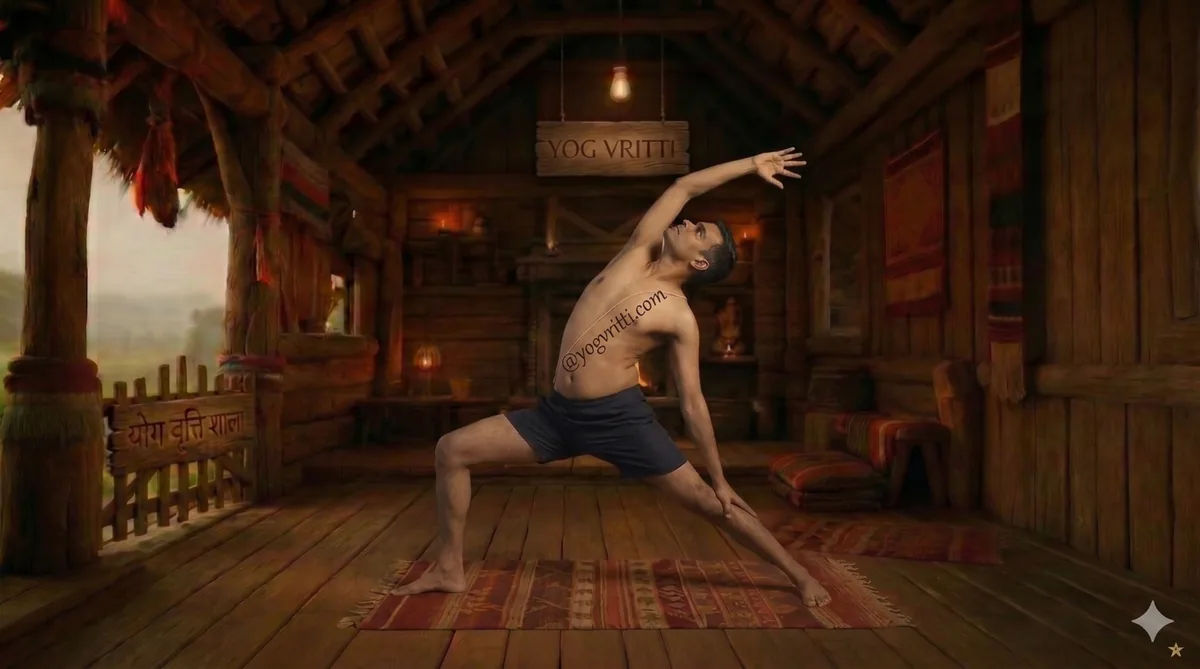
Viparita Virabhadrasana, or Reverse Warrior, is a deeply expansive standing posture that beautifully marries strength with surrender. It offers a profound lateral stretch along the entire side body, from the outer heel to the fingertips, while grounding the lower body through strong leg engagement. This pose cultivates an energetic lift and opening (udana vayu), inviting a sense of spaciousness and freedom in the torso and breath, making it invaluable for improving posture and cultivating a calm, focused mind. It's a testament to how stability in the lower half can create boundless space in the upper body, fostering both physical integrity and mental clarity.
Reverse Warrior Pose, also called Peaceful Warrior is a classical yoga posture. Its Sanskrit name Viparita Virabhadrasana translates word-for-word as: Viparita (Reversed) · Virabhadra (Warrior) · Asana (Pose). From a standing position, the body roots firmly through the feet while the spine extends upward. The posture works to engage the obliques, strengthen the quadriceps and open and strengthen the shoulders. Strengthens legs. Beautiful flow pose. It is particularly valued for developing greater flexibility and improving overall posture. Suitable for beginners and regular practitioners alike, it is an excellent warm-up, particularly beneficial for beginners. Practitioners with shoulder injury and knee injury should approach with care or consult a qualified teacher.
Helps with
Muscles Worked
Obliques
[External and Internal Obliques]
These powerful abdominal muscles wrap around your waist, running diagonally.
In Reverse Warrior, the obliques on the side of the lifted arm experience a profound lengthening, creating space between the ribs and the hip, while the obliques on the opposite side activate to stabilize the torso.
This differential action allows for a deep, yet supported, expansion through the trunk, releasing tension often held from habitual sitting or twisting.
Intercostals
[External and Internal Intercostals]
Nestled between each rib, these small but crucial muscles play a direct role in your breathing mechanics.
As you reach your arm overhead and laterally flex, the intercostals on the top side of your rib cage are gently stretched, creating more space for the lungs.
This increased mobility in the rib cage allows for a fuller, more expansive breath, directly impacting your capacity to take in prana and release stagnant energy.
Quadriceps
[Rectus Femoris, Vastus Lateralis, Medialis, Intermedius]
The large, powerful muscles on the front of your bent thigh (quadriceps) are actively engaged in this pose, working synergistically to stabilize the front knee and support the weight-bearing leg.
This isometric contraction builds strength and endurance in the thighs, creating a solid foundation for the expansive upper body.
Yogically, this grounding strength cultivates a sense of unwavering stability and presence, connecting you firmly to the earth.
Serratus Anterior
[Serratus Anterior]
Often called the "boxer's muscle," the serratus anterior lies under the armpit and attaches to the ribs and shoulder blade.
In Reverse Warrior, it's crucial for upwardly rotating and protracting the shoulder blade, allowing the arm to lift fully overhead without crunching the neck.
Activating this muscle helps stabilize the shoulder girdle, preventing strain and creating a feeling of lightness and freedom in the arm reach, enhancing the flow of apana vayu from the upper body.
Latissimus Dorsi
[Latissimus Dorsi]
This broad muscle covers much of your back, extending from the spine to the upper arm.
As the arm reaches overhead and back, the latissimus dorsi on that side receives a significant lengthening stretch, especially if there's a tendency for the shoulder to pull forward.
This release helps to decompress the shoulder joint and free up the entire side of the torso, facilitating a greater sense of opening and energetic flow through the entire lateral line of the body.
Joints Mobilized
Spine
mobilizingThe many small joints along your spine, from the tailbone to the neck, are actively involved in this lateral bend.
The movement gently mobilizes the vertebral column, encouraging space between the individual vertebrae on the side of the lifted arm.
This subtle decompression helps alleviate stiffness and improves the overall flexibility of the spine, allowing prana to flow more freely along the central channel (sushumna nadi).
Regular practice fosters a more supple and resilient spine.
Hip
stabilizingBoth hip joints are engaged, with the front hip in external rotation and flexion, while the back hip is in extension.
The strong engagement of the leg muscles around the front hip creates stability, preventing excessive rotation and protecting the joint.
This grounding action provides a stable base for the upper body's expansion, allowing the practitioner to feel deeply connected to their foundation, enhancing a sense of muladhara chakra stability.
Shoulder
mobilizingThe ball-and-socket joint of the shoulder on the reaching arm is actively mobilized into flexion and abduction, with the humerus externally rotated to create space.
When done with intelligent alignment, this action helps to articulate the shoulder joint fully, improving range of motion and preventing impingement.
This open shoulder allows for an uninhibited flow of energy through the arm and into the heart space, fostering a sense of openness and receptivity.
Organ & System Benefits
Lungs / Respiratory System
The expansive lateral stretch in Reverse Warrior directly affects the respiratory system by creating more space within the rib cage.
This increased volume allows the lungs to expand more fully, particularly on the side of the stretch, encouraging deeper and more complete inhalations.
This enhanced breath capacity helps to oxygenate the blood more efficiently and cultivates a greater intake of vital life force (prana), invigorating the entire system.
Abdominal Organs (Liver, Spleen, Kidneys)
Through the gentle lateral compression and stretch of the torso, the abdominal organs receive a subtle internal massage.
On the side of the bent knee, there is a mild compression, while the side reaching overhead experiences a lengthening and opening.
This action helps stimulate circulation to these vital organs, supporting their detoxifying and metabolic functions.
Energetically, this gentle internal movement can help release stagnant energy in the manipura chakra, promoting vitality and digestive harmony.
Nervous System
The steady, grounded base of the legs combined with the expansive lift of the upper body creates a unique balance that can profoundly calm the nervous system.
As the body is rooted, the mind finds an anchor, reducing the chatter of chitta vritti (mind fluctuations).
This allows for a deeper sense of presence and quietude, moving the practitioner towards a more parasympathetic state.
The emphasis on opening the side body and expanding the breath directly impacts the vagus nerve, which runs through the torso.
By creating space for fuller respiration, we gently stimulate the vagal tone, promoting relaxation and reducing the "fight or flight" response.
This encourages a feeling of inner peace and resilience, making the practitioner feel both strong and serene.
Mental & Emotional
Viparita Virabhadrasana encourages a powerful shift from inward focus to outward expansion, fostering a sense of courage and self-expression.
The open chest and upward gaze can lift the spirit, helping to dissolve feelings of constraint or timidity.
This physical act of reaching and opening translates into a mental willingness to embrace new perspectives and possibilities.
The pose demands a balance between effort and ease (sthira sukham asanam), cultivating dharana (concentration) as one maintains alignment in the legs while simultaneously extending the spine.
This sustained focus on both grounding and reaching helps to integrate the mind and body, bringing the practitioner into a state of mindful presence.
It teaches us that strength can coexist with grace, and stability can underpin boundless freedom.
Because of Its Shape
standing
Standing poses are fundamental for building a strong foundation, literally connecting us to the earth.
They cultivate stability and balance, engaging the large muscle groups of the legs and core.
Anatomically, they strengthen the skeletal structure and improve proprioception, enhancing our awareness of the body in space.
From a yogic perspective, standing poses ground apana vayu, bringing a sense of rootedness and presence, essential for developing tapas (inner discipline and heat).
This particular standing pose, with its lateral bend, offers a unique opportunity to explore expansion within a grounded framework.
It strengthens the legs and feet, which are the base of our physical and energetic structure, while simultaneously creating length and space in the torso.
This dual action of grounding and lifting helps to balance the flow of energy, making the practitioner feel both stable and light, ready to meet life's challenges with poise.
Fascial Lines
Fascia, the intricate web of connective tissue, envelops every muscle, organ, and bone, linking the entire body.
In Viparita Virabhadrasana, the entire Superficial Back Line of the reaching arm, and particularly the Lateral Line of the body, are profoundly lengthened.
This sustained stretch releases tension stored within these fascial pathways, improving overall flexibility and mobility.
Yogically, this unwinding of the fascial matrix helps to open the nadis (energy channels), allowing for an unhindered flow of prana and releasing deeply held physical and emotional patterns.
Breathing & Respiratory
The expansive lateral stretch of Viparita Virabhadrasana naturally encourages a fuller and deeper inhalation, particularly into the side of the rib cage that is opening.
As the intercostal muscles lengthen and the diaphragm gains more space, the lungs can draw in more air with less effort.
This conscious, deep breathing cultivates pranayama by increasing vital capacity and calming the nervous system.
It helps to purify the system and vitalize the mind, making the breath a direct conduit for internal energy.
Anatomical Caution
Teachers should guide students to maintain proper alignment in the front knee, ensuring it tracks directly over the ankle and doesn't collapse inward or outward, to protect the knee joint.
Also, encourage a soft neck and gaze, avoiding any forceful craning that could strain the cervical spine.
The goal is expansion, not compression, so listen to the body's signals and back off if any sharp pain arises.