5
Muscles
4
Joints
3
Organs
3
Mental
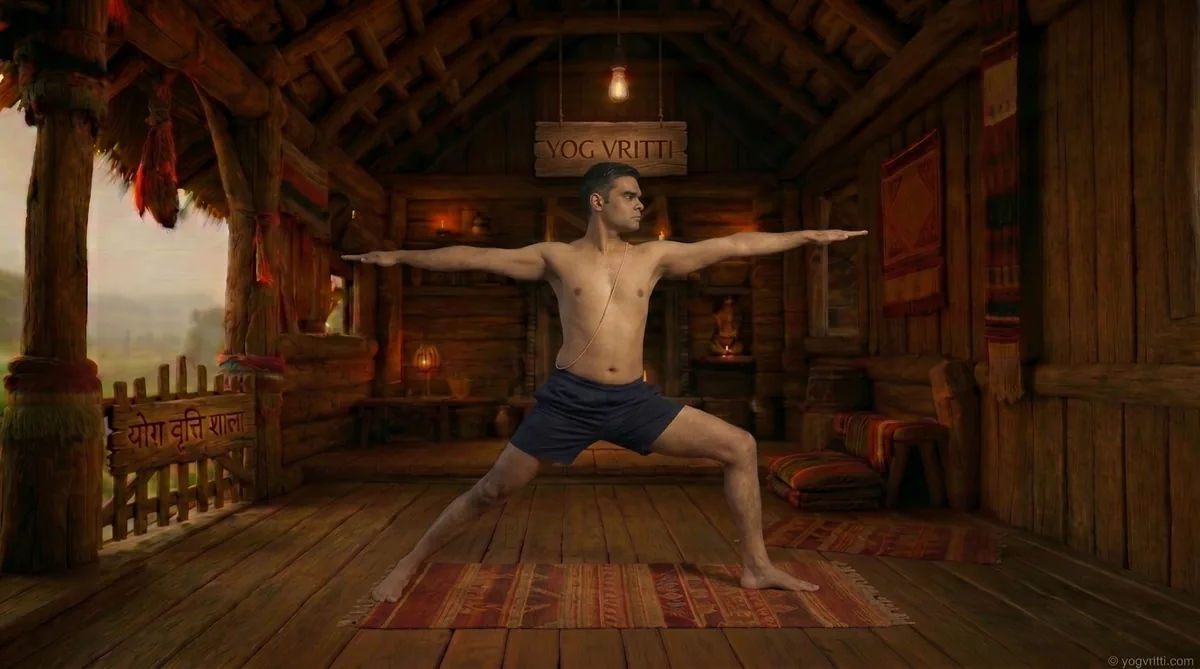
Virabhadrasana II
वीरभद्रासन II
Virabhadrasana II (Warrior II) is a foundational standing pose that powerfully grounds the practitioner while simultaneously expanding the chest and heart. It meticulously sculpts strength and stability in the legs and core, fostering impeccable alignment from the feet through the fingertips. Energetically, this pose cultivates unwavering focus and courage, allowing the upward flow of prana for an expansive sense of awareness and inner fortitude. It is invaluable for refining posture, building physical and mental resilience, and embodying a quiet, steadfast presence.
Warrior II Pose, also called Warrior Two is a classical yoga posture. Its Sanskrit name Virabhadrasana II translates word-for-word as: Virabhadra (Warrior (Divine Hero)) · Asana (Pose — II). From a standing position, the body roots firmly through the feet while the spine extends upward. The posture works to strengthen the quadriceps, activate the glutes and open and strengthen the shoulders. Opens hips. Strengthens shoulders. It is particularly valued for building full-body strength and improving overall posture. Suitable for beginners and regular practitioners alike, it is an excellent warm-up, particularly beneficial for beginners and athletes.
Helps with
Muscles Worked
Quadriceps
[Rectus Femoris, Vastus Lateralis, Vastus Medialis, Vastus Intermedius]
The front thigh muscles, particularly the quadriceps of the front leg, are intensely engaged in this pose as they work eccentrically to stabilize the deeply bent knee.
They bear a significant portion of the body's weight, creating sustained isometric strength that transforms the legs into unwavering pillars of support.
This deep engagement builds physical resilience, fostering a profound sense of inner stability and a steady foundation for both body and mind.
Gluteus Medius and Minimus
[Gluteus Medius, Gluteus Minimus]
These muscles, located on the outer side of the front hip, are crucial for externally rotating the femur and preventing the front knee from collapsing inward, thus maintaining its precise alignment over the ankle.
They actively stabilize the pelvis, ensuring a level foundation for the spine and upper body.
This intelligent engagement cultivates awareness of the often-neglected lateral hip, fostering integrated strength and balance that translates into a feeling of grounded confidence in all movements.
Adductors
[Adductor Magnus, Longus, Brevis, Pectineus, Gracilis]
The inner thigh muscles of the back leg experience a significant and sustained lengthening as the legs spread wide and the hips open.
Simultaneously, the adductors of the front leg engage subtly to draw the thigh toward the midline, preventing excessive outward rotation and contributing to knee stability.
This dual action cultivates both flexibility and intelligent engagement in the hips, releasing stagnation in the pelvic region and allowing for a freer flow of apana vayu, bringing a sense of lightness and spaciousness.
Deltoids
[Anterior, Medial, Posterior Deltoid]
The deltoid muscles, which cap the shoulders, are actively engaged to lift and extend the arms out to the sides, parallel to the floor, with sustained isometric contraction.
This action builds strength and endurance in the shoulders, creating a feeling of broadness across the chest and collarbones.
Energetically, extending the arms outward cultivates a sense of reaching, expansion, and courage, mirroring the warrior's readiness to face life with an open heart and unwavering resolve.
Core Muscles
[Transverse Abdominis, Obliques, Rectus Abdominis, Erector Spinae]
The deep core muscles, including the transverse abdominis and obliques, are essential for stabilizing the trunk and maintaining the upright, elongated posture of the spine.
They prevent the lower back from arching excessively or rounding, creating a strong, supportive cylinder around the torso.
This inner stability provides a central axis for the pose, allowing the breath to flow freely and fostering a sense of inner strength and self-possession, connecting to the activation of Manipura chakra.
Joints Mobilized
Knee Joint
weight bearingThe front knee joint is deeply flexed and bears significant weight, requiring meticulous alignment to protect its delicate ligaments and menisci.
The synergistic engagement of the quadriceps and glutes works to stabilize the joint, preventing inward collapse (valgus stress) or outward splaying.
This intelligent engagement strengthens the muscles surrounding the knee, improving its long-term stability and range of motion, while fostering a sense of patience and mindful action in the body.
Hip Joint
mobilizingThe front hip joint is deeply flexed and externally rotated, creating an expansive opening across the front of the pelvis, while the back hip is extended and abducted, establishing a broad, stable stance.
This combination mobilizes the hip capsules, improving their range of motion and releasing deeply held tension within the pelvic bowl.
Yogically, this hip opening is believed to release emotional stagnation and cultivate a sense of freedom and openness in the seat of creativity and security.
Shoulder Joint
mobilizingBoth shoulder joints are abducted and externally rotated as the arms extend powerfully out from the heart, parallel to the floor.
This action mobilizes the glenohumeral joint, improving its range of motion and strengthening the intricate rotator cuff muscles that stabilize it.
The broadness across the collarbones and chest cultivates an open heart space, releasing tension in the upper back and promoting a feeling of expansiveness, courage, and unburdening.
Sacroiliac (SI) Joint
stabilizingThe Sacroiliac (SI) joint, where the sacrum meets the ilium, is meticulously stabilized in Virabhadrasana II through the balanced engagement of the gluteal muscles and the inner and outer thigh muscles.
This precise stabilization is crucial for supporting the lower back and preventing undue strain in the pelvis.
A stable SI joint provides a strong, integrated foundation for the spine, allowing for a steady upright posture and a feeling of grounded integrity in the very core of the body.
Organ & System Benefits
Digestive Organs
The upright and expansive posture of Virabhadrasana II creates ample space within the abdominal cavity, preventing compression and allowing for the optimal function of the digestive organs.
The subtle yet sustained engagement of the core muscles provides a gentle internal massage, stimulating peristalsis and enhancing circulation to the digestive system.
This promotes efficient digestion and elimination, contributing to a feeling of lightness and vitality, aligning with the balanced activation of samana vayu.
Lungs
The broad opening across the chest and the elongated, upright alignment of the spine in Virabhadrasana II create optimal space for the lungs to fully expand.
The diaphragm is able to descend deeply, facilitating full and unrestricted breath, particularly in the lower lobes of the lungs.
This enhanced respiratory capacity significantly increases oxygen intake, revitalizes the entire system, and profoundly calms the nervous system, fostering a deep and conscious connection to prana.
Heart
While not directly compressed or stretched, the heart benefits immensely from the expansive chest opening and the improved systemic circulation throughout the body.
The upright posture and deep, uninhibited breathing reduce physical tension around the heart, allowing it to pump more efficiently and rhythmically.
This creates a feeling of openness, courage, and emotional release, cultivating an expansive heart space and enhancing the feeling of anahata chakra, the center of love and compassion.
Nervous System
The sustained effort and meticulous alignment required in Virabhadrasana II cultivate a profound sense of presence, drawing the mind away from external distractions and internal chatter.
This focused engagement of the body acts as a moving meditation, gradually shifting the nervous system from a state of 'fight or flight' (sympathetic) towards 'rest and digest' (parasympathetic).
The steady gaze (drishti) further anchors the attention, quieting the incessant fluctuations of the mind (chitta vritti) and fostering deep inner calm.
The deep, rhythmic breathing naturally encouraged by the open chest and stable posture directly stimulates the vagus nerve, a key component of the parasympathetic nervous system.
As the breath deepens and slows, a wave of tranquility washes over the body and mind, reducing anxiety and promoting a feeling of centeredness.
This conscious connection to the breath becomes a powerful tool for self-regulation, enhancing emotional resilience and mental clarity.
Holding the pose with unwavering attention, despite the physical challenge, builds immense mental fortitude and equanimity.
The body learns to integrate strength with stillness, sending signals to the brain that it is safe, capable, and resilient.
This practice diminishes hypersensitivity to discomfort, strengthening the practitioner's capacity for sustained focus and inner peace, even amidst life's inevitable challenges and demands.
Mental & Emotional
Virabhadrasana II is a powerful pose for cultivating unwavering focus and determination.
The steady gaze (drishti) over the front hand trains the mind to remain present and concentrated, filtering out distractions and enhancing mental clarity.
This practice of sustained attention strengthens dharana, the ability to concentrate, which is a vital step on the yogic path towards deeper meditation and self-realization.
Embodying the warrior archetype, this pose instills a profound sense of courage and inner strength, helping to overcome feelings of fear or hesitation.
The expansive chest and grounded stance foster a resolute spirit, encouraging us to stand firmly in our truth and face challenges with an open heart.
It cultivates a quiet, steadfast power rather than aggressive force, allowing us to embody our authentic self with confidence.
The balance between sustained effort and subtle ease in Virabhadrasana II teaches patience and perseverance.
While the pose is physically demanding, the practice of finding stillness within the effort cultivates mental resilience and a calm demeanor.
This develops an inner warrior who is not only strong but also compassionate and steady, able to weather the storms of life with grace and unwavering equanimity.
Because of Its Shape
standing
Standing poses like Virabhadrasana II are fundamental for building profound strength and stability throughout the entire body, particularly in the legs and core.
They engage large muscle groups, strengthening the skeletal system and improving bone density over time.
Energetically, they are profoundly grounding, rooting the practitioner deeply into the earth and cultivating a powerful sense of stability and steadfastness, essential for navigating life's challenges with resilience.
The wide stance and upright torso in this standing pose significantly improve posture by strengthening the intrinsic postural muscles of the back and core.
It teaches impeccable alignment of the spine, pelvis, and limbs, meticulously counteracting the detrimental effects of prolonged sitting and slouching.
This architectural integrity not only enhances physical appearance but also allows for a freer, unimpeded flow of prana, reducing physical blockages and promoting a feeling of lightness and ease in the body.
Standing poses demand a sophisticated balance between effort and surrender, cultivating mental focus, endurance, and unwavering presence.
The sustained physical engagement required helps to quiet the incessant chatter of the mind by giving it a clear object of attention—the body in space.
This practice builds mental resilience, concentration, and equanimity, teaching us to find stillness and strength even when faced with significant physical challenge, thereby preparing the mind for deeper meditative states.
Fascial Lines
In Virabhadrasana II, the intricate, body-wide web of connective tissue, or fascia, receives a deep and intelligent release and integration.
The lateral line, running along the outer seams of the body from the outer ankle up through the hips and torso, is particularly lengthened, especially on the back leg, while the spiral line is engaged to stabilize the trunk and create rotational integrity.
This sustained, multidirectional stretch and intelligent engagement helps to unwind fascial restrictions, improving overall flexibility, fluidity of movement, and proprioception.
From a yogic perspective, this releases stored tension and opens up nadis, allowing prana to flow more freely, contributing to a feeling of spaciousness and unburdening throughout the entire system.
Breathing & Respiratory
The expansive chest and elongated, upright spinal alignment in Virabhadrasana II naturally encourage a deep and full diaphragmatic breath.
As the rib cage lifts and broadens, the lungs have ample space to fill completely, promoting a longer, more complete inhalation and exhalation.
This rhythmic, unforced breath profoundly calms the nervous system and enhances prana flow throughout the entire body.
It pairs beautifully with Ujjayi pranayama, where the subtle constriction in the throat creates an audible, soothing sound that further deepens concentration and cultivates profound inner awareness.
Anatomical Caution
Teachers should meticulously guide students to be mindful of their front knee, ensuring it tracks directly over the ankle and doesn't collapse inward or splay outward, to stringently protect the delicate knee ligaments.
Those with pre-existing hip or knee issues should judiciously reduce the depth of the lunge.
Always encourage listening to the body's innate wisdom, prioritizing stability and comfort over depth, especially for beginners and those with sensitivities.