5
Muscles
4
Joints
3
Organs
3
Mental
Vyaghrasana
व्याघ्रासन
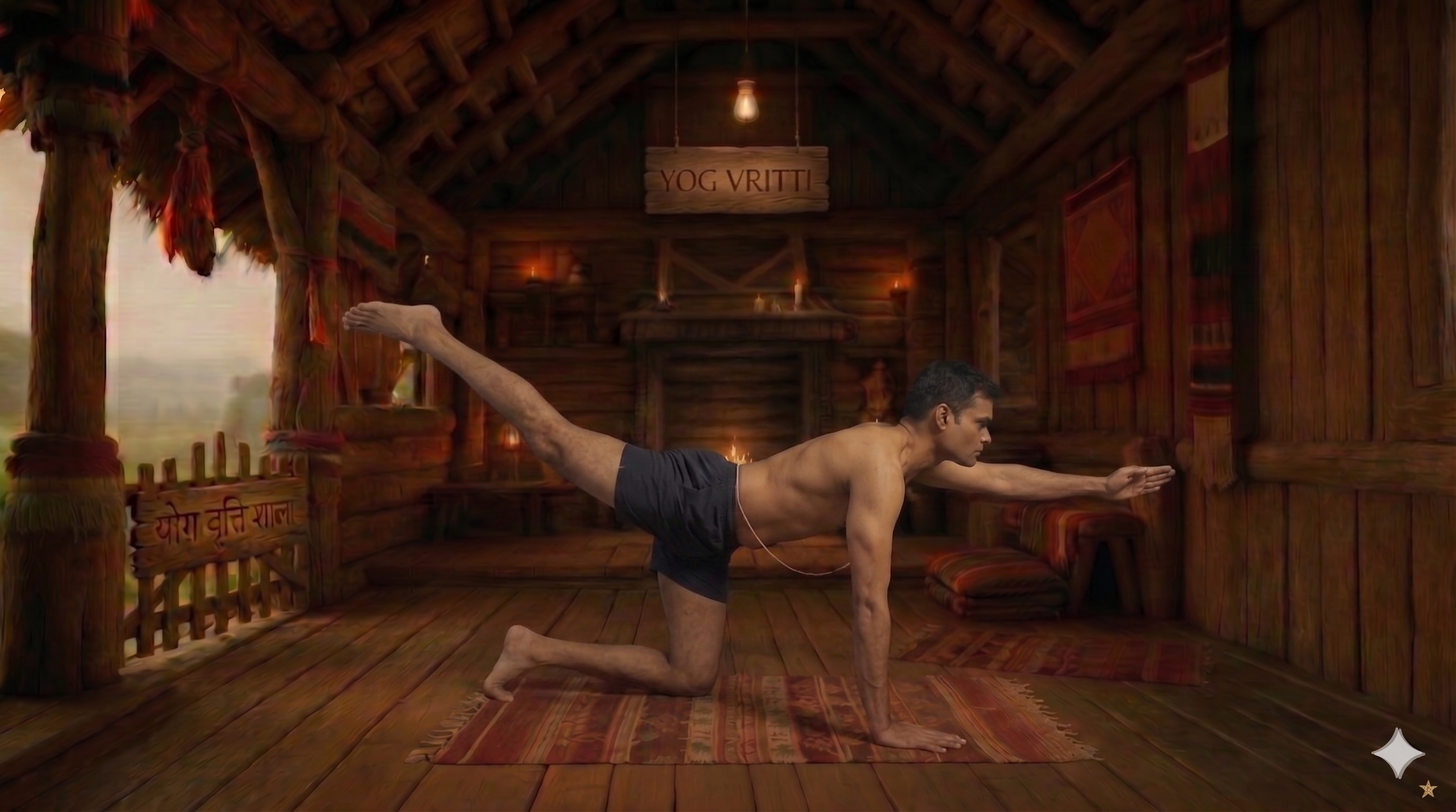
Vyaghrasana, or Tiger Pose, is a potent dynamic movement originating from a stable table-top base, meticulously articulating the spine through rhythmic flexion and extension. This practice deeply engages the core musculature, strengthening the abdominal wall and stabilizing the pelvis, while simultaneously enhancing the mobility and strength of the hips and glutes. Energetically, it balances the upward flow of prana vayu with the downward current of apana vayu, fostering a sense of grounded vitality and inner warmth. For teachers and students alike, it offers a profound pathway to cultivate spinal awareness, build integrated body strength, and release chronic tension, preparing the body for more complex asanas.
Tiger Pose, also called Tiger Stretch is a classical yoga posture. Its Sanskrit name Vyaghrasana translates word-for-word as: Vyaghra (Tiger) · Asana (Pose). Beginning from a kneeling position, the practitioner aligns the body with precision and intentional breath. The posture works to engage the core, activate the glutes and stretch the hip flexors. Strengthens glutes and hip flexors. Improves coordination. It is particularly valued for alleviating back discomfort and building full-body strength. Suitable for intermediate practitioners with foundational yoga experience, it is an excellent warm-up, particularly beneficial for beginners. Practitioners with wrist injury should approach with care or consult a qualified teacher.
Helps with
Muscles Worked
Deep Abdominal Muscles
Transversus Abdominis, Multifidus
These deepest core muscles wrap around your midsection like a corset (Transversus Abdominis) and stabilize each individual vertebra of your spine (Multifidus).
In Vyaghrasana, they are constantly engaged to maintain stability in the table-top foundation and to control the spinal movement, preventing excessive arching or rounding.
This deep engagement cultivates inner strength, providing a stable foundation from which all movement originates, and in yogic terms, awakens the manipura chakra, the seat of personal power and transformation.
Buttocks
Gluteus Maximus
The largest muscle of your buttocks, the Gluteus Maximus, is powerfully engaged as you extend the leg back and up, lifting the heel towards the ceiling.
This action strengthens the posterior chain of the body, crucial for hip extension and maintaining an upright posture.
Through this focused activation, we build strength and stamina in the lower body, helping to ground our physical being and channel our energy downwards, fostering a sense of stability and rootedness.
Hip Flexors
Iliopsoas
The Iliopsoas, a powerful muscle group deep in the pelvis, connects your spine to your inner thigh bone and is responsible for lifting your knee towards your chest.
In the knee-to-nose phase of Vyaghrasana, these muscles shorten concentrically, but in the leg extension phase, they are gently lengthened, creating balance.
This dynamic action helps to release chronic tightness often held from prolonged sitting, improving hip mobility and freeing the flow of energy, particularly in the lower abdominal region.
Spinal Erectors
Erector Spinae
These long muscles run along both sides of your spine, helping you stand upright and extend your back.
In the leg extension phase of Vyaghrasana, they work to gently arch the lower back and lift the chest, counteracting the pull of gravity on the extended leg.
This strengthens the back body, improving spinal resilience and posture, and energetically awakens the sushumna nadi, the central energy channel, promoting a feeling of openness and vitality along the spine.
Abdominal Wall
Rectus Abdominis, Obliques
The superficial muscles of your abdomen, the Rectus Abdominis (your 'six-pack' muscles) and the Obliques (side waist muscles), are significantly engaged as you draw your knee towards your nose.
This action requires strong contraction to create spinal flexion and lift the leg against gravity.
This strengthens the entire abdominal wall, which supports the internal organs and provides a protective sheath for the spine, fostering a sense of internal containment and core power, essential for both physical and energetic stability.
Joints Mobilized
Spine (Vertebral Column)
mobilizingThe entire length of your spine, from the sacrum to the cervical vertebrae, undergoes a gentle yet profound mobilization in Vyaghrasana.
As you alternate between arching and rounding, each individual vertebra articulates, increasing the range of motion and nourishing the intervertebral discs with fresh synovial fluid.
This dynamic movement releases stiffness, improves overall spinal health, and in yogic terms, encourages the free flow of prana along the central axis of the body, bringing a feeling of lightness and fluidity.
Hip Joint
mobilizingThe ball-and-socket joint of your hip experiences a full range of motion, moving from deep flexion as the knee draws towards the chest, to extension as the leg reaches back and up.
This rhythmic movement helps to lubricate the joint, improve the flexibility of the surrounding soft tissues, and build strength in the muscles that control hip movement.
Over time, this practice can alleviate stiffness, increase overall lower body agility, and release stagnant energy held in the pelvic region, promoting a sense of freedom and openness.
Shoulder Girdle
stabilizingWhile not the primary focus of movement, the shoulder girdle, comprising the shoulder blade (scapula) and collarbone (clavicle), is actively engaged in stabilizing the upper body.
The hands press firmly into the mat, engaging the muscles around the shoulders to create a stable support base, preventing slumping.
This isometric strengthening improves shoulder integrity and endurance, allowing for a more grounded and secure upper body, which translates into a feeling of steadiness and confidence in other weight-bearing poses.
Wrist Joint
weight bearingThe wrist joint bears significant weight in Vyaghrasana, requiring strength and stability from the forearm muscles and surrounding ligaments.
The even distribution of weight through the palms and fingers is crucial to protect this joint.
Regular practice, with proper alignment, strengthens the wrists and forearms, improving their capacity for weight-bearing and reducing vulnerability to strain.
This cultivates a sense of firm foundation and resilience in the hands, which are our primary tools for interaction with the world.
Organ & System Benefits
Abdominal Organs (Digestive System)
The dynamic compression and release of the abdomen in Vyaghrasana provides a gentle internal massage to the digestive organs, including the stomach, intestines, and liver.
As the knee draws to the nose, the abdomen compresses, and as the leg extends, it stretches.
This rhythmic action stimulates peristalsis, aiding digestion and elimination, and in yogic thought, ignites 'agni' or digestive fire, enhancing metabolism and detoxification, leaving practitioners feeling lighter and more energized.
Kidneys and Adrenal Glands
During the spinal extension phase when the leg lifts, there is a gentle compression and release around the lower back, which can indirectly stimulate the kidneys and the adrenal glands situated atop them.
This subtle stimulation may help to regulate hormonal balance and reduce feelings of fatigue.
From a yogic perspective, working with the lower back invigorates the apana vayu, which governs elimination and grounding, contributing to overall vitality and stress resilience.
Circulatory System
The continuous movement and core engagement in Vyaghrasana enhance blood flow throughout the body, particularly to the spine, abdominal region, and limbs.
The rhythmic contraction and relaxation of muscles act as a pump, improving circulation and oxygen delivery to tissues.
This increased circulation helps to flush out metabolic waste and bring fresh nutrients, leaving the body feeling invigorated and refreshed, fostering a sense of vibrant health and sustained energy.
Nervous System
Vyaghrasana's rhythmic, coordinated movement between breath and action brings a profound sense of calm and focused presence.
The dynamic flow requires sustained attention, drawing the mind away from external distractions and into the immediate sensation of the body.
This conscious engagement helps to quiet the 'chitta vritti' – the restless fluctuations of the mind – fostering a state of meditative awareness and reducing mental chatter, which can alleviate anxiety and promote mental clarity.
The integration of breath with movement, inhaling on extension and exhaling on flexion, directly influences the autonomic nervous system.
This synchronized breathing stimulates the parasympathetic nervous system, promoting relaxation and reducing the 'fight or flight' response.
As a result, practitioners often feel a deep sense of grounding and internal peace, a rebalancing of the energetic currents (prana) within, leading to a more harmonious state of being.
The intricate coordination required for Vyaghrasana enhances proprioception – the body's sense of its position in space – and interoception, the awareness of internal bodily states.
This heightened sensory feedback refines the brain-body connection, improving balance and coordination.
Regular practice sharpens bodily intelligence, making movements more efficient and graceful, and deepening the yogi's ability to listen to and understand their own subtle bodily signals.
Mental & Emotional
This pose cultivates an unwavering sense of focus and concentration, demanding full attention to the interplay of breath, movement, and alignment.
The sequential nature of the action trains the mind to stay present, moving from one moment to the next with intention, rather than dwelling on the past or future.
This practice of 'dharana' – concentrated attention – strengthens mental discipline, making the mind more capable of sustained effort and clarity in all aspects of life.
Vyaghrasana builds mental resilience and patience, as practitioners learn to move with fluidity and control, rather than force.
The challenge of coordinating the dynamic movement with breath, especially when working with strength and balance, fosters a 'tapas' or inner discipline that extends beyond the mat.
This cultivation of inner strength and perseverance helps to overcome mental obstacles and fosters a courageous spirit, preparing the mind for deeper meditative states.
Through the rhythmic, almost meditative nature of the movement, Vyaghrasana offers a pathway to release accumulated mental and emotional tension.
The physical exertion, combined with conscious breathing, can act as a catharsis, allowing pent-up stress and frustration to dissipate.
This release promotes a feeling of mental lightness and emotional freedom, enabling practitioners to approach challenges with a more balanced and open perspective, aligning physical movement with inner peace.
Because of Its Shape
backbend
While Vyaghrasana is a dynamic flow, its extension phase is a gentle backbend, which creates space and mobility in the anterior body.
This action lengthens the abdominal muscles and hip flexors, counteracting the effects of prolonged sitting and slouching.
Anatomically, it encourages extension of the thoracic and lumbar spine, improving posture and creating a sense of openness across the chest and front body.
Energetically, backbends are considered heart-opening, cultivating courage, compassion, and a feeling of expansive joy, lifting the spirit and combating lethargy.
The dynamic nature of Vyaghrasana also incorporates elements of a forward bend as the knee draws towards the nose, creating spinal flexion.
This rounding action stretches the muscles of the back and posterior chain, decompressing the spine and releasing tension.
From an anatomical perspective, it promotes flexibility in the spine and hamstrings, improving overall range of motion.
Yogically, forward bends are grounding and introspective, encouraging 'pratyahara' or withdrawal of the senses, calming the nervous system, and fostering a sense of surrender and inner peace.
Fascial Lines
The dynamic nature of Vyaghrasana works deeply with the fascial lines that connect the front and back of the body, particularly the Superficial Back Line and the Deep Front Line.
As the spine extends and flexes, these interconnected myofascial pathways are rhythmically lengthened and strengthened, releasing restrictions that can limit movement and perpetuate pain.
This continuous engagement helps to hydrate and organize the connective tissue, improving overall bodily integrity and fluidity.
From a yogic perspective, this release of fascial tension helps to open the nadis, the energetic channels, allowing for a more unhindered flow of prana throughout the body and dissolving deeply held physical and emotional patterns.
Breathing & Respiratory
In Vyaghrasana, the breath is intimately coordinated with the movement, creating a seamless 'vinyasa' that deepens the practice.
You naturally inhale as you extend the leg and arch the spine, expanding the chest and lungs, and exhale as you draw the knee to the nose and round the spine, compressing the abdomen.
This rhythmic breathing pattern maximizes lung capacity and cultivates breath awareness, transforming the pose into a moving meditation.
This natural synchronization is an excellent preparation for more formal pranayama, particularly Ujjayi breath, as it teaches control and lengthening of both inhalation and exhalation, calming the mind and energizing the body.
Anatomical Caution
Teachers should guide students to be mindful of their wrists and knees in Vyaghrasana, ensuring even weight distribution in the hands and adequate padding under the knees.
Emphasize drawing the navel towards the spine to protect the lower back during the spinal extension phase, preventing excessive arching that could lead to strain.
Gentle, controlled movement is paramount to avoid injury and cultivate true strength and flexibility.