6
Muscles
3
Joints
2
Organs
3
Mental
Warrior II Pose
वीरभद्रासन II
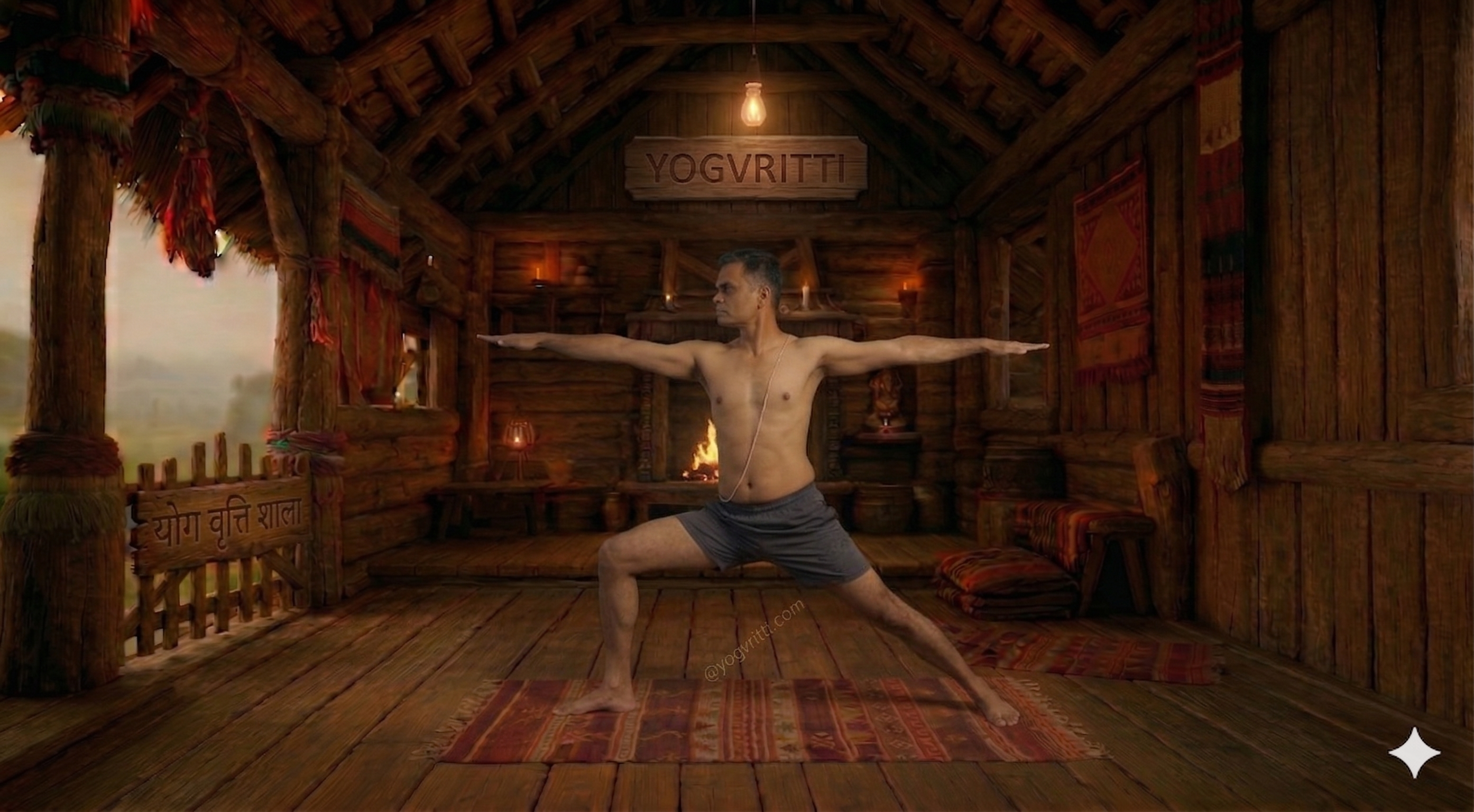
Warrior II is a foundational standing posture that deeply roots the lower body while simultaneously expanding the upper body and spirit. It powerfully engages the entire leg musculature for strength and stability, particularly the quadriceps and glutes, while simultaneously opening the hips and broadening the chest. This creates a potent energetic balance, cultivating an unwavering sense of groundedness (Apana Vayu) alongside an expansive, courageous heart (Prana Vayu), making it invaluable for developing both physical and mental resilience. It’s a pose that teaches patience in effort and stillness in action, essential qualities for any yogi, transforming the physical body into a vessel for inner strength and peace.
Warrior II Pose, also called Virabhadrasana II is a classical yoga posture in the Iyengar tradition. From a standing position, the body roots firmly through the feet while the spine extends upward. The posture works to strengthen the quadriceps, activate the glutes and lengthen the hamstrings. Improves balance. Increases endurance. Suitable for beginners and regular practitioners alike, it is an excellent warm-up, particularly beneficial for beginners and athletes. Practitioners with neck pain and knee injury should approach with care or consult a qualified teacher.
Muscles Worked
Quadriceps
[Quadriceps femoris]
The large muscles on the front of your bent thigh are working intensely here to maintain the knee flexion.
Specifically, the rectus femoris, vastus lateralis, medialis, and intermedius contract concentrically to stabilize the knee directly over the ankle.
This sustained engagement builds incredible endurance and power in the legs, cultivating a deep sense of physical stability and a fiery inner resolve, anchoring the body firmly to the earth.
Glutes
[Gluteus maximus, medius, minimus]
Your gluteal muscles, especially the gluteus maximus on the bent leg, are actively engaged to externally rotate the hip and stabilize the pelvis, preventing the knee from collapsing inward.
This deep activation helps create a stable foundation for the spine and torso, allowing you to feel firmly rooted and centered, preventing unnecessary sway in the lower back.
Energetically, this strengthens your connection to the earth, enhancing a feeling of unwavering support and inner strength.
Hamstrings
[Biceps femoris, semitendinosus, semimembranosus]
On the front leg, the hamstrings are engaged in an eccentric contraction, lengthening under tension as the quadriceps work to stabilize the knee.
On the back leg, they are actively strengthening to keep the leg straight and strong, preventing hyperextension.
This balanced engagement across both legs ensures stability and creates a subtle yet profound awareness of the entire posterior chain, fostering a sense of integrated power throughout the lower body and releasing tension stored in the back of the legs.
Adductors
[Adductor magnus, longus, brevis, gracilis, pectineus]
The adductors of the back leg are engaged to keep the leg strong and the inner thigh lifting, preventing the knee from bowing out.
On the front leg, they assist in stabilizing the hip and knee, maintaining the external rotation.
This internal lifting action creates a sense of integration from the inner heel all the way up to the pelvic floor, channeling energy upwards (Udana Vayu) and creating a feeling of lightness and lift within the pose, countering the downward pull of gravity.
Deltoids
[Deltoid anterior, medial, posterior]
The deltoid muscles, particularly the medial deltoid, work to abduct and hold the arms extended horizontally, bringing strength and stability to the shoulders.
This sustained engagement creates a sense of unwavering determination and broadens the chest, symbolizing an open heart and courageous spirit.
The arms become strong channels for energetic extension, allowing you to project your presence outward with confidence.
Core muscles
[Transversus abdominis, obliques, erector spinae]
The deep core muscles, including the transversus abdominis and multifidi, are constantly engaged to stabilize the spine and maintain an upright torso, preventing any slouching or excessive arching.
This internal support creates a stable axis from which the limbs can extend, fostering a sense of inner containment and equilibrium.
It allows the breath to flow freely, bringing a feeling of calm strength to the center of your being, supporting the upward flow of Prana.
Joints Mobilized
Knee Joint (front leg)
weight bearingThe front knee joint (tibiofemoral joint) is deeply flexed and bearing significant weight, requiring conscious alignment to protect the ligaments and menisci.
Ensuring the knee tracks directly over the ankle and in line with the second toe prevents undue strain and strengthens the surrounding musculature.
This mindful engagement teaches proprioception and stability, translating to greater confidence and ease in everyday movements and preventing future knee issues, fostering intelligent awareness in the body.
Hip Joints
external rotationThe front hip undergoes significant external rotation and abduction, opening the groin and inner thigh, while the back hip remains relatively neutral or in slight internal rotation.
This asymmetrical action mobilizes the front hip while strengthening the stabilizers of both, creating flexibility and stability simultaneously.
Over time, this practice can alleviate stiffness in the hips, releasing stored emotional tension and fostering a sense of freedom and openness in the pelvic region, promoting the healthy flow of Apana Vayu.
Shoulder Joints
stabilizingThe shoulder joints (glenohumeral joints) are held in abduction and slight external rotation as the arms extend powerfully outwards, parallel to the floor.
The rotator cuff muscles work continuously to stabilize the humerus within the shoulder socket, preventing impingement.
This sustained extension strengthens the shoulder girdle, improving posture and creating a sense of spaciousness across the chest, which can alleviate tension often held in the upper back and neck, inviting a more expansive breath and open heart.
Organ & System Benefits
Lungs and Diaphragm
The broad opening of the chest and the upright torso in Warrior II create optimal space for the lungs to expand fully with each breath.
The diaphragm can move without restriction, encouraging deep, rhythmic breathing, which is vital for oxygenation.
This expansive posture facilitates increased oxygen intake and efficient carbon dioxide release, purifying the blood and invigorating the entire system, while calming the mind through steady, deliberate respiration, supporting Prana Vayu.
Abdominal Organs
While there is no direct compression or strong twist, the gentle internal lift of the core muscles provides a subtle toning effect on the abdominal organs, encouraging healthy peristalsis.
This engagement supports healthy digestion and circulation within the abdominal cavity, preventing stagnation and promoting detoxification.
The stability of the trunk ensures that the vital energy (Samana Vayu) governing digestion and assimilation is balanced and active, contributing to overall well-being.
Nervous System
Holding Warrior II requires sustained focus and physical effort, which grounds the sympathetic nervous system, preventing the 'fight or flight' response from becoming overwhelming.
The challenge of the pose, combined with steady breathing, helps to integrate the body and mind, bringing the practitioner into the present moment and fostering a sense of calm determination, reducing mental chatter (Chitta Vritti).
The expansive nature of the pose, with open chest and extended arms, can evoke feelings of courage and empowerment, directly influencing the vagal tone.
This activation of the parasympathetic nervous system promotes a sense of safety and reduces anxiety, allowing for deeper relaxation even within the effort, and cultivating a steady, unwavering mind that can face challenges with equanimity.
The symmetrical extension of the arms and the grounded foundation of the legs create a sense of balance and integration across both hemispheres of the brain.
This bilateral activation can enhance coordination and body awareness, leading to a profound feeling of being centered and capable, reducing mental scatteredness and promoting mental clarity essential for deeper yogic practices.
Mental & Emotional
Warrior II demands sustained attention and concentration, drawing the mind away from external distractions and inward towards the sensations of the body and breath (Pratyahara).
This intense focus cultivates mental discipline and sharpens the faculty of concentration (Dharana), training the mind to remain steady amidst challenge, a valuable skill both on and off the mat.
The powerful stance and open-hearted gesture of Warrior II can instill a profound sense of self-confidence and courage.
By embodying a posture of strength and resilience, students learn to face physical discomfort with equanimity, which translates into a greater capacity to meet life's challenges with an uplifted spirit and unwavering resolve, embodying the warrior's spirit.
The pose encourages a balance between effort and surrender, teaching us to find stillness within action, even when the muscles are working hard.
This mental equilibrium helps to release attachment to outcomes and cultivate a sense of inner peace, allowing the practitioner to experience the present moment fully without judgment, fostering a deep connection to their inner warrior spirit and resilience.
Because of Its Shape
standing
Standing poses, by their very nature, build strong foundations and cultivate stability in the lower body.
They engage large muscle groups in the legs and core, strengthening bones and connective tissues through sustained weight-bearing, which is crucial for bone density.
This grounding action helps to stabilize Apana Vayu, fostering a deep sense of security and presence, reducing restlessness and bringing the awareness firmly into the physical body.
The expansive nature of Warrior II, with open hips and a broad chest, actively counteracts the effects of prolonged sitting and sedentary lifestyles.
It gently stretches the inner thighs and groins while strengthening the outer hips, improving overall hip mobility and releasing physical and energetic blockages in the pelvic region.
This opening allows for a freer flow of Prana throughout the lower chakras, promoting emotional release and creative energy.
The upright posture and extended arms promote spinal lengthening and chest opening, which directly improves respiratory capacity and circulation by creating space for the heart and lungs.
Anatomically, this decompresses the vertebral column and enhances oxygen exchange.
Energetically, it cultivates courage, expands the heart chakra, and fosters an expansive outlook on life, helping to release emotional constriction and build confidence.
Fascial Lines
In Warrior II, the superficial back line of fascia along the back leg is lengthened and strengthened, while the front leg engages the superficial front line.
Crucially, the spiral lines that wrap around the torso and legs are deeply engaged and stretched, particularly in the outer hip and inner thigh of the front leg, as well as the lateral line extending through the arms.
This integrated fascial engagement helps to release chronic tension patterns, improving overall mobility and creating a sense of integrated strength throughout the body, allowing Prana to flow more freely through these interconnected pathways and enhancing the body's natural resilience.
Breathing & Respiratory
Warrior II naturally encourages a deep, expansive breath due to the open chest and upright torso, which removes physical constrictions to the respiratory system.
The stable base of the legs allows the diaphragm to descend fully on the inhalation, drawing fresh prana deep into the lungs, and to ascend completely on the exhalation, releasing stale air and tension from the body.
This steady, rhythmic breath (Ujjayi pranayama) can be cultivated within the pose, further calming the nervous system and deepening concentration, turning the physical effort into a moving meditation and enhancing vital energy.
Anatomical Caution
Always remind students to keep the front knee tracking directly over the ankle and in line with the second toe to protect the knee joint from strain and prevent injury to ligaments.
If a student experiences any sharp pain in the knee, hip, or lower back, encourage them to reduce the depth of the lunge or straighten the front leg slightly.
Pay attention to the lower back; encourage a gentle lift of the lower ribs to prevent excessive arching and maintain spinal integrity.