8
Muscles
4
Joints
3
Organs
3
Mental
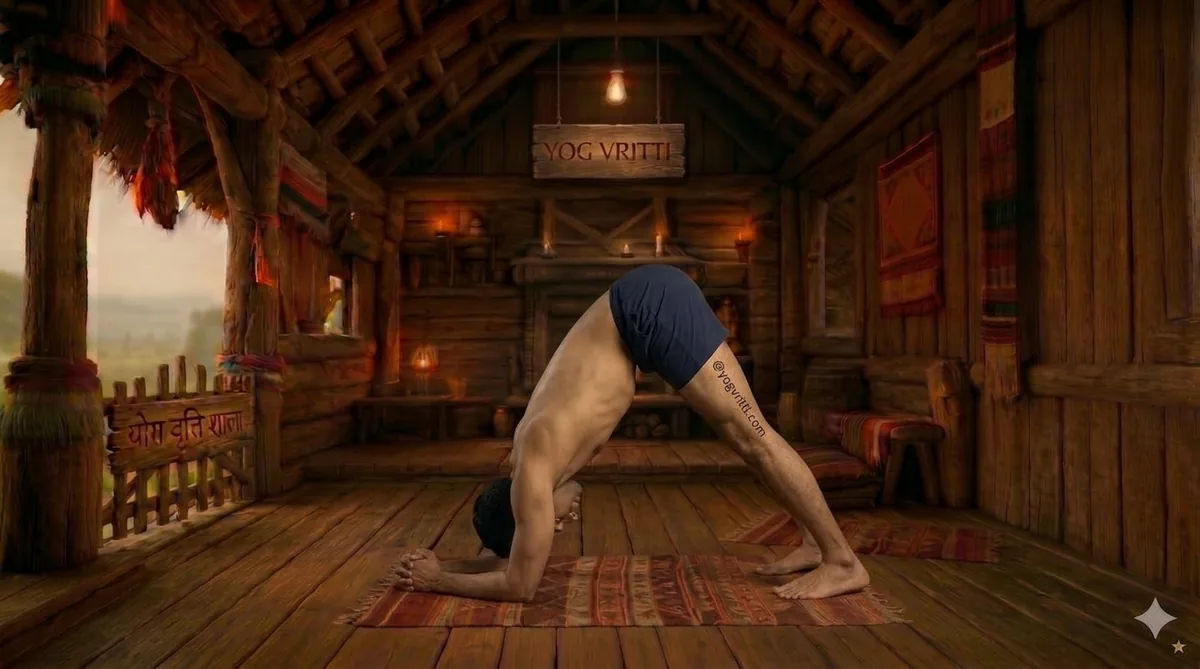
Adho Mukha Svanasana (on forearms)
अधो मुख श्वानासन (संस्थित)
The fundamental shift in Adho Mukha Svanasana (on forearms) lies in grounding through the entire forearm rather than the palms, creating a shorter lever and directly alleviating pressure on the wrists. This adaptation allows students with wrist sensitivities to access the profound benefits of the pose, while simultaneously intensifying the stretch and engagement in the shoulder girdle. It's a powerful way to explore deeper shoulder mobility and build robust upper body stability. Adho Mukha Svanasana, or Downward-Facing Dog, is a foundational pose that masterfully integrates strength, length, and profound introspection. This inverted V-shape creates a continuous lengthening through the entire posterior chain, from the heels to the fingertips, while simultaneously building robust support in the arms and legs. It's a dynamic blend of active extension and stable grounding, fostering spaciousness within the joints and calming the active mind. For a teacher, understanding its therapeutic nuances allows for a deeper transmission of stability, flexibility, and inner quiet, making it accessible and transformative for all students, guiding them towards a more integrated self.
Dolphin Pose, also called Forearm Down Dog is a classical yoga posture. Its Sanskrit name Adho Mukha Svanasana (on forearms) translates word-for-word as: Adho (Downward) · Mukha (Face) · Svana (Dog) · Asana (Pose). In this posture, the body reverses the pull of gravity, bringing the hips or legs above the heart. The posture works to open and strengthen the shoulders, engage the core and lengthen the hamstrings. Stretches the hamstrings and calves. Calms the mind. Suitable for beginners and regular practitioners alike, it is an excellent warm-up, particularly beneficial for beginners and desk workers. Practitioners with pregnancy and hypertension should approach with care or consult a qualified teacher.
What This Variation Changes
Placing the forearms on the mat fundamentally alters the leverage and weight distribution, immediately alleviating direct pressure on the wrists and shifting the load to the elbows and forearms. This shorter lever also changes the angle of the shoulder joint, allowing for a deeper stretch and opening across the entire shoulder girdle and upper back. The grounded forearms create a stable, broad base, encouraging a different quality of lift and spaciousness in the torso.
Muscles Worked
Hamstrings
While still primarily lengthening, the forearms-down position can subtly shift the pelvis higher relative to the shoulders, potentially intensifying the stretch sensation in the hamstrings, particularly near their origin.
This encourages a deeper release in the posterior chain, allowing the hips to lift more freely and further decompressing the lower spine.
The quality of length becomes less about pushing back through the hands and more about drawing the sit bones skyward from a stable forearm foundation.
Deltoids
The deltoids, particularly the posterior and middle heads, move from a primarily stabilizing and supportive role to one that emphasizes deep lengthening and release.
With the forearms grounded, the humerus is encouraged into a more pronounced internal rotation, allowing the shoulder blades to broaden and the upper back to open.
This creates an intense, yet therapeutic, stretch across the shoulder joint, fostering both mobility and a sense of release in this often-restricted area.
Triceps Brachii
In the forearm variation, the triceps brachii shift significantly from their primary role of actively extending the elbow in the root pose.
Here, they engage isometrically to stabilize the elbow joint, pressing the forearms firmly into the earth and preventing collapse.
This sustained, subtle activation builds endurance and proprioceptive awareness around the elbow, offering a different quality of strength compared to the dynamic extension required in the full hand-supported version.
Calves
The calves continue their essential lengthening action, drawing the heels towards the floor to extend through the Achilles tendon and gastrocnemius.
The altered arm position may slightly change the angle of the torso relative to the legs, which can subtly influence the intensity or specific focus of the calf stretch, encouraging a deeper release along the entire posterior lower leg.
This sustained lengthening helps to open the ankle joint and improve flexibility in the lower extremities.
Erector Spinae
The erector spinae muscles remain crucial for lengthening and stabilizing the entire spinal column, from the sacrum to the skull.
In this variation, with the shorter lever and potential for deeper shoulder opening, these muscles are challenged to maintain the natural curves of the spine with increased vigilance, preventing any rounding or excessive arching in the lower back.
Their sustained, subtle engagement fosters spinal integrity and creates spaciousness between the vertebrae.
Rotator Cuff Muscles
Supraspinatus, Infraspinatus, Teres Minor, Subscapularis (collective)
The Rotator Cuff muscles become profoundly active in this variation, working synergistically to stabilize the head of the humerus within the glenoid fossa.
As the shoulders experience an intensified stretch, these deep muscles prevent impingement and ensure healthy articulation, fostering both strength and mobility.
Their precise engagement protects the delicate shoulder joint, allowing for a safe and expansive opening.
Serratus Anterior
Serratus Anterior
The Serratus Anterior plays a critical role in protracting and stabilizing the scapulae against the rib cage, preventing 'winging' and creating a strong foundation for the upper body.
With the forearms grounded, its activation is essential for broadening the upper back and lifting the torso away from the floor, contributing significantly to shoulder girdle stability and preventing undue strain on the neck and upper trapezius.
This engagement empowers the lift and expansion of the chest.
Transversus Abdominis
Transversus Abdominis
The Transversus Abdominis, the deepest abdominal muscle, becomes vitally important for stabilizing the lumbar spine and preventing the lower back from sagging, which can be a common tendency with the shorter arm lever.
Its subtle, drawing-in action supports the core, helping to maintain the integrity of the spinal curves and allowing for a more effective lengthening of the posterior chain.
This deep engagement fosters internal support and energetic lift.
Joints Mobilized
Shoulder Girdle
stabilizingThe complex of joints connecting your arms to your torso (glenohumeral and scapulothoracic joints) are asked to stabilize with intelligent action in Adho Mukha Svanasana.
By pressing firmly through the hands and drawing the shoulder blades down the back, you create a broad, stable foundation, preventing the shoulders from collapsing or 'hanging.' This conscious engagement protects the delicate rotator cuff muscles and cultivates an open, expansive feeling across the chest, inviting freedom into the heart center.
Spine
decompressingThe entire length of your spinal column (vertebral column) receives a profound decompression and lengthening in this pose, especially when the pelvis is tilted anteriorly.
By actively lifting the sitting bones towards the ceiling and drawing the navel gently in, you create traction through the intervertebral discs, alleviating pressure from gravity.
This therapeutic lengthening encourages vital energy to flow freely along the central axis of the body, releasing stiffness and fostering a sense of lightness and fluidity.
Hip Joints
mobilizingThe ball-and-socket joints of your hips (acetabulofemoral joints) are gently mobilized into flexion and external rotation, allowing for a deeper stretch in the hamstrings and inner thighs.
As you lift your sitting bones high and imagine drawing the inner thighs back, you create space and freedom within the hip sockets, improving their range of motion.
This gentle opening releases tension stored in the pelvic region, promoting a sense of ease and allowing the lower body to feel more grounded and integrated.
Ankle Joints
mobilizingYour ankle joints (talocrural joints) receive a significant stretch and mobilization as you press your heels towards the floor, even if they don't touch.
This action gently lengthens the Achilles tendon and calf muscles, improving dorsiflexion and overall ankle mobility.
Greater flexibility in the ankles enhances stability in all standing poses and cultivates a deeper connection to the earth, allowing for a more rooted and balanced foundation in your practice and daily life.
Organ & System Benefits
Abdominal Organs
In Adho Mukha Svanasana, the gentle inversion and mild compression of the abdominal region stimulate the digestive organs.
This position encourages fresh blood flow to the digestive tract after the slight compression, aiding in detoxification and improving metabolic function.
From a yogic perspective, this action helps to balance Samana Vayu, the energy responsible for assimilation, leading to a feeling of inner warmth and improved digestive fire (agni).
Brain
As a mild inversion, Adho Mukha Svanasana gently reverses the flow of gravity to the brain, encouraging increased blood circulation to the head and face.
This fresh oxygenated blood nourishes brain cells, potentially improving cognitive function, memory, and concentration.
The subtle shift in perspective also helps to calm an overactive mind, fostering mental clarity and a quiet space for introspection, akin to a gentle cleansing of the thought patterns.
Lungs
The expansive opening of the chest and the gentle inversion in this pose create optimal conditions for deeper, fuller breathing.
The diaphragm has more space to descend, allowing the lungs to draw in more oxygen and release stale air efficiently.
This enhanced respiratory capacity not only vitalizes the body but also directly influences the nervous system, inviting a sense of calm and promoting the harmonious flow of prana throughout the entire system.
Nervous System
The gentle inversion and sustained nature of Adho Mukha Svanasana naturally invite a sense of calm and quiet into the nervous system.
By bringing the head below the heart, the vagus nerve, a key player in the parasympathetic 'rest and digest' response, is gently stimulated.
This encourages a down-regulation of stress hormones, allowing the practitioner to feel a profound sense of peace and groundedness, effectively taming the fluctuations of the mind (chitta vritti).
While the pose builds strength and engages muscles, the overall effect is one of balancing the sympathetic (fight or flight) and parasympathetic (rest and digest) branches of the nervous system.
The active engagement provides a healthy outlet for pent-up energy, while the sustained stretch and rhythmic breath encourage deep relaxation.
This dynamic equilibrium helps to release chronic tension patterns stored in the body, leading to a more resilient and adaptable nervous system.
Mental & Emotional
The inverted nature of Adho Mukha Svanasana offers a unique opportunity to literally shift one's perspective, both physically and mentally.
Turning the world upside down can help to dislodge rigid thought patterns and offer a fresh outlook on challenges or anxieties.
This subtle mental recalibration fosters a sense of detachment from daily stressors, allowing for greater clarity and a renewed sense of possibility.
Holding Adho Mukha Svanasana requires both physical stability and mental presence, making it an excellent pose for cultivating dharana, or concentration.
The focus on aligning the body, distributing weight evenly, and maintaining a steady breath draws the mind away from external distractions and internal chatter.
This practice of sustained attention strengthens mental discipline, leading to a more centered and unflustered state of being, both on and off the mat.
The combination of physical effort and release in this pose can be deeply cathartic, helping to clear mental clutter and emotional stagnation.
As the body lengthens and opens, there's a corresponding spaciousness created in the mind, allowing for a release of worries or habitual thinking patterns.
This process facilitates pratyahara, the withdrawal of the senses, creating an inner sanctuary where the mind can find true rest and peace.
Because of Its Shape
inversion
As an inversion, Adho Mukha Svanasana reverses the usual gravitational pull on the body, offering a unique form of decompression for the spine and internal organs.
This counteracts the compressive forces of daily upright living, creating space between the vertebrae and allowing for improved circulation throughout the upper body and brain.
From a yogic perspective, it helps to redistribute prana, drawing energy upwards and rejuvenating the entire system.
The head-below-heart position inherently has a calming effect on the nervous system, engaging the parasympathetic response.
This gentle inversion reduces heart rate and blood pressure, quieting the 'fight or flight' response and encouraging a state of deep relaxation and introspection.
It helps to settle chitta vritti, the fluctuations of the mind, bringing a sense of groundedness and inner peace.
By elevating the hips above the heart, blood flow to the brain and upper extremities is gently increased, providing fresh oxygen and nutrients.
This can sharpen mental faculties, improve memory, and alleviate feelings of fatigue or sluggishness.
Energetically, this re-energizes the higher chakras, promoting mental clarity and a brighter, more optimistic outlook.
Fascial Lines
The interconnected web of connective tissue, or fascia, that encases every muscle, bone, and organ in your body receives a comprehensive release and lengthening in Adho Mukha Svanasana.
Specifically, the entire Superficial Back Line, from the soles of the feet to the crown of the head, is gently stretched and hydrated.
This opening helps to unwind chronic tension patterns held deep within the body's matrix, improving overall flexibility and allowing for a more unimpeded flow of prana, releasing energetic blockages that can manifest as physical stiffness.
Breathing & Respiratory
The inverted V-shape of Adho Mukha Svanasana naturally encourages a deep and expansive breath, particularly in the back and side ribs.
With the diaphragm having greater freedom to move downwards due to the abdominal compression, the inhalation can become fuller and the exhalation more complete, releasing stale air from the lower lobes of the lungs.
This pose is an excellent preparation for Ujjayi breath, as the stability and length it cultivates allow for a sustained, oceanic sound, deepening concentration and further calming the nervous system.
Anatomical Caution
While beneficial for wrists, this variation can place increased strain on the neck if the head is allowed to hang passively or is lifted excessively, compromising cervical alignment.
Students must also be mindful of overstretching in the shoulders, particularly if there's a history of impingement, ensuring the shoulder blades broaden and the chest opens rather than collapsing.
Additionally, a tendency to sag in the lower back due to the shorter lever necessitates vigilant core engagement to protect the lumbar spine.