5
Muscles
5
Joints
2
Organs
2
Mental
Adho Mukha Vajrasana
अधो मुख वज्रासन
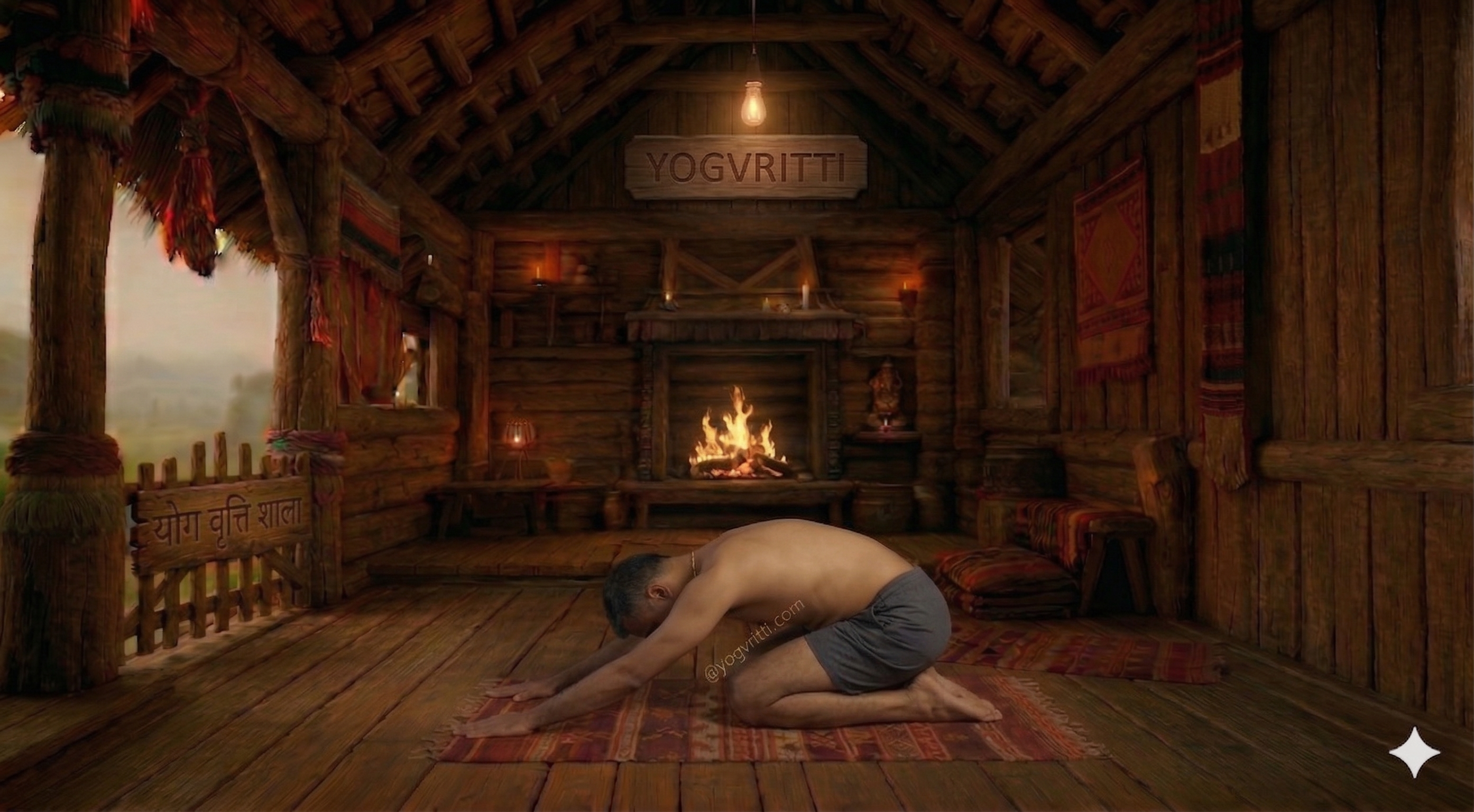
Adho Mukha Vajrasana, or Downward-Facing Thunderbolt Pose, is a profound yet accessible kneeling forward bend that invites deep introspection and release. It gently lengthens the entire posterior chain, from the shoulders and back muscles (erector spinae, latissimus dorsi) down to the hips and gluteals, while providing a soothing compression to the abdominal organs. This pose skillfully combines physical decompression of the spine and shoulders with a profound energetic grounding, calming the nervous system and drawing awareness inward. It is a cornerstone restorative posture, invaluable for releasing accumulated stress and cultivating a sense of surrender and inner quietude.
Downward Facing Thunderbolt Pose, also called Child's Pose on Heels is a classical yoga posture. Its Sanskrit name Adho Mukha Vajrasana translates word-for-word as: Adho (Downward) · Mukha (Face) · Vajra (Thunderbolt) · Asana (Pose). Beginning from a kneeling position, the practitioner aligns the body with precision and intentional breath. The posture works to open and strengthen the shoulders, lengthen the hamstrings and release tension in the hips. Relieves stress and fatigue. Calms the mind. Suitable for beginners and regular practitioners alike, it is a calming cool-down, particularly beneficial for beginners and seniors. A blanket and bolster can be used to make the posture more accessible and support correct alignment. Practitioners with pregnancy and knee injury should approach with care or consult a qualified teacher.
Muscles Worked
Shoulder Girdle Muscles
Trapezius, Rhomboids, Serratus Anterior
The muscles surrounding the shoulder blades and upper back, such as the trapezius and rhomboids, experience a gentle but sustained release as the arms extend forward and the head rests.
This action helps to unwind chronic tension often held in this region from daily activities and stress, allowing the shoulder blades (scapulae) to broaden away from the spine.
Energetically, this release opens the energetic channels (nadis) in the upper back, fostering a sense of lightness and freedom in the chest and heart space.
Regular practice can alleviate stiffness and improve postural alignment in the upper torso.
Broad Back Muscle
Latissimus Dorsi
The large, powerful muscles spanning the width of your back from the armpit to the lower spine (latissimus dorsi) are gently lengthened as you stretch your arms forward.
This creates a subtle traction through the side body, encouraging a sense of expansion in the rib cage.
This lengthening action helps to release any tightness that might restrict arm movement or pull down on the lower back, facilitating deeper, more expansive breathing.
From a yogic perspective, this opening of the side body can help to free the flow of prana, enhancing vitality and ease.
Spinal Erectors
Erector Spinae
The long muscles running parallel to your spine (erector spinae) are gently elongated and decompressed in this forward bend.
As the torso folds over the thighs and the head rests, the natural curves of the spine are respected, allowing these muscles to soften rather than contract.
This release helps to alleviate stiffness and tension accumulated from prolonged sitting or standing, promoting a sense of ease in the entire back body.
Energetically, this action encourages the downward flow of apana vayu, grounding the practitioner and calming the agitated mind.
Gluteal Muscles
Gluteus Maximus, Gluteus Medius
As the hips fold deeply and the buttocks rest towards the heels, the powerful muscles of the buttocks (gluteus maximus and medius) are encouraged to release.
This is not a strong stretch but rather a passive softening, particularly beneficial for those who hold tension in their hips from prolonged sitting or athletic activities.
The gentle compression and release in this area can help to unlock stagnant energy in the pelvic region, promoting a sense of openness and stability in the foundation of the pose.
This can lead to a feeling of greater ease in the entire lower body.
Hamstrings
Biceps Femoris, Semitendinosus, Semimembranosus
While not a primary hamstring stretch, the deep flexion of the hip joints in Adho Mukha Vajrasana allows the muscles at the back of the thighs (hamstrings) to passively release.
The absence of active engagement encourages these often-tight muscles to soften, particularly if the hips are well-supported on a bolster.
This subtle release contributes to a feeling of overall relaxation in the lower body, reducing any residual pull on the pelvis and lower back.
In yogic terms, this helps to settle the lower chakras, promoting a sense of security and rootedness.
Joints Mobilized
Shoulder Joint
decompressingThe shoulder joint (glenohumeral joint) experiences a gentle traction as the arms extend forward, especially if the hands are actively reaching.
This subtle pull helps to decompress the joint space, alleviating any stiffness or impingement.
This action, combined with the support of the props, allows for a release of tension around the rotator cuff muscles, promoting greater mobility and ease in the shoulders.
Over time, this can restore a sense of spaciousness and freedom in the upper extremities.
Spine (Vertebral Joints)
decompressingThe entire spinal column, from the neck to the tailbone, undergoes a gentle decompression and lengthening in this forward fold.
As the torso rests and the head is supported, gravity assists in creating space between the individual vertebrae (intervertebral joints).
This mild traction can alleviate pressure on the spinal discs and nerves, reducing back stiffness and promoting spinal health.
From a yogic perspective, a healthy, decompressed spine allows for the unimpeded flow of prana up and down the central energy channel (sushumna nadi), fostering vitality and mental clarity.
Hip Joint
mobilizingThe hip joints (acetabulofemoral joints) are deeply flexed in Adho Mukha Vajrasana, promoting mobility in the anterior hip capsule.
The passive nature of the pose, especially with bolster support, allows for a gentle release of tension in the hip flexors and surrounding musculature.
This sustained flexion, while not a dynamic movement, helps to maintain the full range of motion in the hips, crucial for overall lower body health and agility.
Energetically, this pose can help to release stored emotional tension often held in the hips, leading to a feeling of greater emotional freedom.
Knee Joint
weight bearingThe knee joints (tibiofemoral joints) are deeply flexed and bear the body's weight, though much of it is distributed through the hips and supported by the bolster.
The blanket under the knees provides cushioning, protecting the delicate structures of the kneecaps (patella) and menisci.
While the knees are in a state of deep flexion, the pose is static and restorative, allowing for a gentle stretch of the joint capsule and surrounding ligaments.
This can improve circulation around the knees and maintain their flexibility, provided there is no existing injury.
Ankle Joint
mobilizingThe ankle joints (talocrural joints) are in a position of deep plantarflexion, meaning the tops of the feet are stretched and the heels are drawn towards the buttocks.
This provides a gentle mobilization for the ankles and feet, stretching the anterior ankle ligaments and muscles.
This action helps to counteract the stiffness often experienced from wearing restrictive footwear or prolonged standing.
From a yogic standpoint, promoting circulation and flexibility in the feet connects us more deeply to the earth, enhancing grounding and stability.
Organ & System Benefits
Abdominal Organs (Digestive System)
As the torso rests gently on the thighs, the abdominal organs, including the stomach, intestines, and liver, receive a soft, internal compression.
This gentle pressure, combined with the rhythmic diaphragmatic breathing, acts like a mild internal massage.
This can stimulate peristalsis, aiding digestion and elimination, and promoting healthy organ function.
From a yogic perspective, this compression can help to balance Samana Vayu, the energy responsible for assimilation and digestion, leading to a feeling of inner harmony and well-being.
Lungs and Diaphragm
In this forward bend, the front of the torso is gently compressed, encouraging a more expansive breath into the back and sides of the rib cage.
The diaphragm, the primary muscle of respiration, has greater space to descend into the abdominal cavity, promoting deeper, more efficient breathing.
This enhanced diaphragmatic movement improves lung capacity and oxygenation.
Energetically, this deep, quiet breathing calms the nervous system, allowing prana to flow more smoothly throughout the body, fostering a profound sense of peace.
Nervous System
Adho Mukha Vajrasana is a powerful catalyst for shifting the nervous system from a state of 'fight or flight' (sympathetic dominance) to 'rest and digest' (parasympathetic dominance).
As the body folds forward and the head is supported, sensory input is reduced, and the breath naturally deepens and slows.
This directly signals the vagus nerve to activate the parasympathetic response, leading to a profound sense of calm and release of stress.
The practitioner feels a deep sense of security and groundedness, allowing the mind to quiet and chronic tension to melt away from the body.
The sustained, gentle pressure of the torso on the thighs, combined with the support of props, creates a feeling of being held and nurtured.
This tactile feedback, along with the inward focus, helps to calm the 'chitta vritti' – the fluctuations of the mind – reducing anxiety and mental chatter.
This allows for a deeper state of introspection and self-awareness, where the practitioner can connect with their inner stillness.
Regularly practicing this pose can build resilience against daily stressors, promoting emotional balance and mental clarity.
Mental & Emotional
The very act of folding forward and resting the forehead on the earth or a prop cultivates a profound sense of surrender and humility.
This physical posture encourages a release of mental control and the need to 'do,' inviting the mind to simply 'be.' It's an opportunity for pratyahara, withdrawal of the senses, allowing the practitioner to turn their attention inward, away from external distractions.
This practice helps to quiet the incessant mental loops, fostering a state of inner peace and acceptance.
Adho Mukha Vajrasana is a potent antidote to stress and mental fatigue, offering a sanctuary for the mind to decompress.
By intentionally creating a quiet, contained space for the body, the pose facilitates a 'reset' for the brain, enhancing clarity and focus.
The act of resting and allowing can help to reframe perspectives, moving away from rigid thinking towards a more fluid and compassionate outlook.
For teachers, understanding this deep mental release allows them to guide students towards true mental restoration, beyond just physical relaxation.
Because of Its Shape
forward bend
Forward bends, like Adho Mukha Vajrasana, are inherently grounding and introspective postures.
By bringing the head below the heart and folding the torso over the lower body, the flow of energy (prana) is directed inward and downward, fostering a sense of stability and centeredness.
Anatomically, this action decompresses the spine and stretches the entire posterior chain, releasing physical tension.
Energetically, it calms the nervous system, helping to quiet the mind and prepare it for deeper states of meditation.
This particular forward bend offers a unique blend of gentle compression and expansion.
The front body is softly compressed, stimulating the abdominal organs, while the back body expands with each breath, creating space in the spine and rib cage.
This dual action promotes both physical release and energetic balance.
From a yogic perspective, it encourages a balance between apana vayu (downward energy) and prana vayu (upward energy), leading to a feeling of holistic well-being and integration.
Fascial Lines
Adho Mukha Vajrasana primarily influences the superficial back line of fascia, which runs from the soles of the feet, up the back of the legs, spine, and over the head to the eyebrows.
As the body folds forward and the arms extend, this entire fascial chain receives a gentle, sustained lengthening and release.
Additionally, the arm lines (superficial and deep) are stretched as the arms reach.
This unwinding of the fascial web helps to release chronic stiffness and 'stuck' patterns, improving overall bodily fluidity and reducing restrictions to movement.
From a yogic perspective, releasing fascial tension is akin to clearing energetic blockages, allowing prana to flow more freely and enhancing the body's innate healing capacity.
Breathing & Respiratory
In Adho Mukha Vajrasana, the forward-folding shape naturally encourages a deeper, more expansive breath into the posterior and lateral aspects of the rib cage.
With the abdomen gently compressed against the thighs, the diaphragmatic breath becomes more pronounced, pushing outward into the back and sides.
This promotes a longer, more complete exhalation, which is crucial for activating the parasympathetic nervous system and releasing tension.
This pose is an excellent preparation for restorative pranayama practices like Ujjayi breath or a simple natural breath awareness, as it naturally calms the mind and deepens the respiratory rhythm, fostering a sense of inner quietude and presence.
Anatomical Caution
Teachers should guide students to approach this pose with care if they have any knee or ankle sensitivities.
Ensure a folded blanket is placed under the knees for cushioning, and if deep ankle plantarflexion is uncomfortable, students can place a rolled towel under the ankles or even sit on a block between the feet.
For shoulder discomfort, advise students to keep the arms relaxed or adjust the reach to avoid strain.
The goal is comfort and release, not force.