Benefits· लाभ
What Handstand II does for you
Adho Mukha Vrksasana II · अधो मुख वृक्षासन II
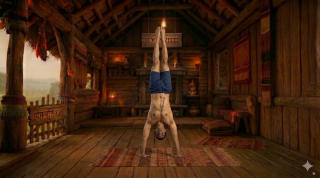
Adho Mukha Vrksasana II introduces a dynamic element of hip opening into the established strength of Handstand. By consciously separating the legs or adopting a modified leg position, this variation invites a deeper exploration of inner thigh mobility, transforming the pose from a purely vertical alignment challenge into a more expansive expression of energetic freedom and balance.
What this version changes: The wall continues to serve as an invaluable tool for establishing foundational stability and alignment in this variation, particularly for the shoulders and core, much like in the root pose. However, with the conscious opening of the legs, the practitioner learns to integrate this external support while simultaneously cultivating internal balance against the altered leverage of the splayed legs. The wall can specifically guide the hips to remain level and prevent excessive rotation as the inner thighs release, offering a tangible reference for maintaining spinal integrity amidst the dynamic leg action.
Muscles
- Shoulder Musclesstabilises
- Back of Upper Armsstrengthens
- Serratus Anteriorstabilises
- Deep Core Stabilizersstabilises
- Forearm Musclesstrengthens
Joints
- Shoulder Girdlestabilises
- Elbowsstabilises
- Wristsstabilises
- Spinedecompressing
Inside the body
- Brain
- Heart
- Abdominal Organs
- Breathing
Mind
Handstand is a potent builder of self-confidence and courage, as it requires overcoming primal fears of falling and being upside down.
Take care
Teachers must emphasize meticulous preparation and careful spotting for Handstand, especially for students with known wrist, shoulder, neck injuries, or uncontrolled high blood pressure.
Gradual progression through preparatory poses like Pincha Mayurasana and practicing near a wall are crucial to build strength and confidence safely. Always encourage students to listen deeply to their body's signals and respect its limits, ensuring their safety and well-being above all.
Muscles
Shoulder Muscles
StabilisesWith the legs actively opening or adopting a tree-like shape, the leverage on the trunk shifts, demanding a more nuanced and active stabilization from the entire shoulder girdle.
Read moreShow less
The deltoids, rotator cuff, and other shoulder stabilizers must work with greater precision to counteract lateral sway and maintain the integrity of the stacked alignment from wrists to shoulders.
This requires not just strength, but also a heightened proprioceptive awareness to micro-adjust against the altered distribution of weight above the base.
Back of Upper Arms
StrengthensTriceps Brachii
The triceps, located on the back of your upper arms, are intensely active, working to fully extend and maintain a strong, straight line from your wrists to your shoulders.
Read moreShow less
This sustained isometric contraction is crucial for pushing the floor away and creating lift, preventing the elbows from buckling.
This active engagement creates a feeling of unwavering support and a direct channel of energy flowing from the earth through your arms, grounding you even as you invert.
Serratus Anterior
StabilisesSerratus Anterior
These 'saw-like' muscles along the side of your ribs, beneath your armpits, are vital for protracting and upwardly rotating the shoulder blades, keeping them flat against your back.
Read moreShow less
This action prevents the shoulder blades from 'winging' and provides a stable platform for the arms, ensuring optimal shoulder health and powerful pushing.
Activating the serratus anterior creates a broadness across the upper back and chest, symbolizing an opening of the heart space and a sense of protective strength.
Deep Core Stabilizers
StabilisesThe act of separating the legs or moving them into a specific shape in Adho Mukha Vrksasana II significantly alters the body's center of gravity and leverage on the pelvis.
Read moreShow less
Consequently, the deep core stabilizers, including the transversus abdominis and multifidus, must engage with heightened intensity and sophistication to prevent any compensatory arching or rounding of the lumbar spine.
This variation demands a more intricate and sustained engagement to maintain a stable, neutral pelvis, creating a solid foundation for the inverted legs and spine.
Forearm Muscles
StrengthensFlexor and Extensor Muscles of the Forearm
The muscles in your forearms, both on the palm side (flexors) and back side (extensors), are constantly active, gripping the floor with intelligent sensitivity and distributing weight evenly through your hands and wrists.
Read moreShow less
This intricate engagement creates a stable and responsive foundation, allowing for subtle adjustments in balance.
This intelligent rooting through the hands connects you deeply to the earth, channeling its steady energy upward and cultivating a finely tuned awareness (pratyahara) in your foundation.
Hip Adductors
StretchesAdductor longus, brevis, magnus, pectineus, gracilis
In this variation, the conscious opening of the inner thighs, whether into a wide split or a more subtle tree-like shape, specifically targets the hip adductor muscle group for lengthening.
Read moreShow less
While in a standard handstand these muscles might subtly engage to keep the legs together, here they are actively challenged to release and extend.
This creates a profound opening in the groin and inner thighs, enhancing flexibility and energetic release in the lower body, which is a distinct focus from the root pose.
Joints
Shoulder Girdle
StabilisesThe complex shoulder girdle, comprising the glenohumeral (shoulder ball-and-socket) and scapulothoracic (shoulder blade-rib cage) joints, becomes a primary weight-bearing structure.
Read moreShow less
Precise muscular engagement is required to stack the bones vertically, creating a stable column from the hands to the hips and protecting the delicate rotator cuff tendons.
This alignment cultivates a sense of unwavering support and spaciousness, allowing the energy of the heart center to expand without constriction.
Elbows
StabilisesThe elbow joints must be fully extended but not locked, maintaining a strong, straight line that acts as a pillar of support for the body.
Read moreShow less
This active extension prevents hyperextension and ensures the weight is transferred efficiently through the bones, rather than collapsing into the joint.
This unwavering stability in the elbows symbolizes a direct, clear channel of energy, preventing energetic leakage and fostering a feeling of steadfastness throughout the pose.
Wrists
StabilisesThe wrist joints bear significant weight, requiring strength and intelligent distribution of pressure through the palms and fingers.
Read moreShow less
Active engagement of the forearm muscles protects the carpal bones and ligaments, preventing compression and allowing for subtle micro-adjustments in balance.
This intelligent connection to the earth through the wrists cultivates a deep sense of grounding and sensitivity, allowing the practitioner to feel subtle shifts in weight and respond with immediate presence.
Spine
DecompressingWhile core muscles work intensely to stabilize the trunk, the inverted nature of Handstand gently reverses the usual gravitational compression on the spinal discs and vertebrae.
Read moreShow less
This creates subtle traction and space along the spinal column, promoting hydration of the discs and potentially alleviating chronic back tension.
Energetically, this lengthening of the central axis (sushumna nadi) facilitates the upward flow of prana, bringing a sense of lightness and freedom to the core.
Inside the body
Brain
Inversions like Handstand significantly increase blood flow to the brain, providing a fresh supply of oxygen and nutrients while aiding venous return.
Read moreShow less
This enhanced circulation revitalizes brain cells, which can sharpen mental acuity, improve memory, and promote a sense of clarity and alertness.
From a yogic perspective, this increased cerebral blood flow awakens the higher centers of consciousness, promoting a state of sattvic (pure) awareness and quietening the fluctuations of the mind (chitta vritti).
Heart
The inverted posture reduces the heart's workload by assisting venous return from the lower extremities, as gravity now helps rather than hinders blood flow back to the heart.
Read moreShow less
This gentle decompression and reduced effort can calm the cardiovascular system, making the heart's pumping more efficient.
Energetically, this easing of the heart's physical burden can translate into a feeling of emotional lightness and inner peace, reducing the burden of anxiety and stress.
Abdominal Organs
Handstand gently repositions the abdominal organs, reversing the usual downward pull of gravity and promoting lymphatic drainage and fresh blood flow upon return to an upright position.
Read moreShow less
This 'internal massage' can stimulate sluggish digestive and reproductive organs, aiding detoxification and improving their function.
Yogically, this rebalancing of the abdominal region helps to regulate apana vayu, the downward-moving energy, creating a sense of inner cleansing and vitality in the lower body.
Breathing
In Handstand, the inverted position shifts the diaphragm's resting place and the weight of the abdominal organs, naturally encouraging a more focused and controlled breath.
Read moreShow less
Initially, the breath may feel more constricted in the upper chest, but with practice and core stability, it can deepen into the diaphragm, providing a stable foundation for the pose.
The challenge of the posture demands conscious regulation of the breath, transforming it into a powerful tool for stability, focus, and maintaining internal heat (tapas), allowing the practitioner to sustain the posture with greater ease and presence.
Ujjayi breath is particularly beneficial here, as its gentle constriction helps to regulate energy and quiet the mind.
Fascia (connective tissue)
In Handstand, the entire Superficial Back Line of fascia, which runs from the soles of the feet up the back of the legs, spine, and neck, is actively engaged and lengthened to create a unified, lifted line.
Read moreShow less
Simultaneously, the Superficial Front Line is also engaged, particularly through the core and front of the body, to prevent collapse and create anterior stability.
This integrated engagement of fascial lines creates a feeling of being 'zipped up' and unified from hands to feet, allowing for efficient force transmission.
Mind and nervous system
- Nervous system
The intense focus and concentration required to balance in Handstand demand a profound quieting of external distractions and internal chatter.
Read moreShow less
This forced absorption in the present moment acts as a powerful form of pratyahara, drawing the senses inward and shifting the nervous system away from a reactive state.
The sustained effort and focused breath naturally encourage a parasympathetic response, leading to a profound sense of calm and mental clarity after the initial exertion.
By challenging the body in an unfamiliar orientation, Handstand engages the vestibular system—our internal sense of balance—and requires constant, subtle adjustments.
Read moreShow less
This heightened proprioceptive awareness, coupled with the reversal of blood flow, can reset the body's stress response mechanisms.
The courage to face and overcome the fear of inversion builds resilience, signaling to the nervous system that it is safe to be vulnerable, thereby reducing overall anxiety levels and promoting a sense of inner strength.
- Mind & mood
Handstand is a potent builder of self-confidence and courage, as it requires overcoming primal fears of falling and being upside down.
Read moreShow less
Each successful lift, no matter how brief, reinforces a belief in one's own capabilities, translating into greater resilience and an ability to face challenges both on and off the mat.
This mastery over fear cultivates a strong, unwavering inner spirit.
The literal act of turning your world upside down offers a profound shift in perspective, challenging habitual ways of seeing and thinking.
Read moreShow less
This physical reorientation often inspires a mental one, allowing practitioners to approach problems with fresh eyes, break free from rigid thought patterns, and gain new insights.
It encourages a playful curiosity and a willingness to explore the unknown.
The precise alignment and intense focus necessary for balancing in Handstand cultivate single-pointed concentration (dharana) like few other poses.
Read moreShow less
The mind must be fully absorbed in the present moment, coordinating subtle muscular actions and breath, leaving no room for distraction or mental wandering.
This heightened state of awareness trains the mind to be steady and present, a foundational step towards deeper meditative states.
Because it is a inversion pose
Inversions reverse the pull of gravity on the body, aiding venous return from the lower extremities and increasing blood flow to the brain and upper body.
Read moreShow less
This fresh, oxygenated blood revitalizes cells and tissues throughout the head, neck, and upper torso.
Yogically, this redirection of prana (vital life force) stimulates the higher chakras, enhancing mental clarity, intuition, and a sense of energetic upliftment.
The inverted position gently decompresses the spine, creating subtle space between the vertebrae and relieving the constant downward compression from gravity.
Read moreShow less
This can alleviate lower back pain, improve spinal flexibility, and promote the health of intervertebral discs.
Energetically, this lengthening of the central axis (sushumna nadi) facilitates the unobstructed flow of energy, bringing a sense of lightness and freedom to the entire body.
By literally turning the world upside down, inversions offer a unique psychological shift in perspective, challenging our habitual relationship with gravity and the earth.
Read moreShow less
This physical reorientation can lead to a profound mental shift, fostering courage, confidence, and a renewed sense of possibility.
It encourages us to look at life's challenges from a different angle, promoting creative problem-solving and a sense of inner liberation.