9
Muscles
4
Joints
2
Organs
2
Mental
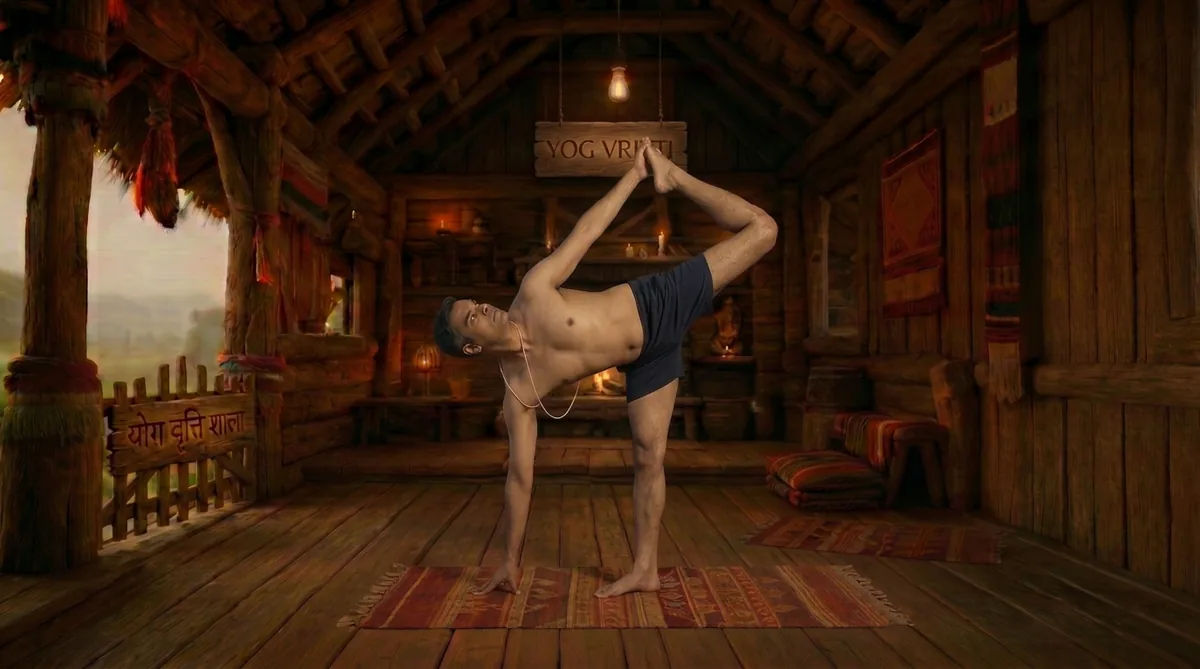
Ardha Chandrasana Chapasana
अर्ध चंद्रासन चापासन
This variation deepens the experience by transforming the expansive side-body opening into a dynamic backbend and profound shoulder stretch. It introduces the challenge of bending the lifted leg to grasp the foot, which shifts the energetic focus from horizontal expansion to vertical ascension and heart-opening. This modification not only intensifies the balance but also cultivates a greater sense of freedom and courage in the practitioner. Ardha Chandrasana, the Half Moon Pose, is a profound standing balance that integrates strength, flexibility, and refined awareness. It dynamically strengthens the entire lower limb chain, from the arch of the foot to the glutes, while simultaneously opening the hips and chest. Energetically, it cultivates a sense of lightness and expansion, lifting the prana upwards while rooting the standing leg firmly to the earth. For any teacher, understanding this pose deeply allows for precise instruction that balances effort and surrender, guiding students towards physical stability and mental clarity.
Sugar Cane Pose, also called Half Moon Bow Pose is a classical yoga posture. Its Sanskrit name Ardha Chandrasana Chapasana translates word-for-word as: Ardha (Half) · Chandra (Moon) · Asana (Pose). From a standing position, the body roots firmly through the feet while the spine extends upward. The posture works to lengthen the hamstrings, activate the glutes and strengthen the quadriceps. Strengthens the legs, core, and shoulders. Increases flexibility in the spine and hips. It is particularly valued for building full-body strength and developing greater flexibility. Suitable for advanced practitioners with developed body awareness, it is a meaningful addition to any practice, particularly beneficial for athletes. A block and wall can be used to make the posture more accessible and support correct alignment. Practitioners with low blood pressure and migraine should approach with care or consult a qualified teacher.
Helps with
What This Variation Changes
The block, while still valuable for establishing height and stability for the standing hand, now primarily serves as a grounding point to allow for the increased challenge of the backbend and leg grab. The wall continues to offer external support for balance, enabling the practitioner to explore the deeper backbend and shoulder opening without the immediate concern of falling, fostering confidence and allowing for greater freedom in the posture.
Muscles Worked
Hamstrings
In the root pose, the hamstrings of the lifted leg primarily work eccentrically to lengthen and support a straight leg, or concentrically for subtle knee flexion.
In Chapasana, the hamstrings of the lifted leg concentrically contract to powerfully flex the knee, drawing the heel towards the glute, while simultaneously undergoing a profound stretch as the hand pulls the foot upwards.
This dual demand on strength and flexibility creates a deep release through the quadriceps and hip flexors.
Quadriceps
While the standing leg quadriceps remain actively engaged for knee extension and stability, the quadriceps of the lifted leg transition from active engagement to a profound, dynamic lengthening.
As the heel is drawn towards the glute, these muscles are intensely stretched, requiring controlled release and surrender to deepen the backbend.
This creates a significant opening across the front of the thigh and hip.
Glutes
In the root, the glutes primarily extend and externally rotate the hip to lift and open the leg.
In Chapasana, they continue this work with added emphasis on creating deeper hip extension and potentially greater external rotation in the lifted leg.
This action allows for the leg to be drawn higher and further back, facilitating the backbend and providing the necessary space for the hand to grasp the foot, thus deepening both hip mobility and power.
Core muscles
While always vital for stability, in Chapasana, the core muscles (transversus abdominis, obliques, rectus abdominis) must work with even greater intensity to stabilize the lumbar spine against the increased forces of the backbend and the pulling action on the lifted leg.
They act as the central anchor, preventing excessive arching and maintaining the integrity of the spinal curve, allowing for a safe and supported backbend while keeping the front body expansive.
Spinal Erectors
In the root pose, these muscles work to maintain a long, relatively neutral spine with a subtle lift.
In Chapasana, their engagement intensifies significantly as they actively initiate and deepen the backbend, extending the thoracic and lumbar spine.
This creates a more pronounced upward and backward arch, requiring sustained strength and precise control to protect the lower back while fostering a profound opening across the chest and abdomen.
Deltoids
Deltoideus
The deltoids, particularly the anterior and middle fibers, are actively engaged in lifting and stabilizing the arm as it reaches back to grasp the foot.
This requires isometric strength to hold the arm in flexion and abduction against gravity, while also facilitating the external rotation necessary for the hand to find its grip.
They contribute significantly to the expansive quality of the shoulder opening in this posture.
Rotator Cuff Muscles (Infraspinatus, Teres Minor)
Infraspinatus, Teres Minor
These muscles are crucial for the external rotation of the humerus, which is essential for the hand to reach back and grasp the foot comfortably and safely.
They work synergistically with the deltoids to stabilize the shoulder joint in this externally rotated and extended position, preventing impingement and allowing for a deeper, more controlled opening of the chest and heart space.
Psoas Major
Psoas Major
While the psoas is active in the root for hip flexion, in Chapasana, it becomes a key player in deepening the backbend from the front of the body.
It concentrically contracts to contribute to hip extension and further lift the thigh, while simultaneously being stretched as the leg is pulled back and up.
This dual action helps to create a deeper arch in the lumbar spine and open the front of the hip.
Rhomboids
Rhomboideus Major & Minor
The rhomboids work to retract and stabilize the scapula as the arm reaches back and the chest opens.
This action helps to draw the shoulder blades towards the spine, creating a broadness across the upper back and facilitating a deeper and safer shoulder opening.
They support the integrity of the shoulder girdle, allowing for greater freedom in the upper body's expansive actions.
Joints Mobilized
Hip Joint
mobilizingThe standing hip joint (coxal joint) is the pivot point for the entire pose, requiring significant stability while simultaneously allowing for abduction and external rotation of the lifted leg.
This dynamic engagement strengthens the surrounding musculature, improving overall hip health and range of motion.
For the yogi, this opening in the hip area releases stored emotional tension and promotes a sense of freedom and mobility in the pelvis, which is often a repository of stress.
Knee Joint
stabilizingThe standing knee joint (tibiofemoral joint) requires precise alignment and muscular engagement to prevent hyperextension or collapse, bearing the full weight of the body.
Proper engagement of the quadriceps and hamstrings ensures the knee is strong and protected, promoting joint longevity.
This focused awareness on the knee fosters a sense of grounded stability, preventing the mind from wavering and bringing a conscious presence to the foundation of the pose, mirroring mental steadfastness.
Ankle Joint
stabilizingThe standing ankle joint (talocrural joint) and the intrinsic muscles of the foot work intensely to maintain balance and distribute weight evenly, making subtle adjustments throughout the pose.
This continuous micro-adjustment strengthens the ligaments and muscles around the ankle, enhancing proprioception.
This deep connection to the earth through the foot cultivates a powerful sense of rooting and steadiness, allowing the practitioner to feel deeply connected to the ground, no matter how challenging the balance becomes.
Spine
decompressingThe entire spine, particularly the lumbar and thoracic regions, is lengthened and subtly rotated in Ardha Chandrasana, creating space between the vertebrae.
This gentle decompression helps alleviate lower back compression and encourages better postural alignment.
This spinal extension allows for an unobstructed flow of vital energy (prana) through the central nervous system, bringing a sense of lightness and clarity to the mind and body, enhancing overall vitality.
Organ & System Benefits
Abdominal Organs
The gentle lateral opening and mild compression on one side of the abdomen, coupled with expansion on the other, provides a subtle massage to the digestive organs (stomach, intestines).
This action can stimulate peristalsis and improve circulation to these areas, aiding digestion and elimination.
From a yogic perspective, this cleansing action in the abdominal region helps to stoke agni, the digestive fire, leading to better assimilation of nutrients and a feeling of lightness and inner cleanliness.
Heart and Lungs
The expansive opening of the chest in Ardha Chandrasana creates more space for the lungs to fully inflate, encouraging deeper and fuller breathing.
This expansion also gently stimulates the heart, improving circulation and oxygenation throughout the body.
This chest opening is deeply connected to anahata chakra, fostering feelings of courage, compassion, and emotional openness, allowing the practitioner to breathe more freely both physically and emotionally.
Nervous System
The inherent challenge of balancing on one leg in Ardha Chandrasana demands acute focus and proprioceptive awareness, which can be profoundly calming for the nervous system.
As the mind concentrates on alignment and subtle shifts in weight, it draws attention away from external distractions and internal anxieties.
This sustained internal focus helps to quiet the 'chitta vritti' (mind fluctuations), leading to a state of mental stillness and reduced sympathetic nervous system activity, fostering a deep sense of presence and peace.
The sustained effort and precise muscular engagement required in this pose trains the neuromuscular pathways, enhancing coordination and body mapping in the brain.
This heightened communication between the brain and muscles refines motor control and balance, reducing the likelihood of falls and improving overall agility.
From a yogic perspective, this sharpens the senses (indriyas) and directs prana with intention, leading to a more integrated and harmonious mind-body connection.
Mental & Emotional
Ardha Chandrasana profoundly cultivates mental concentration and unwavering focus (dharana) as the practitioner must maintain a steady gaze and internal awareness to hold the balance.
This intense mental engagement acts as a potent anchor for the mind, drawing it away from external distractions and internal chatter.
The ability to maintain stability amidst physical challenge translates into greater mental resilience and the capacity to stay present and calm in life's unpredictable moments.
Successfully holding Ardha Chandrasana instills a profound sense of self-confidence and courage, as it challenges both physical and mental limitations.
The act of expanding and opening in such a vulnerable, unsupported position can be empowering, shifting one's perception of capability.
This physical courage reflects a deeper psychological shift, helping to overcome fear and cultivate an inner strength that extends beyond the mat, fostering a more expansive and optimistic outlook on life.
Because of Its Shape
balance
As a primary balancing pose, Ardha Chandrasana significantly enhances proprioception, the body's ability to sense its position and movement in space, by challenging the inner ear (vestibular system) and sensory receptors in the joints and muscles.
This continuous feedback loop refines neuromuscular coordination and strengthens the stabilizing muscles throughout the body.
Yogically, balancing poses teach us to find stillness amidst movement, cultivating mental equanimity and the ability to find our center even when external circumstances feel unstable.
The standing nature of Ardha Chandrasana deeply grounds the practitioner, connecting them firmly to the earth's energy through the standing foot.
This rooting action strengthens the legs and core, building a solid foundation from which to expand upwards.
This connection to the earth fosters a sense of stability and security, activating muladhara chakra and allowing for the safe release of tension, creating a feeling of being deeply supported and present in the moment.
The lateral opening of the torso and the abduction of the lifted leg in this pose gently opens the hips, releasing tension in the outer hip rotators and inner thigh muscles.
This can improve range of motion in the hip joint, alleviating stiffness and discomfort.
In yogic philosophy, the hips are often considered storage sites for emotional blockages and past trauma; opening them can facilitate emotional release and cultivate a sense of freedom and spaciousness in the pelvic region.
Ardha Chandrasana is a beautiful chest opener, extending the arms and creating space across the collarbones and sternum.
This expansion counteracts the slouched posture prevalent in modern life, improving respiratory capacity and promoting a more upright and confident stance.
This energetic opening of the heart space (anahata chakra) fosters feelings of compassion, generosity, and emotional vulnerability, allowing for a deeper connection to oneself and others.
Fascial Lines
Ardha Chandrasana creates a profound lengthening and release along the lateral fascial line of the body, from the outer ankle of the standing leg, up the outer thigh and torso, and out through the lifted arm.
Simultaneously, the superficial back line is engaged and lengthened, particularly in the standing leg.
This integrated fascial stretch helps to unravel chronic patterns of holding and stiffness, improving overall tissue hydration and fluidity.
Yogically, releasing these fascial constrictions opens energetic channels, allowing prana to flow more freely and removing physical impediments to deeper meditative states, fostering a feeling of lightness and unrestricted movement.
Breathing & Respiratory
The expansive chest opening in Ardha Chandrasana naturally invites a fuller, more complete breath, encouraging deep inhalation and a steady, controlled exhalation.
The lateral stretch of the torso creates space between the ribs, allowing the intercostal muscles to work more efficiently, enhancing lung capacity.
This mindful, rhythmic breathing (ujjayi pranayama) in a balancing pose helps to calm the nervous system, deepen concentration, and stabilize the mind, transforming physical effort into a moving meditation and grounding the practitioner in the present moment.
Anatomical Caution
This variation introduces significant stress to the lumbar spine due to the deeper backbend and to the knee of the lifted leg from the intense flexion.
Students with lower back sensitivities, knee issues, or shoulder impingement should approach with extreme caution, modifying the depth of the backbend and the intensity of the leg grab, or avoiding the pose entirely until foundational strength and flexibility are safely established.