Benefits· लाभ
What Half Moon Pose with Block does for you
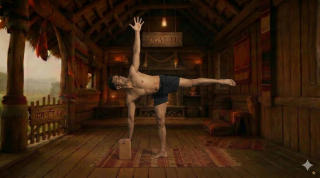
Ardha Chandrasana with Block · अर्ध चन्द्रासन ब्लॉक
Ardha Chandrasana with Block transforms the experience of Half Moon by offering grounded support, fundamentally altering the interplay between stability and expansion. This variation allows practitioners to cultivate deeper spinal length and more precise hip opening, shifting the focus from precarious balance to integrated alignment.
What this version changes: The block acts as an extension of the arm, effectively raising the floor to meet the hand, thereby reducing the required depth of the forward fold. This external support significantly enhances stability and allows for a more upright torso, shifting the energetic focus from merely staying balanced to exploring spinal length and hip openness. It redistributes weight, making the pose more accessible and enabling a deeper connection to the principles of alignment.
Muscles
- Hamstringsstabilises
- Quadricepsstrengthens
- Glutesstrengthens
- Core musclesstabilises
- Spinal Erectorsstretches
Joints
- Hip Jointmobilises
- Knee Jointstabilises
- Ankle Jointstabilises
- Spinedecompressing
Inside the body
- Abdominal Organs
- Heart and Lungs
- Breathing
Mind
Ardha Chandrasana profoundly cultivates mental concentration and unwavering focus (dharana) as the practitioner must maintain a steady gaze and internal awareness to hold the balance.
Take care
Teachers must guide students to protect the standing knee, ensuring it does not hyperextend or lock; a micro-bend is always advised.
Be mindful of lower back compression by encouraging length through the spine rather than collapsing, particularly for those with existing lumbar issues. For students new to balancing, always encourage the use of the wall or a block for support, prioritizing stability over depth to build confidence and prevent falls.
Muscles
Hamstrings
StabilisesWhile the standing leg hamstrings remain crucial for knee stabilization and foundational rooting, the block significantly reduces the demand for intense lengthening.
Read moreShow less
By elevating the supporting hand, the forward flexion at the hip is lessened, allowing for a more stable and less strained engagement of the hamstrings.
This enables practitioners with tighter hamstrings to maintain a straight standing leg without compromising spinal integrity or creating undue tension in the posterior chain.
Quadriceps
StrengthensRectus Femoris, Vastus Lateralis, Vastus Medialis, Vastus Intermedius
The powerful muscles on the front of the standing thigh (quadriceps) engage intensely to stabilize the knee and support the body's weight, particularly the vastus medialis which helps prevent knee collapse.
Read moreShow less
This isometric contraction builds significant strength and endurance in the leg, creating a solid foundation for the pose.
This engagement cultivates tapas, inner heat, which purifies and strengthens the physical structure, allowing the practitioner to feel more grounded and powerful.
Glutes
StrengthensThe glutes, particularly the gluteus medius and minimus of the standing leg, are engaged with heightened precision in this supported variation.
Read moreShow less
The block provides a stable reference point, allowing the practitioner to consciously draw the standing outer hip in and lift the lifted leg with controlled abduction, rather than relying on the supporting hand for primary stability.
This intelligent engagement strengthens the hip stabilizers, fostering a more balanced and integrated pelvic foundation.
Core muscles
StabilisesThe core muscles find a more refined and integrated engagement when supported by the block.
Read moreShow less
With the primary challenge of balance partially mitigated, the practitioner can direct their awareness to drawing the navel towards the spine and broadening across the sacrum.
This allows for a deeper activation of the transverse abdominis and obliques, supporting the spinal extension and creating a stable center from which the limbs can extend freely and without strain.
Spinal Erectors
StretchesWith the external support of the block, the spinal erectors can engage with greater ease and efficacy to create profound length through the entire vertebral column.
Read moreShow less
This reduces the gravitational struggle often present in the unsupported pose, allowing for a more sustained and expansive opening across the chest and collarbones.
The block empowers the practitioner to truly lift through the spine, cultivating a sense of lightness and upward energy without compensatory rounding.
Joints
Hip Joint
MobilisesThe standing hip joint (coxal joint) is the pivot point for the entire pose, requiring significant stability while simultaneously allowing for abduction and external rotation of the lifted leg.
Read moreShow less
This dynamic engagement strengthens the surrounding musculature, improving overall hip health and range of motion.
For the yogi, this opening in the hip area releases stored emotional tension and promotes a sense of freedom and mobility in the pelvis, which is often a repository of stress.
Knee Joint
StabilisesThe standing knee joint (tibiofemoral joint) requires precise alignment and muscular engagement to prevent hyperextension or collapse, bearing the full weight of the body.
Read moreShow less
Proper engagement of the quadriceps and hamstrings ensures the knee is strong and protected, promoting joint longevity.
This focused awareness on the knee fosters a sense of grounded stability, preventing the mind from wavering and bringing a conscious presence to the foundation of the pose, mirroring mental steadfastness.
Ankle Joint
StabilisesThe standing ankle joint (talocrural joint) and the intrinsic muscles of the foot work intensely to maintain balance and distribute weight evenly, making subtle adjustments throughout the pose.
Read moreShow less
This continuous micro-adjustment strengthens the ligaments and muscles around the ankle, enhancing proprioception.
This deep connection to the earth through the foot cultivates a powerful sense of rooting and steadiness, allowing the practitioner to feel deeply connected to the ground, no matter how challenging the balance becomes.
Spine
DecompressingThe entire spine, particularly the lumbar and thoracic regions, is lengthened and subtly rotated in Ardha Chandrasana, creating space between the vertebrae.
Read moreShow less
This gentle decompression helps alleviate lower back compression and encourages better postural alignment.
This spinal extension allows for an unobstructed flow of vital energy (prana) through the central nervous system, bringing a sense of lightness and clarity to the mind and body, enhancing overall vitality.
Inside the body
Abdominal Organs
The gentle lateral opening and mild compression on one side of the abdomen, coupled with expansion on the other, provides a subtle massage to the digestive organs (stomach, intestines).
Read moreShow less
This action can stimulate peristalsis and improve circulation to these areas, aiding digestion and elimination.
From a yogic perspective, this cleansing action in the abdominal region helps to stoke agni, the digestive fire, leading to better assimilation of nutrients and a feeling of lightness and inner cleanliness.
Heart and Lungs
The expansive opening of the chest in Ardha Chandrasana creates more space for the lungs to fully inflate, encouraging deeper and fuller breathing.
Read moreShow less
This expansion also gently stimulates the heart, improving circulation and oxygenation throughout the body.
This chest opening is deeply connected to anahata chakra, fostering feelings of courage, compassion, and emotional openness, allowing the practitioner to breathe more freely both physically and emotionally.
Breathing
The expansive chest opening in Ardha Chandrasana naturally invites a fuller, more complete breath, encouraging deep inhalation and a steady, controlled exhalation.
Read moreShow less
The lateral stretch of the torso creates space between the ribs, allowing the intercostal muscles to work more efficiently, enhancing lung capacity.
This mindful, rhythmic breathing (ujjayi pranayama) in a balancing pose helps to calm the nervous system, deepen concentration, and stabilize the mind, transforming physical effort into a moving meditation and grounding the practitioner in the present moment.
Fascia (connective tissue)
Ardha Chandrasana creates a profound lengthening and release along the lateral fascial line of the body, from the outer ankle of the standing leg, up the outer thigh and torso, and out through the lifted arm.
Read moreShow less
Simultaneously, the superficial back line is engaged and lengthened, particularly in the standing leg.
This integrated fascial stretch helps to unravel chronic patterns of holding and stiffness, improving overall tissue hydration and fluidity.
Yogically, releasing these fascial constrictions opens energetic channels, allowing prana to flow more freely and removing physical impediments to deeper meditative states, fostering a feeling of lightness and unrestricted movement.
Mind and nervous system
- Nervous system
The inherent challenge of balancing on one leg in Ardha Chandrasana demands acute focus and proprioceptive awareness, which can be profoundly calming for the nervous system.
Read moreShow less
As the mind concentrates on alignment and subtle shifts in weight, it draws attention away from external distractions and internal anxieties.
This sustained internal focus helps to quiet the 'chitta vritti' (mind fluctuations), leading to a state of mental stillness and reduced sympathetic nervous system activity, fostering a deep sense of presence and peace.
The sustained effort and precise muscular engagement required in this pose trains the neuromuscular pathways, enhancing coordination and body mapping in the brain.
Read moreShow less
This heightened communication between the brain and muscles refines motor control and balance, reducing the likelihood of falls and improving overall agility.
From a yogic perspective, this sharpens the senses (indriyas) and directs prana with intention, leading to a more integrated and harmonious mind-body connection.
- Mind & mood
Ardha Chandrasana profoundly cultivates mental concentration and unwavering focus (dharana) as the practitioner must maintain a steady gaze and internal awareness to hold the balance.
Read moreShow less
This intense mental engagement acts as a potent anchor for the mind, drawing it away from external distractions and internal chatter.
The ability to maintain stability amidst physical challenge translates into greater mental resilience and the capacity to stay present and calm in life's unpredictable moments.
Successfully holding Ardha Chandrasana instills a profound sense of self-confidence and courage, as it challenges both physical and mental limitations.
Read moreShow less
The act of expanding and opening in such a vulnerable, unsupported position can be empowering, shifting one's perception of capability.
This physical courage reflects a deeper psychological shift, helping to overcome fear and cultivate an inner strength that extends beyond the mat, fostering a more expansive and optimistic outlook on life.
Because it is a balance pose
As a primary balancing pose, Ardha Chandrasana significantly enhances proprioception, the body's ability to sense its position and movement in space, by challenging the inner ear (vestibular system) and sensory receptors in the joints and muscles.
Read moreShow less
This continuous feedback loop refines neuromuscular coordination and strengthens the stabilizing muscles throughout the body.
Yogically, balancing poses teach us to find stillness amidst movement, cultivating mental equanimity and the ability to find our center even when external circumstances feel unstable.
The standing nature of Ardha Chandrasana deeply grounds the practitioner, connecting them firmly to the earth's energy through the standing foot.
Read moreShow less
This rooting action strengthens the legs and core, building a solid foundation from which to expand upwards.
This connection to the earth fosters a sense of stability and security, activating muladhara chakra and allowing for the safe release of tension, creating a feeling of being deeply supported and present in the moment.
The lateral opening of the torso and the abduction of the lifted leg in this pose gently opens the hips, releasing tension in the outer hip rotators and inner thigh muscles.
Read moreShow less
This can improve range of motion in the hip joint, alleviating stiffness and discomfort.
In yogic philosophy, the hips are often considered storage sites for emotional blockages and past trauma; opening them can facilitate emotional release and cultivate a sense of freedom and spaciousness in the pelvic region.
Ardha Chandrasana is a beautiful chest opener, extending the arms and creating space across the collarbones and sternum.
Read moreShow less
This expansion counteracts the slouched posture prevalent in modern life, improving respiratory capacity and promoting a more upright and confident stance.
This energetic opening of the heart space (anahata chakra) fosters feelings of compassion, generosity, and emotional vulnerability, allowing for a deeper connection to oneself and others.