5
Muscles
3
Joints
1
Organs
2
Mental
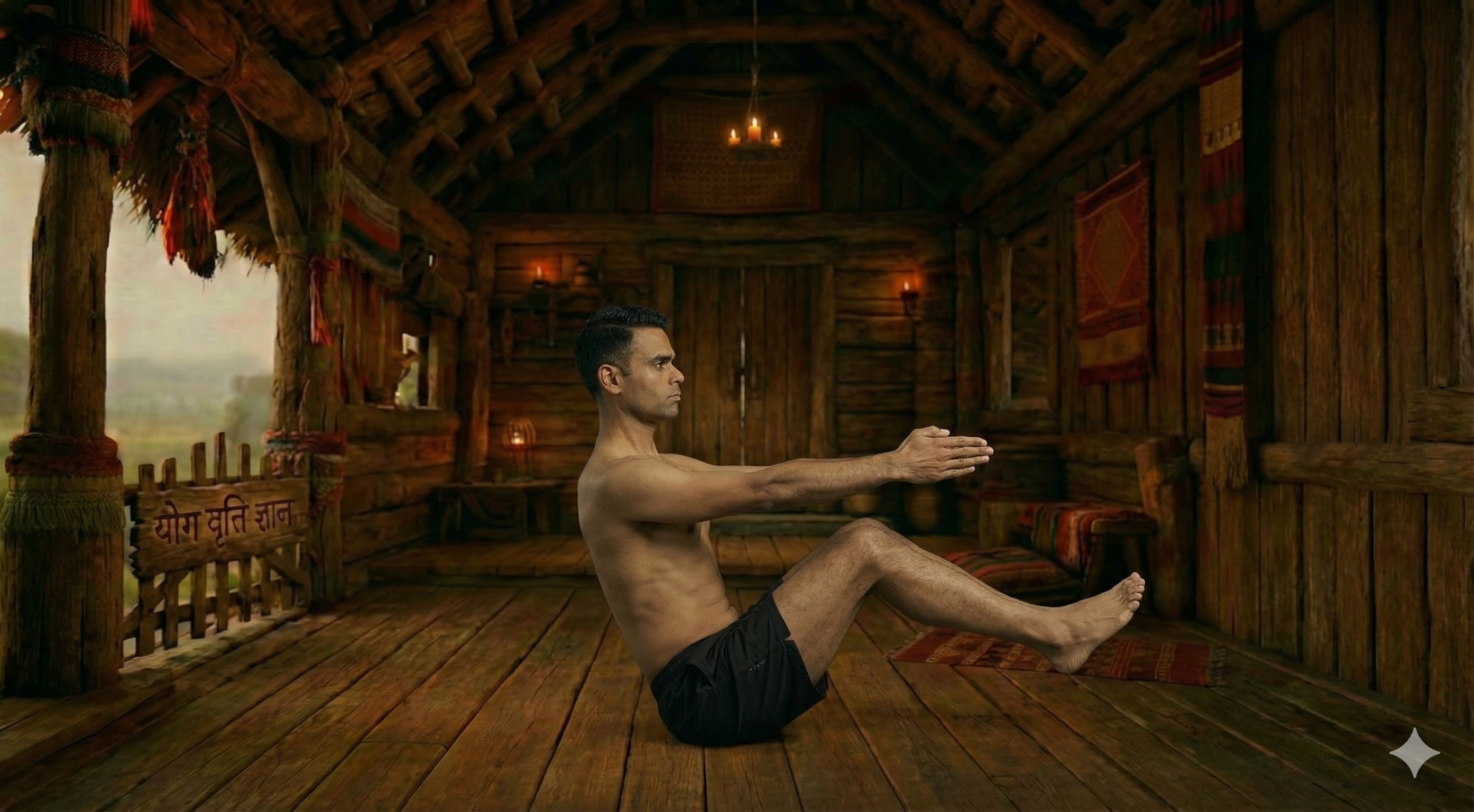
Ardha Navasana
अर्ध नावसन
Ardha Navasana is a potent core-strengthening posture that cultivates unwavering stability and inner fire. Balancing delicately on the sitting bones, the body engages the deep abdominal muscles and hip flexors to keep the legs and torso suspended just above the earth. This pose powerfully awakens the manipura chakra, fostering a sense of inner strength and determination, while building foundational endurance for more advanced asanas. It teaches us to find our center amidst challenge, translating physical stability into mental steadiness and resilience.
Half Boat Pose, also called Half Navasana is a classical yoga posture. Its Sanskrit name Ardha Navasana translates word-for-word as: Ardha (Half) · Nava (Boat) · Asana (Pose). Performed lying down, the body releases into the support of the floor, allowing gravity to assist. The posture works to engage the core. Tones the hip flexors and lower back. Builds core endurance for advanced postures. It is particularly valued for building full-body strength and improving overall posture. Suitable for intermediate practitioners with foundational yoga experience, it is an excellent warm-up, particularly beneficial for beginners and teens. A strap and blanket can be used to make the posture more accessible and support correct alignment. Practitioners with abdominal surgery and pregnancy should approach with care or consult a qualified teacher.
Helps with
Muscles Worked
Rectus Abdominis
[Rectus Abdominis]
The superficial 'six-pack' muscles, running vertically from your ribs to your pelvis, are intensely engaged here, particularly the lower fibers.
As you draw your navel towards your spine and maintain the rounded shape, these muscles contract concentrically to flex the trunk, bringing the rib cage closer to the pelvis.
This action builds tremendous heat and core power, cultivating a feeling of grounded strength and resilience in the body's center.
Transverse Abdominis
[Transversus Abdominis]
This deepest layer of abdominal muscle acts like a natural corset, wrapping horizontally around your midsection from front to back.
In Ardha Navasana, it contracts deeply to stabilize the lumbar spine and pelvis, preventing excessive strain and creating a firm foundation for the pose.
This subtle engagement brings a profound sense of inner support and containment, allowing prana to gather and focus in the abdominal region without dispersion.
Hip Flexors
[Iliopsoas, Rectus Femoris]
The powerful muscles at the front of your hips, connecting your spine and pelvis to your thigh bones, work tirelessly to lift and hold your legs in this hovering position.
The iliopsoas (iliacus and psoas major) is particularly active, flexing the hip joint and maintaining the elevation of the legs against gravity.
This sustained effort builds endurance and strength in a crucial area often tight from sitting, releasing stagnant energy and invigorating the lower body.
Quadriceps
[Rectus Femoris, Vastus Lateralis, Vastus Medialis, Vastus Intermedius]
The large muscle group on the front of your thighs is also actively engaged, especially if you strive to straighten your legs fully.
The rectus femoris, which crosses both the hip and knee, assists with hip flexion, while the other vasti muscles work to extend the knee.
This engagement brings firmness and activation to the legs, creating a sense of lightness and lift, and channeling energy upwards from the earth.
Erector Spinae
[Erector Spinae group: Iliocostalis, Longissimus, Spinalis]
While the spine is rounded, the muscles running along either side of your spinal column are not entirely passive; they are eccentrically lengthening and controlling the spinal flexion.
They work in concert with the abdominals to maintain the controlled curve, preventing a collapse and protecting the discs.
This intelligent engagement cultivates spinal awareness and flexibility, allowing for a balanced flow of apana and prana in the central channel.
Joints Mobilized
Lumbar Spine
mobilizingThe lower back region of your spine is gently flexed and rounded in Ardha Navasana, which can help to decompress the posterior aspect of the intervertebral discs.
This controlled flexion, supported by strong abdominal engagement, encourages mobility in the lumbar curve.
With regular practice, this can alleviate stiffness and improve the natural suppleness of the lower spine, enhancing the feeling of ease and fluidity in everyday movements.
Sacroiliac Joint
stabilizingThe joints connecting your sacrum (the triangular bone at the base of your spine) to your ilium (pelvic bones) are profoundly stabilized by the deep core engagement.
The co-contraction of the transverse abdominis and pelvic floor muscles creates a compressive force across the SI joints.
This stability is crucial for preventing lower back discomfort and cultivates a deep sense of integration and groundedness at the very foundation of your trunk, anchoring your awareness.
Hip Joints
mobilizingYour hip joints are in a state of sustained flexion, as your thighs are drawn towards your torso and held aloft.
This continuous engagement of the hip flexors and surrounding musculature helps to improve the range of motion and strength in these crucial ball-and-socket joints.
Over time, this practice can lead to greater freedom and ease in all movements involving the legs and pelvis, embodying a sense of agility and lightness.
Organ & System Benefits
Abdominal Organs
The deep engagement of the abdominal wall in Ardha Navasana creates a gentle, sustained compression on the organs within the abdominal cavity.
This internal massage can stimulate peristalsis, the rhythmic contractions that move food through the digestive tract, and enhance blood flow to these vital organs upon release.
This internal cleansing action aids in detoxification and revitalizes the digestive fire (agni), leading to improved digestion and assimilation of nutrients, both physical and energetic.
Nervous System
The intense focus required to maintain balance and hold Ardha Navasana draws the mind inward, effectively quieting the incessant chatter of thoughts (chitta vritti).
This sustained concentration on the physical effort and breath shifts the nervous system from a scattered state to one of deep presence and steadiness.
The challenge itself, when met with conscious breath, helps to train the mind to remain calm under pressure, building resilience.
While initially activating the sympathetic nervous system due to the intense effort, the controlled breath and sustained hold eventually promote a deeper parasympathetic response upon release.
The gradual build-up of endurance, coupled with mindful breathing, teaches the nervous system to sustain effort without triggering a full fight-or-flight response.
This cultivation of inner stillness amidst exertion is a profound yogic lesson in self-regulation.
Mental & Emotional
Ardha Navasana is a powerful crucible for mental fortitude and determination.
The physical challenge demands unwavering focus and perseverance, teaching the practitioner to push beyond perceived limits with a calm and steady mind.
This cultivation of will (ichha shakti) translates directly into greater confidence and resolve in facing life's challenges off the mat.
The act of balancing on the sitting bones while maintaining the pose requires intense concentration (dharana), drawing the senses inward (pratyahara).
This internal gaze helps to develop a deep sense of self-awareness and presence, detaching the mind from external distractions.
Regularly confronting and overcoming the mental resistance that arises in this pose builds immense inner strength and mental discipline.
Because of Its Shape
balance
Balancing postures inherently demand deep engagement of core stabilizers and proprioceptive awareness.
In Ardha Navasana, balancing on the sitting bones requires the entire core — front, back, and sides — to work synergistically to find and maintain equilibrium.
This physical demand refines the body's internal sensing mechanisms, enhancing coordination and fostering a profound connection to one's center.
The act of balancing cultivates profound mental stillness and concentration, making it an excellent preparation for meditation.
As the body seeks its point of equilibrium, the mind naturally quietens, drawn into the present moment and the subtle shifts within the body.
This practice develops dharana, the ability to hold the mind steady, and helps to integrate body and mind into a unified field of awareness.
Fascial Lines
The deep engagement of the core and hip flexors in Ardha Navasana creates a significant pull and activation along the anterior fascial lines of the body, particularly the superficial and deep front lines.
As the abdominal wall contracts and the hip flexors shorten, the fascial network around the abdominal organs and along the front of the spine is gently compressed and then released.
This dynamic interaction helps to hydrate and mobilize the connective tissue, releasing stored tension and allowing for a freer flow of prana through the central channels, enhancing overall body awareness.
Breathing & Respiratory
In Ardha Navasana, the intense abdominal engagement naturally restricts the full expansion of the diaphragm, encouraging a more refined, shallower breath in the upper chest initially.
As endurance builds, the challenge is to deepen the breath into the lower lobes of the lungs, finding a steady Ujjayi breath that supports the pose without strain.
This practice cultivates breath control (pranayama) under duress, teaching the practitioner to maintain a calm, even breath even when the body is working hard, which is a powerful tool for self-regulation and mental focus.
Anatomical Caution
Teachers should observe students carefully for any sign of lower back strain or discomfort.
If students struggle to maintain the abdominal engagement, they may compensate by arching the lower back excessively, which can be detrimental.
Offer modifications such as holding the backs of the thighs or keeping the knees bent, emphasizing the engagement of the deep core rather than simply lifting the legs high.