Benefits· लाभ
What Humble Warrior Pose does for you
Baddha Virabhadrasana · बद्ध वीरभद्रासन
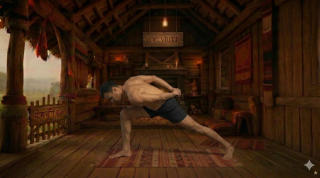
Baddha Virabhadrasana, or Humble Warrior, is a profound standing posture that simultaneously grounds the practitioner while inviting a deep internal release. It powerfully lengthens the entire posterior chain, particularly the hamstrings and spinal erectors, while opening the shoulders and hips in a unique bound expression.
Muscles
- Hamstringsstretches
- Glutesstrengthens
- Quadricepsstrengthens
- Hip Flexorsstretches
- Core Musclesstabilises
Joints
- Hip Jointmobilises
- Hip Jointstabilises
- Knee Jointstabilises
- Knee Jointstabilises
- Shoulder Jointmobilises
Inside the body
- Abdominal Organs (Digestive System)
- Lungs and Diaphragm
- Heart
- Breathing
Mind
The very name 'Humble Warrior' speaks to the psychological shift this pose cultivates: a powerful surrender.
Take care
Teachers should guide students to approach this pose with mindful awareness, particularly if they have pre-existing hip or knee injuries.
Ensure the front knee is directly over the ankle and not collapsing inward, protecting the knee joint from undue strain. For shoulder injuries, avoid forcing the bind; a strap can be used to make the posture more accessible and prevent overstretching. Always prioritize the student's comfort and proper alignment over achieving the full expression of the pose.
Muscles
Hamstrings
StretchesBiceps Femoris, Semitendinosus, Semimembranosus
The powerful muscles running along the back of your front thigh (hamstrings) experience a deep, sustained lengthening as you fold forward.
Read moreShow less
This isn't a passive stretch but an active release, where the muscle fibers are encouraged to extend under controlled tension.
Anatomically, this action helps to decompress the posterior aspect of the knee and hip joints, fostering greater range of motion.
Energetically, releasing tension in these muscles allows apana vayu – the downward-moving energy – to flow more freely, promoting a sense of groundedness and stability in the lower body.
Glutes
StrengthensGluteus Maximus, Medius, Minimus
The muscles of your buttocks (glutes), particularly the gluteus maximus, are actively engaged in both legs to stabilize the hips and pelvis.
Read moreShow less
In the front leg, they assist in maintaining external rotation and preventing the knee from collapsing inward, while in the back leg, they work to extend the hip and maintain a strong, straight leg.
This deep activation provides a powerful anchor for the posture, creating a stable foundation from which the spine can lengthen.
From a yogic perspective, engaging these powerful core-to-leg muscles helps to awaken muladhara chakra, fostering a feeling of security and inner strength.
Quadriceps
StrengthensRectus Femoris, Vastus Lateralis, Vastus Medialis, Vastus Intermedius
The large muscles on the front of your front thigh (quadriceps) are dynamically engaged to hold the deep bend in the knee.
Read moreShow less
They work eccentrically as the knee flexes, controlling the descent, and then isometrically to maintain the pose, building significant strength and endurance.
This continuous engagement supports the knee joint and prevents strain, creating a strong and resilient leg foundation.
The sustained effort in the quadriceps cultivates tapas – the inner fire and discipline – essential for building both physical stamina and mental fortitude.
Hip Flexors
StretchesPsoas Major, Iliacus
On the back leg, the deep muscles at the front of your hip (hip flexors) receive a gentle yet significant lengthening as the hip extends.
Read moreShow less
This area is often tight from prolonged sitting, and this pose helps to counteract that stiffness, creating more space in the pelvic bowl.
Anatomically, this release can improve pelvic alignment and reduce anterior pelvic tilt.
Energetically, opening the hip flexors helps to free up stagnant energy in the lower abdomen, allowing for a smoother flow of prana and a greater sense of ease and fluidity in movement.
Core Muscles
StabilisesTransverse Abdominis, Obliques, Multifidus
Your deep abdominal and back muscles (core muscles) are continuously engaged to support and protect the spine as you fold forward.
Read moreShow less
The transverse abdominis wraps like a corset, while the obliques and multifidus provide rotational stability and spinal integrity.
This internal support creates a stable base, allowing the upper body to release and lengthen without collapsing.
A strong, engaged core is vital for maintaining balance and alignment, fostering a sense of centeredness and control, not just physically but also in the mind, quieting distractions (chitta vritti).
Shoulders
StretchesRotator Cuff, Deltoids, Rhomboids
The muscles of your shoulder girdle and upper back (deltoids, rotator cuff, rhomboids) are actively engaged in the bind, promoting external rotation and retraction of the shoulder blades.
Read moreShow less
This action creates significant opening across the chest and upper back, counteracting the common tendency to round the shoulders forward.
Anatomically, this improves shoulder mobility and strengthens the muscles responsible for good posture.
From a yogic perspective, opening the chest helps to expand the heart center (anahata chakra), fostering feelings of compassion, courage, and emotional freedom.
Back Extensors
StretchesErector Spinae, Multifidus
As you fold forward in Humble Warrior, the muscles running along your spine (erector spinae, multifidus) are actively lengthening while maintaining spinal integrity.
Read moreShow less
They work to create space between the vertebrae, preventing compression and encouraging a long, even curve in the spine.
This controlled lengthening helps to release chronic tension in the back, often accumulated from daily activities and stress.
Energetically, this spinal decompression allows for an unobstructed flow of prana along the sushumna nadi, promoting vitality and clarity throughout the entire system.
Joints
Hip Joint (Front Leg)
MobilisesThe ball-and-socket joint of your front hip undergoes deep flexion and internal rotation in this pose.
Read moreShow less
This challenges the hip's full range of motion, helping to release tightness in the deep hip rotators and surrounding musculature.
Anatomically, this can improve the lubrication of the joint capsule and increase overall hip flexibility.
For the practitioner, this mobilization translates to greater ease in walking, sitting, and other daily movements, and a sense of freedom from stiffness that often holds emotional tension.
Hip Joint (Back Leg)
StabilisesThe hip joint of your back leg is in extension, creating a stable anchor for the entire pelvic girdle.
Read moreShow less
While the front hip is mobilizing, the back hip is actively engaged to prevent excessive anterior tilt of the pelvis, ensuring proper alignment.
This stabilization is crucial for protecting the sacroiliac joint and lower back.
Through consistent practice, this action builds strength and resilience around the hip, contributing to a more balanced and grounded feeling in all standing postures and improving overall lower body stability.
Knee Joint (Front Leg)
StabilisesThe hinge joint of your front knee is deeply flexed and bears a significant portion of your body weight.
Read moreShow less
This position, when properly aligned with the ankle and hip, strengthens the muscles surrounding the knee, particularly the quadriceps and hamstrings, improving its stability and resilience.
It's a controlled strengthening, teaching the joint to bear load safely and effectively.
For the yogi, this builds a sense of unwavering strength in the legs, a metaphorical root system that supports the entire practice and daily life, fostering confidence and determination.
Knee Joint (Back Leg)
StabilisesThe hinge joint of your back knee is extended but not locked, with the quadriceps actively engaged to maintain a strong, straight leg.
Read moreShow less
This action provides a stable base for the back leg, preventing hyperextension and distributing weight evenly through the foot.
Anatomically, it reinforces the integrity of the knee ligaments and strengthens the surrounding musculature.
This subtle yet powerful engagement helps to create a feeling of length and lift through the entire back body, promoting proper alignment and reducing strain on the lower back and hips over time.
Shoulder Joint
MobilisesThe ball-and-socket joint of your shoulders undergoes a complex movement pattern, involving extension, internal rotation, and then external rotation to achieve the bind behind the back.
Read moreShow less
This action significantly mobilizes the shoulder joint, increasing range of motion and releasing stiffness in the surrounding muscles.
It actively counteracts the common slouched posture by encouraging retraction and depression of the scapulae.
This opening brings a sense of freedom and lightness to the upper body, allowing for deeper breaths and an open heart, both physically and emotionally.
Sacroiliac (SI) Joint
StabilisesThe Sacroiliac (SI) joint, connecting the sacrum to the ilium, is a critical area for pelvic stability, and in Baddha Virabhadrasana, it is actively stabilized through the precise engagement of the legs and core.
Read moreShow less
By rooting through both feet and squaring the hips, tension is evenly distributed across the pelvis, preventing undue shearing forces on the joint.
This mindful engagement can alleviate chronic SI joint discomfort and improve overall pelvic alignment.
A stable SI joint contributes to a feeling of deep groundedness and security, both physically and energetically.
Inside the body
Abdominal Organs (Digestive System)
As you fold deeply over your front thigh, the abdominal organs receive a gentle compression and massage.
Read moreShow less
This internal pressure stimulates circulation to the digestive tract, aiding in the detoxification process and promoting healthy peristalsis.
From a yogic perspective, this action helps to release stagnant apana vayu – the downward and outward moving energy – which can accumulate in the lower abdomen, fostering a sense of internal cleansing and lightness, and improving digestive efficiency.
Lungs and Diaphragm
While the forward fold creates a gentle compression on the front of the torso, the bind and chest opening encourage expansion in the back and sides of the rib cage, allowing for deeper, fuller breaths.
Read moreShow less
The diaphragm, though gently compressed, is encouraged to work more effectively, drawing breath into areas of the lungs that might otherwise be underutilized.
This enhances oxygen intake and carbon dioxide release, promoting a sense of calm and energetic refreshment throughout the body, improving pranic flow and nervous system regulation.
Heart
In this mild inversion, with the head below the level of the heart, there is a gentle reduction in the gravitational pull on the heart.
Read moreShow less
This can provide a subtle, soothing effect, reducing strain and promoting a sense of calm.
Energetically, bringing the heart closer to the earth encourages humility and introspection, shifting focus from external achievements to internal awareness.
This subtle change in perspective can be profoundly calming, helping to quiet the incessant chatter of the mind and fostering a sense of peace.
Breathing
The unique shape of Baddha Virabhadrasana naturally influences the breath, encouraging a deeper and more expansive inhalation into the back and sides of the rib cage.
Read moreShow less
While the abdominal compression may limit front-body expansion, the chest-opening bind and spinal lengthening create space for the lungs to fill laterally and posteriorly.
This encourages a more diaphragmatic and three-dimensional breath, which is highly calming for the nervous system.
Practicing Ujjayi breath in this pose helps to deepen the internal focus, creating a rhythmic, internal sound that anchors the mind and cultivates a steady, meditative state.
Fascia (connective tissue)
Baddha Virabhadrasana engages and releases several key fascial lines, most notably the Superficial Back Line, which runs from the soles of the feet up the hamstrings, glutes, and along the spine to the head.
Read moreShow less
The deep forward fold creates a sustained stretch through this entire chain, releasing chronic tension and improving overall flexibility.
Additionally, the arm lines are activated and lengthened through the shoulder bind, opening the chest and releasing tightness around the pectorals and biceps.
This comprehensive fascial release helps to unbind the body's connective tissues, improving fluidity of movement and allowing prana to flow more freely, dissolving energetic blockages.
Mind and nervous system
- Nervous system
The inward focus and mild inversion of Humble Warrior naturally activate the parasympathetic nervous system, promoting a profound sense of calm and relaxation.
Read moreShow less
As the head dips below the heart and the gaze turns inward, the external stimuli are reduced, allowing the mind to quiet and the body to release accumulated tension.
This shift gently guides the practitioner away from the 'fight or flight' response, fostering a state of rest and digest, which is essential for deep healing and restoration.
The intricate balance required to maintain Baddha Virabhadrasana, with its deep hip flexion and shoulder bind, significantly enhances proprioception – your body's awareness of its position in space.
Read moreShow less
This heightened sensory feedback from muscles, joints, and ligaments refines neuromuscular coordination and cultivates a deeper connection between mind and body.
This increased bodily awareness (vijnanamaya kosha) helps to ground the practitioner in the present moment, reducing mental wandering and fostering a state of mindful presence.
The sustained holds and precise alignment inherent in Iyengar yoga, particularly in a complex pose like this, demand intense concentration and mental focus.
Read moreShow less
This deliberate focus helps to calm the fluctuations of the mind (chitta vritti), drawing attention away from external distractions and into the internal experience of the pose.
This practice of dharana, or concentration, not only strengthens mental discipline but also cultivates a sense of unwavering presence and clarity, which can translate into greater focus in daily life.
- Mind & mood
The very name 'Humble Warrior' speaks to the psychological shift this pose cultivates: a powerful surrender.
Read moreShow less
By bowing the head below the heart, we physically embody humility, letting go of ego and the need for external validation.
This act of turning inward fosters introspection and self-reflection, allowing practitioners to connect with their inner strength and vulnerability simultaneously, leading to greater self-acceptance and emotional resilience.
Despite the 'humble' aspect, holding Baddha Virabhadrasana demands significant mental fortitude and unwavering determination.
Read moreShow less
The sustained effort in the legs, core, and shoulders builds an inner resilience, teaching the mind to remain steady amidst challenge.
This cultivation of tapas – inner discipline and heat – empowers practitioners to persevere through difficulties, developing a deep sense of courage and inner strength that transcends the physical mat.
The mild inversion, bringing the head below the heart, offers a subtle shift in perspective, literally and figuratively.
Read moreShow less
This change can challenge habitual thought patterns, encouraging new ways of seeing and understanding situations.
By momentarily reversing our usual orientation, we can gain clarity, stimulate creativity, and detach from overwhelming thoughts, fostering a sense of mental spaciousness and renewed outlook on life's challenges.
Because it is a standing pose
As a standing posture, Baddha Virabhadrasana fundamentally builds strength and stability in the lower body, rooting the practitioner firmly to the earth.
Read moreShow less
The active engagement of the legs and feet creates a powerful foundation, literally connecting us to the ground beneath us.
This grounding effect helps to balance the muladhara chakra, fostering a profound sense of security, stability, and presence in the physical body and mind.
This posture is also a deep forward bend, bringing the torso in close proximity to the front thigh.
Read moreShow less
This action promotes significant lengthening along the entire posterior chain, from the hamstrings through the spine, while simultaneously quieting the mind.
Forward bends are inherently introspective and calming, encouraging pratyahara (withdrawal of the senses) and helping to release accumulated tension, both physical and mental, through the downward flow of apana vayu.
The deep flexion and internal rotation of the front hip, combined with the extension of the back hip, make this an effective hip opener.
Read moreShow less
It targets tightness in the deep hip rotators and flexors, areas often restricted by modern lifestyles.
Releasing tension in the hips can unlock stored emotional energy (linked to svadhisthana chakra), creating greater fluidity in movement and a sense of emotional freedom and creativity.
The bind behind the back transforms this into a profound chest and shoulder opener.
Read moreShow less
It actively retracts and depresses the shoulder blades, expanding the collarbones and lifting the sternum.
This counteracts postural imbalances from sitting, improving lung capacity and promoting an open-hearted quality.
Energetically, this opening stimulates the anahata chakra, fostering compassion, courage, and a greater capacity for giving and receiving love.