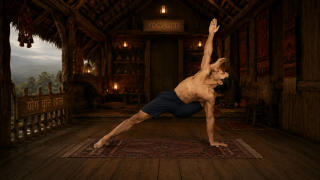
Benefits· लाभ
What Destroyer of the Universe Pose does for you
Bhairavasana · भैरवासन
Bhairavasana, the Destroyer of the Universe Pose, is a profound seated posture that demands and cultivates an exquisite balance of stability and release within the body. It deeply lengthens the entire posterior chain of the extended leg while simultaneously opening the hip of the bent leg into significant external rotation.
Muscles
- Hamstringsstretches
- Hip Flexorsstretches
- Adductorsstretches
- Spinal Erector Musclesstrengthens
- Gluteal Musclesstabilises
Joints
- Hip Jointsmobilises
- Sacroiliac Jointstabilises
- Lumbar Spinedecompressing
- Knee Jointsmobilises
Inside the body
- Abdominal Organs
- Pelvic Floor
- Breathing
Mind
Bhairavasana demands an unwavering focus and presence, drawing the practitioner's attention away from external distractions and into the immediate experience of the body and breath.
Take care
Teachers should guide students into Bhairavasana with utmost care, especially those with pre-existing hip or hamstring injuries, or any history of sacroiliac joint instability.
It is crucial to prioritize the integrity of the knee on the extended leg by encouraging quadriceps engagement, and to ensure the hip joint of the bent leg is not forced beyond its comfortable range of external rotation. Remind students to listen intently to their body's signals, moving slowly and backing off immediately if they feel any sharp pain or pinching, particularly around the sitting bones or in the groin.
Muscles
Hamstrings
StretchesBiceps femoris, Semitendinosus, Semimembranosus
The powerful muscles running along the back of your extended thigh (hamstrings) experience a deep, sustained lengthening here, specifically at their attachment to the sitting bone (ischial tuberosity) and behind the knee.
Read moreShow less
As the trunk hinges forward from the hips with a long spine, these muscles are encouraged to release chronic tension, allowing for greater range of motion at the hip joint.
This profound opening in the posterior chain frees up blocked energy, promoting a feeling of lightness and ease in the entire leg as apana vayu flows more freely.
Hip Flexors
StretchesIliopsoas, Rectus Femoris
On the extended leg, the deep muscles at the front of your hip and thigh (iliopsoas and rectus femoris) are gently elongated as the leg stretches forward and the pelvis is stabilized.
Read moreShow less
This release helps to counteract the shortening effect of prolonged sitting, improving posture and reducing strain on the lower back by releasing tension in the anterior pelvic tilt.
Simultaneously, the sustained stretch encourages a softening around the sacrum, allowing for greater energetic flow and a sense of internal spaciousness.
Adductors
StretchesAdductor Magnus, Longus, Brevis, Pectineus, Gracilis
The muscles along the inner thigh (adductors) of the extended leg are brought into a gentle yet persistent stretch as the leg extends straight out from the hip socket.
Read moreShow less
This lengthening, particularly of the adductor magnus, contributes significantly to the overall opening of the hip joint and the release of tension in the groin.
On the bent leg, these muscles provide subtle stability, helping to maintain the deep external rotation without strain, fostering a sense of integrated strength and flexibility in the pelvic girdle and promoting a wider energetic base.
Spinal Erector Muscles
StrengthensErector Spinae group
To maintain the integrity of the spine as the pelvis grounds and the leg extends, the muscles running along either side of your spinal column (erector spinae) are actively engaged.
Read moreShow less
This isometric action helps to lengthen and decompress the vertebral column, preventing slumping and ensuring the spine remains tall and spacious even as you hinge forward from the hips.
The conscious effort to lift and broaden the chest against the pull of the hamstrings cultivates a sense of inner strength and uplifted awareness, preventing the collapse of vital energy (prana vayu).
Gluteal Muscles
StabilisesStretchesGluteus Maximus, Medius, Minimus
The muscles of your buttocks (gluteal muscles) play a crucial role in stabilizing the pelvis, particularly on the side of the extended leg, ensuring a firm foundation.
Read moreShow less
On the bent leg, as the hip moves into deep external rotation and flexion, the gluteus medius and piriformis are encouraged to release, allowing for greater freedom of movement within the hip socket.
This combination of stability and release helps to balance the forces acting on the sacrum, promoting a sense of integration and ease in the lower body and the flow of energy through the root chakra.
Joints
Hip Joints
MobilisesBoth hip joints (coxal joints) are profoundly mobilized in Bhairavasana, albeit asymmetrically.
Read moreShow less
One hip is in deep flexion and external rotation, while the other is in extension and neutral rotation, allowing for a comprehensive release of tension around the femoral head within its socket.
This systematic increase in range of motion addresses stiffness accumulated from daily activities, improving overall hip health and mobility.
The increased space and freedom felt in the hips can translate into a greater sense of emotional release and openness in the pelvic region, where many subtle energetic blockages reside.
Sacroiliac Joint
StabilisesMobilisesThe joint connecting your sacrum (the triangular bone at the base of your spine) to your pelvis (ilium) is engaged in a delicate balance of stability and subtle mobilization.
Read moreShow less
While the posture aims to ground the sitting bones evenly, the asymmetrical leg action can create a gentle pull, encouraging minor adjustments and release in the ligaments surrounding the joint.
This mindful engagement helps to improve the proprioception around the SI joint, fostering greater awareness of pelvic stability and reducing the potential for discomfort or misalignment, thereby supporting the integrity of the central energetic channel (sushumna nadi).
Lumbar Spine
DecompressingMobilisesBy maintaining a tall, extended spine while hinging from the hips, the lumbar vertebrae (lower back) are encouraged to decompress, creating more space between each segment and reducing pressure on the intervertebral discs.
Read moreShow less
The deliberate effort to lengthen the trunk against the pull of the hamstrings helps to restore the natural curve of the lower back, counteracting the effects of slumping.
This spinal lengthening, supported by a stable pelvis, promotes healthy nerve flow and cultivates a feeling of lightness and freedom in the lower back, allowing energy (prana) to flow more freely upwards.
Knee Joints
MobilisesExtensionStabilisesThe knee of the extended leg is in full extension, requiring careful engagement of the quadriceps to protect the joint, while the knee of the bent leg is in deep flexion and external rotation.
Read moreShow less
This asymmetrical demand strengthens the ligaments and muscles supporting both knees, improving their stability and resilience over time.
Practitioners learn to discern the difference between a beneficial stretch in the hamstrings and potential strain in the knee, cultivating a heightened sense of body awareness (pratyahara) and respect for the joint's delicate mechanics, ensuring longevity in their practice.
Inside the body
Abdominal Organs
In Bhairavasana, particularly as the trunk leans forward over the extended leg, the abdominal organs receive a gentle compression and massage.
Read moreShow less
This internal pressure, combined with the deep, diaphragmatic breathing encouraged by the pose, helps to stimulate circulation to the digestive and eliminatory organs.
This 'squeeze and release' action can aid digestion, reduce bloating, and support the efficient removal of waste, contributing to a feeling of internal cleansing and vitality that supports the agni (digestive fire).
Pelvic Floor
The deep grounding through the sit bones and the significant hip opening in Bhairavasana bring a heightened awareness to the muscles of the pelvic floor.
Read moreShow less
As the hips stretch and release, the pelvic floor is encouraged to soften and lengthen, particularly on the side of the deeply externally rotated hip.
This release can alleviate chronic tension in the pelvic region, promoting a sense of energetic stability and allowing for the free flow of apana vayu, which is crucial for groundedness, healthy elimination, and the foundation of our energetic being.
Breathing
The deep seated nature of Bhairavasana, especially with the trunk leaning forward, naturally encourages a deeper, more diaphragmatic breath.
Read moreShow less
The gentle compression of the abdomen promotes a fuller exhalation, which in turn primes the body for a more expansive inhalation, drawing breath deep into the lower lobes of the lungs.
This sustained, rhythmic breathing helps to calm the nervous system and deepen the stretch, allowing the muscles and fascia to release more effectively.
Practicing Ujjayi breath (victorious breath) here can enhance the experience, using the subtle sound to draw awareness inwards and synchronize movement with the flow of prana, turning the physical pose into a moving meditation.
Fascia (connective tissue)
Fascia, the intricate web of connective tissue that wraps around every muscle, organ, and bone in your body, plays a significant role in Bhairavasana.
Read moreShow less
This pose specifically targets the superficial back line (which includes the hamstrings and spinal fascia) and aspects of the deep front line (psoas) and lateral lines (IT band) of the extended leg.
By holding the deep stretches with conscious breath, we encourage the fascial matrix to hydrate and release, allowing for greater tissue elasticity and freedom of movement.
This release of fascial restrictions is akin to opening energetic channels (nadis), allowing prana to flow unimpeded and releasing old patterns of tension held deep within the body's memory.
Mind and nervous system
- Nervous system
The sustained hold and deep stretches in Bhairavasana gently encourage the nervous system to shift from a state of 'fight or flight' (sympathetic activation) towards 'rest and digest' (parasympathetic dominance).
Read moreShow less
As the body gradually surrenders into the pose, the mind follows, leading to a profound sense of calm and reduced anxiety.
This intentional slowing down helps to quiet the fluctuations of the mind (chitta vritti), fostering inner peace and mental clarity, which is the very purpose of yoga.
The deep engagement with the body's subtle sensations in this advanced posture cultivates heightened interoception — our ability to perceive internal states and sensations with precision.
Read moreShow less
By mindfully observing the stretch, the breath, and any areas of resistance, practitioners develop a deeper connection to their physical and energetic self.
This refined body awareness is a powerful tool for self-regulation and understanding the intricate interplay between physical sensation and emotional well-being, enhancing one's presence in the moment.
- Mind & mood
Bhairavasana demands an unwavering focus and presence, drawing the practitioner's attention away from external distractions and into the immediate experience of the body and breath.
Read moreShow less
This intense concentration (dharana) on internal sensations helps to still the restless mind, cultivating a profound sense of mental discipline and resilience.
The challenge of the pose becomes a mirror for the mind, revealing patterns of resistance and offering an opportunity for mental fortitude and a deeper understanding of one's inner landscape.
This posture, with its deep and often challenging stretches, cultivates profound patience and the art of surrender.
Read moreShow less
As the body slowly unwinds, the practitioner learns to meet discomfort with equanimity, understanding that true progress comes not from forcing but from allowing the body to open in its own time.
This mental discipline translates into daily life, fostering a greater capacity for acceptance and letting go of attachment to outcomes, embodying the yogic principle of Ishvara pranidhana (surrender to a higher power).
Because it is a seated | hip opener | forward bend pose
Seated postures provide a stable foundation, grounding the practitioner through the sit bones and connecting them firmly to the earth.
Read moreShow less
This physical grounding allows the spine to lengthen effortlessly upwards, creating a sense of both stability and lightness simultaneously.
Energetically, seated poses are excellent for cultivating apana vayu, the downward-moving energy, which promotes a feeling of centeredness, calm, and inner quiet, preparing the mind for deeper meditative states and introspection.
Hip opening postures like Bhairavasana release deep-seated tension in the hip joints and surrounding musculature, which often accumulate from prolonged sitting, repetitive movements, or emotional stress.
Read moreShow less
Anatomically, this increases the range of motion in the hips, improving flexibility and reducing strain on the lower back and knees.
From a yogic perspective, the hips are often considered a storage place for emotions and past traumas, and opening them can facilitate emotional release and a greater sense of freedom, allowing for a more uninhibited flow of prana.
Forward bends encourage introspection and a quieting of the mind by bringing the attention inwards and gently compressing the front body, which calms the nervous system.
Read moreShow less
Physically, they lengthen the entire posterior chain, particularly the hamstrings and spine, decompressing the vertebral column and easing tension in the back.
Energetically, forward bends are profoundly calming, helping to soothe the nervous system and draw the senses inwards (pratyahara), making them ideal for cultivating a meditative state and fostering self-reflection.