4
Muscles
3
Joints
2
Organs
3
Mental
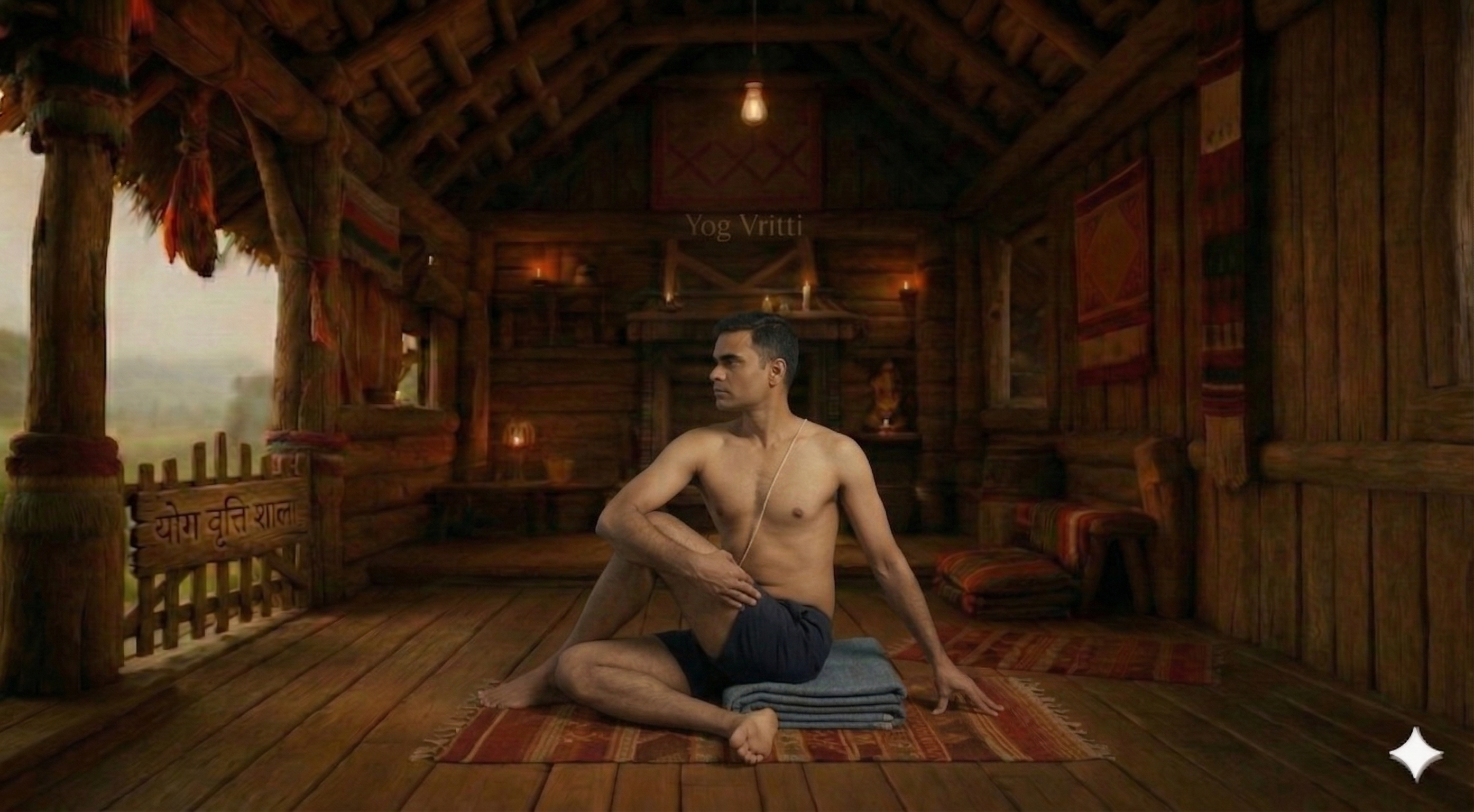
Bharadvajasana (seated, with blanket support)
भरद्वाजासन (बैठे, कम्बल के सहारे)
Bharadvajasana, especially in this supported variation, is a profound twist that teaches us to rotate the spine from its core, rather than just the neck or lower back. By elevating the pelvis with a blanket, we create a stable foundation, allowing the thoracic spine to unwind gently and safely, fostering both physical release and mental clarity. This pose skillfully mobilizes the vertebral column while simultaneously soothing the nervous system, offering a deep sense of internal spaciousness and energetic rebalancing. It’s a masterful practice for cultivating spinal health, releasing deep-seated tension, and inviting a meditative quality into the body and mind, making it invaluable for therapeutic applications.
Bharadvaja's Twist with Blanket Support, also called Supported Seated Twist is a classical yoga posture. Its Sanskrit name Bharadvajasana (seated, with blanket support) translates word-for-word as: Bharadvaja (Sage Bharadvaja) · Asana (Pose — Supported). Seated on the mat, the practitioner rotates the spine, creating space between each vertebra. The posture works to strengthen and extend the back and engage the core. Relieves stiffness in the back and shoulders. Massages the abdominal organs. It is particularly valued for alleviating back discomfort and developing greater flexibility. Suitable for beginners and regular practitioners alike, it is an excellent warm-up, particularly beneficial for beginners and seniors. A blanket and wall can be used to make the posture more accessible and support correct alignment. Practitioners with spinal injury and abdominal surgery should approach with care or consult a qualified teacher.
Helps with
Muscles Worked
Obliques (side abdominal muscles)
Internal and External Oblique Abdominis
These strong sheets of muscle wrap around your waist, forming the sides of your abdominal wall.
In Bharadvajasana, the obliques on one side actively contract to initiate and deepen the spinal twist, drawing the rib cage towards the opposite hip.
Simultaneously, the obliques on the other side lengthen, creating a gentle stretch and release across the abdomen.
This balanced action helps to wring out tension from the midsection, promoting a feeling of lightness and improved energy flow (prana) in the core.
Spinal Erectors (muscles alongside the spine)
Erector Spinae Group (Iliocostalis, Longissimus, Spinalis)
These long, powerful muscles run vertically along either side of your spine, responsible for keeping your back upright and extended.
In this supported twist, the erector spinae work subtly to maintain the length of the spine as you rotate, preventing collapse or compression.
This co-contraction ensures that the twist happens with integrity, creating space between the vertebrae rather than crunching them, which translates into a feeling of elongation and freedom throughout the entire spinal column, allowing energy to flow unimpeded upwards (udana vayu).
Quadratus Lumborum (deep lower back muscle)
Quadratus Lumborum
The QL is a deep muscle located in your lower back, connecting your pelvis to your lowest rib and lumbar vertebrae.
While primarily a lateral flexor, in a twist, it works to stabilize the lumbar spine, preventing excessive or uncontrolled rotation in this vulnerable area.
The blanket support under the hips helps to ground the pelvis, allowing the QL to subtly engage and protect the lower back, fostering a sense of security and stability (sthira) in the foundation of the pose.
Gluteal Muscles (buttock muscles)
Gluteus Medius and Minimus
The gluteal muscles, particularly the gluteus medius and minimus, are located on the sides of your hips and are crucial for stabilizing the pelvis.
In Bharadvajasana, with the hips externally rotated and supported by the blanket, these muscles work gently to maintain the evenness of the sit bones.
This subtle engagement prevents one side of the pelvis from hiking up, ensuring a balanced foundation for the spinal twist and allowing the practitioner to feel deeply rooted and grounded (apana vayu) through the hips.
Joints Mobilized
Spine (vertebral column)
mobilizingThe entire vertebral column, from the sacrum to the atlas, is involved in this twist, but the primary focus is on the thoracic spine (mid-back).
The blanket elevation of the pelvis helps to stabilize the lumbar spine (lower back), allowing for a more focused and therapeutic rotation in the thoracic region.
This mobilization helps to break up stiffness between the vertebrae, improving the range of motion and creating a sense of increased suppleness and fluidity (sukham) in the back, which translates to easier movement in daily life and a more upright posture over time.
Hips (acetabulofemoral joints)
rotatingThe hip joints are where your thigh bones (femurs) meet your pelvis.
In Bharadvajasana, one hip is in external rotation (outward turn) and the other is in internal rotation (inward turn), with both in a degree of flexion.
The blanket support helps to level the pelvis, reducing strain on the hip joints and allowing the rotation to originate from the spine rather than forcing the hips.
This gentle, sustained rotation helps to release tension in the deep hip rotators, leading to greater ease and openness in the pelvic region, which supports healthy energy flow (apana vayu) and reduces strain on the lower back.
Sacroiliac (SI) Joint
stabilizingThe SI joints are located where the sacrum (the triangular bone at the base of your spine) meets the ilium (the largest part of your hip bone).
In this pose, the blanket under the hips helps to keep the pelvis level and stable, minimizing any shearing forces on the SI joints.
This stability is crucial for anyone with SI joint sensitivity, as it allows the spine to twist safely from a grounded foundation.
The practitioner experiences a feeling of security and balance in the pelvic girdle, which is foundational for overall spinal health and ease of movement.
Organ & System Benefits
Digestive Organs (Intestines, Liver, Spleen)
As you gently twist in Bharadvajasana, the abdominal organs, including the intestines, liver, and spleen, experience a gentle compression on one side and a release on the other.
This 'wringing out' action is thought to stimulate circulation to these organs, encouraging the elimination of stagnant blood and toxins, and bringing in fresh, oxygenated blood upon release.
From a yogic perspective, this aids in balancing samana vayu, the energy responsible for digestion and assimilation, leading to improved digestion, reduced bloating, and a feeling of internal cleansing and vitality.
Lungs
The twisting action in Bharadvajasana creates a subtle compression on one side of the rib cage while simultaneously expanding the other side.
This uneven pressure encourages a more conscious and refined breathing pattern, drawing attention to the often-neglected sides and back of the lungs.
This gentle massage of the lung tissue can improve respiratory capacity over time, promoting deeper and fuller breaths, which in turn calms the nervous system and enhances the flow of prana throughout the body, leading to a feeling of greater spaciousness and ease in breathing.
Nervous System
The sustained, gentle nature of this supported twist, combined with focused breathing, actively shifts the nervous system from a state of 'fight or flight' (sympathetic) towards 'rest and digest' (parasympathetic).
As the spine gently unwinds and the breath deepens, the vagus nerve is stimulated, sending signals of safety and calm throughout the body.
This leads to a palpable reduction in overall stress and tension, allowing the practitioner to feel a profound sense of inner peace and tranquility, quieting the incessant chatter of the mind (chitta vritti nirodha).
Bharadvajasana enhances proprioception, which is your body's innate awareness of its position and movement in space.
By consciously guiding the twist through the spine, segment by segment, you become acutely aware of subtle movements and restrictions in your vertebral column.
This heightened body awareness helps to refine neural pathways, improving coordination and balance, and fostering a deeper connection between the physical body and the subtle energy (prana) moving within it, leading to a more integrated sense of self.
Mental & Emotional
This pose cultivates profound patience and acceptance, as the therapeutic twist encourages a gradual, rather than forced, release of tension.
By consciously allowing the body to unwind at its own pace, the practitioner learns to surrender to the present moment and let go of expectations or judgments.
This mental discipline, a form of pratyahara (withdrawal of the senses), fosters a deep sense of calm and resilience, translating into a more adaptable and less reactive mindset in daily life.
Bharadvajasana offers an opportunity for deep introspection and a shift in perspective.
As the torso twists, the gaze often softens, and the internal landscape becomes more prominent than external distractions.
This turning inward facilitates dharana (concentration), helping to quiet the surface mind and access a deeper state of awareness.
For teachers, it's a powerful tool to guide students towards inner stillness and self-reflection, fostering mental clarity and emotional equilibrium.
The sustained nature of this supported twist helps to release mental and emotional rigidity, often held as physical tension in the spine and core.
As the body softens and opens, the mind naturally follows suit, shedding layers of stress, anxiety, and worry.
This process of release creates a feeling of spaciousness and lightness, empowering the practitioner to approach challenges with greater equanimity and a renewed sense of mental freedom.
Because of Its Shape
twist
Twists are fundamental for spinal health, as they encourage rotational mobility, which is often lost in our sedentary lifestyles.
This supported twist specifically mobilizes the synovial fluid within the facet joints of the spine, nourishing the cartilage and improving the overall lubrication and flexibility of the vertebral column.
From a yogic perspective, twists are purifying, helping to 'wring out' energetic blockages (granthis) along the central energy channel (sushumna nadi), promoting a more harmonious flow of prana.
The twisting action in Bharadvajasana provides a gentle yet profound massage to the internal organs, particularly those in the abdominal cavity.
This compression and decompression stimulate circulation, aiding in detoxification and supporting the functions of the digestive and eliminatory systems.
Energetically, this cleansing action helps to balance the element of fire (Agni) within the body, enhancing vitality, boosting metabolism, and clearing stagnant energy that can contribute to sluggishness or emotional imbalance.
Twists are incredibly grounding and calming for the nervous system, as they require a focused internal awareness and often lead to a lengthening of the exhalation.
The gentle rotation in this pose helps to release deeply held tension in the muscles surrounding the spine, which often store stress and anxiety.
This physical release translates into a profound mental and emotional unwinding, fostering a sense of inner peace, emotional stability, and a quiet mind, making it an excellent practice for mitigating the effects of stress.
Fascial Lines
Fascia is the intricate, interconnected web of connective tissue that envelops every muscle, organ, nerve, and bone in your body, providing support and allowing for movement.
In Bharadvajasana, the spiral lines of fascia, which run diagonally across the torso and limbs, are gently engaged and lengthened.
This sustained stretch helps to release adhesions and restrictions within these fascial lines, improving the fluidity of movement and reducing a sense of 'stuckness' in the body.
From a yogic perspective, releasing fascial tension is akin to opening up the subtle energy channels (nadis), allowing prana to flow more freely and enhancing overall vitality and sensation.
Breathing & Respiratory
In Bharadvajasana, the supported twist naturally invites a deeper and more conscious diaphragmatic breath.
The gentle compression on one side of the torso encourages a fuller expansion into the back and sides of the rib cage, making each inhalation more expansive and each exhalation longer and more complete.
This sustained, rhythmic breathing pattern, particularly the emphasis on the lengthened exhalation, directly stimulates the parasympathetic nervous system.
This pose beautifully complements pranayama practices like Nadi Shodhana or Ujjayi, as it prepares the body for deeper energetic work by cultivating internal stillness and a profound connection to the life force (prana) through the breath.
Anatomical Caution
When teaching Bharadvajasana, especially with support, always remind students to listen intently to their bodies and never force the twist.
Pay close attention to the knees; ensure there is no strain, and if discomfort arises, adjust the blanket support or modify the leg position.
For individuals with lower back sensitivity or recent spinal injuries, emphasize initiating the twist from the thoracic spine and keeping the lumbar region long and stable, avoiding any sharp, sudden movements.
The neck should turn last and gently, never straining to look over the shoulder.