5
Muscles
4
Joints
2
Organs
2
Mental
Bhekasana
भेकासन
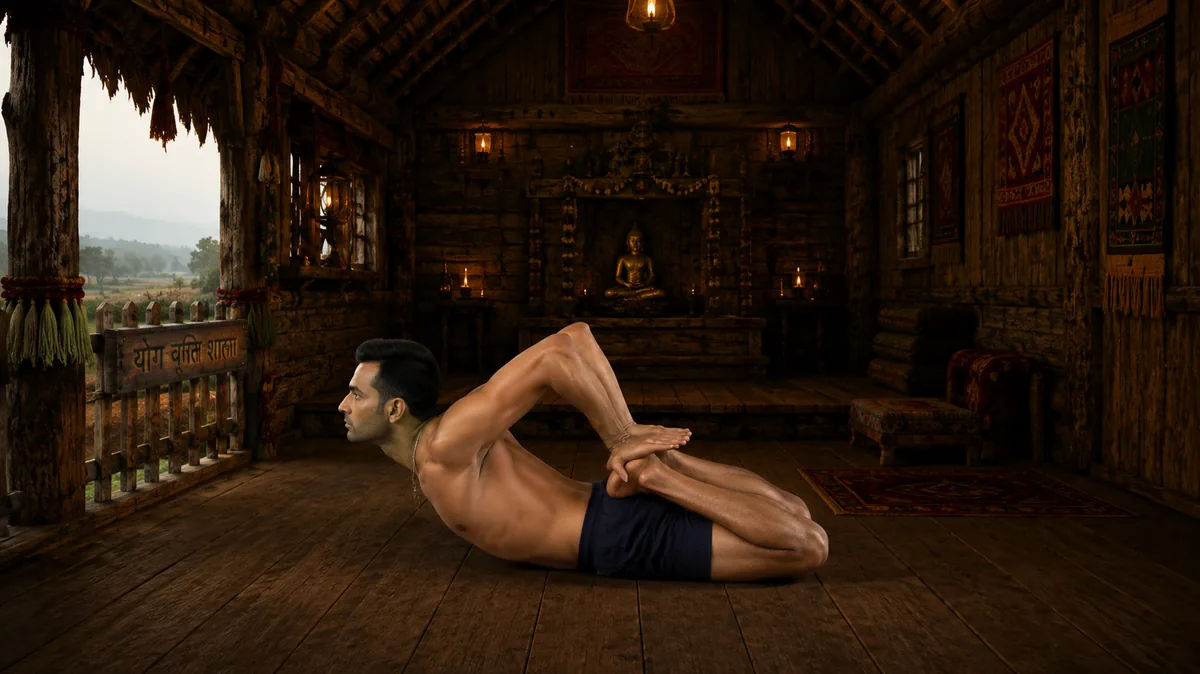
Bhekasana, or Frog Pose, is an advanced prone backbend that profoundly opens the entire front of the body, from the quadriceps and hip flexors to the chest and shoulders. It demands deep flexibility and strength, particularly in the spinal extensors, while simultaneously challenging and liberating the practitioner. This pose works to lengthen the superficial front fascial line, fostering not only physical openness and spinal vitality but also cultivating mental resilience and an expansive heart-centered awareness, allowing for a deeper flow of prana throughout the system.
Frog Pose, also called Bhekasana is a classical yoga posture. Its Sanskrit name Bhekasana translates word-for-word as: Bheka (Frog) · Asana (Pose). In this posture, the body engages the posterior chain against the gentle resistance of gravity. The posture works to strengthen the quadriceps, stretch the hip flexors and open and strengthen the shoulders. Opens the chest and shoulders. Strengthens the back muscles. Suitable for advanced practitioners with developed body awareness, it is a meaningful addition to any practice, particularly beneficial for athletes and runners. A blanket and strap can be used to make the posture more accessible and support correct alignment. Practitioners with ankle injury and knee injury should approach with care or consult a qualified teacher.
Muscles Worked
Quadriceps
[Rectus Femoris, Vastus Lateralis, Medialis, Intermedius]
The muscles on the front of your thighs (quadriceps) receive an intense, sustained stretch as you draw your feet towards your hips.
This action, particularly targeting the Rectus Femoris which crosses both the hip and knee, works to lengthen muscle fibers that are often shortened from sitting, improving knee and hip flexibility.
This deep release frees the anterior aspect of the pelvis, reducing tension that can pull on the lower back and allowing vital energy (prana) to flow unimpeded through the leg channels.
Hip Flexors
[Iliopsoas, Rectus Femoris, Tensor Fasciae Latae]
The deep muscles at the front of the hip (iliopsoas) are profoundly lengthened as the pelvis extends and the thighs lift away from the floor.
Chronic tightness in these muscles, often from prolonged sitting, contributes to restricted hip mobility and lower back pain.
This sustained release creates space in the front of the body, encouraging the pelvis to find a more neutral alignment.
Energetically, releasing the iliopsoas can help unlock deeply stored emotional tension, bringing a sense of lightness and emotional freedom.
Spinal Extensors
[Erector Spinae, Multifidus]
The muscles running along both sides of your spine (erector spinae and multifidus) engage powerfully to lift and extend the trunk, supporting the deep backbend.
They work eccentrically to control the spinal curve, building strength and resilience throughout the entire posterior chain of the spine.
This action enhances spinal vitality and mobility, directly improving posture and counteracting the effects of gravity and forward-flexion.
Yogically, this awakens energy along the sushumna nadi, promoting alertness and mental clarity.
Shoulder Girdle Muscles
[Pectoralis Major/Minor, Anterior Deltoid, Biceps Brachii]
As you reach back to grasp your feet, the muscles across the front of your chest and shoulders (pectoralis major/minor and anterior deltoids) undergo a significant lengthening.
This action helps to counteract rounded shoulders and a collapsed chest, improving upper body posture and creating more space.
The rotator cuff muscles subtly stabilize the shoulder joint, preventing strain.
This expansion of the chest region fosters an opening of the heart center (Anahata Chakra), cultivating feelings of courage, compassion, and emotional openness.
Abdominal Muscles
[Rectus Abdominis, Transverse Abdominis, Obliques]
The superficial abdominal muscles (rectus abdominis) are gently lengthened across the front of the trunk as the spine extends into the backbend.
Simultaneously, the deeper core muscles (transverse abdominis and obliques) engage to provide essential stability to the lumbar spine, preventing over-compression.
This intelligent engagement creates a stable foundation, allowing for a safe and expansive arch in the spine.
This subtle core support allows the chest to lift with integrity, fostering a sense of inner strength and centeredness.
Joints Mobilized
Knee Joint
flexion & compressionThe knee joint (tibiofemoral joint) experiences deep flexion as the heels are drawn towards the hips, creating significant compression on the anterior aspect of the joint.
This movement stretches the anterior joint capsule and quadriceps, enhancing the overall range of motion in the knee.
Careful attention to alignment, ensuring the kneecap (patella) glides smoothly, is crucial to prevent strain.
With mindful practice, this action can improve circulation around the joint, bringing a feeling of warmth and suppleness, ultimately promoting long-term joint health.
Hip Joint
extension & internal rotationThe hip joint (acetabulofemoral joint) moves into significant extension as the thighs lift away from the floor, combined with a subtle internal rotation as the feet are brought inward.
This action deeply stretches the hip flexors and the anterior hip capsule, thereby increasing the range of motion and flexibility in the hips.
This opening releases chronic tightness that often restricts daily movements like walking and standing, improving overall lower body mobility.
From a yogic perspective, deeply opening the hips can release stored emotional patterns, fostering a sense of freedom and fluidity in one's being.
Spine (Vertebral Joints)
extension & mobilizingThe entire spinal column, particularly the thoracic (mid-back) and lumbar (lower back) regions, moves into extension, mobilizing the individual vertebral joints.
This action increases the suppleness and flexibility of the spine, counteracting the stiffness caused by prolonged sitting and forward bending.
The lengthening and strengthening of the spinal muscles surrounding these joints contribute to better posture and reduced back discomfort.
Yogically, a flexible and strong spine is considered paramount for the unhindered flow of prana, enhancing vitality and mental clarity.
Shoulder Joint
extension & external rotationThe shoulder joint (glenohumeral joint) moves into extension and external rotation as the arms reach back to grasp the feet, creating a profound opening across the chest and front of the shoulders.
This movement challenges and improves the mobility of the shoulder girdle, releasing tension in the pectoral muscles and enhancing overall upper body posture.
This expansion creates more physical space for deeper breathing, fostering a sense of openness and freedom in the upper torso.
Energetically, this action stimulates the Anahata Chakra, cultivating qualities of compassion and emotional release.
Organ & System Benefits
Abdominal Organs (Digestive System)
In Bhekasana, the prone position gently compresses the abdominal organs against the floor initially, followed by a release and stretch as the chest lifts and the spine extends.
This creates a subtle internal massage effect on the stomach, intestines, and liver, stimulating circulation and aiding in digestive processes and detoxification.
This gentle internal stimulation can enhance organ function, leading to feelings of lightness and improved metabolic balance.
Yogically, this purification of the internal organs supports the upward flow of prana and enhances overall vitality.
Lungs and Diaphragm (Respiratory System)
As the chest lifts and expands in this deep backbend, the front of the torso and rib cage are significantly stretched, creating more expansive space for the lungs to fully inflate.
This encourages deeper and fuller inhalations, allowing the diaphragm to descend more completely and efficiently.
This increased lung capacity improves oxygen intake and the assimilation of vital energy, leading to a feeling of invigoration and mental clarity.
From a yogic perspective, an open chest and full, uninhibited breath are essential for cultivating prana and calming the fluctuations of the mind.
Nervous System
The deep chest and throat opening in Bhekasana, coupled with the challenging yet sustained nature of the pose, can subtly stimulate the vagus nerve.
This nerve is a primary component of the parasympathetic nervous system, responsible for initiating the body's 'rest and digest' response.
This gentle stimulation can lead to a profound sense of calm and release, effectively reducing feelings of stress and anxiety.
The practitioner often experiences a quietening of the mind and a deeper connection to their inner state of peace.
This advanced pose demands intense body awareness, precise muscular engagement, and a focused gaze, providing rich proprioceptive feedback to the nervous system.
The brain receives detailed information about the body's position and movement in space, significantly enhancing kinesthetic awareness and coordination.
This heightened sensory input grounds the practitioner firmly in the present moment, effectively reducing mental distractions (chitta vritti) and fostering a state of deep, unwavering presence and concentration.
Mental & Emotional
Bhekasana is an intense pose that cannot be forced; it demands profound patience, unwavering breath awareness, and a willingness to surrender to the body's natural opening process.
The practitioner learns to observe physical and mental resistance without reacting, gradually allowing the body to unfold.
This mental discipline cultivated on the mat translates into daily life, fostering resilience and a calm, accepting approach to challenges, teaching the vital lesson of non-attachment to immediate outcomes.
Backbends are inherently heart-opening poses, and Bhekasana is no exception, demanding a degree of vulnerability and courage to expose the front of the body.
Overcoming the physical intensity and any initial mental apprehension cultivates profound inner strength and a sense of fearlessness.
This profound physical and energetic opening can extend beyond the mat, encouraging a more expansive, compassionate, and accepting outlook on life and interactions with others.
Because of Its Shape
backbend
Backbends extend the entire spinal column, directly counteracting the pervasive effects of gravity and modern sedentary lifestyles that often lead to forward flexion and rounded shoulders.
This action strengthens the posterior chain muscles of the back while simultaneously lengthening the anterior chain of the torso, significantly improving posture and spinal health.
Energetically, backbends are considered uplifting and energizing, stimulating the heart and solar plexus chakras, fostering courage, joy, and profound emotional release.
This pose is a powerful hip opener, deeply stretching the hip flexors (iliopsoas) and the anterior hip capsule, releasing chronic tension accumulated from prolonged sitting and standing.
Opening the hips dramatically improves mobility, reduces strain on the lower back, and enhances overall fluidity and ease in movement.
From a yogic perspective, the hips are often considered a repository for emotional tension and unprocessed experiences; their opening can facilitate deep emotional release and a profound feeling of liberation.
The intense opening across the chest and shoulders dramatically expands the space for the lungs, facilitating deeper and more complete breathing and improved oxygenation throughout the body.
This action effectively counteracts slumped posture, promoting an upright, confident, and expansive stance.
Energetically, opening the chest stimulates the Anahata (Heart) Chakra, fostering feelings of compassion, empathy, and a deeper emotional connection to oneself and to the world.
Fascial Lines
In Bhekasana, the entire superficial front line of fascia, a continuous web of connective tissue, undergoes a profound and sustained stretch.
This line extends from the tops of the feet, up the shins, quadriceps, hip flexors, abdominal wall, chest, and finally the front of the shoulders and arms.
This deep unwinding of the interconnected fascial system helps to release long-held restrictions and adhesions, significantly improving overall flexibility and reducing feelings of stiffness and 'stuckness' in the body.
This release facilitates the unhindered flow of prana through the body's energetic channels (nadis), fostering a sense of lightness, freedom, and integration.
Breathing & Respiratory
The prone position and deep backbend in Bhekasana naturally compress the abdomen against the floor, initially making deep diaphragmatic breathing more challenging.
However, as the chest lifts and opens significantly, it encourages a more expansive breath into the upper lobes of the lungs and the side ribs, creating newfound space.
This encourages a conscious, controlled breath, often leading to a finer awareness of the respiratory process and a gentle lengthening of the exhalation, which in turn calms the nervous system.
This mindful breathing, akin to Ujjayi pranayama, is essential for sustaining the pose with ease and deepening the internal yogic experience.
Anatomical Caution
As teachers, we must observe students with great care in Bhekasana, particularly for any signs of strain in the knees, lower back, or shoulders.
Ensure the kneecaps are protected, perhaps with a folded blanket, and that no sharp or pinching pain is felt in any joint.
The intensity of the quadriceps stretch can be overwhelming, so encourage students to respect their body's current limits and always offer a strap to assist if grasping the feet is challenging, prioritizing safety and a gradual, mindful approach.