7
Muscles
3
Joints
2
Organs
2
Mental
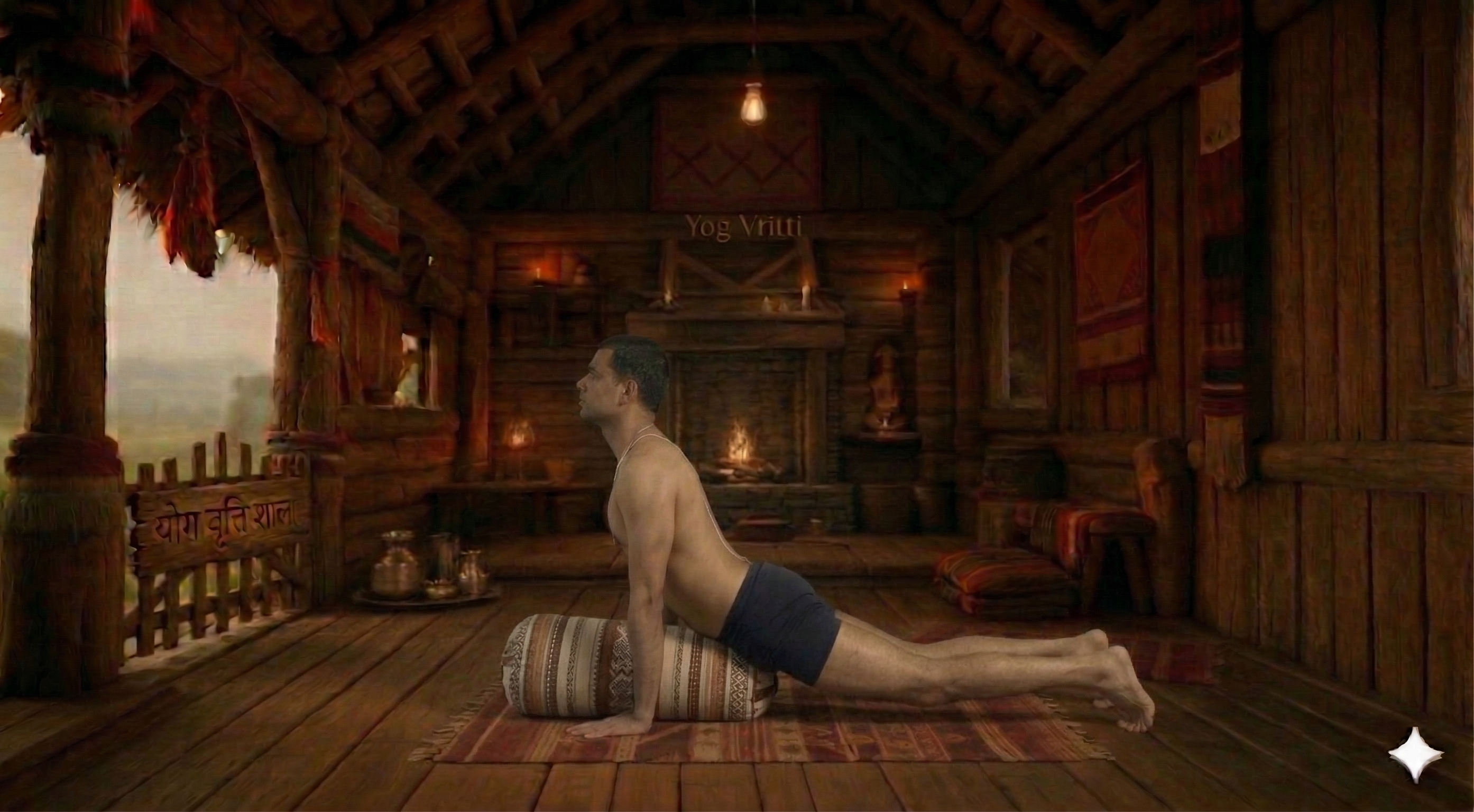
Bhujangasana (with Bolster Support)
भुजंगासन (बोलस्टर सपोर्ट के साथ)
This bolster-supported variation of Bhujangasana transforms the active strength of the root pose into a deeply restorative experience. By cradling the torso, the bolster offers passive support, allowing for a sustained, gentle backbend that reduces muscular effort in the posterior chain. It's an invaluable choice for cultivating profound release, especially for those seeking therapeutic spinal extension or a more introspective heart-opening. Bhujangasana, or Cobra Pose, is a foundational backbend that gently yet profoundly awakens the entire spinal column, promoting both strength in the posterior chain and expansive flexibility in the anterior torso. It engages the deep spinal muscles and gluteals to support the lumbar curve, while simultaneously opening the chest and abdomen, stimulating vital organs. This pose cultivates a sense of upliftment and energetic expansion, making it invaluable for improving posture, easing back discomfort, and fostering a quiet confidence from within.
Supported Cobra Pose, also called Bolster Cobra is a classical yoga posture. Its Sanskrit name Bhujangasana (with Bolster Support) translates word-for-word as: Bhujanga (Cobra / Snake) · Asana (Pose). Performed lying down, the body engages the posterior chain against the gentle resistance of gravity. The posture works to strengthen and extend the back, open the chest and engage the core. Reduces demand on back muscles. Therapeutic for mild back pain. It is particularly valued for alleviating back discomfort and improving overall posture. Suitable for beginners and regular practitioners alike, it is deeply restorative when held with support, particularly beneficial for beginners and seniors. A bolster and blanket can be used to make the posture more accessible and support correct alignment. Practitioners with spinal injury and abdominal surgery should approach with care or consult a qualified teacher.
Helps with
What This Variation Changes
The bolster elevates the chest and upper abdomen, providing continuous, passive support that completely redefines the pose's experience. This physical foundation redistributes the body's weight, allowing the spine to extend and the front body to open without active muscular engagement. Energetically, it shifts the focus from building strength to cultivating surrender and deep, sustained release, transforming the pose into a restorative heart-opener.
Muscles Worked
Spinal Erectors
Instead of actively contracting to lift and sustain the spinal extension, the bolster in this variation cradles the torso, allowing the spinal erectors to soften and release.
This shifts them from a primary role of concentric contraction to one of gentle, passive lengthening over the support, encouraging a sustained opening without muscular strain.
The energetic focus moves from building strength to cultivating release and ease within the spinal column, inviting a deeper sense of surrender.
Gluteals
While still subtly engaged for grounding and to prevent unwanted compression in the lower back, the intense, active contraction of the gluteals seen in the full Bhujangasana to lift the hips and lengthen the tailbone is significantly diminished.
Here, their role becomes more about maintaining a stable foundation and supporting gentle pelvic alignment, allowing the practitioner to release tension rather than exert forceful contraction.
They offer a quiet anchor, encouraging the spinal opening to blossom upwards with ease.
Abdominals
In the supported variation, the abdominal muscles are encouraged to release and lengthen over the bolster rather than actively engage for strong core support against gravity.
While still maintaining a subtle tone to protect the lumbar spine and prevent overstretching, their primary role shifts from active stabilization to one of receptive expansion.
This allows for a deeper, more sustained opening across the front of the body, inviting a sense of spaciousness and ease in the breath and inner organs.
Shoulder Stabilizers
With the chest already lifted and supported by the bolster, the shoulder stabilizers shift from an intense, active retraction to a more subtle role of maintaining broadness and integrity across the collarbones.
Their primary function here is to prevent slumping or hyper-extension, allowing the shoulder blades to gently release down the back, fostering a sustained opening in the chest without unnecessary tension.
This encourages a feeling of effortless expansion rather than forceful engagement, promoting a sense of ease in the upper body.
Triceps
In the bolster-supported variation, the triceps are significantly less engaged in actively pressing the hands down to lift the torso, as the bolster provides the primary elevation.
While they may still offer gentle support if the hands are on the floor, their role shifts from a strong concentric contraction to one of subtle stabilization or even passive lengthening.
This allows for a release of tension in the arms and shoulders, directing the focus inward to the passive opening of the heart space and upper back.
Pectorals
The pectorals, already in a state of lengthening in the root pose, experience an even more profound and sustained opening in the bolster-supported variation.
With the chest gently elevated and held by the prop, these muscles can release more deeply over time, counteracting the effects of prolonged forward-folding and habitual slouching.
This passive, gravitational lengthening encourages the front of the body to soften and expand, fostering a sense of vulnerability and openness in the heart center without active strain.
Intercostals
Musculi intercostales externi et interni
While present in all chest-opening postures, the sustained, passive support of the bolster allows the intercostal muscles to experience a deeper and more prolonged stretch.
This gentle lengthening between the ribs facilitates greater elasticity in the rib cage, fostering a sense of expansive breath without muscular effort.
It encourages a release of habitual tension often held in the respiratory muscles, enhancing both physical and energetic openness in the thoracic cavity and promoting a calmer nervous system.
Joints Mobilized
Spinal Column
mobilizingThe numerous small joints between your vertebrae, known as facet joints, are gently mobilized into extension throughout the entire length of the spine in Bhujangasana.
This action counteracts the common tendency towards spinal flexion (rounding), promoting healthier articulation and lubrication of the vertebral discs.
Regular practice maintains the natural curves of the spine, fostering a sense of suppleness and vitality, allowing for greater freedom of movement and an upright, confident posture.
Shoulder Girdle
stabilizingThe shoulder girdle, comprising the scapulae (shoulder blades) and clavicles (collarbones), is stabilized and gently retracted in Bhujangasana.
By drawing the shoulder blades down and back, you create a broad, open space across the front of the chest, preventing slumping or compression.
This intelligent alignment protects the delicate structures of the shoulder joint and allows for an expansive, unhindered breath, connecting the practitioner to a feeling of spaciousness and ease in the upper body.
Hip Joints
stabilizingIn Bhujangasana, the hip joints (femoroacetabular joints) are held in a relatively neutral position with a slight internal rotation, with the tops of the thighs gently pressing down into the floor.
This grounding action helps to stabilize the pelvis and prevent excessive anterior tilting, which can lead to compression in the lower back.
This firm foundation in the hips cultivates a sense of stability and connection to the earth, allowing for a more focused and intentional upward lift through the spine, fostering a feeling of rootedness and calm.
Organ & System Benefits
Abdominal Organs (Digestive System)
The gentle compression and subsequent release of the abdomen in Bhujangasana provides a subtle massage to the digestive organs, including the stomach, intestines, and liver.
This action can stimulate peristalsis, the muscular contractions that move food through the digestive tract, and encourage healthy blood flow to these vital organs.
From a yogic perspective, this stimulation helps to stoke agni, the digestive fire, promoting efficient digestion, assimilation of nutrients, and the elimination of toxins, leading to greater physical and energetic well-being.
Lungs and Heart
As the chest lifts and broadens in Bhujangasana, the rib cage expands, creating more space for the lungs to fully inflate.
This deep, unhindered inhalation allows for increased oxygen uptake and improved gaseous exchange, benefiting the entire cardiovascular system.
The open heart center, or anahata chakra, is also profoundly affected, promoting a sense of emotional openness and courage.
This physical and energetic expansion can alleviate feelings of constriction, fostering deeper, more nourishing breaths and a greater capacity for compassion.
Nervous System
Initially lying prone on the earth provides a grounding sensation that encourages the nervous system to settle, shifting towards a more parasympathetic state even before the backbend begins.
As the spine extends and the chest opens, the gentle stimulation of the spinal nerves, particularly in the thoracic region, sends signals of awakening and invigoration.
This combination of grounding and gentle activation helps to balance the nervous system, reducing mental chatter (chitta vritti) and fostering a sense of calm alertness.
The sustained, conscious breathing that accompanies Bhujangasana further regulates the nervous system.
The opening of the chest naturally encourages deeper inhalations, which can be subtly energizing without overstimulating.
This mindful breath work helps to soothe anxiety and quiet the 'fight or flight' response, allowing the practitioner to feel more present and at ease in their body.
Cultivating this internal quietude is a direct path to pratyahara, the withdrawal of the senses, leading to deeper states of contemplation.
Mental & Emotional
Bhujangasana cultivates a profound sense of grounded presence, as the body is firmly rooted to the earth while the spine lifts with grace.
This dual action helps to quiet the restless mind, drawing attention away from external distractions and inward towards the sensations of the breath and body.
This practice of dharana, or concentration, strengthens one's ability to focus and be fully embodied, fostering a sense of mental clarity and calm amidst life's demands.
The gentle heart-opening quality of Bhujangasana can subtly shift one's mental state from introspection or guardedness towards a feeling of quiet confidence and openness.
As the chest expands, it often correlates with a release of emotional tension held in the front body.
This physical release can translate into a psychological shift, allowing for a greater capacity for courage, vulnerability, and compassionate self-acceptance, encouraging a more expansive outlook on life.
Because of Its Shape
backbend
Backbends, by their very nature, extend the spine, counteracting the pervasive tendency to slouch and round forward in daily life.
This action helps to restore the natural curves of the spine, improving overall postural alignment and relieving pressure on the vertebral discs.
Anatomically, it strengthens the posterior chain of muscles while lengthening the anterior torso, creating balance and resilience in the trunk.
Energetically, backbends are considered uplifting and heart-opening poses, directly stimulating the anahata chakra, the energy center associated with love, compassion, and joy.
This opening can help to release stored emotional tension and cultivate a sense of courage and expansiveness.
The activation of the sympathetic nervous system in a controlled manner can also be invigorating, awakening a sense of vitality and inner strength.
The therapeutic benefit of backbends like Bhujangasana extends to improving respiratory function by expanding the rib cage and allowing deeper breaths.
This increased oxygenation supports overall bodily functions and calms the nervous system.
For a teacher, understanding this allows them to guide students not just into a shape, but into an experience of physical liberation and energetic awakening.
Fascial Lines
The fascial network, that intricate web of connective tissue encapsulating every muscle, organ, and bone, is profoundly influenced in Bhujangasana.
The Superficial Front Line (SFL) of fascia, which runs from the tops of the feet up the front of the body to the skull, receives a gentle, sustained lengthening as the chest and abdomen lift.
Simultaneously, the Superficial Back Line (SBL) is toned and strengthened, particularly along the spine.
This dual action helps to release chronic restrictions in the anterior body, which often contribute to poor posture, while invigorating the posterior chain, allowing for a more integrated and fluid sense of movement and energy flow throughout the body's energetic channels (nadis).
Breathing & Respiratory
In Bhujangasana, the physical act of lifting the chest away from the floor naturally encourages a deeper and fuller inhalation, as the rib cage expands and the diaphragm has more space to descend.
The gentle pressure of the abdomen against the floor on the exhalation can also help to draw out a longer, more complete release of breath.
This natural deepening of respiration enhances oxygenation and calms the nervous system.
Practicing Ujjayi breath (victorious breath) here can amplify the internal heat and focus, extending the energetic benefits of the pose and fostering greater internal awareness.
Anatomical Caution
Always guide students to listen to their lower back in Bhujangasana; if any sharp pain is felt, they should immediately reduce the lift or come out of the pose.
Remind them to keep the tops of the feet and thighs grounded to protect the lumbar spine from compression.
Also, cue them to lengthen the back of the neck and keep the gaze soft, avoiding excessive hyperextension that can strain the cervical vertebrae.