Benefits· लाभ
What Staff Pose with Strap does for you
Dandasana with Strap · दण्डासन स्ट्रैप
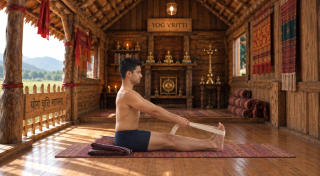
The Dandasana with Strap variation introduces a fundamental Iyengar prop to enhance accessibility and refine alignment in this foundational posture. By looping a strap around the feet, practitioners can achieve a deeper, more supported lengthening of the hamstrings and a more effortless elevation of the spine.
What this version changes: The strap serves as a crucial bridge, physically connecting the hands to the feet, thereby extending the reach and leverage of the arms. This allows the practitioner to maintain an upright, elongated spine while gently encouraging the hamstrings to release and the legs to straighten. It subtly redistributes the effort, shifting the focus from muscular force to intelligent alignment, making the pose more accessible and profound for those with tighter hamstrings or less developed core strength.
Muscles
- Hamstringsstretches
- Spinal Erectorsstabilises
Joints
- Hip Jointsmobilises
- Knee Jointsstabilises
- Spinedecompressing
- Ankle Jointsstabilises
Inside the body
- Abdominal Organs
- Lungs
- Breathing
Mind
Dandasana inherently cultivates unwavering focus and concentration (dharana) as you meticulously align each part of your body.
Take care
Teachers should always prioritize spinal integrity over leg extension in Dandasana.
If students have very tight hamstrings, forcing the legs straight will invariably lead to rounding of the lower back, which can strain the lumbar spine. Encourage them to sit on a folded blanket or block to elevate the hips, or even allow a soft bend in the knees, ensuring the spine remains long and neutral. The pose is about establishing a strong, upright foundation, not achieving a particular shape at the expense of safety.
Muscles
Hamstrings
StretchesWhile Dandasana inherently lengthens the hamstrings, the strap acts as an extension of the arms, allowing a gentle, sustained pull without compensatory rounding of the lower back.
Read moreShow less
This assistance permits a more accessible and profound release in the posterior thigh muscles, fostering a gradual increase in flexibility rather than forceful stretching.
It encourages the legs to root more effectively into the floor, promoting deeper extension without compromising spinal integrity.
The strap ensures the lengthening is initiated from the pelvis, rather than through flexion of the spine.
Spinal Erectors
StabilisesThe strap's engagement, by allowing the hamstrings to release more readily, indirectly supports the spinal erectors in their primary role of extending the spine.
Read moreShow less
Instead of struggling against tight hamstrings which can pull the pelvis into a posterior tilt, these muscles can work more efficiently to lift the trunk vertically.
This creates a sensation of lightness and sustained lift through the vertebral column, encouraging the natural curves of the spine to align without undue effort.
The support from the strap allows for a more refined and less strenuous activation, promoting sustained height.
Joints
Hip Joints
MobilisesThe ball-and-socket joints of your hips (acetabulofemoral joints) are positioned in a neutral, slightly flexed state in Dandasana, allowing for optimal alignment of the pelvis.
Read moreShow less
This pose encourages the femoral heads to seat deeply within the hip sockets, promoting stability and healthy joint articulation.
Regular practice helps to maintain mobility and prevent stiffness in the hips, which can impact the lower back.
Energetically, this pose helps to release stagnation in the hip region, fostering a sense of freedom and openness.
Knee Joints
StabilisesYour knee joints (tibiofemoral and patellofemoral) are actively extended in Dandasana, with the quadriceps engaged to protect and stabilize them.
Read moreShow less
The action of pressing the heels away and lifting the kneecaps ensures proper tracking of the kneecap (patella) and alignment of the tibia and femur.
This mindful engagement strengthens the supporting musculature around the knees, promoting stability and preventing hyperextension.
The clarity and straightness cultivated in the knees translate to a focused and unwavering lower body.
Spine
DecompressingThe entire length of your spine, particularly the lumbar and thoracic vertebral joints, experiences gentle decompression and lengthening in Dandasana.
Read moreShow less
By actively lifting the torso from the pelvis and engaging the spinal erectors, space is created between the intervertebral discs, alleviating compression.
This sustained effort strengthens the postural muscles, improving spinal integrity and preventing slouching.
Yogically, this upward lengthening aligns the central energy channel (sushumna nadi), promoting mental clarity and a feeling of inner lightness.
Ankle Joints
StabilisesYour ankle joints (talocrural joints) are held in a neutral dorsiflexion in Dandasana, with the feet flexed and heels pressing away.
Read moreShow less
This engagement helps to lengthen the Achilles tendons and the muscles of the calves, promoting flexibility in the ankles.
This action also grounds the lower body, creating a strong connection to the earth through the heels and the balls of the feet.
This mindful awareness of the feet enhances overall balance and proprioception, anchoring the body and mind.
Inside the body
Abdominal Organs
In Dandasana, the upright and stable posture of the torso provides a neutral environment for the abdominal organs.
Read moreShow less
The gentle engagement of the core muscles offers a subtle, internal support without active compression or twisting.
This allows for optimal function of the digestive system, as there is no undue pressure to impede organ activity.
Energetically, this stable environment helps to balance Samana Vayu, promoting healthy digestion and assimilation, and fostering a sense of internal harmony.
Lungs
The elongated and uncompromised spine in Dandasana allows for the full and unimpeded movement of your diaphragm and the expansion of your rib cage, creating optimal space for your lungs.
Read moreShow less
This encourages deeper, more complete breaths, enhancing oxygen intake and carbon dioxide release.
The expansive chest cultivates a sense of openness and vitality, directly impacting your prana (life force) and calming the nervous system.
This posture inherently supports a more mindful and restorative breathing pattern.
Breathing
Dandasana's upright and stable spinal alignment naturally creates optimal conditions for a full, expansive breath.
Read moreShow less
With the torso lifted and the rib cage unconstrained, the diaphragm has its full range of motion, inviting deeper inhalations and complete exhalations.
This pose is inherently conducive to a calm, even breath (sama vritti), which can be further enhanced with practices like Ujjayi pranayama.
The steady breath cultivated here calms the nervous system, deepens concentration, and supports the even distribution of prana throughout the body.
Fascia (connective tissue)
In Dandasana, the intricate web of connective tissue known as fascia is gently elongated along the entire posterior chain, particularly the superficial back line.
Read moreShow less
As the hamstrings lengthen and the spine extends upwards, this fascial network, running from the soles of the feet up the back of the legs, pelvis, and spine, receives a sustained, intelligent stretch.
This release helps to unwind chronic tension patterns and adhesions within the fascial system, improving overall flexibility and allowing for a freer, more uninhibited flow of energy and movement throughout the entire body.
Mind and nervous system
- Nervous system
The steady, grounded foundation and the upright, expansive posture of Dandasana send signals of safety and stability to your brain, gently activating the parasympathetic nervous system.
Read moreShow less
This shift helps to calm the "fight or flight" response, reducing feelings of anxiety and promoting a profound sense of inner peace.
As the breath becomes more regulated and the body finds stillness, the mind's fluctuations (chitta vritti) begin to subside, allowing for deeper relaxation and mental clarity.
Dandasana is a master teacher of proprioception, the body's awareness of its position in space, as it demands precise, subtle adjustments to maintain alignment.
Read moreShow less
The sustained engagement of numerous muscle groups and the connection to the earth through the sit bones heighten your internal body map.
This heightened awareness brings your mind fully into the present moment, fostering dharana (concentration) and deepening your connection to the intelligence of your physical form.
- Mind & mood
Dandasana inherently cultivates unwavering focus and concentration (dharana) as you meticulously align each part of your body.
Read moreShow less
The subtle yet constant effort required to maintain spinal length, leg engagement, and a neutral pelvis keeps the mind tethered to the present moment and the sensations within the pose.
This practice of sustained attention strengthens mental discipline, gradually quieting the external chatter and preparing the mind for deeper states of meditation.
It teaches us to be fully present with what is.
Holding Dandasana with integrity, especially as the hamstrings lengthen, requires a profound cultivation of patience and inner steadiness (sthira).
Read moreShow less
It's a practice of meeting sensation without reacting, breathing through subtle discomfort to find moments of ease (sukham).
This embodied understanding of "sthira sukham asanam" teaches us to approach challenges in life with a calm and resilient mindset, fostering inner strength and a non-reactive presence.
Dandasana is a powerful anchor, fostering a deep sense of grounding and mental centering.
Read moreShow less
The firm connection of the sit bones to the earth provides a stable foundation, counteracting feelings of restlessness or being unmoored.
This physical stability translates directly into a more centered and balanced mental state, allowing scattered thoughts to settle and bringing a profound sense of inner calm.
It establishes the base from which all other actions can arise with clarity.
Because it is a seated pose
This fundamental seated shape provides a stable base directly connected to the earth, allowing the spine to lengthen upwards with less muscular effort than standing poses.
Read moreShow less
Anatomically, it encourages a neutral pelvis and optimal spinal alignment, which are crucial for overall posture and internal organ health.
Energetically, this shape cultivates apana vayu (downward-moving energy), fostering a profound sense of rootedness and inner calm, making it ideal for contemplative practices.
The deliberate action of lengthening the spine upwards from the tailbone to the crown of the head actively creates space between each vertebra.
Read moreShow less
This gentle, self-induced traction helps to decompress the intervertebral discs and strengthens the deep postural muscles, significantly improving overall spinal health and upright posture.
Yogically, this vertical alignment activates prana vayu, fostering mental clarity, alertness, and an expansive feeling in the chest and mind, connecting earth and sky.