Benefits· लाभ
What One-Legged Koundinya's Pose II does for you
Eka Pada Koundinyasana II · एक पाद कौण्डिन्यासन II
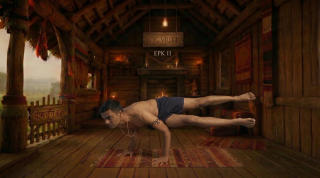
Eka Pada Koundinyasana II, or Flying Splits II, dramatically shifts the body's orientation from a horizontal plane to a more dynamic, upward-angled 'flying split' posture. This variation challenges the practitioner to actively lift the torso and legs higher off the ground, emphasizing a profound and active opening in the hips and hamstrings in a new dimensional plane.
What this version changes: The primary positional change in Eka Pada Koundinyasana II is the profound shift from a horizontal to a more diagonal, upward-angled body alignment. This fundamental alteration in leverage and weight distribution on the supporting arms and core demands a heightened, more dynamic engagement of the deep abdominal wall to actively elevate the torso and legs. The energetic focus transforms from maintaining horizontal stability to actively lifting, extending, and expanding, cultivating a powerful sense of buoyancy and flight.
Muscles
- Deep Abdominal Wallstrengthens
- Shoulder Stabilizersstabilises
- Wrist and Forearm Musclesstabilises
- Hip Flexorsstrengthens
- Hamstringsstretches
Joints
- Wrist Jointsstabilises
- Shoulder Girdlestabilises
- Spinal Columnmobilises
- Hip Jointmobilises
Inside the body
- Abdominal Organs (Digestive and Excretory Systems)
- Circulatory System
- Breathing
Mind
Eka Pada Koundinyasana I is a powerful teacher of mental fortitude and courage, inviting practitioners to confront and move beyond perceived limitations.
Take care
The deeper hip extension and flexion required for the 'flying split' in Eka Pada Koundinyasana II necessitates particular attention to the mobility and stability of the hip joints and hamstrings.
Practitioners with pre-existing tightness or any impingement in these areas should approach with heightened awareness, ensuring full and safe range of motion is achieved through thorough preparation to prevent strain or injury in the hip complex or hamstring attachments.
Muscles
Deep Abdominal Wall (Core)
StrengthensIn Eka Pada Koundinyasana I, the core's primary role is to stabilize the torso in a strong, horizontal line.
Read moreShow less
For Eka Pada Koundinyasana II, the deep abdominal wall must engage with heightened intensity to actively lift the torso and legs against gravity, creating a distinct diagonal line from the hands to the crown of the head.
This demands a more dynamic and sustained contraction from the rectus abdominis and obliques, transforming the action from pure horizontal stabilization to active upward elevation and expansive lift.
Shoulder Stabilizers
StabilisesWhile both poses require immense shoulder integrity, Eka Pada Koundinyasana II often presents a different leverage challenge for the scapular stabilizers and rotator cuff muscles.
Read moreShow less
With the torso potentially more upright and the front leg frequently hooked over an arm rather than simply resting, the shoulder joint experiences altered angles of weight bearing and rotational forces.
This necessitates a more specific activation of muscles like the serratus anterior and lower trapezius to robustly protract and depress the scapulae, creating a stable, elevated platform for a body that is actively 'flying' upwards.
Wrist and Forearm Muscles
StabilisesThe changed angle of the body and the altered center of gravity in Eka Pada Koundinyasana II means the wrists and forearms must adapt to a significantly different distribution of weight and pressure.
Read moreShow less
While still providing foundational grounding, the specific points of eccentric loading and compressive force shift, requiring a more nuanced and intelligent engagement from the intrinsic hand muscles and forearm extensors.
This ensures the wrist joint maintains its integrity and stability, preventing hyperextension under the new, dynamic leverage points.
Hip Flexors (Lifted Leg)
StrengthensIn Eka Pada Koundinyasana II, the front leg is actively and often more profoundly lifted, frequently hooking over the arm, demanding a greater degree of sustained hip flexion.
Read moreShow less
This requires a more powerful and enduring contraction from the primary hip flexors, particularly the iliopsoas and rectus femoris, to achieve and maintain this elevated position against gravity.
The emphasis shifts from a supported resting position to an active, powerful, and sustained lift, integrating strength with the expansive opening of the hip.
Hamstrings (Lifted Leg)
StretchesThe back leg in Eka Pada Koundinyasana II extends more dramatically and often at a higher, more acute angle relative to the ground, embodying the 'flying split' aspect of the pose.
Read moreShow less
This places a significantly more intense and active lengthening demand on the hamstrings (biceps femoris, semitendinosus, semimembranosus) to achieve full extension and elevation.
The stretch is not only deeper but also more active, requiring concurrent engagement to maintain the lift, thereby integrating profound flexibility with dynamic strength in an expanded range of motion.
Joints
Wrist Joints
StabilisesThe radiocarpal and midcarpal joints of the wrists bear significant body weight in this arm balance, requiring robust stability and careful alignment.
Read moreShow less
The bones and ligaments of the wrist are meticulously engaged to create a strong yet supple foundation, distributing pressure evenly across the palm and fingers.
With consistent, mindful practice, this weight-bearing strengthens the connective tissues around the wrist, enhancing joint integrity and resilience, and cultivating a deep sense of groundedness and trust in one's own support system.
Shoulder Girdle (Scapulothoracic and Glenohumeral)
StabilisesThe shoulder girdle, comprising the scapulothoracic joint (shoulder blade on rib cage) and the glenohumeral joint (arm bone in shoulder socket), is intensely stabilized to support the entire upper body.
Read moreShow less
The muscles surrounding these joints create a firm, integrated unit, preventing excessive movement and protecting the joint capsules.
This active stabilization fosters a sense of empowerment and courage, allowing the practitioner to feel strong and secure in their own structure, while also promoting better posture and mobility in daily life.
Spinal Column (Thoracic and Lumbar)
MobilisesThe vertebral joints of the thoracic and lumbar spine undergo a significant rotational action, creating the core twist that defines this pose.
Read moreShow less
This rotation, combined with axial extension, helps to mobilize the individual vertebrae, increasing their range of motion and improving spinal flexibility.
Energetically, this twisting action is believed to 'wring out' stagnation from the internal organs, stimulating circulation and awakening the energy centers (chakras) along the spine, leading to a feeling of refreshed vitality and mental clarity.
Hip Joint (Acetabulofemoral)
MobilisesThe hip joint of the extended leg is actively mobilized into flexion and abduction, requiring both strength from the hip flexors and flexibility in the hamstrings and inner thighs.
Read moreShow less
This dynamic engagement helps to improve the range of motion in the hip, releasing tightness that often accumulates from prolonged sitting.
By creating space and freedom in the hips, practitioners can experience a release of stored emotional tension, allowing for a greater sense of openness and fluidity in movement and being.
Inside the body
Abdominal Organs (Digestive and Excretory Systems)
The deep twist in Eka Pada Koundinyasana I creates a gentle, compressive massage for the abdominal organs, including the stomach, intestines, liver, and kidneys.
Read moreShow less
This 'wringing out' action is believed to stimulate blood flow and lymphatic drainage, aiding in detoxification and improving digestive and excretory functions.
From a yogic perspective, this internal cleansing helps to purify the nadis (energy channels), fostering a sense of lightness and vitality throughout the entire body.
Circulatory System
While not a full inversion, the posture subtly shifts the relationship of the head to the heart, creating a mild gravitational assist for venous return from the lower body.
Read moreShow less
The intense muscular engagement, particularly in the core and limbs, also acts as a pump, encouraging efficient blood flow throughout the body.
This invigorated circulation brings fresh, oxygenated blood to the tissues, enhancing cellular function and contributing to an overall feeling of energy and well-being, aligning with the yogic concept of vitalizing prana.
Breathing
The twisting and compressive nature of Eka Pada Koundinyasana I naturally restricts the expansive movement of the rib cage and diaphragm, demanding a more focused and controlled breath.
Read moreShow less
Practitioners learn to breathe deeply and smoothly into the back and sides of the lungs, utilizing the intercostal muscles and engaging the diaphragm with greater intention.
This conscious, rhythmic breathing (ujjayi pranayama is highly complementary) helps to maintain mental calm and physical stability in a challenging pose, demonstrating how control over prana (life force) through breath can sustain and deepen the asana, transforming effort into ease.
Fascia (connective tissue)
The intricate fascial network, a continuous web of connective tissue encapsulating muscles, bones, and organs, is deeply engaged and integrated in Eka Pada Koundinyasana I.
Read moreShow less
The Spiral Line fascia, running from the head down one side of the torso, across the front of the hips, and up the opposite leg, is particularly strengthened and released through the twisting and extending actions.
This holistic engagement helps to untangle fascial restrictions, improving overall body elasticity and fluidity, and in yogic terms, facilitates the unobstructed flow of prana through the body's subtle channels, promoting a sense of seamless unity and ease.
Mind and nervous system
- Nervous system
This advanced balance pose demands absolute mental focus, drawing the mind away from external distractions and deeply into the present moment.
Read moreShow less
The intense concentration required for balance and coordination helps to quiet the 'chitta vritti' – the fluctuations of the mind – fostering a state of deep meditative awareness.
As the breath becomes steady and controlled despite the physical challenge, the parasympathetic nervous system is subtly engaged, bringing a sense of calm resilience amidst effort, leading to a profound feeling of inner peace and presence.
The intricate coordination of strength and balance in Eka Pada Koundinyasana I stimulates proprioceptors throughout the body, enhancing spatial awareness and body-mind connection.
Read moreShow less
This heightened sensory input refines the nervous system's ability to interpret and respond to the body's position in space, improving overall coordination and agility.
Over time, this practice cultivates a more integrated nervous system, leading to greater mental clarity and a quiet confidence that extends beyond the mat, making one more grounded and responsive in daily life.
- Mind & mood
Eka Pada Koundinyasana I is a powerful teacher of mental fortitude and courage, inviting practitioners to confront and move beyond perceived limitations.
Read moreShow less
The initial challenge often brings up fear or self-doubt, but by patiently approaching the pose with dedication and a calm mind, students learn to trust their strength and inner wisdom.
This process of overcoming mental barriers cultivates an unwavering resolve (dharana) and a deep sense of accomplishment, reinforcing the belief that with consistent effort, any goal is attainable.
This posture demands intense concentration, acting as a form of moving meditation that draws the mind inward, away from external distractions.
Read moreShow less
The precise alignment and synchronized breath required for balance and stability compel the practitioner to be fully present, quieting the constant chatter of the mind.
Cultivating this deep focus not only refines the pose but also trains the mind to be more attentive and less reactive in everyday life, fostering a state of mental clarity and emotional equilibrium (pratyahara).
Because it is a balance pose
Arm balances like Eka Pada Koundinyasana I dramatically enhance core strength and stability, as the entire body's weight is supported through the arms and torso.
Read moreShow less
This requires profound engagement of the deep abdominal muscles and stabilizers around the shoulders, forging an integrated foundation.
Anatomically, this builds muscular endurance and joint resilience in the upper body, while yogically, it cultivates a deep sense of inner equilibrium, helping practitioners feel grounded and centered even amidst challenge, translating to mental steadiness.
Developing proficiency in arm balances fosters an incredible sense of mental focus and presence, as even a momentary lapse in concentration can disrupt the pose.
Read moreShow less
This intense requirement for 'dharana' (concentration) trains the mind to be sharp, alert, and fully immersed in the present moment, quieting the usual mental chatter.
The physical act of balancing then becomes a metaphor for balancing life's demands, empowering the practitioner with greater mental agility and a calm, unwavering resolve.