6
Muscles
5
Joints
2
Organs
3
Mental
Eka Pada Pranamasana
एक पाद प्रणामसन
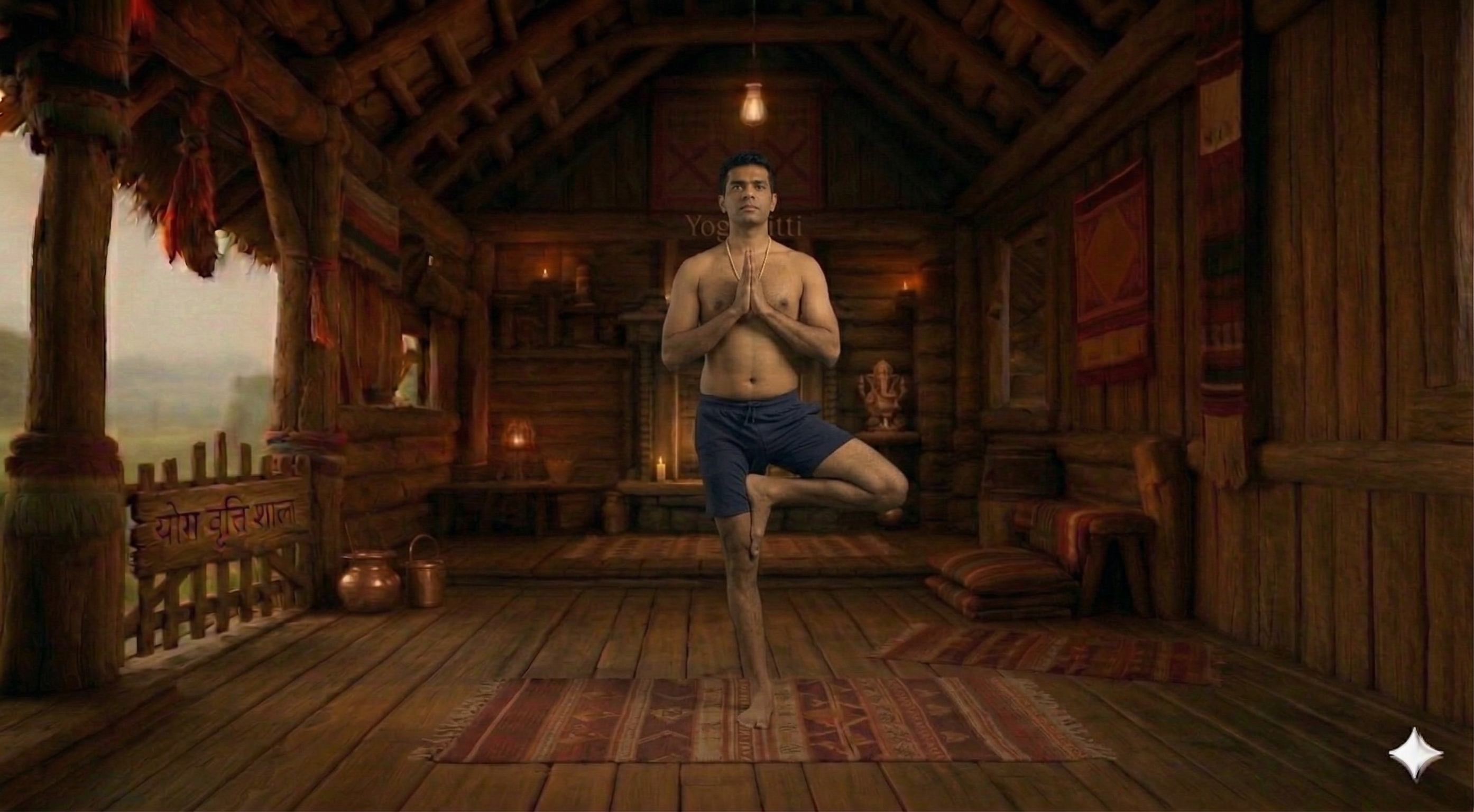
Eka Pada Pranamasana, or One-Legged Prayer Pose, is a profound journey into balance and inner stability, demanding a conscious integration of strength and surrender. This standing asana dynamically engages the entire standing leg – from the intricate ankle stabilizers to the powerful quadriceps and glutes – while gently opening the hip of the lifted leg. It cultivates a deep sense of grounding through the earth-bound foot, simultaneously inviting an upward energetic lift through the crown of the head. For the dedicated practitioner, it is a moving meditation that refines proprioception, steadies the fluctuations of the mind, and fosters a quiet yet powerful inner resolve.
Standing Praying Pose, also called Tree Pose Variation is a classical yoga posture. Its Sanskrit name Eka Pada Pranamasana translates word-for-word as: Eka (One) · Pada (Foot / Leg) · Pranamasana (Pranamasana) · Asana (Pose). From a standing position, the body roots firmly through the feet while the spine extends upward. The posture works to strengthen the quadriceps, activate the glutes and lengthen the hamstrings. Strengthens the standing leg. Opens the hip of the lifted leg. It is particularly valued for improving overall posture and building full-body strength. Suitable for intermediate practitioners with foundational yoga experience, it is a meaningful addition to any practice, particularly beneficial for beginners. A wall can be used to make the posture more accessible and support correct alignment. Practitioners with knee injury and ankle injury should approach with care or consult a qualified teacher.
Helps with
Muscles Worked
Quadriceps (standing leg)
[Rectus Femoris, Vastus Lateralis, Vastus Medialis, Vastus Intermedius]
The large muscles on the front of your standing thigh (quadriceps) are powerfully engaged, working to extend and stabilize the knee joint.
This active engagement creates a firm foundation, preventing the knee from collapsing and protecting its integrity under weight.
Energetically, this firming action cultivates a sense of unwavering determination and strength, building a solid base for the entire posture.
It teaches the leg to be both strong and intelligently yielding.
Glutes (standing leg)
[Gluteus Maximus, Medius, Minimus]
The powerful muscles of your standing buttock (glutes) are crucial for stabilizing the hip and pelvis, preventing any lateral sway or misalignment.
Specifically, Gluteus Medius and Minimus work tirelessly to keep the pelvis level and the femur centered in the hip socket, providing a sense of rootedness.
This deep engagement grounds the lower body, allowing the upper body to feel light and expansive, fostering a sense of inner security and balance.
Hamstrings (standing leg)
[Biceps Femoris, Semitendinosus, Semimembranosus]
While not primarily lengthening, the muscles on the back of your standing thigh (hamstrings) are eccentrically engaged, providing crucial dynamic stability to the knee joint in conjunction with the quadriceps.
They subtly resist hyperextension, creating a balanced tension across the knee.
This nuanced action brings awareness to the entire posterior chain, contributing to the overall steadiness and intelligent engagement of the standing leg, preventing rigidity and encouraging a fluid strength.
Core Muscles
[Transversus Abdominis, Obliques, Erector Spinae]
The deep muscles of your abdomen and back (Transversus Abdominis, Obliques, Erector Spinae) are continuously active, creating a strong, supportive cylinder around your trunk.
This engagement lengthens the spine, lifts the rib cage, and prevents slumping or arching, allowing for optimal breath and spinal health.
From a yogic perspective, this core engagement cultivates an inner axis, a central channel of energy (sushumna nadi), fostering mental clarity and a sense of upright dignity.
Ankle Stabilizers (standing leg)
[Peroneals, Tibialis Anterior, Tibialis Posterior]
The small but mighty muscles surrounding your standing ankle (Peroneals, Tibialis Anterior, Tibialis Posterior) are constantly making micro-adjustments to maintain your equilibrium.
They respond instantaneously to shifts in weight, preventing wobbling and keeping the foot firmly rooted.
This continuous, subtle effort sharpens your proprioception and refines your connection to the earth, teaching the body to be both responsive and utterly steady, cultivating a deep sense of trust in your own foundation.
Hip Flexors (lifted leg)
[Iliopsoas, Rectus Femoris]
The deep muscles at the front of your lifted hip (Iliopsoas, Rectus Femoris) experience a gentle but sustained lengthening as the knee draws out to the side for the foot placement.
This mindful release helps to open the front of the hip joint, counteracting the effects of prolonged sitting and promoting greater range of motion.
Energetically, releasing tension in this area can free up blocked energy in the pelvic region, promoting a sense of ease and fluidity in the lower body.
Joints Mobilized
Ankle Joint (standing leg)
weight bearingThe ankle joint of the standing leg bears the full weight of the body, making continuous, subtle adjustments (dorsiflexion, plantarflexion, inversion, eversion) to maintain balance.
This dynamic weight-bearing strengthens the ligaments and musculature around the joint, improving its stability and resilience.
Through this intricate dance of balance, the ankle becomes a sensitive conduit to the earth, enhancing proprioception and cultivating a deep sense of groundedness.
Knee Joint (standing leg)
stabilizingThe knee joint of the standing leg is held in a neutral, extended position, requiring precise muscular engagement from both the quadriceps and hamstrings to prevent hyperextension or collapse.
This intelligent stabilization strengthens the surrounding muscles and ligaments, promoting healthy alignment and reducing strain.
The steady, firm yet soft quality in the knee reflects a balanced mind, neither rigid nor lax, fostering a sense of unwavering internal support.
Hip Joint (standing leg)
stabilizingThe standing hip joint is a central fulcrum for the entire pose, requiring significant stabilization from the surrounding gluteal and core muscles to keep the pelvis level and the femur centered.
This deep engagement strengthens the joint's supporting structures, improving its long-term health and mobility.
A stable standing hip provides a powerful foundation, allowing the upper body to extend upwards freely, symbolizing the unwavering core strength needed to navigate life's challenges.
Hip Joint (lifted leg)
mobilizingThe hip joint of the lifted leg undergoes external rotation and flexion, opening the inner groin and front of the hip.
This gentle mobilization increases the range of motion in the hip capsule, releasing stiffness and improving circulation to the area.
From a yogic perspective, opening the hips can release stored emotional tension, promoting a sense of freedom and emotional spaciousness within the pelvic bowl, allowing energy to flow more freely.
Sacroiliac Joint (SI Joint)
stabilizingThe Sacroiliac (SI) joint, located at the base of the spine where the sacrum meets the pelvis, is actively stabilized by the engagement of the glutes and deep core muscles.
This intelligent co-activation helps to maintain the integrity and neutral alignment of the pelvis, preventing excessive movement or strain in this often-vulnerable area.
A stable SI joint contributes to a feeling of deep core support and an unshakeable foundation, both physically and energetically.
Organ & System Benefits
Digestive Organs (Stomach, Intestines)
The upright posture and gentle engagement of the core muscles in Eka Pada Pranamasana provide a subtle lift and toning to the abdominal region.
This light internal compression and release, supported by deep diaphragmatic breathing, can stimulate peristalsis and improve circulation to the digestive organs.
This energetic activation helps to clear stagnation and promote healthy digestion and elimination, allowing for a lighter and more energetic feeling in the belly.
Heart and Lungs
Maintaining an upright, balanced posture with an open chest in this asana creates optimal space for the heart and lungs to function efficiently.
The unconstrained rib cage allows for deeper, fuller breaths, enhancing oxygen intake and promoting healthy cardiovascular circulation.
Yogically, this open-hearted posture cultivates a sense of courage, compassion, and inner spaciousness, inviting the flow of prana to nourish the entire system and calm the mind.
Nervous System
Eka Pada Pranamasana intensely engages your body's proprioceptors (sensors in muscles and joints) and the vestibular system (inner ear, for balance).
The constant, subtle adjustments required to stay upright heighten your awareness of your body's position in space, refining your internal map.
This deep sensory feedback helps to integrate the physical and mental bodies, fostering a profound sense of presence and self-awareness.
The focused concentration and steady breath required to maintain balance in this pose actively engage the parasympathetic nervous system, promoting a state of calm and relaxation.
As you find your equilibrium, the fight-or-flight response diminishes, allowing for a release of tension held in the body and mind.
This shift cultivates a quiet inner stillness, reducing anxiety and promoting a sense of inner peace and resilience.
The inherent challenge of balancing on one leg demands unwavering attention, seamlessly linking physical effort with mental focus.
This integration of mind and body helps to quiet the incessant chatter of the mind (chitta vritti), drawing awareness inward and fostering a state of dharana, or concentration.
Regular practice strengthens this connection, leading to greater mental clarity and emotional stability both on and off the mat.
Mental & Emotional
The very essence of Eka Pada Pranamasana demands unwavering mental focus, as even a momentary lapse can disrupt balance.
This sustained attention trains the mind to stay present and centered, developing the yogic quality of Dharana.
As you steadily root down and lift up, the mind becomes a mirror reflecting the body's unwavering steadiness, leading to profound mental clarity and a quiet inner resolve.
Mastering balance takes time, patience, and persistent effort, teaching the practitioner the invaluable lessons of perseverance and non-attachment to immediate results.
Each wobble becomes an opportunity to re-center and refine, fostering a resilient spirit that doesn't shy away from challenge.
This cultivation of inner strength translates into greater self-confidence and the ability to gracefully navigate life's inevitable ups and downs.
By demanding complete attention to the present moment, Eka Pada Pranamasana naturally draws the senses inward (Pratyahara), away from external distractions.
As the body finds its point of equilibrium, the mind too settles into a state of quietude and presence.
This profound inner stillness allows for a deeper connection to one's true self, fostering a sense of calm and centeredness that extends beyond the mat.
Because of Its Shape
balance
Eka Pada Pranamasana is fundamentally a balance pose, challenging the body's entire proprioceptive and vestibular systems.
This continuous micro-adjustment strengthens the core, legs, and ankles, refining the body's internal map and coordination.
Energetically, mastering balance cultivates inner stability and mental equilibrium, teaching the mind to find stillness amidst external shifts and fostering a deep sense of self-trust.
Fascial Lines
Eka Pada Pranamasana engages the intricate fascial web throughout the body, particularly activating the deep front line for core stability and the lateral lines for hip and ankle stabilization.
The continuous micro-adjustments required for balance gently stretch and release tension within these connective tissues, improving their elasticity and communication.
This fascial awakening enhances the flow of prana, allowing for greater freedom of movement and a feeling of integrated lightness throughout the entire structure.
Breathing & Respiratory
The focused nature of Eka Pada Pranamasana naturally encourages a steady, even, and deep diaphragmatic breath, often in Ujjayi.
The upright, elongated spine creates ample space for the lungs, inviting fuller inhalations that energize and longer exhalations that ground and release tension.
This conscious, rhythmic breathing anchors the mind in the present moment, transforming the physical challenge into a moving meditation and enhancing the flow of prana throughout the body.
Anatomical Caution
Teachers should advise students with chronic knee or ankle instability, or acute hip pain, to approach this pose with extreme caution, often modifying with the support of a wall.
The standing leg's knee should remain soft, not locked, and the lifted foot's placement should never put undue pressure on the standing leg's knee joint.
Prioritize stability and comfort over depth, ensuring a safe and beneficial experience for all.