5
Muscles
4
Joints
2
Organs
2
Mental
Eka Pada Rajakapotasana
एक पाद राजकपोतासन
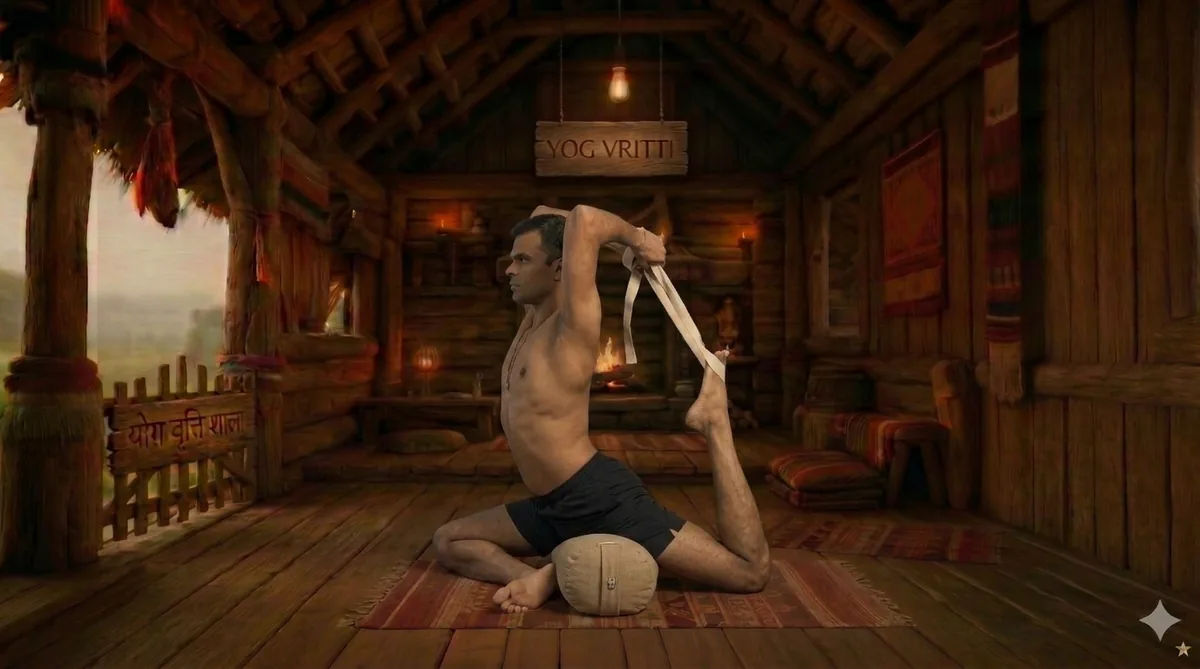
Eka Pada Rajakapotasana is a profound backbend that deeply unravels the anterior chain of the body, offering immense expansion to the hip flexors, quadriceps, chest, and shoulders. This advanced posture cultivates an expansive energetic quality, opening the heart center and fostering a sense of courage and surrender. It's invaluable for teachers and practitioners seeking to release deep physical and emotional blockages, promoting profound flexibility, mental clarity, and an elevated sense of well-being. The pose demands precision and mindful engagement, leading to a harmonious blend of strength and spaciousness throughout the entire being.
One-Legged King Pigeon Pose, also called King Pigeon is a classical yoga posture. Its Sanskrit name Eka Pada Rajakapotasana translates word-for-word as: Eka (One) · Pada (Leg) · Raja (King) · Kapota (Pigeon). Beginning from a kneeling position, the practitioner opens the chest and stretches the entire front body. The posture works to stretch the hip flexors, strengthen the quadriceps and release the lower back. Opens the chest and shoulders. Improves spinal flexibility. Suitable for advanced practitioners with developed body awareness, it is a meaningful addition to any practice. A blanket and block can be used to make the posture more accessible and support correct alignment. Practitioners with hip injury and knee injury should approach with care or consult a qualified teacher.
Muscles Worked
Hip Flexors
[Iliopsoas, Rectus Femoris]
The deep muscles at the front of your hip and thigh on the extended leg (iliopsoas and rectus femoris) experience a profound stretch, releasing chronic tightness often accumulated from prolonged sitting.
This sustained lengthening helps to decompress the lumbar spine by reducing the anterior pelvic tilt often associated with tight hip flexors.
Energetically, releasing these muscles can unblock the flow in the lower abdominal region, fostering a sense of lightness and freedom in the pelvic bowl, connecting you more deeply to your roots.
Quadriceps
[Rectus Femoris, Vastus Lateralis, Vastus Medialis, Vastus Intermedius]
On the extended leg, the quadriceps muscles, particularly the rectus femoris which crosses both the hip and knee, are actively lengthened as the knee flexes deeply and the hip extends.
This stretch is crucial for creating space in the front of the thigh, allowing the femur to move more freely within the hip socket.
From a yogic perspective, this unwinding of the front of the thigh releases accumulated tension and can help in softening the fight-or-flight response often held in these strong muscle groups.
Spinal Erectors
[Erector Spinae, Multifidus]
The muscles running along either side of your spine (erector spinae and multifidus) are actively engaged to support and deepen the backbend, creating an arc in the lumbar and thoracic regions.
They work eccentrically to control the extension, preventing collapse and promoting an even curve throughout the spinal column.
This engagement strengthens the posterior chain of the trunk, building resilience and vitality in the spine, which is considered the central energetic channel (sushumna nadi) in yoga.
Pectorals
[Pectoralis Major, Pectoralis Minor]
The chest muscles (pectorals) are deeply stretched as the arms reach back and the chest lifts, opening the front body extensively.
This action counteracts the common postural habit of rounded shoulders and a collapsed chest, promoting an upright and expansive posture.
Energetically, opening the heart space in this way is believed to release emotional blockages and foster feelings of compassion, courage, and vulnerability, allowing the practitioner to connect more deeply with ananda (bliss).
Deltoids
[Deltoid]
In the arms reaching back to grasp the foot, the deltoid muscles, particularly the anterior and medial heads, are engaged to lift and rotate the arm, while the posterior deltoid gets a stretch.
This action helps to stabilize the shoulder joint while simultaneously creating external rotation and extension, which is crucial for the full expression of the pose.
Developing strength and flexibility in the deltoids supports a broader range of movement in the shoulder girdle, allowing for greater freedom in the upper body and a more expansive breath, symbolizing the removal of limitations.
Joints Mobilized
Hip Joints
mobilizingThe hip joint of the front leg is in external rotation and flexion, while the hip joint of the back leg is in deep extension.
This asymmetrical action profoundly mobilizes the articulation between the femur and the pelvis, increasing range of motion in multiple planes.
Mechanically, it helps to release tension around the joint capsule, improving synovial fluid distribution and nutrient supply.
Yogically, this deep opening in the hips is said to release deeply held emotional tension and samskaras (subtle impressions), leading to a feeling of emotional liberation and greater fluidity in daily movement.
Spine (Vertebral Column)
mobilizingThe entire vertebral column undergoes a deep and progressive extension, particularly in the lumbar and thoracic regions, creating a long, even arc.
This gentle traction and extension help to decompress the intervertebral discs, promoting hydration and nutrient exchange while strengthening the surrounding musculature.
Practitioners often experience a sense of increased height and lightness in the torso, feeling the energetic lift of prana moving freely up the sushumna nadi.
Regular practice enhances spinal mobility, resilience, and vitality, contributing to a more youthful and energetic posture.
Shoulder Girdle
mobilizingThe shoulder joint (glenohumeral) of the arm reaching back is in deep extension and external rotation, while the shoulder blades (scapulae) retract and depress to support the chest opening.
This combined action mobilizes the entire shoulder girdle, increasing flexibility and stability crucial for overhead movements and deeper backbends.
Mechanically, it helps to free up frozen shoulders and improve rotator cuff health.
The yogic experience is one of profound heart opening and emotional release, as the chest expands and the shoulders draw back, symbolizing the shedding of burdens and the embrace of vulnerability.
Knee Joint
mobilizingThe knee joint of the back leg undergoes significant flexion, with the heel drawing towards the head, requiring healthy patellofemoral tracking and collateral ligament integrity.
This deep bend helps to maintain mobility in the knee, but requires careful attention to alignment to prevent undue strain on the ligaments and menisci.
From a yogic perspective, working with the knees in this manner encourages patience and discernment, as one must listen closely to the body's limits.
Over time, it can improve the range of motion and flexibility necessary for seated meditation postures.
Organ & System Benefits
Abdominal Organs
In this deep backbend, the abdominal organs are gently stretched and massaged as the front body lengthens extensively.
This action stimulates the digestive system, encouraging peristalsis and improving circulation to organs like the stomach, liver, and intestines.
Yogically, this activation of Manipura Chakra (navel center) is believed to stoke agni, the digestive fire, enhancing metabolism and the body's ability to process both food and experiences.
It can alleviate sluggishness and promote a feeling of internal cleansing and renewed energy.
Lungs and Heart
The expansive opening of the chest in Eka Pada Rajakapotasana creates significant space for the lungs to expand, allowing for deeper and fuller inhalations.
This increased capacity improves oxygen uptake and invigorates the entire cardiovascular system, promoting healthy blood flow to the heart.
From a yogic perspective, this heart-opening posture stimulates Anahata Chakra, cultivating compassion, love, and emotional freedom.
It can alleviate feelings of constriction and anxiety, replacing them with a sense of spaciousness and joy.
Nervous System
This deep backbend, while challenging, can be deeply calming once the body begins to surrender into the shape, shifting the nervous system from sympathetic (fight-or-flight) to parasympathetic (rest-and-digest) dominance.
The sustained opening of the front body and the emphasis on a full, deep breath directly influence the vagus nerve, promoting a sense of ease and reducing physiological stress responses.
As the practitioner settles, the scattered mental chatter (chitta vritti) begins to quiet, fostering a profound sense of inner peace and presence.
The intense stretch in the hip flexors and quadriceps, often areas of stored trauma and tension, can trigger a release in the nervous system.
As these deep tissues unwind, the body's protective mechanisms can soften, leading to a felt sense of liberation from chronic holding patterns.
This physical release translates into emotional and mental lightness, allowing for a more harmonious flow of prana throughout the body and mind, reducing anxiety and promoting emotional balance.
Mental & Emotional
Eka Pada Rajakapotasana demands immense focus and mental fortitude, cultivating dharana (concentration) as the practitioner navigates the pose's complexities with awareness and precision.
The sustained effort required to open the body, particularly the heart and hips, builds resilience and courage, encouraging the mind to move beyond perceived limitations.
This process directly challenges self-doubt and fosters a powerful sense of accomplishment and self-efficacy, translating into greater confidence in daily life.
The expansive nature of this heart-opening backbend can evoke feelings of vulnerability and openness, inviting the practitioner to release emotional armor and embrace a more compassionate connection with themselves and others.
By consciously surrendering to the pose's intensity, one practices pratyahara (withdrawal of the senses), turning attention inward to observe and integrate deep emotional releases.
This profound engagement with the self cultivates emotional intelligence and a capacity for greater joy and empathy.
Because of Its Shape
backbend
Backbends, like Eka Pada Rajakapotasana, extend the spine, counteracting the effects of prolonged sitting and forward flexion, which often lead to a rounded upper back and stiff lower back.
Anatomically, this action strengthens the posterior spinal muscles while stretching the anterior body, improving spinal mobility and posture.
Yogically, backbends are considered invigorating and uplifting, stimulating the heart chakra and fostering courage, enthusiasm, and a sense of fearlessness, allowing prana to flow freely upwards.
This pose also functions as a profound hip opener, particularly for the extended leg, targeting the hip flexors and quadriceps in deep extension.
This release in the hips helps to free up the pelvis, which is often a repository for emotional tension and stress, improving overall lower body mobility.
From a yogic perspective, opening the hips facilitates the release of apana vayu, the downward-moving energy, promoting grounding while simultaneously allowing for the upward flow of prana, creating a balanced energetic state.
The deep chest and shoulder opening in this advanced backbend helps to expand the rib cage, improving respiratory function and lung capacity.
Anatomically, it stretches the pectoral muscles and encourages better alignment of the shoulder girdle, counteracting kyphosis and promoting an upright posture.
Energetically, it opens Anahata Chakra, the heart center, fostering qualities of love, compassion, and emotional resilience, allowing for a more expansive and joyful experience of life.
Fascial Lines
Eka Pada Rajakapotasana profoundly influences the fascial network, particularly the Superficial Front Line and the Deep Front Line on the extended leg side, as well as the Spiral and Arm Lines in the upper body.
This pose creates a continuous, lengthening stretch through these interconnected myofascial meridians, releasing adhesions and improving the fluid dynamics within the connective tissue.
By unwinding these fascial restrictions, we open up energetic channels (nadis), allowing for a more unhindered flow of prana and a greater sense of bodily freedom and integration, extending from the toes to the fingertips.
Breathing & Respiratory
The expansive chest and abdominal opening inherent in Eka Pada Rajakapotasana naturally encourages a deeper, fuller diaphragmatic breath, particularly on the inhalation.
The arch in the spine lifts the sternum, providing more space for the lungs to fill from the bottom up, promoting maximal oxygenation and a heightened sense of vitality.
This deep, sustained breathing in a challenging posture helps to calm the nervous system and anchor the mind, making it an excellent preparation for pranayama practices like Ujjayi, as it cultivates a profound awareness of the breath's capacity to create space and release tension.
Anatomical Caution
Teachers must approach this pose with immense caution, as it places significant stress on the knee of the extended leg and the lumbar spine.
Always ensure the hips are squared and the front knee is protected, using props generously to support alignment and prevent twisting in the knee joint.
Listen intently for any sharp pain, especially in the knees or lower back, and guide students to back off immediately, prioritizing safety and gradual progression over forcing the pose.