Benefits· लाभ
What One-Legged Headstand does for you
Eka Pada Sirsasana · एक पाद शीर्षासन
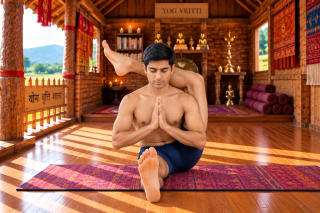
This variation dramatically shifts from a seated, gravity-assisted hip opening to an inverted, gravity-defying posture, Eka Pada Sirsasana in Headstand. The primary focus transitions from passive lengthening and release to active strengthening, balance, and full-body stabilization.
What this version changes: In this inverted variation, the wall's role transforms from supporting a deep, passive stretch to being a critical aid for building confidence and refining alignment. It offers a tangible boundary for balance and stability, allowing the practitioner to explore the vertical stacking of the body without fear of toppling, thereby facilitating deeper engagement with core and shoulder strength while safely learning the pose.
Muscles
- Hamstringsstretches
- Deep Hip Rotatorsstabilises
- Iliopsoasstrengthens
- Erector Spinaestrengthens
- Core musclesstabilises
Joints
- Hip Jointmobilises
- Sacroiliac Jointmobilises
- Spinedecompressing
Inside the body
- Abdominal Organs (Digestive System)
- Kidneys and Adrenal Glands
- Breathing
Mind
Eka Pada Sirsasana demands immense patience and humility, teaching the practitioner to approach their body with non-violence and acceptance.
Take care
This inversion places direct weight through the cervical spine and shoulders, demanding significant strength and precise alignment to avoid injury.
Individuals with pre-existing neck instability, herniated discs, or shoulder impingement must exercise extreme caution, as the pose can exacerbate these conditions if not performed with expert guidance and proper preparation.
Muscles
Hamstrings
StretchesStrengthensStabilisesWhile still experiencing length in the leg behind the head, the hamstrings in the other leg now actively engage to lift and extend it vertically against gravity.
Read moreShow less
This requires not only flexibility but also significant strength to maintain the straight line and control the eccentric lowering, a dynamic engagement distinct from the predominantly passive lengthening in the seated root pose.
Deep Hip Rotators
StabilisesStrengthensStretchesIn the seated pose, these muscles primarily release and lengthen to allow the deep external rotation.
Read moreShow less
In the inversion, they are still lengthened for the leg behind the head, but now crucially engage to actively stabilize the hip in this externally rotated position against the constant downward pull of gravity.
This demands a more subtle and sustained isometric activation to maintain the integrity of the hip joint in an inverted, weight-bearing context.
Iliopsoas
StrengthensStabilisesPreviously experiencing a stretch, the iliopsoas now becomes a powerful activator, strongly engaging as a primary hip flexor to lift and extend the straight leg vertically towards the ceiling.
Read moreShow less
Concurrently, it plays a vital role in stabilizing the pelvis and lumbar spine in the inverted position, preventing excessive arching or rounding and creating a strong foundation for the pose.
Erector Spinae
StrengthensStabilisesMobilisesWhere it primarily lengthened and decompressed in the seated pose, the erector spinae in the inversion shifts to a crucial role in active spinal extension and stabilization.
Read moreShow less
These muscles work intensely to maintain a straight, strong line from the shoulders through the hips to the lifted leg, actively resisting gravity's tendency to collapse or round the spine, thereby creating a long, supported axial extension.
Core muscles
StabilisesStrengthensTransversus Abdominis, Obliquus Internus Abdominis, Obliquus Externus Abdominis, Rectus Abdominis
These muscles are newly and profoundly engaged, creating a stable and integrated foundation for the entire torso in the inversion.
Read moreShow less
They work synergistically to prevent the lumbar spine from collapsing or hyperextending, drawing the navel towards the spine (Uddiyana Bandha) to lighten the body and create energetic lift, essential for balance and spinal protection.
Shoulder Girdle Stabilizers
StrengthensStabilisesSerratus Anterior, Deltoideus, Trapezius, Rotator Cuff (Supraspinatus, Infraspinatus, Teres Minor, Subscapularis)
These muscles bear the primary weight of the body in headstand, actively pressing the forearms and elbows into the floor to lift the shoulders away from the ears and stabilize the shoulder joint.
Read moreShow less
They create a strong, expansive platform, protecting the neck and allowing the energetic line of the pose to extend upwards, defying gravity with strength and unwavering precision.
Joints
Hip Joint
MobilisesThe hip joint (coxal joint) is undergoing extreme external rotation, abduction, and flexion for the leg behind the head, while the other hip is in deep flexion.
Read moreShow less
This intricate movement deeply mobilizes the ball-and-socket joint, encouraging the synovial fluid to lubricate the articulating surfaces and nourish the cartilage.
Regular practice enhances the range of motion in all planes, preventing stiffness and promoting a feeling of freedom and lightness in the lower body, which translates to ease in walking and sitting.
Sacroiliac Joint
MobilisesThis pose brings subtle but significant movement to the sacroiliac (SI) joint, where the sacrum meets the ilium, helping to release any mild fixations.
Read moreShow less
The deep hip opening and forward fold can help to gently realign and stabilize this crucial joint, often a source of lower back discomfort.
As the pelvis becomes more balanced and supple, the practitioner experiences a greater sense of stability and integration between the upper and lower body, allowing for a more harmonious flow of energy through the pelvic bowl.
Spine (Vertebral Joints)
DecompressingAs you fold forward in Eka Pada Sirsasana, the intervertebral discs along your spine experience a gentle decompression, especially in the lumbar and thoracic regions.
Read moreShow less
The weight of the head and upper body, combined with the stretch in the posterior chain, creates traction that helps to hydrate the discs and alleviate compression.
This leads to a feeling of increased space and fluidity within the spine, supporting the upward flow of prana (Udana Vayu) and enhancing overall postural awareness.
Inside the body
Abdominal Organs (Digestive System)
The forward bend in this pose creates a gentle compression of the abdominal organs, including the stomach, intestines, and liver.
Read moreShow less
This mild pressure acts like a soft internal massage, stimulating circulation and encouraging the removal of stagnant blood and toxins.
Yogically, this compression helps to activate Samana Vayu, the balancing energy responsible for digestion and assimilation, leading to improved digestive function and a feeling of lightness and clarity in the gut.
Kidneys and Adrenal Glands
Located in the posterior abdomen, the kidneys and adrenal glands receive a gentle stimulation as the torso folds forward and the lower back lengthens.
Read moreShow less
This subtle compression and release can help to improve blood flow to these vital organs, supporting their detoxification processes and hormone regulation.
From a yogic perspective, working with the kidneys and adrenals can help to balance the energetic system, reducing feelings of stress and promoting a deeper sense of inner calm and resilience.
Breathing
The deep forward bend and the intense hip opening in Eka Pada Sirsasana naturally encourage a more diaphragmatic and refined breath, especially focusing on the exhalation.
Read moreShow less
The compression of the abdomen on the inhalation restricts the full expansion of the belly, prompting the breath to move more into the side ribs and upper chest, demanding conscious control.
This encourages a longer, smoother exhalation, which in turn activates the parasympathetic nervous system, calming the mind and body.
This natural lengthening of the exhale makes it an excellent pose for cultivating rechaka pranayama (exhalation retention) and fostering a deep sense of surrender and release.
Fascia (connective tissue)
The intricate web of connective tissue (fascia) throughout the entire posterior chain and around the hip joint receives an extensive and comprehensive release in Eka Pada Sirsasana.
Read moreShow less
Specifically, the superficial back line and the spiral line of the body are profoundly lengthened, along with the deep fascial layers surrounding the hip rotators and adductors.
This sustained traction helps to melt away adhesions and restrictions, restoring the fluidity and elasticity of the tissues.
Yogically, this release of fascial tension is akin to clearing energetic blockages, allowing prana to flow unimpeded through the nadis, enhancing overall vitality and freedom of movement.
Mind and nervous system
- Nervous system
This deep forward bend and hip opener naturally encourages a shift towards the parasympathetic nervous system, helping to calm the mind and body profoundly.
Read moreShow less
The sustained hold and introspective nature of the pose signal to the brain that it's safe to relax, reducing the 'fight or flight' response.
This allows for a deep release of tension held in the fascial tissues, promoting a profound sense of peace and inner quiet, easing the chatter of chitta vritti (mental fluctuations).
The focused attention required to navigate this complex posture cultivates a state of present moment awareness, drawing the senses inward (pratyahara).
Read moreShow less
As the breath deepens and becomes more refined in the stillness, the sympathetic nervous system downregulates, reducing heart rate and blood pressure.
This internal focus fosters mental clarity and emotional stability, allowing the practitioner to experience a profound sense of groundedness and inner spaciousness.
- Mind & mood
Eka Pada Sirsasana demands immense patience and humility, teaching the practitioner to approach their body with non-violence and acceptance.
Read moreShow less
The challenge of the pose cultivates mental fortitude and a profound sense of discipline, helping to quiet the restless mind (chitta vritti nirodhah).
This process of sustained focus and surrender builds resilience, allowing one to face life's challenges with greater equanimity and an unwavering inner calm.
The deep hip opening often brings up stored emotions, requiring the practitioner to observe these feelings without judgment, creating a container for emotional release.
Read moreShow less
By consciously breathing into discomfort and staying present, one learns to release old patterns of emotional holding, fostering emotional liberation.
This journey of self-discovery through the body cultivates a deeper sense of self-awareness and compassion, both for oneself and others, ultimately leading to greater inner freedom.
Achieving this advanced posture, even partially, instills a deep sense of accomplishment and self-efficacy, boosting confidence and determination.
Read moreShow less
It is a powerful practice in dharana (concentration), as the mind must remain acutely focused on the sensations and alignment, preventing distraction.
This rigorous mental training translates into improved focus and persistence in daily life, enhancing one's ability to achieve goals and maintain inner balance even amidst chaos.
Because it is a hip opener pose
This pose is a supreme hip opener, specifically targeting the external rotators and abductors of the hip joint with remarkable intensity.
Read moreShow less
It systematically creates space within the hip capsule, increasing the range of motion and flexibility in the entire pelvic girdle by stretching the deep gluteal muscles and the surrounding connective tissues.
These areas are often tight from prolonged sitting and habitual movement patterns, restricting vital energy flow.
Energetically, opening the hips is profound, as the pelvic region is considered the seat of the root (Muladhara) and sacral (Svadhisthana) chakras, where primal energy and emotions are stored.
Read moreShow less
Releasing tension here allows for a freer flow of apana vayu, promoting a sense of groundedness, emotional stability, and creativity.
This physical release often leads to a significant emotional discharge, helping to clear stagnant energy and cultivate a feeling of liberation and lightness.