5
Muscles
4
Joints
2
Organs
2
Mental
Gomukhasana
गोमुखासन
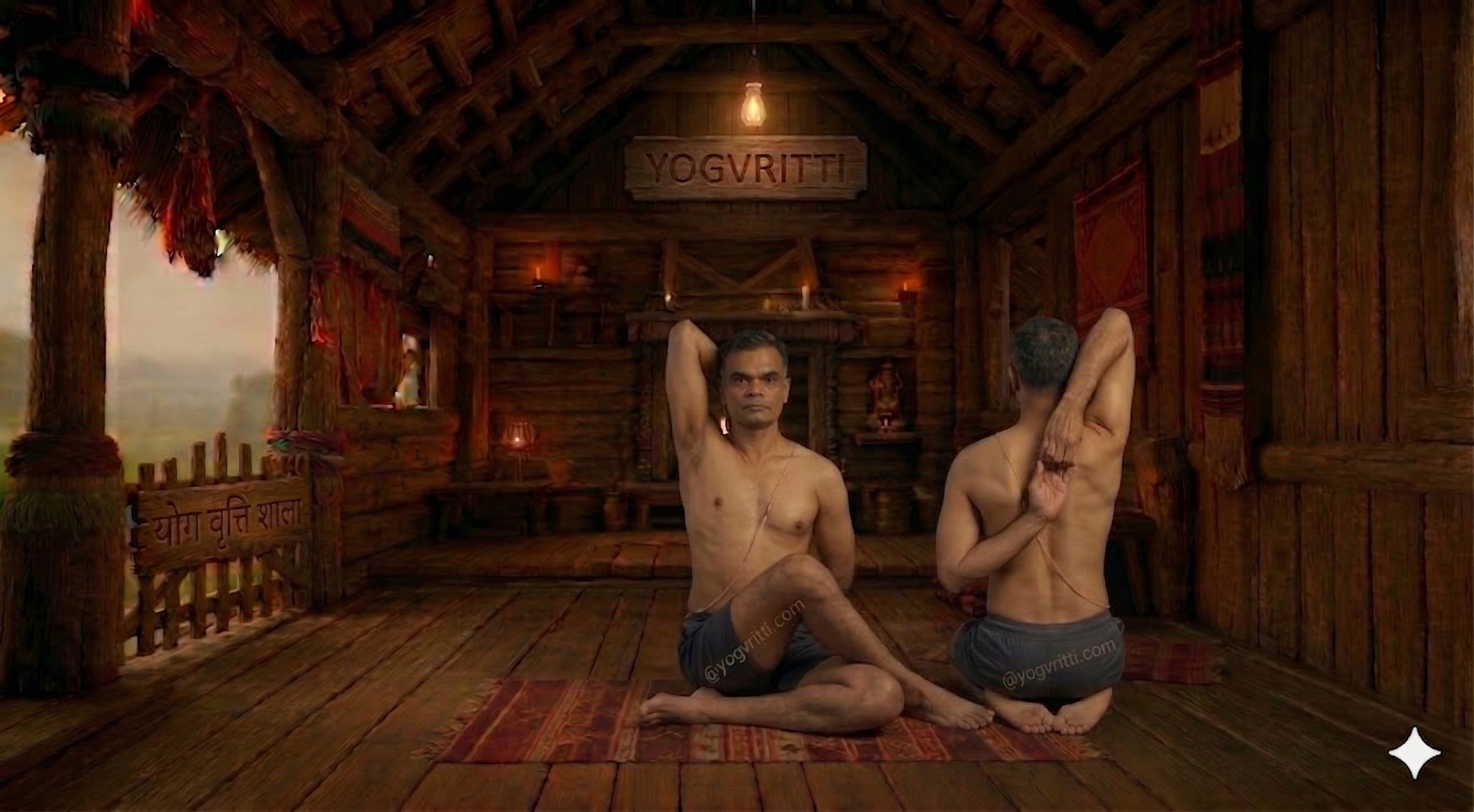
Gomukhasana, or Cow Face Pose, is a profound seated posture that intricately weaves together deep releases in the hips and shoulders with an expansive opening of the chest. It's a symphony of external rotation in one hip and internal rotation in the other, paired with reciprocal actions in the shoulders, creating a powerful cross-body stretch and mobilization. This pose cultivates a sense of grounded stability while simultaneously fostering openness and lightness in the upper body, inviting a harmonious flow of prana and deep introspection. It is cherished for its ability to unravel deep-seated physical and energetic tension, promoting both flexibility and mental tranquility, making it a cornerstone for therapeutic practice and preparation for meditation.
Cow Face Pose, also called Gomukhasana is a classical yoga posture. Its Sanskrit name Gomukhasana translates word-for-word as: Go (Cow) · Mukha (Face) · Asana (Pose). In this posture, the body grounds through the sit bones while the spine rises tall. The posture works to open and strengthen the shoulders, release tension in the hips and stabilise the ankles. Improves posture. Opens the chest and increases lung capacity. It is particularly valued for developing greater flexibility and improving overall posture. Suitable for intermediate practitioners with foundational yoga experience, it is a calming cool-down, particularly beneficial for desk workers and prenatal. A block and blanket can be used to make the posture more accessible and support correct alignment. Practitioners with shoulder injury and hip injury should approach with care or consult a qualified teacher.
Helps with
Muscles Worked
Gluteals & Deep Hip Rotators
[Gluteus maximus, medius, minimus, Piriformis, Obturator internus/externus, Gemelli superior/inferior, Quadratus femoris]
These powerful muscles, situated deep in your buttocks, are key players in rotating your thigh bone (femur) within the hip socket.
In Gomukhasana, one hip is deeply externally rotated while the other is internally rotated, creating a profound and often challenging stretch through these powerful muscles.
This reciprocal action helps to release chronic tension patterns often held from prolonged sitting, allowing apana vayu—the downward-moving energy—to move more freely and fostering a sense of release in the pelvis.
Regular practice here progressively unwinds deep-seated stiffness, improving overall hip health and alleviating lower back strain.
Adductors (Inner Thighs)
[Adductor magnus, longus, brevis, Pectineus, Gracilis]
The muscles running along your inner thighs are profoundly lengthened in the externally rotated hip, as the knee moves away from the midline.
This stretch targets the often-tight adductor group, which can restrict hip mobility and contribute to pelvic imbalance and discomfort.
Releasing these muscles helps to open the inner energy channels (nadis), promoting a feeling of spaciousness in the groin and cultivating a deeper connection to the earth element, enhancing stability in seated postures.
Deltoids & Rotator Cuff (Shoulders)
[Deltoid, Supraspinatus, Infraspinatus, Teres minor, Subscapularis]
The large, cap-like muscle over your shoulder (deltoid) and the deeper rotator cuff muscles are intricately engaged in the arm bind.
One arm is in deep external rotation and abduction (upper arm), while the other is in internal rotation and adduction (lower arm), creating a complex, reciprocal stretch and activation.
This dual action stretches and strengthens the shoulder girdle, unwinding stiffness and promoting fluidity in the upper body, which is crucial for healthy arm movement.
Energetically, it helps to open Anahata Chakra, fostering a sense of heart-centered awareness and emotional release, counteracting the effects of rounded shoulders.
Triceps (Back of Upper Arm)
[Triceps Brachii]
The triceps muscle, located on the back of your upper arm, is significantly lengthened in the upper arm as it reaches overhead and bends at the elbow, creating a long line of extension.
Simultaneously, the triceps in the lower arm may gently activate to support the elbow's flexion and maintain the bind, providing subtle stabilization.
This dual engagement helps to release tension along the back of the arm, improving circulation and promoting a feeling of lightness and extension through the upper limbs, enhancing the overall spaciousness of the pose.
Ankle Dorsiflexors (Shin Muscles)
[Tibialis anterior, Extensor digitorum longus, Extensor hallucis longus]
As the feet are tucked beside the hips, the muscles on the front of your shins responsible for lifting your foot (dorsiflexors) are gently lengthened.
This subtle but important action helps to release tension in the lower leg and improve ankle mobility, which is crucial for stable and comfortable seated postures.
From a yogic perspective, this brings awareness to the often-neglected extremities, helping to ground the energy and connect more fully with the earth, establishing a solid foundation for the pose.
Joints Mobilized
Hip Joint
mobilizingThe hip joints (coxal joints) are undergoing significant and reciprocal rotation, with one thigh bone (femur) externally rotating and the other internally rotating within the hip socket (acetabulum).
This intense mobilization helps to break up adhesions and improve the range of motion, particularly in those tight deep rotators and the hip capsule.
The sustained stretch encourages synovial fluid production, lubricating the joint and releasing emotional and energetic stagnation often stored in the hips, leading to greater freedom in movement and spirit.
Shoulder Joint
mobilizingThe shoulder joints (glenohumeral joints) are actively mobilized in a complex manner, with one arm in deep external rotation and abduction, and the other in internal rotation and adduction.
This reciprocal action systematically stretches the joint capsule and surrounding ligaments, enhancing flexibility and stability in the shoulder girdle.
This opening in the upper body can release physical and emotional burdens, promoting a sense of expansion and lightness, allowing prana to flow more freely through the chest and arms.
Knee Joint
stabilizing | gentle compression/flexionThe knee joints (tibiofemoral joints) are deeply flexed and subjected to some degree of rotation and compression in Gomukhasana, particularly the knee of the internally rotated hip.
While the primary action is hip opening, proper alignment is crucial to ensure the knee remains stable and free from any twisting strain, which could damage ligaments or menisci.
This deep flexion, when mindful, can gently stimulate circulation around the joint, and from a yogic perspective, encourages a humble, grounded posture, connecting us to the root and reinforcing stability.
Ankle Joint
mobilizingThe ankle joints (talocrural joints) are deeply plantarflexed as the tops of the feet rest against the floor beside the hips, gently stretching the front of the ankle and shin.
This action helps to improve the flexibility of the ankle complex, which is often restricted due to footwear or lack of movement.
Enhancing ankle mobility contributes to a more stable and comfortable seated foundation, allowing the practitioner to feel more rooted and settled in their practice and promoting better circulation in the lower extremities.
Organ & System Benefits
Abdominal Organs (Digestive System)
The deep flexion and slight compression of the lower body against the abdominal area provide a gentle internal massage to the digestive organs.
This mild, sustained pressure can stimulate peristalsis and improve circulation to the stomach, intestines, and liver, aiding in the detoxification process.
From a yogic perspective, this gentle compression helps to stoke Agni (digestive fire), enhancing metabolism and promoting a sense of inner cleanliness and vitality, contributing to overall well-being.
Lungs & Heart (Cardiopulmonary System)
The expansive opening of the chest and shoulders in Gomukhasana creates more space for the lungs to expand, encouraging deeper and fuller breaths, particularly into the side and back body.
This direct increase in thoracic capacity allows for a more efficient exchange of oxygen and carbon dioxide, benefiting the entire cardiopulmonary system and increasing energy levels.
Energetically, this chest opening stimulates Anahata Chakra, fostering feelings of compassion, love, and emotional openness, while calming the heart and settling the breath.
Nervous System
The deep hip and shoulder opening, combined with the grounded seated position, signals safety to the nervous system, initiating a profound shift towards parasympathetic dominance.
This allows the body's 'rest and digest' functions to take over, reducing the fight-or-flight response often active in daily life.
You'll feel a profound sense of calm washing over you, as the constant mental chatter (chitta vritti) begins to subside, inviting a state of inner peace and deep relaxation.
Holding Gomukhasana with conscious breath encourages a prolonged exhalation, which is a direct pathway to calming the vagus nerve and downregulating the sympathetic nervous system.
This sustained exhale slows the heart rate and quiets the mind, fostering a deep sense of relaxation, reducing anxiety, and promoting presence.
This practice teaches the nervous system to release stored tension, allowing for greater resilience and a more balanced emotional state, both on and off the mat.
Mental & Emotional
Gomukhasana demands a focused, sustained attention to the intricate alignment of the hips and shoulders, drawing the mind away from external distractions and into the present moment.
This intense focus cultivates pratyahara, the withdrawal of the senses, and dharana, concentration, as the practitioner becomes absorbed in the internal landscape of the pose.
This deep introspection helps to quiet the fluctuations of the mind, leading to a profound sense of mental clarity and inner stillness, preparing the mind for meditation.
The challenge inherent in Gomukhasana, particularly in finding balance between effort (sthira) and surrender (sukha), builds mental resilience, patience, and humility.
As you learn to breathe through the intensity and find comfort within the stretch, you develop a stronger capacity to face discomfort with equanimity and acceptance.
This practice translates directly into daily life, equipping you with the mental fortitude to navigate challenges with grace, a steady mind, and a more compassionate outlook.
Because of Its Shape
seated
This shape profoundly mobilizes the hip joints, encouraging both external and internal rotation in a reciprocal fashion, which is unique and highly effective for releasing deep tension.
Anatomically, it targets the deep hip rotators and adductors, releasing chronic tightness that can restrict movement and contribute to lower back pain and sciatica.
Yogically, opening the hips is believed to release stored emotions and energetic blockages (granthis), fostering a sense of freedom, emotional release, and allowing apana vayu to move more freely through the pelvic region.
The intricate arm bind and upright spine in Gomukhasana actively expand the chest and shoulders, counteracting the common posture of rounded shoulders and thoracic kyphosis.
This action stretches the pectoral muscles and mobilizes the shoulder girdle, improving lung capacity and promoting a more open, confident posture.
Energetically, this opening stimulates the Anahata Chakra, the heart center, cultivating feelings of compassion, self-acceptance, and emotional spaciousness, inviting a deeper connection to oneself and others.
As a seated posture, Gomukhasana inherently cultivates grounding and stability, connecting the practitioner deeply to the earth and establishing a firm foundation.
This stable base allows for an upward energetic lift through the spine (uddiyana bandha and mula bandha), promoting a sense of rootedness while simultaneously encouraging expansion and lightness in the upper body.
From a yogic perspective, this seated foundation helps to quiet the mind, making it an excellent pose for meditation and pranayama, fostering a sense of inner peace and profound presence.
Fascial Lines
Gomukhasana provides a comprehensive release and lengthening across multiple fascial lines, particularly targeting the deep lateral line of the hips, the superficial back arm line, and the deep front arm line.
The intricate crossing of the legs and arms creates a spiraling stretch through the connective tissue that encases muscles, bones, and organs, releasing long-held tension patterns and improving inter-tissue glide.
This unwinding of the fascial web helps to restore elasticity and fluidity to the body, allowing for greater freedom of movement and a more unobstructed flow of prana throughout the subtle body channels, enhancing overall vitality.
Breathing & Respiratory
The unique architecture of Gomukhasana, with its deep hip opening and expansive chest lift, naturally encourages a fuller, deeper diaphragmatic breath, particularly into the side and back ribs.
While the lower body is compressed and grounded, the upper body is lifted and open, inviting a more complete inhalation and a longer, more releasing exhalation.
This natural deepening of the breath helps to calm the nervous system and is an excellent preparation for pranayama practices like Ujjayi, as it cultivates a sense of spaciousness within the torso and allows prana to permeate every cell, bringing mental clarity and emotional balance.
Anatomical Caution
Always approach Gomukhasana with mindful awareness, especially if students have pre-existing knee issues or significant shoulder stiffness.
Never force the knees to stack perfectly if it causes any discomfort, pinching, or lateral strain; prioritize knee safety over aesthetic depth, perhaps by placing a block between the knees.
For the shoulders, listen carefully for pinching or sharp pain, and always offer a strap to bridge the hands if they don't meet comfortably, ensuring a gradual and safe opening without impingement.