Benefits· लाभ
What Half Splits Pose does for you
अर्ध हनुमानासन
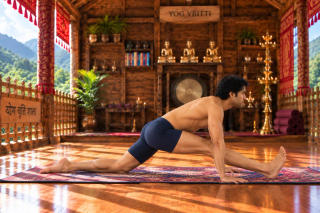
Half Splits Pose, or Ardha Hanumanasana, is a deeply grounding and inwardly focused kneeling posture that systematically lengthens the entire posterior chain of the front leg while strengthening its anterior muscles, and simultaneously opens the hip flexors of the kneeling leg. It cultivates intelligent flexibility and stability around the hips and knees, easing common discomforts like sciatica.
Muscles
- Hamstringsstretches
- Quadricepsstrengthens
- Hip Flexorsstretches
- Gluteal musclesstabilises
- Calf musclesstretches
Joints
- Hip Jointmobilises
- Knee Jointstabilises
- Knee Jointstabilises
- Sacroiliac Jointstabilises
Inside the body
- Abdominal Organs
- Pelvic Organs
- Breathing
Mind
This pose is a profound teacher of patience and surrender, both physically and mentally.
Take care
Teachers should guide students with existing hamstring tears or acute knee pain to approach this pose with utmost care, utilizing ample props such as blocks under the hands and blankets under the kneeling knee.
The intention is a gentle, intelligent lengthening, not a forceful stretch, particularly protecting the hamstring attachment at the sit bone and the delicate ligaments of the knee. Always prioritize comfort and stability over depth, encouraging students to listen intently and honor their body's unique signals, preventing injury and fostering a sense of self-awareness.
Muscles
Hamstrings
StretchesBiceps femoris, Semitendinosus, Semimembranosus
The powerful muscles running along the back of the front thigh, known as the hamstrings, receive a deep, sustained lengthening in this pose.
Read moreShow less
As the body folds forward, these muscles are gently invited to release chronic tension often accumulated from prolonged sitting or athletic activity.
This mindful unwinding not only improves flexibility but also releases trapped 'apana vayu,' the downward-moving energy, promoting a feeling of profound groundedness and ease in the lower body, which can significantly alleviate lower back strain.
Quadriceps (front leg)
StrengthensRectus femoris, Vastus lateralis, Vastus medialis, Vastus intermedius
The large muscles on the front of the extended thigh, the quadriceps, are actively engaged to lift the kneecap (patella) and protect the knee joint.
Read moreShow less
This isometric contraction creates a subtle yet powerful opposition to the hamstring stretch, preventing hyperextension and fostering intelligent length rather than passive overstretching.
This conscious engagement brings awareness and stability to the knee, ensuring that the 'prana' (life force) flows harmoniously through the joint, cultivating strength and integrity.
Hip Flexors (back leg)
StretchesPsoas major, Iliacus
The deep muscles at the front of the hip of the kneeling leg, the hip flexors, are gently stretched as the hip extends backward.
Read moreShow less
This action helps to release deep-seated tension often held from prolonged sitting or repetitive movements, which can contribute to lower back pain.
Creating more space in the front of the hip allows for greater freedom of movement in the pelvic bowl, encouraging the smooth flow of 'samana vayu' (balancing energy) and fostering a sense of openness and release in the core.
Gluteal muscles (front leg)
StabilisesGluteus maximus, medius, minimus
The muscles of the buttocks on the extended leg, particularly the gluteus maximus and medius, are subtly engaged to anchor the hip and maintain a neutral pelvic alignment.
Read moreShow less
This intelligent contraction prevents excessive anterior tilt of the pelvis and helps to square the hips, ensuring the hamstring stretch originates purely from the hip joint.
This engagement provides a stable foundation, cultivating a sense of rootedness and integrity in the hip, which allows for a more effective and safer lengthening of the posterior chain.
Calf muscles
StretchesGastrocnemius, Soleus
With the front foot actively flexed and the toes drawing back towards the shin, the muscles of the calf, both the superficial gastrocnemius and the deeper soleus, receive a gentle but effective stretch.
Read moreShow less
This action contributes to the overall lengthening of the posterior chain of the leg, enhancing ankle flexibility and promoting better circulation to the lower leg and foot.
It deepens the connection to the earth, allowing 'prana' to flow more freely down the leg and out through the heel, creating a strong sense of grounding.
Core muscles
StabilisesTransversus abdominis, Obliques, Erector spinae
The deep muscles of the abdomen and back, collectively known as the core, are subtly engaged to stabilize the spine and pelvis throughout the pose.
Read moreShow less
This engagement prevents excessive rounding or arching of the lower back, ensuring that the stretch is focused on the hamstrings rather than placing undue stress on the lumbar vertebrae.
Cultivating this inner support brings a sense of centeredness and integration, allowing the 'prana' to be drawn inward and upward, fostering a feeling of strength and stability from the deepest layers of the body.
Joints
Hip Joint (front leg)
MobilisesThe hip joint of the extended leg, where the thigh bone (femur) meets the pelvis (acetabulum), undergoes significant mobilization as the torso folds forward.
Read moreShow less
This action encourages deeper flexion and a subtle anterior tilt of the pelvis, enhancing the range of motion in the sagittal plane.
Releasing stiffness in this major joint not only improves daily movements like walking and bending but also creates a sense of openness and freedom in the pelvic region, allowing for a more unhindered flow of energy.
Knee Joint (front leg)
StabilisesThe knee joint (tibiofemoral joint) of the extended leg is held in a neutral or subtly flexed position, with the quadriceps actively engaged to lift the kneecap.
Read moreShow less
This conscious stabilization protects the delicate ligaments and menisci from strain, ensuring that the lengthening occurs safely in the hamstrings.
This intelligent engagement cultivates a profound awareness of the knee's integrity, fostering a sense of secure foundation and preventing the common tendency to hyperextend, thus promoting long-term joint health.
Knee Joint (back leg)
StabilisesThe kneeling leg's knee joint bears a substantial portion of the body's weight, distributing it evenly across the lower thigh bone (femur) and upper shin bone (tibia).
Read moreShow less
The use of a blanket provides essential cushioning, protecting the kneecap (patella) and the underlying soft tissues from excessive pressure.
This foundational stability allows the practitioner to root down firmly, providing a secure anchor for the upper body and fostering a sense of unwavering support and groundedness throughout the pose.
Sacroiliac (SI) Joint
StabilisesThe sacroiliac joints, located at the base of the spine where the sacrum meets the pelvic bones (ilia), are encouraged towards stability through careful alignment in Ardha Hanumanasana.
Read moreShow less
By squaring the hips and maintaining a neutral pelvic tilt, undue shearing forces or torsion on these complex joints are minimized.
This subtle stabilization helps to integrate the pelvis and spine, alleviating common discomforts associated with SI joint dysfunction and fostering a sense of solid, unified support at the body's core.
Inside the body
Abdominal Organs
In this gentle forward bend, the abdominal organs, including the intestines, liver, and spleen, receive a soft, internal compression against the thighs.
Read moreShow less
This gentle 'internal massage' can stimulate peristalsis, aiding in healthy digestion and elimination, and promoting a sense of inner cleansing.
This subtle compression also encourages fresh blood flow upon release, revitalizing the abdominal region and contributing to a feeling of lightness and improved vitality.
Pelvic Organs
The forward fold and the subtle opening in the hips create a gentle lengthening and broadening sensation in the pelvic floor, which can improve circulation to the reproductive and urinary organs.
Read moreShow less
This enhanced blood flow nourishes the tissues and can help alleviate chronic tension in the pelvic region.
Energetically, this pose grounds and stabilizes the 'muladhara' and 'svadhisthana' chakras, fostering a sense of security, creative flow, and release of stagnant energy in the lower body.
Breathing
In Ardha Hanumanasana, the forward fold naturally encourages a lengthening and deepening of the exhalation, as the gentle compression on the abdomen allows the diaphragm to ascend more fully.
Read moreShow less
This emphasis on the outward breath helps to activate the parasympathetic nervous system, calming the mind and facilitating a deeper release of muscular tension.
Combining this natural breath pattern with 'Ujjayi pranayama' (victorious breath) can further deepen the stretch and enhance mental focus, allowing the body to soften more completely into the pose, inviting 'prana' to flow into the newly created space.
Fascia (connective tissue)
Ardha Hanumanasana profoundly influences the Superficial Back Line (SBL) of fascia, a continuous web of connective tissue running from the soles of the feet, up the calves, hamstrings, glutes, and along the spine to the skull.
Read moreShow less
This pose systematically lengthens this entire fascial chain, releasing deep restrictions that can manifest as tightness in the lower back, hamstrings, and even neck.
This mindful unwinding of the fascial network, often rigid from sedentary lifestyles, allows for greater fluidity of movement, improved postural alignment, and an unhindered flow of 'prana' (life force) throughout the entire posterior aspect of the body.
Mind and nervous system
- Nervous system
The sustained, gentle stretch in the hamstrings, coupled with the introspective nature of the forward fold, effectively activates the parasympathetic nervous system.
Read moreShow less
This signals the body to move into a state of 'rest and digest,' counteracting the effects of chronic stress and the 'fight-or-flight' response.
Practitioners often experience a profound sense of calm and mental quietude, as the nervous system releases deeply held physical and emotional tension, fostering a feeling of profound inner peace.
The deliberate focus on precise alignment and intentional breath in Ardha Hanumanasana cultivates 'interoception,' a heightened awareness of internal bodily sensations.
Read moreShow less
This mindful engagement draws attention away from external distractions and the incessant 'chitta vritti' (mind-stuff), creating a pathway to deeper presence.
This practice of inward attention leads to a more grounded and focused state, promoting mental clarity, reducing anxiety, and fostering emotional equilibrium.
- Mind & mood
This pose is a profound teacher of patience and surrender, both physically and mentally.
Read moreShow less
As the body slowly, patiently releases into the stretch, the mind learns to let go of force and embrace gentle, persistent effort, embodying the yogic principle of 'tapas' (disciplined effort) without aggression.
This mental training translates into greater resilience and the ability to approach life's challenges with equanimity, fostering a calm and steadfast inner disposition, on and off the mat.
Ardha Hanumanasana inherently encourages introspection and a turning inward, embodying the principle of 'pratyahara' (withdrawal of the senses).
Read moreShow less
The forward bend naturally directs the gaze and awareness inward, creating a quiet space for contemplating inner sensations and thoughts without judgment.
This deep, focused attention helps to still the incessant fluctuations of the mind, fostering a sense of inner peace and clarity, invaluable for cultivating 'dharana' (concentration) and preparing for meditation.
Because it is a forward bend pose
Forward bends are inherently calming and introspective, gently compressing the front of the body while lengthening the entire posterior aspect, from the heels to the crown.
Read moreShow less
Anatomically, this action extends the superficial back line of fascia and musculature, releasing tension often stored from daily activities.
Energetically, forward folds encourage the downward flow of 'apana vayu,' promoting grounding, surrender, and a profound sense of inner quietude, making them excellent for stress reduction and mental clarity.
As a hip opener, this pose specifically targets the flexibility of the hip joint, particularly in the sagittal plane for the extended leg and extension for the kneeling leg.
Read moreShow less
It works to release chronic tension in the deep rotators and flexors of the hips, often accumulated from prolonged sitting and emotional holding.
Yogically, opening the hips is believed to release stored emotions and energetic blockages in the 'svadhisthana chakra,' promoting fluidity, creative energy, and a greater sense of emotional freedom.