7
Muscles
6
Joints
3
Organs
2
Mental
Nakrasana
नक्रासन
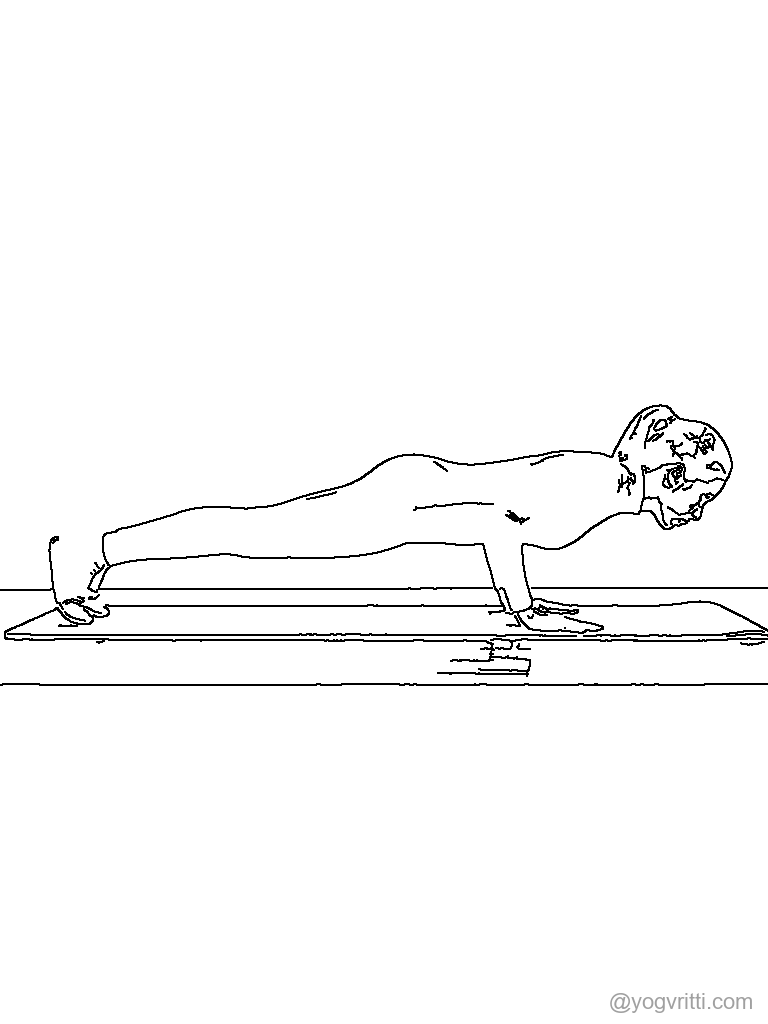
Nakrasana, the Crocodile Walk, is a potent, dynamic practice that transforms your entire body into a unified, moving entity. It's a challenging variation of Chaturanga Dandasana, requiring immense strength in the chest, arms, shoulders, and deep core stabilizers to lift and propel the body without touching the floor. This pose cultivates profound physical resilience and mental focus, teaching practitioners to move with controlled power and lightness. Beyond mere muscle building, it integrates breath and movement, awakening a deep sense of embodied awareness and inner determination, making it a foundational practice for advanced strength and agility.
Crocodile Hopping Pose, also called Nakrasana is a classical yoga posture. Its Sanskrit name Nakrasana translates word-for-word as: Nakra (Crocodile) · Asana (Pose). In this posture, the body engages the posterior chain against the gentle resistance of gravity. The posture works to open the chest, engage the core and open and strengthen the shoulders. Core endurance. Builds explosive power. It is particularly valued for building full-body strength. Suitable for intermediate practitioners with foundational yoga experience, it is a meaningful addition to any practice. Practitioners with wrist injury and shoulder injury should approach with care or consult a qualified teacher.
Helps with
Muscles Worked
Chest muscles
Pectoralis Major and Minor
These broad muscles across your chest and under your collarbone are intensely engaged as you push off the floor and control the descent.
They work to adduct and internally rotate the arm bone (humerus) while stabilizing the shoulder blade (scapula) against the rib cage.
This powerful action builds remarkable upper body strength and endurance, creating a solid, stable foundation for all arm balances and inversions.
The practitioner feels a deep activation, translating into robust power and a sense of physical capability.
Muscles on the back of your upper arm
Triceps Brachii
The triceps are the primary movers for straightening your elbows, and in Nakrasana, they are constantly contracting to support your body weight and propel you forward and back.
This intense engagement builds remarkable arm strength and muscular endurance, translating directly to stability in all weight-bearing arm poses.
The feeling is one of unwavering support and powerful extension flowing through the arms, cultivating a sense of unshakeable foundation.
Deep core muscles
Transversus Abdominis, Rectus Abdominis, Obliques
Your entire abdominal wall and deep core stabilizers are profoundly active, knitting together your rib cage and pelvis to create a rigid, stable torso.
They prevent your hips from sagging or arching, ensuring a straight line from head to heels, protecting the lower back.
This deep activation cultivates a powerful internal energetic lock (Uddiyana Bandha), centralizing your strength and bringing a sense of unwavering stability and grounded power to your center.
Shoulder muscles
Deltoids, Rotator Cuff group
The deltoids, which cap your shoulders, and the deeper rotator cuff muscles (supraspinatus, infraspinatus, teres minor, subscapularis) are working synergistically to stabilize the shoulder joint as you bear weight and move dynamically.
They keep the head of the arm bone (humerus) securely centered in its socket, protecting the joint from strain and promoting healthy articulation.
This active stabilization develops robust shoulder integrity, fostering confidence and safety in all weight-bearing arm postures, and a feeling of broadness and strength across the upper back.
Muscles of the forearms and hands
Wrist Flexors and Extensors
The muscles in your forearms are highly engaged to stabilize the wrist joint, allowing your hands to firmly grip the floor and absorb the impact of the dynamic movement.
They work to maintain a neutral alignment of the wrist (radiocarpal and ulnocarpal joints), preventing collapse and distributing the body's weight effectively.
This continuous engagement strengthens the wrists and hands, preparing them for the demands of more advanced arm balances and inversions, and cultivating a feeling of rooted connection to the earth.
Buttock muscles
Gluteus Maximus and Medius
These powerful muscles in your buttocks are actively engaged to extend your hips and stabilize your pelvis, preventing it from tilting or swaying as you move.
They contribute significantly to maintaining the straight line from head to heels, working in concert with the core to create a unified body.
This activation brings a sense of grounded power to the lower body, linking it firmly to the core and enhancing overall body integration, fostering a feeling of full-body engagement.
Thigh muscles
Quadriceps Femoris
The large muscles on the front of your thighs are strongly contracted to keep your knees straight and your legs active and engaged throughout the movement.
This isometric contraction ensures that the legs remain a stable, unified extension of the torso, preventing any slackness or bending at the knees.
This creates a feeling of alertness and readiness throughout the lower body, contributing to the overall integrity and lightness of the pose, and enhancing the flow of energy through the legs.
Joints Mobilized
Shoulder joint
stabilizingThe shoulder complex (glenohumeral joint and scapulothoracic articulation) is intensely stabilizing as it bears the majority of your body weight and manages the dynamic movement.
The rotator cuff muscles work tirelessly to keep the upper arm bone (humerus) securely centered in the shoulder socket, while the scapula glides smoothly on the rib cage.
This continuous engagement builds incredible strength and resilience around the shoulders, fostering a sense of rooted support and preventing excessive strain, leading to greater freedom and ease in daily movements.
Elbow joint
weight bearingThe elbow joints (humeroulnar and humeroradial joints) are primarily weight-bearing and stabilizing, holding a strong, slightly bent position to support the body's weight and absorb shock during the dynamic hops.
The triceps muscles work eccentrically and concentrically to control the flexion and extension, preventing hyperextension.
This action strengthens the ligaments and muscles around the elbow, creating stable, powerful hinges that can bear significant load over time, offering a feeling of secure and reliable support.
Wrist joint
weight bearingThe wrist joints (radiocarpal and ulnocarpal joints) are weight-bearing and stabilizing, acting as crucial interfaces between your hands and the floor, absorbing the impact of each 'hop.' Strong engagement of the forearm muscles helps maintain a neutral wrist position, distributing the pressure evenly across the carpal bones.
This continuous, controlled loading strengthens the small bones and ligaments of the wrist, preparing them for the demands of more advanced arm balances and inversions, and cultivating a feeling of strength and dexterity in the hands.
Spinal column
stabilizingThe entire spinal column (vertebral column) is stabilizing in a neutral alignment, supported by the deep core muscles, to maintain a straight line from the crown of the head to the heels.
This prevents any sagging or arching, protecting the delicate structures of the intervertebral discs and spinal nerves from compressive forces.
This cultivation of spinal integrity translates to a feeling of central axis stability and energetic alignment, allowing prana to flow freely along the sushumna nadi, enhancing overall body awareness and energetic balance.
Hip joint
stabilizingThe hip joints (acetabulofemoral joints) are stabilizing in a neutral extension, held firm by the active engagement of the gluteal and thigh muscles.
This prevents any unwanted flexion or rotation, ensuring the lower body remains aligned with the torso and contributes to the overall rigidity of the pose.
This strong, stable hip alignment creates a powerful base, connecting the legs to the core and fostering a sense of integrated strength throughout the lower body, promoting efficient movement patterns.
Knee joint
stabilizingThe knee joints (tibiofemoral and patellofemoral joints) are stabilizing in a fully extended position, with the quadriceps muscles actively engaged to maintain this straightness.
This ensures the legs act as strong, unified levers, contributing to the overall rigidity of the body and preventing any micro-movements.
This active engagement protects the knee ligaments and cartilages, building strength and resilience in the entire leg structure, offering a feeling of unwavering support from the ground up and enhancing proprioception.
Organ & System Benefits
Abdominal Organs
During Nakrasana, the deep engagement of the core muscles creates a gentle, sustained compression and release around the abdominal organs (stomach, intestines, liver, spleen).
This rhythmic action acts like an internal massage, encouraging healthy circulation and aiding the processes of digestion and elimination.
From a yogic perspective, this stimulation helps to awaken Manipura Chakra, enhancing vitality, inner fire (agni), and promoting a sense of energetic cleansing within the abdominal cavity.
Lungs and Diaphragm
The intense physical demand of Nakrasana requires deep, controlled breathing, which naturally strengthens the diaphragm and the intercostal muscles that assist in respiration.
The engaged core supports the diaphragm, allowing for more efficient inhalation and exhalation, even under strenuous conditions, preventing shallow breathing.
This practice cultivates greater lung capacity and breath control, allowing for a deeper connection to prana, the vital life force, and enhancing the body's ability to oxygenate and energize itself efficiently.
Heart and Circulatory System
This dynamic and strength-based pose significantly increases the demand on the heart, prompting it to pump more blood throughout the body to supply oxygen to working muscles and carry away metabolic waste.
This cardiovascular challenge strengthens the heart muscle and improves overall circulatory efficiency, enhancing endurance and stamina.
The feeling is one of profound invigoration, as fresh, oxygenated blood nourishes every cell, revitalizing the entire system and cultivating a strong, healthy cardiovascular rhythm.
Nervous System
The intense focus required to execute Nakrasana with precision immediately draws the mind away from external distractions, fostering a deep state of concentration and present moment awareness.
This active engagement of the sympathetic nervous system, followed by the challenge of maintaining calm amidst exertion, helps to build resilience and mental fortitude.
It teaches the practitioner to control the fluctuations of the mind (chitta vritti nirodhah) even under pressure, leading to a profound sense of inner quietude and controlled energy.
The rhythmic, controlled breathing that accompanies the dynamic movement in Nakrasana helps to regulate the nervous system, preventing the 'fight or flight' response from overwhelming the practitioner.
By consciously maintaining a steady breath, even during strenuous effort, one learns to integrate physical challenge with mental serenity.
This practice cultivates a refined sense of interoception, where the body's internal state is keenly felt and understood, leading to greater self-regulation and a deeper, more grounded sense of inner peace.
Mental & Emotional
Nakrasana demands unwavering concentration and mental fortitude, cultivating a powerful sense of determination and discipline.
The challenge of maintaining a stable, unified body while moving dynamically forces the mind to stay entirely present, quieting the incessant chatter (chitta vritti) and cultivating single-pointed focus (dharana).
This practice builds profound mental resilience, teaching the student to push past perceived limitations and embrace the power of sustained, focused effort.
The mastery of this physically demanding pose brings a profound sense of accomplishment and self-efficacy, translating into increased confidence in other areas of life.
It fosters a deep connection between mind and body (pratyahara), as every micro-adjustment requires conscious awareness and control, enhancing proprioception and kinesthetic intelligence.
This cultivated mental strength empowers students to approach challenges with greater courage, perseverance, and an unshakeable belief in their own capabilities, both on and off the mat.
Because of Its Shape
prone
Lying face down on the floor in a prone position, even momentarily before lifting, offers a grounding and internalizing quality, bringing awareness to the front of the body and its connection to the earth.
While the dynamic movement lifts you, the foundational shape connects you to the earth, fostering a sense of stability and support from below.
This allows the practitioner to cultivate a deep sense of rootedness and humility before engaging in powerful, upward-moving actions, balancing effort with surrender.
This pose is a prime example of strength building, demanding isometric and dynamic contractions from major muscle groups throughout the entire body—arms, shoulders, chest, core, and legs.
It systematically strengthens the entire posterior chain and anterior core, creating a robust physical foundation and enhancing muscular endurance.
This cultivation of physical power also builds inner resilience and willpower, fostering a feeling of capability and empowering the practitioner to face life's challenges with vigor and determination.
The dynamic, hopping movement of Nakrasana cultivates agility, coordination, and a profound sense of body awareness in motion, integrating strength with fluid movement.
It requires precise timing and control, synchronizing breath with movement in a continuous flow, demanding complete mental presence.
This dynamic quality enhances the flow of prana throughout the body, breaking up stagnation, improving neuromuscular coordination, and bringing a vibrant, energetic quality to the practice, fostering a sense of lightness and control.
Fascial Lines
Nakrasana intensely engages and strengthens the Superficial Front Line and Deep Front Line of fascia, particularly through the chest, core, and inner thighs, as the body works to maintain a rigid, unified structure against gravity.
Simultaneously, the Superficial Back Line, running from heels to head, is actively engaged to create a strong, straight line, preventing any sagging or collapsing.
This integrated fascial engagement helps to distribute tension evenly throughout the entire body, improving overall structural integrity and releasing old patterns of holding, allowing for greater freedom and fluidity of movement and a sense of energetic coherence.
Breathing & Respiratory
In Nakrasana, the dynamic, strenuous nature of the movement naturally encourages a strong, focused breath, often resembling Ujjayi pranayama, where the breath is audible, deep, and controlled.
The engagement of the deep core muscles creates a powerful internal lock (Uddiyana Bandha) that supports the diaphragm, aiding in both stability and efficient respiration.
This deep, rhythmic breathing not only fuels the muscles with oxygen but also calms the nervous system, allowing the practitioner to sustain effort with greater ease and focus, fostering a profound connection between movement and vital energy (prana).
Anatomical Caution
Teachers should always emphasize meticulous alignment, particularly in the wrists and shoulders, ensuring students press evenly through the hands and keep the shoulders stable and broad, away from the ears.
Watch carefully for any sagging in the lower back or hips, which indicates a lack of core engagement and can strain the lumbar spine.
Encourage students to build strength gradually, using preparatory poses like Plank and Chaturanga Dandasana, rather than attempting the full dynamic movement prematurely, to prevent injury and foster sustainable progress.