6
Muscles
4
Joints
2
Organs
3
Mental
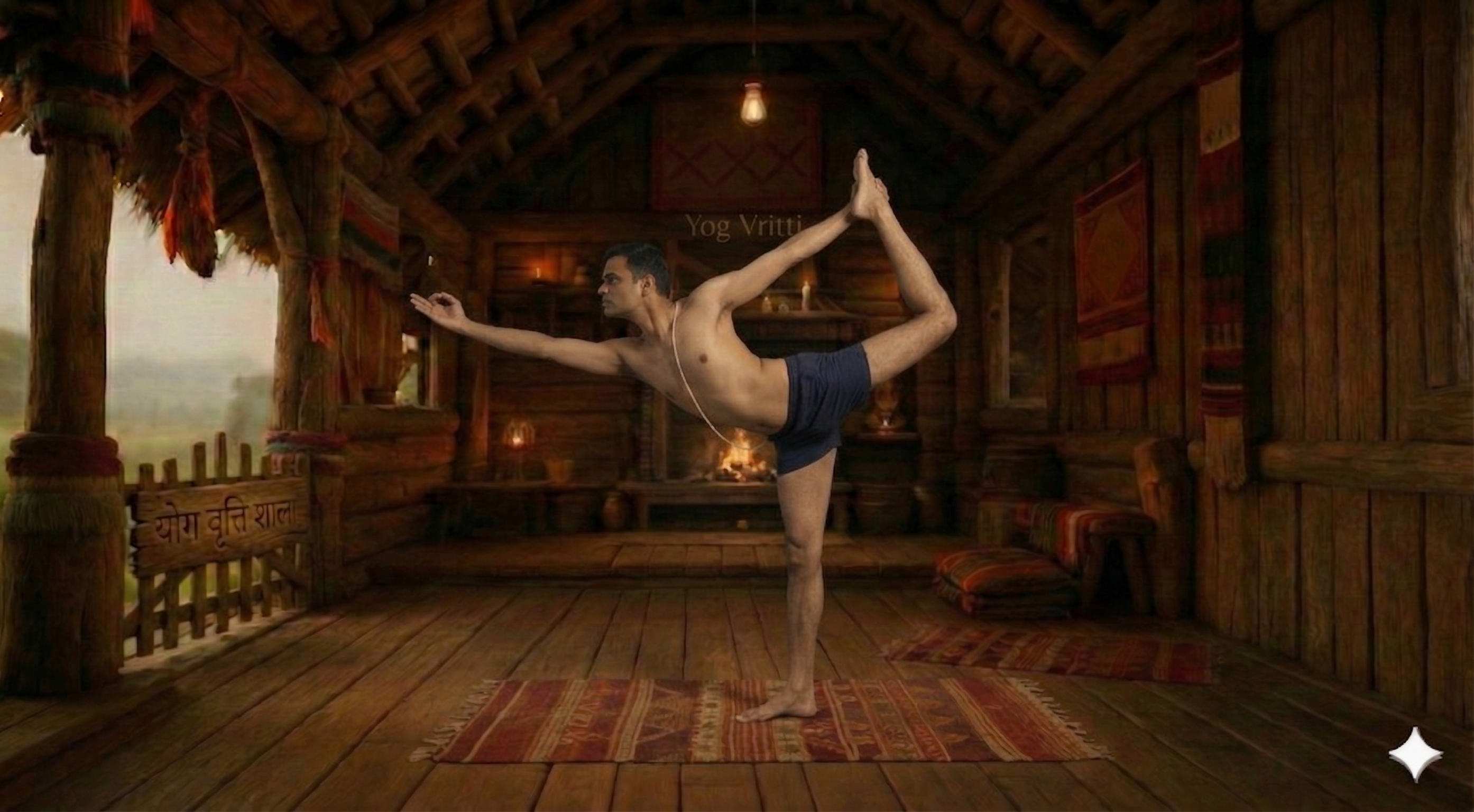
Lord of the Dance Pose
नटराजासन
Natarajasana is a powerful standing backbend that elegantly integrates strength, flexibility, and balance, demanding deep awareness from the practitioner. It profoundly stretches the entire anterior chain of the body – from the hip flexors and quadriceps to the abdominal muscles and chest – while simultaneously strengthening the posterior chain for spinal extension and stability. This pose cultivates a buoyant, open quality in the body and mind, channeling prana upwards to energize the heart and crown, fostering grace, poise, and unwavering focus amidst dynamic challenge. It's a journey into inner stillness through outward expression.
Lord of the Dance Pose, also called Dancer's Pose is a classical yoga posture whose Sanskrit roots break down as: Nata (Dancer) · Raja (King (Shiva)) · Asana (Pose). From a standing position, the body roots firmly through the feet while the spine extends upward. The posture works to strengthen the quadriceps, stretch the hip flexors and open and strengthen the shoulders. Strengthens legs and back muscles. Stretches hip flexors, quadriceps, and shoulders. It is particularly valued for developing greater flexibility and building full-body strength. Suitable for advanced practitioners with developed body awareness, it is a meaningful addition to any practice, particularly beneficial for athletes. A wall and strap can be used to make the posture more accessible and support correct alignment. Practitioners with spinal injury and shoulder injury should approach with care or consult a qualified teacher.
Helps with
Muscles Worked
Quadriceps
[Rectus femoris, Vastus lateralis, Vastus medialis, Vastus intermedius]
The large muscles at the front of your lifted thigh (quadriceps femoris, especially rectus femoris) are undergoing a profound stretch as the knee flexes deeply and the hip extends.
This lengthening helps to release chronic tightness often held from activities like sitting, directly improving hip extension and pelvic alignment.
Energetically, this unwinds blockages in the front of the body, allowing a freer flow of prana, cultivating openness and lightness.
Hip Flexors
[Psoas major, Iliacus]
The deep muscles connecting your spine and pelvis to the front of your thigh (iliopsoas) are significantly lengthened in the lifted leg as the hip moves into extension.
This release is crucial for decompressing the lower back and improving overall pelvic mobility, often tight in modern lifestyles.
From a yogic perspective, releasing the psoas can free up a major energetic channel, allowing a sense of emotional release and greater ease in movement.
Erector Spinae
[Spinalis, Longissimus, Iliocostalis]
The long muscles running along either side of your spine (erector spinae group) are actively engaged to create and sustain the backbend, extending the vertebral column with controlled strength.
This action builds resilience in the spinal muscles, improving posture and counteracting the effects of slouching.
By strengthening these muscles, we empower the central energetic channel (sushumna nadi), promoting vitality and uprightness both physically and mentally.
Gluteals (standing leg)
[Gluteus maximus, medius, minimus]
The muscles of your standing buttock (gluteus maximus, medius, minimus) are powerfully engaged to stabilize the hip and pelvis, anchoring your base as you extend upwards and backwards.
This deep activation provides a solid foundation for the pose, preventing unwanted swaying and protecting the knee joint.
A strong, stable foundation in the lower body allows for greater expansion and freedom in the upper body, embodying the principle of 'sthira sukham asanam' – steady and comfortable.
Rhomboids & Middle Trapezius
[Rhomboid major/minor, Trapezius (middle fibers)]
These muscles between your shoulder blades (rhomboids and middle trapezius) are crucial for drawing the shoulder blades towards the spine and down, opening the chest.
This action prevents the shoulders from rounding forward, creating space across the collarbones and broadening the chest.
This physical opening of the heart space is directly linked to an energetic opening of Anahata Chakra, fostering feelings of compassion, courage, and emotional expansiveness.
Core Muscles
[Transversus abdominis, Obliques, Rectus abdominis]
The deep muscles of your abdomen and waist (transversus abdominis, obliques) are actively engaged to support the lumbar spine and maintain pelvic stability throughout the backbend.
This intelligent engagement prevents excessive compression in the lower back, allowing for a safe and exhilarating extension.
A strong and integrated core provides a sense of inner containment and power, allowing the upper body to soar with grace and freedom.
Joints Mobilized
Hip Joint (lifted leg)
mobilizingIn the lifted leg, the hip joint (coxal joint) is taken into significant extension, challenging its anterior flexibility and creating space within the joint capsule.
This deep mobilization, particularly in extension, helps to free up the joint from stiffness, improving range of motion for walking and other movements.
From a yogic perspective, this action helps to release stored emotional tension in the pelvic region, promoting a sense of freedom and emotional release.
Hip Joint (standing leg)
stabilizingThe hip joint of the standing leg is powerfully stabilized by the surrounding muscles, providing the crucial anchor for the entire pose.
This isometric engagement strengthens the gluteal and deep hip rotator muscles, enhancing overall joint integrity and balance.
Regular practice improves proprioception around the hip, leading to greater confidence in movement and a grounded feeling, essential for navigating daily life with stability.
Spine (Vertebral Column)
mobilizingThe entire vertebral column undergoes a controlled extension, particularly in the thoracic and lumbar regions, increasing its flexibility and mobility.
This gentle arching helps to decompress the intervertebral discs, improving spinal health and nerve function.
Energetically, this opening of the spine allows for an unobstructed flow of prana along the central channel, invigorating the nervous system and fostering mental clarity.
Shoulder Joint
mobilizingThe shoulder joint (glenohumeral joint) of the arm holding the foot is taken into significant extension and external rotation, deeply opening the anterior shoulder capsule and chest.
This action helps to counteract the common forward-slumping posture, improving shoulder mobility and reducing tension.
The expansive feeling in the shoulders and chest cultivates an energetic openness, allowing us to 'receive' and 'give' with greater ease, both physically and emotionally.
Organ & System Benefits
Abdominal Organs
The gentle compression and stretching of the abdominal area in Natarajasana provides a subtle massage to the digestive organs, stimulating their function and improving circulation to the region.
This internal stimulation can aid in detoxification and enhance metabolic processes.
From a yogic viewpoint, this action helps to ignite Agni, the digestive fire, promoting better assimilation of nutrients and a sense of inner warmth and vitality.
Lungs and Heart
The expansive opening of the chest and shoulders in this backbend creates more space for the lungs to fully inflate, encouraging deeper and fuller breaths.
This increased lung capacity enhances oxygen intake and carbon dioxide release, improving overall cardiovascular health.
Energetically, this opening directly impacts the Anahata Chakra, the heart center, fostering feelings of compassion, courage, and an expansive sense of well-being.
Nervous System
The intense focus required to maintain balance in Natarajasana immediately draws the mind into the present moment, stilling the constant chatter (chitta vritti).
This sustained concentration on a single point (drishti) and the subtle adjustments of the body engage the parasympathetic nervous system, leading to a profound sense of calm stability amidst effort.
The act of balancing itself recalibrates our proprioception, enhancing body awareness and reducing generalized anxiety.
The combination of deep backbending and chest opening in Natarajasana is profoundly invigorating to the nervous system, stimulating the sympathetic 'fight or flight' response in a controlled, therapeutic way.
This controlled activation followed by the integration of the pose helps to reset the nervous system, boosting energy and mental alertness without agitation.
It's a dance between effort and surrender, culminating in a balanced state of energized calm.
Mental & Emotional
Natarajasana demands unwavering focus and concentration, training the mind to remain present and undistracted amidst physical challenge.
This practice of dharana, or one-pointed concentration, strengthens mental discipline and sharpens awareness, carrying over into daily life.
The steady gaze (drishti) and the intricate balance required cultivate a deep inner stillness, allowing the practitioner to observe and respond rather than react.
This elegant backbend cultivates immense courage and self-confidence, as it requires a willingness to open the front of the body and extend into the unknown.
Overcoming the initial apprehension of such a challenging pose builds resilience and a belief in one's own capabilities.
The graceful, expansive shape of the pose itself fosters a sense of poise and dignity, reflecting an inner strength and self-assurance.
The act of balancing on one leg while extending into a backbend teaches profound patience and perseverance.
It’s a practice of subtle adjustments and non-judgment, understanding that stability comes from continuous, gentle effort rather than rigid force.
This cultivation of patience translates into a more measured and resilient approach to life's challenges, fostering a calm and steady mind.
Because of Its Shape
standing
Standing poses build a strong foundation, connecting us deeply to the earth and cultivating a sense of grounded stability in the lower body.
They strengthen the legs, ankles, and feet, improving balance and proprioception, which are essential for everyday movement and preventing falls.
Energetically, standing poses help to root apana vayu, the downward-moving energy, providing a sense of security and presence in the physical body.
Standing poses are invaluable for developing body awareness and alignment, teaching us how to distribute weight evenly and engage muscles intelligently.
This conscious engagement translates into improved posture and reduced strain on joints, fostering a more efficient and pain-free way of moving.
They provide the fundamental blueprint for all other asanas, building the strength and stability required for more advanced practices.
Fascial Lines
In Natarajasana, the entire Superficial Front Line of fascia is significantly lengthened, from the tops of the feet, up the quadriceps, across the abdomen, and through the chest and anterior shoulder.
Simultaneously, the Superficial Back Line and the Spiral Line are actively engaged and strengthened to create the backbend and stabilize the torso.
This comprehensive engagement and release helps to unwind long-held fascial restrictions, improving overall elasticity and fluidity throughout the body, allowing for a freer flow of prana and a sense of physical and energetic liberation.
Breathing & Respiratory
The expansive chest opening in Natarajasana naturally encourages a deeper, more expansive inhalation, drawing breath into the upper lobes of the lungs and lifting the sternum.
This shape can initially restrict the abdominal muscles, inviting a more vertical breath rather than a purely diaphragmatic one, but with practice, it encourages a full, three-dimensional breath.
This invigorating breath pattern, akin to Ujjayi pranayama, fuels the backbend, enhances mental clarity, and supports the energetic lift (udana vayu) needed to sustain the pose with grace and ease.
Anatomical Caution
Teachers should guide students to approach this pose with immense care, particularly if they have any lower back sensitivities, knee issues, or shoulder stiffness.
Emphasize lifting and lengthening the spine before deepening the backbend, never forcing the knee or shoulder joint.
Using props like a wall for balance or a strap to hold the foot can provide invaluable support and allow for a gradual, safe exploration of the pose without strain.