6
Muscles
4
Joints
2
Organs
3
Mental
Padangusthasana II
पादांगुष्ठासन II
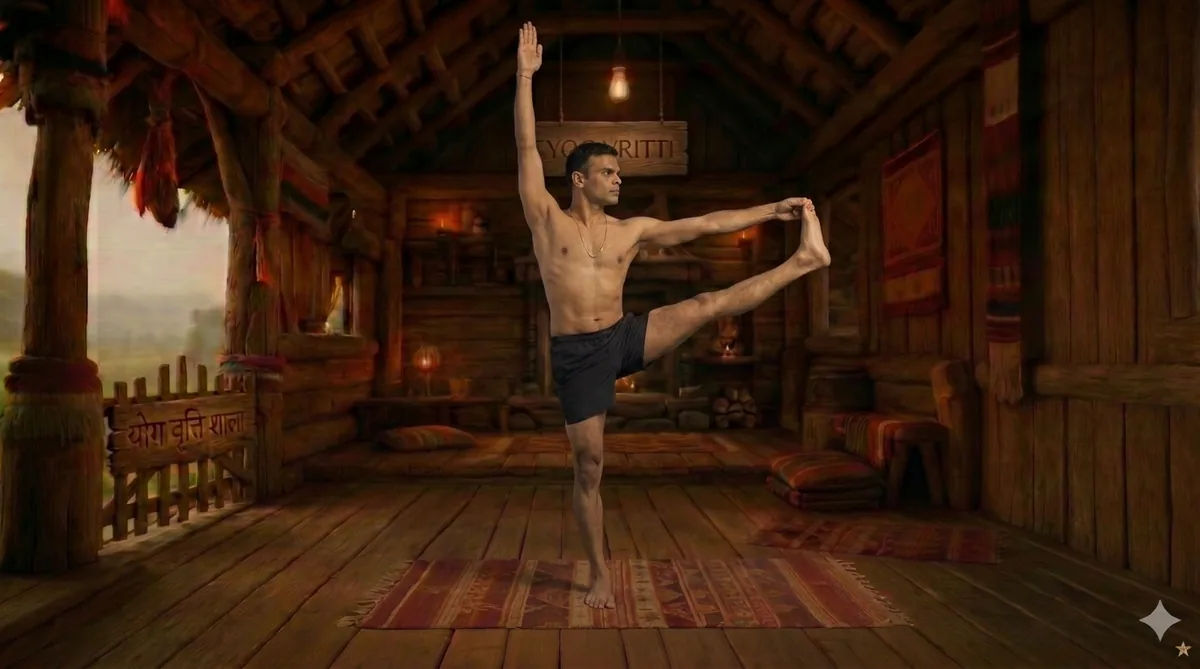
Padangusthasana II introduces a wider stance for the feet, fundamentally altering the base of support and the leverage on the posterior chain. This modification often makes the forward bend more accessible for beginners to deepen spinal lengthening, while simultaneously intensifying the stretch through the inner thighs. It allows for a more profound release in the hamstrings by subtly changing the angle of engagement, fostering greater ease and depth in the pose. Padangusthasana, the 'Big Toe Pose', is a foundational standing forward bend that deeply elongates the entire posterior chain of the body, from the heels through the spine to the crown of the head. This pose not only cultivates strength and stability in the legs and core but also offers a profound internalizing experience, calming the nervous system and drawing awareness inwards. By systematically releasing tension in the hamstrings and calves while decompressing the spine, it creates a grounded sense of ease and mental clarity, making it invaluable for both physical flexibility and emotional balance.
Big Toe Pose II, also called Padangusthasana II is a classical yoga posture. Its Sanskrit name Padangusthasana II translates word-for-word as: Pada (Foot) · Angustha (Big Toe) · Asana (Pose). From a standing position, the body roots firmly through the feet while the spine extends upward. The posture works to lengthen the hamstrings, stretch the calves and engage the core. Strengthens the legs and core. Calms the mind. It is particularly valued for developing greater flexibility and building full-body strength. Suitable for beginners and regular practitioners alike, it is an excellent warm-up, particularly beneficial for beginners. Practitioners with back pain and spinal injury should approach with care or consult a qualified teacher.
Helps with
What This Variation Changes
The primary positional change in Padangusthasana II is the wider stance of the feet, which creates a broader and more stable base of support. This redistributes weight more evenly across the feet and often makes the forward bend more accessible by reducing the direct, intense pull on the hamstrings at their origin. It subtly shifts the joint angles at the hip, allowing for greater pelvic tilt and facilitating a deeper, more comfortable spinal lengthening, particularly beneficial for those with tighter hamstrings or lower back sensitivity.
Muscles Worked
Hamstrings
In Padangusthasana II, with the feet placed wider apart, the hamstrings are still deeply lengthening, but the angle of the stretch is subtly altered.
This wider base often allows for a more even distribution of the stretch across the medial and lateral heads of the hamstrings, and can sometimes reduce the intense pulling sensation at the ischial tuberosities.
This subtle shift provides a different leverage point, facilitating a release that might be restricted in the narrower stance, leading to a more accessible and often deeper forward fold.
Calves
[Gastrocnemius, Soleus]
The muscles at the back of your lower legs (calves) are significantly lengthened as you fold forward and keep the legs straight.
This stretch extends from the heel up towards the knee, addressing tightness that can restrict ankle mobility and affect gait.
By encouraging these muscles to soften, we improve circulation in the lower legs and release energetic stagnation, contributing to a feeling of lightness and improved grounding through the feet.
Quadriceps
The quadriceps continue their essential role in firming the thighs and lifting the kneecaps, providing crucial stability to the knee joints in Padangusthasana II.
In the wider stance, their engagement also contributes to maintaining the integrity of the leg alignment, preventing any inward or outward collapse of the knees.
This ensures the stretch remains focused on the hamstrings and inner thighs without compromising joint safety, while also supporting the deep forward bend.
Erector Spinae
While still actively lengthening to create space and decompress the spine, the wider base of support in Padangusthasana II often allows the erector spinae to release more profoundly.
With less direct compensatory tension pulling from the hamstrings on the pelvis, the spine can elongate with greater ease and less strain.
This encourages a deeper, more yielding forward bend where the focus can shift from overcoming hamstring resistance to truly lengthening and decompressing the entire vertebral column.
Core Abdominals
The core abdominals remain actively engaged in Padangusthasana II, drawing in and lifting to support the lumbar spine and facilitate the forward fold.
The wider base in this variation can allow for a more profound and sustained engagement of the lower abdominals, creating greater space for the torso to fold deeply between the thighs.
This fosters a sense of internal lift and support that prevents slumping, encourages spinal elongation, and deepens the overall internalizing experience of the pose.
Adductor Group
Adductor magnus, longus, brevis, pectineus, gracilis
With the feet placed significantly wider apart in Padangusthasana II, the adductor muscles of the inner thighs are brought into a pronounced lengthening action, which is far less prominent in the narrower stance of Padangusthasana I.
These muscles actively stabilize the wide base, preventing the legs from splaying excessively, while simultaneously experiencing a deep stretch as the pelvis tilts forward and the torso descends between the thighs.
This engagement enhances flexibility in the inner groin and hips, which is crucial for many other standing poses and hip-opening sequences.
Joints Mobilized
Hip Joint
mobilizingThe ball-and-socket joints of your hips (acetabulofemoral joints) are deeply mobilized into flexion as you hinge forward from the pelvis.
This action encourages the femur heads to move deeper into the hip sockets, improving the range of motion and flexibility in the hip flexors and extensors.
Over time, this consistent mobilization helps to free up stiffness in the pelvis, allowing for greater ease in walking and sitting, and a more uninhibited flow of apana vayu.
Knee Joint
stabilizingThe hinge joints of your knees (tibiofemoral joints) are held in a stable, extended position in Padangusthasana.
While the primary action is not movement, the quadriceps muscles engage to lift the kneecaps, protecting the joint and preventing hyperextension.
This mindful stabilization strengthens the muscles around the knee, promoting long-term joint health and a sense of steady support from the ground up.
Ankle Joint
mobilizingThe hinge joints of your ankles (talocrural joints) are gently mobilized into dorsiflexion as the weight shifts slightly forward onto the balls of the feet and the calves lengthen.
This subtle action improves flexibility in the ankle joint and releases tension in the Achilles tendon.
Enhanced ankle mobility contributes to better balance and a more grounded connection to the earth, creating a stable foundation for all standing postures.
Spine (Vertebral Joints)
decompressingThe many small joints between your vertebrae (intervertebral joints) are gently decompressed and elongated as you fold forward with a long spine.
Gravity assists in creating space between the discs, relieving pressure and improving the circulation of cerebrospinal fluid.
This spinal lengthening helps to release accumulated tension along the back, fostering a sense of lightness and fluidity in the trunk, and allowing prana to move unobstructed through the sushumna nadi.
Organ & System Benefits
Digestive Organs
As you fold forward, the abdominal organs are gently compressed against the thighs.
This internal massage stimulates the digestive system, encouraging peristalsis and improving circulation to the stomach, intestines, and liver.
The release after the compression brings a fresh flush of blood, which can alleviate symptoms of sluggish digestion and promote healthy elimination, contributing to a sense of internal cleansing and vitality (agni).
Brain
In this mild inversion, the head is positioned below the heart, increasing blood flow to the brain.
This gentle flush of oxygenated blood can calm the nervous system, reduce mental fatigue, and enhance clarity of thought.
The shift in perspective and increased cerebral circulation contribute to a feeling of mental tranquility and focus, helping to quiet the 'chitta vritti' or fluctuations of the mind.
Nervous System
The act of folding forward and dropping the head below the heart naturally activates the parasympathetic nervous system, shifting the body out of 'fight or flight' mode.
This leads to a noticeable calming effect, slowing the heart rate and deepening the breath.
The sustained quietude in the pose allows for a profound release of accumulated stress and tension, fostering a deep sense of inner peace and relaxation.
As the body settles into the forward bend, the sensory input from the external world diminishes, encouraging a state of introspection and presence.
This internal focus helps to quiet the incessant chatter of the mind (chitta vritti) and directs awareness inwards.
The practitioner experiences a profound sense of grounding and stability, allowing the nervous system to release its hold on anxiety and cultivate a state of centered calm.
The gentle stretch on the posterior chain, particularly the hamstrings and spine, sends signals to the nervous system to relax and release tension.
This physical unwinding directly impacts emotional states, as chronic tension is often intertwined with stress and anxiety.
The sustained nature of the pose allows the nervous system to gradually let go, fostering a feeling of deep surrender and emotional release.
Mental & Emotional
This forward bend encourages a profound sense of introspection and self-reflection, as the gaze is turned inwards and the external world recedes.
By folding the body, we symbolically turn our attention towards our inner landscape, fostering a deeper connection to our true self.
This practice cultivates a quality of 'pratyahara' – withdrawal of the senses – leading to greater self-awareness and mental clarity.
Padangusthasana teaches the mind to surrender and let go of resistance, both physically and mentally.
As the body gradually releases into the stretch, the mind learns to release its grip on expectations and judgments, embracing the present moment fully.
This cultivates patience and acceptance, transforming rigid thought patterns into a more fluid and adaptable mental state, embodying the yogic principle of 'vairagya' (non-attachment).
Holding the pose with mindful awareness requires sustained concentration and focus (dharana), drawing the scattered mind into a single point of attention.
The challenge of maintaining a long spine while deepening the fold trains the mind to be present and persistent.
This mental discipline translates into improved focus in daily life, enhancing one's ability to concentrate on tasks and cultivate inner stillness amidst distractions.
Because of Its Shape
forward bend
A forward bend deeply elongates the entire posterior chain of the body, including the hamstrings, calves, and the muscles along the spine.
This action releases chronic tension that often accumulates from sitting and standing, improving overall flexibility and mobility.
Anatomically, it encourages flexion at the hip joints and gentle decompression of the spinal column, creating space and fluidity in the back body.
The inverted nature of a forward bend, where the head is below the heart, has a profound calming effect on the nervous system.
It reduces mental agitation and stress by gently increasing blood flow to the brain and activating the parasympathetic response.
Yogically, this shape helps to quiet the 'chitta vritti' (mind fluctuations), drawing awareness inward and fostering a sense of introspection and inner peace.
Forward bends are inherently grounding and centering, connecting the practitioner more deeply to the earth.
By folding over the legs, we create a sense of containment and safety, allowing the energetic flow of 'apana vayu' (downward and outward moving energy) to release and stabilize.
This cultivation of groundedness brings emotional stability, reducing feelings of anxiety and promoting a sense of being firmly rooted in oneself.
Fascial Lines
In Padangusthasana, the entire posterior superficial fascial line is intensely lengthened, running from the soles of the feet, up the calves, hamstrings, glutes, erector spinae, and even into the scalp.
This interconnected web of connective tissue gets a sustained release, helping to unwind deeply held tension patterns that restrict movement and posture.
Yogically, this opening of the fascial lines is understood as clearing energetic pathways, allowing for a more unobstructed flow of prana throughout the body and releasing physical manifestations of emotional blockages.
Breathing & Respiratory
The forward bend shape naturally encourages a deeper and more extended exhalation, as the abdominal compression assists in expelling stale air from the lungs.
This gentle compression against the thighs also promotes diaphragmatic breathing, encouraging the breath to move into the back and sides of the rib cage.
In pranayama, this extended exhalation is inherently calming and detoxifying, making Padangusthasana an excellent pose to cultivate 'rechaka' (exhalation) and prepare the body for practices like Nadi Shodhana.
Anatomical Caution
While often more accessible, the wider stance in Padangusthasana II can introduce different safety considerations.
Students must be mindful not to overstretch the inner thighs (adductors) or to force the pelvis into an uneven tilt, which could strain the sacroiliac (SI) joint.
Maintaining an even weight distribution and a gradual descent is crucial to ensure the stretch remains balanced and pain-free, protecting both the inner groin and the lower back.