5
Muscles
4
Joints
2
Organs
3
Mental
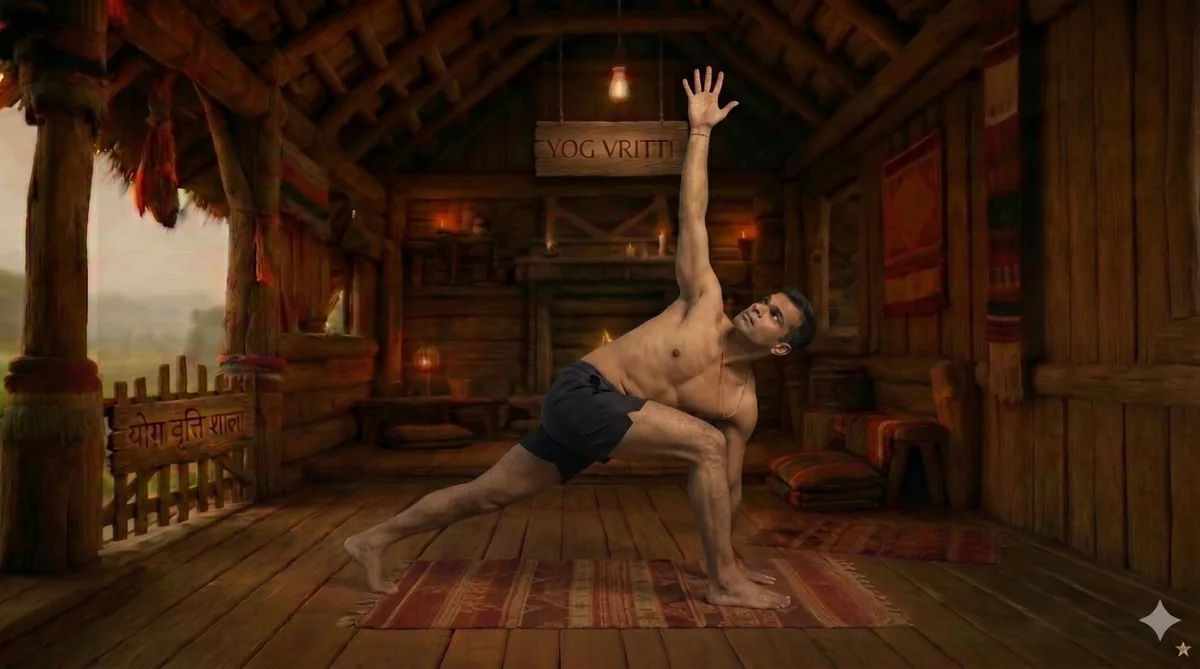
Parivrtta Parsvakonasana
परिवृत्त पार्श्वकोणासन
Parivrtta Parsvakonasana, the Revolved Side Angle Pose, is a powerful standing twist that integrates the entire body. It demands deep engagement from the leg muscles, strengthens the core, and cultivates significant spinal mobility through axial rotation. Energetically, this pose is profoundly grounding through the legs, while simultaneously invigorating and cleansing the internal organs through the 'wringing out' action of the twist. For a teacher, understanding its layered benefits allows for a more precise and impactful instruction, guiding students towards both physical mastery and a profound sense of inner purification and stability.
Revolved Side Angle Pose, also called Twisting Side Angle is a classical yoga posture. Its Sanskrit name Parivrtta Parsvakonasana translates word-for-word as: Parivrtta (Revolved) · Parsva (Side) · Kona (Angle) · Asana (Pose). From a standing position, the body roots firmly through the feet while the spine extends upward. The posture works to engage the core, strengthen the quadriceps and lengthen the hamstrings. Improves spinal flexibility. Stimulates abdominal organs. It is particularly valued for building full-body strength and developing greater flexibility. Suitable for intermediate practitioners with foundational yoga experience, it is a meaningful addition to any practice. A block can be used to make the posture more accessible and support correct alignment. Practitioners with migraine and low blood pressure should approach with care or consult a qualified teacher.
Helps with
Muscles Worked
Quadriceps
Quadriceps femoris
The muscles on the front of your leading thigh (quadriceps femoris) work powerfully here, holding the deep bend in the knee.
They are eccentrically loading to control the descent into the pose and then isometrically contracting to stabilize the knee joint, preventing collapse.
This sustained effort builds incredible strength and endurance in the legs, cultivating a deep sense of tapas, or inner discipline and heat, that grounds your entire practice.
Glutes
Gluteus maximus, medius
The muscles of the buttocks (gluteus maximus and medius) on the leading leg are crucial for stabilizing the hip and preventing the knee from collapsing inward.
They engage to externally rotate the femur slightly, creating space in the hip joint and aligning the leg properly.
This activation roots the lower body firmly, allowing the spine to twist more freely above a stable foundation, embodying the principle of sthira (steadiness) in the pose.
Hamstrings
Hamstring group
The muscles along the back of the trailing thigh (hamstrings) receive a dynamic stretch as the hip extends and the knee straightens in the back leg.
This lengthening is not passive; it requires active engagement of the quadriceps to protect the knee and deepen the stretch safely.
Releasing tension in this posterior chain helps to free the pelvis and lower back, allowing apana vayu, the downward-moving energy, to flow more smoothly, contributing to a feeling of groundedness and release.
Obliques
Internal and external obliques
The powerful muscles at the sides of your waist (internal and external obliques) are the primary engines for the deep spinal rotation in this pose.
The external oblique on the side of the front leg works with the internal oblique on the side of the back leg to initiate and deepen the twist.
This active engagement creates internal heat (agni) and a 'wringing out' action that is deeply purifying, both physically and energetically, stimulating the core and cleansing the abdominal region.
Erector Spinae
Erector spinae group, multifidus
The deep muscles running alongside and between the vertebrae (erector spinae and multifidus) work diligently to maintain length and integrity in the spinal column as it rotates.
They prevent compression and create space between each vertebra, allowing for a more profound and safe twist.
This axial extension while twisting facilitates the free flow of prana along the sushumna nadi, encouraging alertness and vitality throughout the central nervous system.
Joints Mobilized
Spine (Vertebral joints)
mobilizingThe many small joints between your vertebrae (intervertebral joints) are actively mobilized through axial rotation in Parivrtta Parsvakonasana.
This deep twist helps to de-compress the spinal discs by creating space and then nourishing them with fresh synovial fluid upon release.
Regular practice enhances spinal flexibility and suppleness, releasing chronic stiffness and allowing the vital energy, prana, to ascend more freely along the central energetic channel.
Hip joints
mobilizingThe hip joint of the front leg is deeply flexed, abducted, and externally rotated, while the hip of the back leg is extended and internally rotated.
This complex interplay of actions creates a significant opening and mobilization in both hips, challenging their range of motion and stability.
Releasing tension in the hips can unlock stored emotional patterns and facilitate a greater sense of freedom and ease in the lower body, deeply connecting to the earth element.
Knee joints
weight bearingThe knee joint of the front leg bears significant weight in a deep flexion, requiring strength and stability from the surrounding muscles to protect it.
The trailing knee is extended, emphasizing stability and alignment.
Conscious alignment, ensuring the front knee tracks over the ankle, prevents undue stress and builds resilience in these crucial weight-bearing joints, fostering a sense of steadfastness and unwavering support in the lower body.
Shoulder joints
mobilizingOne shoulder joint is typically in internal rotation and adduction (arm down), while the other is in flexion and external rotation (arm overhead).
This creates an asymmetrical opening and strengthening, challenging the mobility and stability of the shoulder girdle.
This expansion across the chest and shoulders helps to release tension stored in the upper back, creating more space for the breath and symbolically opening the heart center (Anahata chakra) to receive and give.
Organ & System Benefits
Abdominal Organs (Digestive System)
The deep twist of Parivrtta Parsvakonasana creates a gentle, compressive 'wringing' action on the abdominal organs such as the liver, spleen, pancreas, and intestines.
This compression on one side and subsequent release upon unwinding stimulates blood flow and lymphatic drainage to these vital organs.
This 'massage' effect is incredibly beneficial for improving digestion, alleviating constipation, and boosting metabolic functions, aligning with the yogic principle of agni (digestive fire) and detoxification.
Kidneys and Adrenal Glands
Situated in the posterior abdomen, the kidneys and their associated adrenal glands receive a gentle massage through the spinal rotation and compression in this pose.
This action is thought to stimulate blood circulation to these glands, supporting their function in fluid balance and stress hormone regulation.
From a yogic perspective, this stimulation can help to balance apana vayu and enhance overall vitality, reducing feelings of fatigue and supporting resilience in the face of stress.
Nervous System
The sustained effort and deep twisting action, coupled with focused breath, shifts the nervous system from a state of sympathetic arousal towards parasympathetic dominance.
As you hold the pose and breathe deeply, the body learns to remain calm amidst intensity, fostering a sense of inner quietude and reducing the 'chitta vritti' or fluctuations of the mind.
This cultivation of stillness under pressure is a direct pathway to pratyahara, the withdrawal of the senses, allowing for deeper introspection.
The intricate balance and proprioceptive demands of Parivrtta Parsvakonasana sharpen your body's self-awareness and spatial orientation.
Your brain constantly receives feedback from muscles and joints, enhancing your kinesthetic intelligence and refining your sense of where you are in space.
This heightened interoception allows practitioners to feel subtle shifts in their physical and energetic body, leading to a profound sense of presence and connection to their inner landscape.
Mental & Emotional
This pose demands unwavering focus and concentration, drawing the mind away from external distractions and into the present moment.
The challenge of maintaining balance, depth, and breath simultaneously cultivates dharana, or one-pointed concentration, which is a foundational step towards meditation.
Through this sustained mental effort, practitioners develop mental discipline and resilience, learning to navigate discomfort with a steady and observant mind.
Engaging in a challenging pose like Parivrtta Parsvakonasana fosters a profound sense of determination and inner strength.
Facing the physical and mental intensity with a calm breath and steady gaze builds tapas – the inner fire of discipline and purification.
This experience translates off the mat, empowering students to approach life's challenges with greater courage, perseverance, and a firm belief in their own capabilities.
The deep twist in this pose can create a significant shift in mental perspective, inviting practitioners to 'unwind' rigid thought patterns and embrace new ways of seeing.
Just as the spine rotates to its maximum capacity, the mind is encouraged to release mental 'kleshas' or afflictions like attachment and aversion.
This energetic cleansing and reorientation can lead to a sense of mental clarity, lightness, and a more adaptable approach to life's complexities.
Because of Its Shape
twist
As a deep twisting pose, Parivrtta Parsvakonasana creates profound axial rotation along the spinal column, segmentally mobilizing each vertebra.
This 'wringing out' action is anatomically beneficial for stimulating circulation around the spinal discs and releasing tension in the deep spinal muscles.
Energetically, twists are considered highly purifying, releasing stagnant prana and emotional blockages, leaving the practitioner feeling cleansed, invigorated, and mentally clear.
The standing nature of this pose grounds the practitioner deeply through the feet and legs, creating a strong and stable foundation.
This engagement of the lower body strengthens the leg muscles, improves balance, and cultivates a sense of rootedness.
From a yogic perspective, standing poses connect us to the earth's energy, activating the Muladhara (root) chakra and fostering a sense of security, stability, and unshakeable presence in the world.
Fascial Lines
The intricate web of connective tissue, or fascia, that envelops muscles, bones, and organs, undergoes significant lengthening and release in Parivrtta Parsvakonasana.
Specifically, the spiral lines and functional lines connecting the opposite shoulder to the hip are deeply engaged and stretched, unwinding chronic tension patterns.
This targeted release of fascial restrictions improves overall body fluidity and energetic flow, allowing prana to move more freely through the body's subtle channels, releasing deeply held physical and emotional imprints.
Breathing & Respiratory
The deep twist of Parivrtta Parsvakonasana naturally compresses one side of the torso while expanding the other, which profoundly influences the breath.
This shape encourages a deeper, more conscious diaphragmatic breath, as the body seeks to find space for expansion within the twist.
The sustained hold often leads to a lengthening of the exhalation, which is inherently calming.
Practitioners can utilize Ujjayi breath to maintain focus and heat, and after the pose, Nadi Shodhana or Kapalabhati can further enhance the cleansing and balancing effects on the pranic body.
Anatomical Caution
Teachers, always guide students to prioritize spinal length over depth of twist to protect the lower back.
Ensure the front knee is directly over the ankle and not collapsing inward to safeguard the knee joint.
For students with neck issues, advise them to keep the head in a neutral position or look down, rather than forcing the gaze upwards, to avoid strain.