5
Muscles
4
Joints
3
Organs
2
Mental
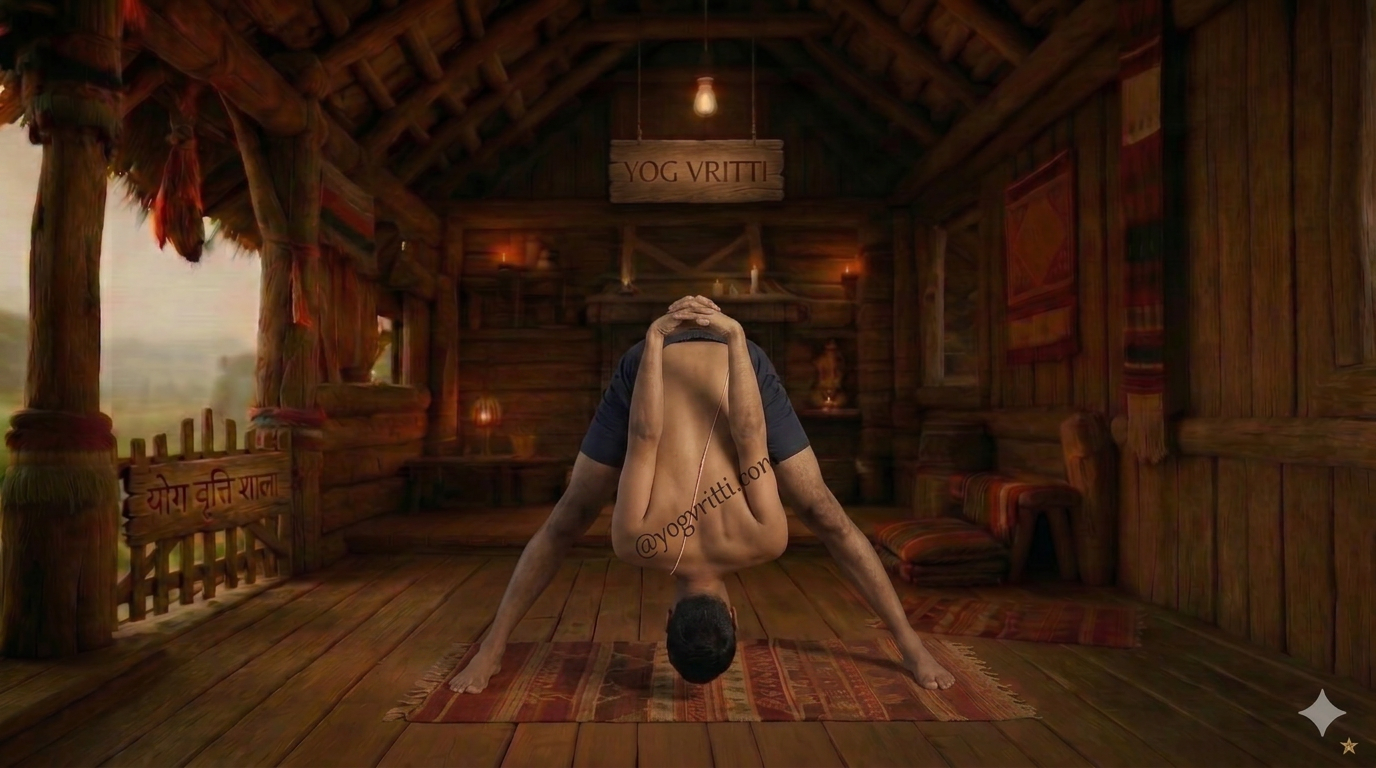
Prasarita Padottanasana IV
प्रसारिता पादोत्तानासन IV
Prasarita Padottanasana IV, a profound wide-legged forward fold with interlaced hands, meticulously stretches the entire posterior chain of the body, from the calves through the hamstrings and spinal erectors, while simultaneously offering a unique opening to the chest and shoulders. This inversion gently reverses blood flow, inviting a deep sense of introspection and quietude, fostering both physical release and mental calmness. It’s a powerful asana for grounding the body, decompressing the spine, and expanding the breath, making it invaluable for cultivating inner stability and releasing chronic tension.
Wide-Legged Forward Bend IV, also called Prasarita IV is a classical yoga posture. Its Sanskrit name Prasarita Padottanasana IV translates word-for-word as: Prasarita (Spread / Extended) · Padottanasana (Padottanasana) · Asana (Pose). From a standing position, the body roots firmly through the feet while the spine extends upward. The posture works to lengthen the hamstrings, engage the core and strengthen the quadriceps. Strengthens legs and back. Opens chest and shoulders. It is particularly valued for developing greater flexibility and building full-body strength. Suitable for intermediate practitioners with foundational yoga experience, it is an excellent warm-up, particularly beneficial for beginners. A block can be used to make the posture more accessible and support correct alignment. Practitioners with spinal injury and shoulder injury should approach with care or consult a qualified teacher.
Helps with
Muscles Worked
Hamstrings
[Semitendinosus, Semimembranosus, Biceps femoris]
The prominent muscles running along the back of your thighs (hamstrings) experience a deep, sustained lengthening as the torso folds forward over straight legs.
This controlled release helps to unwind the chronic tightness often accumulated from prolonged sitting, improving hip flexion and pelvic mobility.
Energetically, this release allows apana vayu, the downward-moving energy, to flow more freely, fostering a profound sense of groundedness and stability in the lower body.
Adductors
[Adductor magnus, longus, brevis, gracilis, pectineus]
Positioned along the inner thighs, the adductor muscles are significantly lengthened in this wide-legged stance, particularly as the pelvis tilts anteriorly into the forward fold.
This action systematically opens the often-neglected inner groin and hip region, enhancing the external rotation capacity of the hips over time.
From a yogic perspective, releasing tension in the adductors can help unlock stored emotional rigidity in the pelvic bowl, allowing for greater freedom and fluidity in movement and being.
Erector Spinae
[Iliocostalis, Longissimus, Spinalis]
The long, powerful muscles that run parallel to your spine (erector spinae) are gently elongated as the spine flexes forward, allowing gravity to decompress the vertebral column.
This passive lengthening helps to release tension built up from maintaining upright posture or from habitual stiffness, creating space between each vertebra.
The resulting feeling is one of spinal ease and freedom, encouraging the upward flow of prana along the sushumna nadi, promoting lightness and clarity.
Quadriceps
[Rectus femoris, Vastus lateralis, Vastus medialis, Vastus intermedius]
While the focus is on lengthening the back of the legs, the muscles on the front of your thighs (quadriceps) must be actively engaged to lift the kneecaps and protect the knee joints, preventing hyperextension.
This co-activation creates a balanced stretch, providing stability to the leg bones (femur and tibia) and ensuring the hamstrings lengthen safely.
This conscious engagement cultivates a sense of active alertness and intelligence in the legs, grounding the practitioner firmly into the earth.
Rotator Cuff Muscles
[Supraspinatus, Infraspinatus, Teres minor, Subscapularis]
When the hands are interlaced behind the back and lifted towards the ceiling, the muscles surrounding the shoulder joint, particularly the rotator cuff muscles, experience a deep and therapeutic stretch.
This action externally rotates the upper arm bone (humerus) and opens the front of the shoulder capsule, counteracting the common hunched posture from desk work.
This expansive opening in the chest and shoulders can dissolve emotional burdens, fostering a sense of lightness and courage, allowing the heart to feel more open and free.
Joints Mobilized
Hip Joints
mobilizingThe ball-and-socket joints of the hips are deeply flexed in Prasarita Padottanasana IV, promoting increased range of motion in the sagittal plane.
This forward flexion, combined with the wide stance, encourages a gentle release of tension around the hip capsule and surrounding ligaments, improving overall hip mobility.
Practitioners will notice greater ease in everyday movements like bending and squatting, and yogically, this release in the hips can free up stagnant energy, fostering a sense of emotional liberation and fluidity.
Spine (vertebral column)
decompressingAs the torso folds forward, the weight of the upper body, combined with the gentle pull of gravity, creates a natural traction effect along the entire length of the spine.
This mild decompression helps to create space between the vertebral discs, potentially alleviating pressure on spinal nerves and promoting better nutrient flow.
The sensation is one of release and lengthening, which can reduce chronic back stiffness and, on a deeper level, allows for a smoother, unhindered flow of prana along the central energetic channel.
Shoulder Joints
mobilizingWith the hands interlaced and lifted, the shoulder joints undergo significant flexion and internal rotation, which then allows for a powerful stretch across the anterior aspect of the shoulders and chest.
This action systematically improves the range of motion in the glenohumeral joint, addressing stiffness and improving postural alignment.
Over time, this mobilization helps to restore full functionality to the shoulders, and from a yogic perspective, it fosters an open heart space, inviting feelings of compassion and receptivity.
Sacroiliac (SI) Joint
stabilizingWhile the spine is in flexion, the wide stance and active engagement of the legs help to create a stable foundation, subtly drawing the pelvic halves together to stabilize the sacroiliac joint.
This gentle stabilization, combined with the traction on the spine, can help to alleviate discomfort associated with SI joint dysfunction by promoting optimal alignment.
The practitioner feels a sense of grounded support in the pelvis, which translates into a feeling of inner security and stability, connecting to the root chakra.
Organ & System Benefits
Abdominal Organs
In this forward fold, the abdominal organs receive a gentle, internal compression against the thighs, which acts like a mild internal massage.
As you release the pose, fresh, oxygenated blood rushes into these areas, aiding in detoxification and improving digestive function.
This gentle compression and release can stimulate the solar plexus, igniting agni (digestive fire) and promoting a sense of inner vitality and energetic balance.
Circulatory System
As a mild inversion, Prasarita Padottanasana IV gently reverses the pull of gravity on your blood flow, encouraging increased circulation to the upper body, particularly the brain and sense organs.
This fresh blood supply can enhance mental clarity, reduce feelings of fatigue, and provide a subtle boost to cognitive function.
Yogically, this inversion helps to redirect prana, calming the nervous system and offering a fresh perspective, akin to 'turning things on their head' to see them anew.
Respiratory System
The forward fold naturally encourages a deeper, more diaphragmatic breath, as the abdominal compression can make the exhalation feel longer and more complete.
The chest opening from the interlaced arms further expands the lung capacity, allowing for fuller inhalations upon release.
This enhanced respiratory function helps to calm the nervous system, and in pranayama, a longer exhalation is directly linked to reducing stress and fostering a profound sense of inner peace and relaxation.
Nervous System
The sustained forward fold and mild inversion in Prasarita Padottanasana IV profoundly activate the parasympathetic nervous system, shifting the body from a 'fight or flight' (sympathetic) state to a 'rest and digest' response.
This physiological change is often felt as a deep sense of calm washing over the practitioner, reducing heart rate and blood pressure.
The quiet introspection fostered by the pose directly quiets the fluctuations of the mind (chitta vritti), leading to a more present and tranquil state of being.
The gentle pressure on the forehead and the increased blood flow to the brain stimulate the vagus nerve, a key component of the parasympathetic system, which further deepens the calming effect.
This stimulation helps to regulate emotional responses and improve resilience to stress, fostering a sense of emotional equilibrium.
Over time, consistent practice helps to 'reset' the nervous system, cultivating a baseline of inner peace and responsiveness rather than reactivity.
Mental & Emotional
This forward fold encourages a profound sense of introspection and turning inward, akin to the yogic principle of Pratyahara, where the senses are withdrawn from external distractions.
By literally folding in on oneself, the mind is invited to quiet down and observe internal sensations and thoughts without judgment.
This practice cultivates a meditative quality, allowing practitioners to gain clarity and detachment from mental chatter.
The sustained hold in Prasarita Padottanasana IV builds mental resilience and patience, requiring the practitioner to surrender to gravity and the stretch rather than forcing it.
This mindful endurance translates into a greater capacity to remain calm and centered amidst life's challenges.
For teachers, guiding students through this pose offers an opportunity to cultivate not just physical flexibility, but also mental fortitude and a deeper connection to their inner wisdom.
Because of Its Shape
forward bend
Forward bends are inherently calming and introspective, as the physical act of folding inward naturally directs attention away from external stimuli.
This shape creates a gentle compression on the abdominal organs, stimulating digestion and encouraging a longer, more complete exhalation.
From a yogic perspective, forward bends help to release apana vayu, grounding the practitioner and quieting the mind, making them excellent preparatory poses for meditation.
This particular forward bend, with its wide stance, provides an unparalleled lengthening of the entire posterior chain of the body, from the calves to the hamstrings and the spinal erectors.
This systematic release of muscular tension not only improves flexibility but also de-stresses the spine.
The benefit is profound physical release and a corresponding mental unwinding, fostering a deep sense of surrender and ease in the body and mind.
Fascial Lines
In Prasarita Padottanasana IV, the entire superficial back line of fascia is deeply released and lengthened, encompassing the plantar fascia, calves, hamstrings, glutes, and the erector spinae muscles.
Additionally, the arm lines of fascia, particularly the superficial front arm line and parts of the deep front arm line, are stretched as the hands interlace and lift overhead.
This integrated fascial release helps to unwind long-held patterns of tension throughout the body, improving overall fluidity and creating a sense of spaciousness within the physical form, allowing prana to flow more freely through these interconnected channels.
Breathing & Respiratory
The forward-folding nature of Prasarita Padottanasana IV naturally encourages a deeper, more conscious diaphragmatic breath.
The gentle compression on the abdomen supports a complete exhalation, creating space for a fuller, more expansive inhalation upon release or subtle lift.
This extended exhalation is inherently calming, activating the parasympathetic nervous system and reducing mental agitation.
For pranayama, this pose beautifully prepares the practitioner for practices that emphasize a long, smooth exhalation, such as Viloma or Nadi Shodhana, deepening the sense of inner peace and stillness.
Anatomical Caution
Teachers, please guide students with care, especially if they have acute lower back pain, disc issues, or significant hamstring tears.
Encourage a gentle bend in the knees if hamstrings are very tight to protect the lumbar spine.
For those with shoulder impingement or chronic shoulder pain, modify by holding elbows or using a strap behind the back instead of interlacing hands, ensuring no sharp pain is felt.