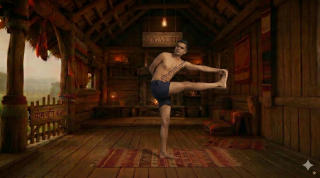
Benefits· लाभ
What Revolved Extended Hand-to-Big-Toe Pose does for you
परिवृत्त उत्थित हस्त पादाङ्गुष्ठासन
Revolved Extended Hand-to-Big-Toe Pose is a profound practice that masterfully integrates stability, extension, and rotation, demanding both physical strength and deep internal awareness. This advanced standing posture intricately lengthens the entire posterior chain while strengthening the core and stabilizing muscles around the hips and spine.
Muscles
- Hamstringsstretches
- Glutesstrengthens
- Quadricepsstrengthens
- Core musclesstabilises
- Obliquesstrengthens
Joints
- Hip Jointstabilises
- Hip Jointmobilises
- Spinemobilises
- Knee Jointstabilises
- Ankle Jointstabilises
Inside the body
- Abdominal Organs (Digestive System)
- Kidneys and Adrenal Glands
- Breathing
Mind
Revolved Extended Hand-to-Big-Toe Pose is a powerful teacher of mental fortitude and unwavering concentration.
Take care
Teachers, please guide your students with utmost care in this advanced posture, especially those with pre-existing hamstring or hip injuries.
Any sharp pain in the back of the thigh or around the hip joint signals an immediate need to back off or modify. Also, be mindful of students with lower back sensitivity, as the combination of extension and deep rotation can place undue stress on the lumbar spine if the core is not adequately engaged. Always prioritize spinal length before initiating the twist, and encourage the use of a strap or wall for support to ensure safe and effective practice.
Muscles
Hamstrings
StretchesBiceps femoris, Semitendinosus, Semimembranosus
The muscles running along the back of the thigh (hamstrings) on the lifted leg receive a deep, intelligent lengthening.
Read moreShow less
Through sustained extension and mindful breathing, these muscles are encouraged to release chronic tightness, not through force but through patient persuasion.
This release creates more space in the back of the hip joint and along the posterior chain, which in yogic terms, frees the flow of apana vayu, leading to a profound sense of grounding and ease in the lower body.
Regular practice helps to restore their optimal length and elasticity, benefiting overall pelvic alignment and reducing strain on the lower back.
Glutes
StrengthensGluteus maximus, medius, minimus
The muscles of the buttocks (glutes) on the standing leg are actively engaged, rooting the pelvis firmly and stabilizing the hip joint.
Read moreShow less
This deep engagement provides the necessary foundation for the upward extension of the spine and the lateral rotation of the trunk.
Activating these muscles cultivates a sense of energetic lift from the earth, fostering a strong connection to Muladhara Chakra, the center of stability and security.
For the lifted leg, the gluteus medius and minimus work subtly to support the leg's extension and prevent strain on the hip.
Quadriceps
StrengthensRectus femoris, Vastus lateralis, medialis, intermedius
The large muscles on the front of the thigh (quadriceps) of the standing leg are powerfully engaged, lifting the kneecap and securing the knee joint.
Read moreShow less
This muscular action creates a strong, stable pillar from the foot to the hip, crucial for maintaining balance in this complex posture.
Energetically, this strength builds tapas – inner fire and discipline – allowing the practitioner to sustain the pose with integrity and focus.
For the lifted leg, the quadriceps activate to straighten the knee, bringing an intelligent firmness to the extended limb.
Core muscles
StabilisesTransversus abdominis, Rectus abdominis, Obliques
The deep abdominal and back muscles (core) are profoundly engaged to stabilize the pelvis and spine, creating a firm central axis for the twist.
Read moreShow less
This engagement is not about hardening but about intelligent integration, drawing the naval gently inward and upward to support the lumbar spine.
This internal lift and stability are vital for protecting the lower back during the rotation, and in yogic thought, it awakens the manipura chakra, fostering strength, self-confidence, and a sense of inner power.
A strong core allows for freedom in the upper body's extension and twist.
Obliques
StrengthensInternal and External Obliques
The side abdominal muscles (obliques) are the primary movers in initiating and deepening the spinal twist in this pose.
Read moreShow less
They work synergistically to rotate the torso away from the lifted leg, creating a 'wringing' action through the waistline.
This dynamic engagement not only strengthens these muscles but also brings a fresh blood supply to the abdominal region, stimulating digestion and detoxification.
From a yogic perspective, this twisting action purifies the energy channels (nadis), allowing prana to flow more freely through the central axis of the body.
Hip flexors
StretchesPsoas major, Iliacus
The deep muscles at the front of the hip (hip flexors) of the standing leg are actively engaged in stabilizing the pelvis, while those on the lifted leg are lengthened through the extension.
Read moreShow less
This dual action helps to create space and mobility in the hip joint, releasing tension that often accumulates from prolonged sitting.
A released psoas allows for greater freedom in the spine and a sense of openness in the front of the body, which can energetically alleviate feelings of anxiety or 'holding on' in the core.
The lengthening also aids in achieving the full extension of the lifted leg.
Joints
Hip Joint (standing leg)
StabilisesThe hip joint of the standing leg, a ball-and-socket joint, is deeply engaged in stabilization, bearing the full weight of the body.
Read moreShow less
The surrounding muscles, particularly the glutes and deep external rotators, work to create a solid foundation, preventing excessive movement.
This deep grounding cultivates a sense of firm connection to the earth, fostering a feeling of security and rootedness within the posture.
Over time, this strengthens the supporting structures around the hip, improving overall joint integrity and balance.
Hip Joint (lifted leg)
MobilisesThe hip joint of the lifted leg undergoes significant mobilization, moving into deep flexion and then internal rotation as the leg extends and the torso twists.
Read moreShow less
This action stretches the posterior capsule of the hip and encourages greater range of motion, particularly in the hamstrings and inner thigh.
This opening creates space in the pelvis, which can release stored emotional tension and promote a sense of freedom and lightness in the lower body.
Consistent practice helps to maintain hip health and prevents stiffness, enhancing fluidity in daily movements.
Spine
MobilisesThe entire spinal column is engaged in a powerful, elongated twist, with particular emphasis on the thoracic and lumbar regions.
Read moreShow less
The spine extends upward, creating space between the vertebrae, before rotating around its central axis, decompressing the intervertebral discs.
This 'wringing' action revitalizes the spinal nerves and improves overall spinal mobility, enhancing the flow of vital energy (prana) throughout the nervous system.
Regular, mindful twisting helps to maintain a supple and strong spine, essential for overall well-being and energetic balance.
Knee Joint (standing leg)
StabilisesThe knee joint of the standing leg is held in a strong, stable position, neither hyperextended nor excessively bent, supported by the active engagement of the quadriceps and hamstrings.
Read moreShow less
This intelligent muscular engagement protects the delicate ligaments and menisci of the knee, promoting joint health.
This stability translates into a feeling of unwavering support and strength, allowing the practitioner to focus on the more complex aspects of the pose without fear of instability.
It teaches precise muscular control around the knee, which is crucial for preventing injury in all standing postures.
Ankle Joint (standing leg)
StabilisesThe ankle joint of the standing leg is actively engaged in maintaining balance, with the small muscles of the foot and lower leg working constantly to adjust and stabilize.
Read moreShow less
This intricate dance of micro-adjustments strengthens the ligaments and muscles surrounding the ankle, enhancing proprioception and overall foot stability.
From a yogic perspective, a firm foundation through the foot connects us deeply to the earth, cultivating a strong sense of grounding and presence, essential for balance and inner steadiness.
This strengthens the 'roots' of our posture, improving balance in all standing activities.
Inside the body
Abdominal Organs (Digestive System)
The deep twisting action of the torso gently compresses and then releases the abdominal organs, including the stomach, liver, spleen, and intestines.
Read moreShow less
This 'wringing out' motion stimulates blood flow and lymphatic drainage, effectively massaging these organs and aiding in their detoxification processes.
Energetically, this action stokes Agni, the digestive fire, promoting better assimilation of nutrients and elimination of waste, which is vital for physical vitality and mental clarity.
It's a natural internal cleanse that leaves the practitioner feeling refreshed and invigorated.
Kidneys and Adrenal Glands
The gentle compression and subsequent release during the twist can subtly stimulate the kidneys and adrenal glands, located in the posterior abdominal region.
Read moreShow less
This stimulation helps to regulate fluid balance and can have a balancing effect on the adrenal glands, which are involved in stress response.
From a yogic perspective, twists can help to release stored tension in these areas, promoting a sense of calm and reducing the cumulative effects of chronic stress on the body and mind.
This contributes to overall energetic harmony and improved stress resilience.
Breathing
The intricate nature of Revolved Extended Hand-to-Big-Toe Pose naturally invites a deep, conscious breath to maintain stability and facilitate the twist.
Read moreShow less
Initially, the breath may feel restricted due to the intense engagement and compression, but with sustained effort and mindful attention, the breath can deepen, particularly into the side ribs and back body.
This deep diaphragmatic breathing, often practiced with Ujjayi pranayama, helps to calm the nervous system, create internal space for the twist, and provide a rhythmic anchor for concentration, allowing the practitioner to find ease within the challenge.
Fascia (connective tissue)
The pose profoundly influences several fascial lines, most notably the Superficial Back Line as it lengthens the hamstrings and calf muscles on the lifted leg, and the Spiral Line due to the deep spinal twist.
Read moreShow less
The entire fascial web, which acts as a continuous, interconnected matrix throughout the body, is stretched and reorganized, releasing adhesions and restrictions.
This intelligent unwinding of the fascia helps to restore optimal tissue hydration and elasticity, enhancing freedom of movement and, from a yogic perspective, opening the energetic channels (nadis) that run through these myofascial meridians, allowing prana to circulate more freely.
Mind and nervous system
- Nervous system
This pose demands intense concentration and focus, immediately drawing the mind away from external distractions and into the present moment.
Read moreShow less
The intricate balance required engages the proprioceptive and vestibular systems, sharpening body awareness and coordination.
This profound mental engagement quiets the 'chitta vritti' (mind fluctuations), leading to a state of calm alertness and reducing the sympathetic nervous system's 'fight or flight' response.
The sustained effort, combined with deep breathing, helps to balance the autonomic nervous system, promoting a sense of inner peace and mental clarity.
The combination of deep muscular engagement and precise alignment required for this advanced posture cultivates a heightened sense of interoception – awareness of internal bodily states.
Read moreShow less
As the practitioner learns to finely tune their muscular effort and balance, the nervous system becomes more refined and efficient in its communication.
This deep, embodied awareness can be profoundly therapeutic, helping to release chronic tension patterns and fostering a more harmonious relationship between mind and body.
- Mind & mood
Revolved Extended Hand-to-Big-Toe Pose is a powerful teacher of mental fortitude and unwavering concentration.
Read moreShow less
The challenge of balancing on one leg while extending and twisting demands complete absorption, drawing the mind into a state of 'dharana' or focused attention.
Overcoming the initial wobbles and maintaining steadiness cultivates resilience and teaches the mind to remain calm and centered amidst perceived difficulty.
This practice strengthens the ability to stay present and committed, translating into greater mental clarity and resolve in daily life.
The intricate nature of this pose requires a delicate balance between effort and surrender, teaching the practitioner to find equanimity even when challenged.
Read moreShow less
As one navigates the physical demands, there's an opportunity to observe mental reactions—frustration, impatience, fear of falling—and to consciously choose a response of patience and determination.
This process fosters a deeper understanding of 'pratyahara' (withdrawal of the senses) and cultivates a profound sense of inner stability and self-mastery, reinforcing the mind's capacity for sustained, peaceful concentration.
Because it is a standing pose
Standing poses are fundamental for building a strong foundation, connecting us deeply to the earth and cultivating a sense of stability and grounding.
Read moreShow less
They strengthen the entire lower body—legs, feet, and core—while teaching us how to extend the spine upwards against gravity, creating length and lightness.
Energetically, they activate the Muladhara and Svadhisthana chakras, fostering security, confidence, and a sense of being firmly rooted in one's own being.
This grounding quality is essential for balancing the more expansive energies of the upper body and mind.
This posture is a profound twist, rotating the spine and torso around its central axis, which has a powerful effect on the internal organs and spinal mobility.
Read moreShow less
Twists are known for their 'wringing and soaking' action, believed to detoxify the body by stimulating circulation and lymphatic flow, particularly in the abdominal region.
From a yogic perspective, twisting purifies the nadis (energy channels), allowing prana to flow more freely, which revitalizes the entire system and clears stagnation, fostering mental clarity and emotional release.
As a balance pose, it hones concentration and proprioception, the body's awareness of its position in space.
Read moreShow less
Balancing on one leg while performing a complex action strengthens the deep stabilizing muscles of the feet, ankles, and hips, and refines the communication between the brain and the body.
Beyond the physical, balancing poses teach us mental steadiness and equanimity, cultivating a calm mind that can navigate life's challenges with grace and composure.
This practice builds inner resilience and confidence, allowing us to find our center amidst dynamic change.
This pose acts as a deep hip opener, particularly for the lifted leg's hip joint, which moves into significant flexion and internal rotation.
Read moreShow less
This action stretches the muscles and connective tissues surrounding the hip, increasing flexibility and range of motion.
Energetically, the hips are often considered a storage place for emotions and past traumas, so opening them can facilitate a release of physical and emotional tension.
This creates a sense of freedom and lightness in the pelvis, promoting a healthier flow of energy throughout the lower body.