6
Muscles
5
Joints
2
Organs
3
Mental
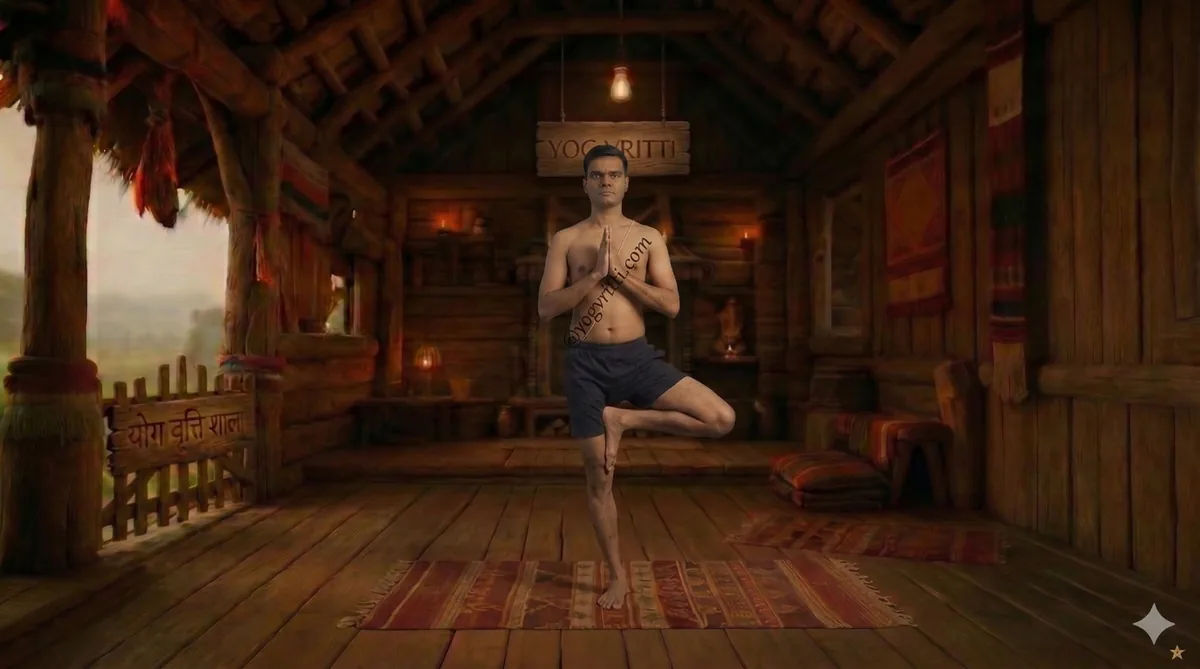
Salamba Vrksasana
सालम्ब वृक्षासन
Salamba Vrksasana, Supported Tree Pose, is a foundational standing balance that cultivates profound stability and inner calm. It meticulously strengthens the entire standing leg from the ankle upwards, engaging the quadriceps and glutes, while simultaneously opening the hip joint of the lifted leg, enhancing both strength and flexibility. This pose grounds the practitioner, activating the deep core to create a sense of internal lift and alignment, directly influencing posture and reducing anxiety by steadying the mind. It is a powerful practice for integrating physical poise with mental serenity, making it invaluable for anyone seeking to build a stronger, more centered self.
Supported Tree Pose, also called Salamba Vrksasana is a classical yoga posture. Its Sanskrit name Salamba Vrksasana translates word-for-word as: Sa (With) · Alamba (Support) · Vrksa (Tree) · Asana (Pose). From a standing position, the body roots firmly through the feet while the spine extends upward. The posture works to engage the core, strengthen the quadriceps and activate the glutes. Strengthens legs, core, and ankles. Increases focus and concentration. It is particularly valued for improving overall posture and building full-body strength. Suitable for beginners and regular practitioners alike, it is an excellent warm-up, particularly beneficial for beginners and seniors. A wall and chair can be used to make the posture more accessible and support correct alignment. Practitioners with low blood pressure and insomnia should approach with care or consult a qualified teacher.
Helps with
Muscles Worked
Quadriceps (standing leg)
Quadriceps Femoris (Rectus Femoris, Vastus Lateralis, Vastus Medialis, Vastus Intermedius)
The large muscles at the front of your standing thigh (quadriceps femoris) engage powerfully to extend the knee and support the entire leg, preventing collapse.
This isometric contraction builds endurance and strength in the lower limb, creating a stable pillar from the ground up.
You feel this as a firm, rooted connection to the earth, which energetically grounds apana vayu and creates a sense of unwavering support.
Regular strengthening here helps protect the knee joint and improves overall leg stability.
Glutes (standing leg)
Gluteus Medius, Gluteus Minimus
The muscles on the side of your standing hip (gluteus medius and minimus) are constantly working to stabilize the pelvis, preventing it from tilting or swaying.
These deep stabilizers ensure that your trunk remains vertically aligned over your standing leg, crucial for maintaining balance.
This continuous, subtle engagement cultivates a deep sense of centeredness and control, helping to align the subtle body and preventing the dispersion of energy.
Strengthening these muscles provides a strong foundation, relieving undue pressure on the lower back and sacroiliac joint.
Core (abdominals, deep spinal stabilizers)
Transversus Abdominis, Multifidus, Obliques (internal and external)
Your deep abdominal muscles (transversus abdominis) and the small muscles along your spine (multifidus) are subtly active, drawing the navel gently towards the spine to create a supportive corset for your torso.
This internal engagement prevents hyperextension or slumping of the lower back, ensuring a long, lifted spine.
This deep core stability fosters a profound sense of inner strength and integration, allowing prana to ascend freely and promoting mental clarity and confidence.
It’s the invisible anchor that supports your entire upper body.
Ankle muscles (standing leg)
Peroneals (Fibularis longus/brevis), Tibialis Anterior, Gastrocnemius/Soleus
The small muscles surrounding your standing ankle and lower shin (peroneals, tibialis anterior, gastrocnemius, soleus) are in constant, delicate communication, making micro-adjustments to keep you upright.
They respond instantaneously to shifts in your center of gravity, acting as highly sensitive shock absorbers and balancers.
This fine-tuned muscular activity enhances proprioception – your body's awareness in space – and cultivates a deep connection to the earth, fostering a sense of groundedness and present moment awareness, calming the restless mind (chitta vritti).
Adductors (lifted leg)
Adductor longus, brevis, magnus, Gracilis, Pectineus
The inner thigh muscles of your lifted leg (adductors) engage gently as you press the sole of your foot into your standing thigh.
This action creates a reciprocal force that helps to lift the pelvic floor and lengthen the inner groin, deepening the external rotation of the hip.
This subtle activation draws energy inwards and upwards, fostering a sense of integration and upward lift (udana vayu), connecting the base of the spine to the crown of the head.
It's an active engagement that supports the opening of the hip without strain.
Hip External Rotators (lifted leg)
Piriformis, Obturator Internus/Externus, Gemellus Superior/Inferior, Quadratus Femoris
The deep muscles on the outer hip of your lifted leg (e.g., piriformis, obturator internus) are gently lengthened as the thigh externally rotates and the knee drops open.
This passive stretch, supported by the foot's placement, helps to release tension often held in the hips from sitting or emotional stress.
This sustained opening frees up the flow of energy in the pelvic region, releasing stagnant apana vayu and allowing for a greater sense of freedom and emotional release.
Over time, this improves hip mobility and reduces tightness in the lower back.
Joints Mobilized
Ankle (standing leg)
weight bearingThe ankle joint of your standing leg bears the full weight of your body, requiring the intricate interplay of bones, ligaments, and muscles to maintain stability.
It acts as a dynamic fulcrum, constantly making subtle adjustments to keep you balanced, preventing excessive pronation or supination.
This deep engagement strengthens the joint and its surrounding structures, rooting you firmly to the earth and fostering a profound sense of stability and connection to the ground beneath you.
With consistent practice, the ankle becomes more resilient and responsive, enhancing overall balance.
Knee (standing leg)
stabilizingThe knee joint of your standing leg is stabilized by the strong engagement of the quadriceps and hamstrings, maintaining a soft, micro-bent position rather than locking out.
This intelligent muscular support protects the joint's delicate ligaments and cartilage from hyperextension and strain.
The conscious effort to keep the knee soft yet strong cultivates awareness and prevents rigidity, allowing energy to flow freely through the leg rather than becoming blocked at the joint.
This fosters a feeling of both strength and fluidity.
Hip (standing leg)
stabilizingThe hip joint of your standing leg is deeply engaged in stabilization, acting as the primary weight-bearing joint that connects your leg to your pelvis.
The surrounding muscles (glutes, deep rotators) work to keep the femoral head centered within the acetabulum, ensuring proper alignment and distributing weight evenly.
This creates a powerful, rooted anchor for the entire pose, fostering a sense of unwavering strength and a stable foundation for the spine to lengthen upwards.
It helps to establish a strong, grounded base for the entire body.
Hip (lifted leg)
mobilizingThe hip joint of your lifted leg undergoes gentle external rotation and abduction, opening the front of the hip and inner groin area.
This movement, supported by the placement of the foot, encourages mobility in a region often tight from prolonged sitting or specific activities.
This therapeutic opening helps to release physical tension and energetically frees up the sacral region, allowing for greater flexibility and the release of stored emotional patterns.
Regular practice can significantly improve hip health and range of motion.
Spine
decompressingThrough the active engagement of the core and the upward lift of the crown of the head, the vertebral column is encouraged to lengthen, creating space between each vertebra.
This gentle traction helps to decompress the intervertebral discs and alleviate pressure on spinal nerves, promoting better posture and alleviating stiffness.
The conscious lengthening of the spine creates a pathway for prana to flow unimpeded, fostering a sense of lightness, mental clarity, and an elevated state of awareness.
It's a vertical ascension from a stable base.
Organ & System Benefits
Digestive Organs (Abdominal Cavity)
The gentle engagement of the core muscles provides a subtle, internal massage to the abdominal organs, including the stomach, intestines, and liver.
This mild compression and release, coupled with the lengthening of the torso, can stimulate peristalsis and improve circulation to these vital organs.
This internal action supports healthy digestion and detoxification, helping to balance samana vayu and fostering a feeling of lightness and efficiency within the digestive system.
Kidneys and Adrenal Glands
The sustained upright posture and subtle core engagement offer a gentle support and 'lift' to the kidneys, which are nestled against the back abdominal wall.
This can promote healthy blood flow and reduce any gravitational drag on these organs.
Energetically, supporting the kidneys can have a calming effect on the adrenal glands, which sit atop them, helping to mitigate stress responses and foster a sense of inner peace and resilience.
This contributes to a balanced energetic state within the body.
Nervous System
As you find your balance and fix your gaze (drishti) on a steady point, your proprioceptive system, which tells your brain where your body is in space, becomes highly activated.
This intense, yet subtle, sensory input overrides the constant stream of external distractions, effectively quieting the "noise" of the mind (chitta vritti).
The focused attention required for balance naturally shifts the nervous system from a state of anxious scatteredness to one of calm, centered presence.
The steadying of the body in Salamba Vrksasana directly influences the breath, encouraging it to become smoother, deeper, and more rhythmic.
This slower, more deliberate breath pattern stimulates the vagus nerve, signaling to the brain that you are safe and grounded, thereby activating the parasympathetic nervous system.
This shift reduces the "fight-or-flight" response, fostering a profound sense of tranquility and reducing feelings of anxiety.
The act of balancing, particularly when supported, builds self-trust and resilience within the nervous system.
Each micro-adjustment, each wobble overcome, reinforces the body's innate ability to find equilibrium, both physically and mentally.
This repeated experience of finding stability amidst subtle challenge strengthens neural pathways associated with self-regulation and composure, transforming nervous energy into a calm, focused awareness of the present moment.
Mental & Emotional
The very act of balancing in Salamba Vrksasana demands unwavering attention and focus, bringing your awareness fully into the present moment.
By fixing your gaze (drishti) and tuning into the subtle shifts of your body, the mind's tendency to wander (chitta vritti) is naturally curtailed.
This sustained concentration cultivates dharana, the ability to hold the mind on a single point, leading to a profound sense of mental clarity and quietude.
Practicing a balancing pose, even with support, inherently builds patience and perseverance.
There will be wobbles, falls, and moments of frustration, but the sustained effort to find equilibrium teaches resilience and self-compassion.
This acceptance of imperfection, coupled with the gentle persistence, translates into a greater capacity to navigate life's challenges with grace, fostering a calm and steadfast inner attitude that transcends external circumstances.
Supported Tree Pose encourages a deep sense of self-awareness and introspection.
As you stand rooted yet lifted, you become acutely attuned to your own physical and energetic alignment, noticing where you hold tension or where your balance falters.
This internal dialogue fosters a connection to your inner self (pratyahara), allowing you to observe your thoughts and emotions without judgment, ultimately leading to greater emotional regulation and a profound sense of inner peace.
Because of Its Shape
balance
The standing balance shape of Salamba Vrksasana fundamentally challenges and refines your proprioception – your body's unconscious awareness of its position in space.
By requiring constant, subtle adjustments, it hones the neuromuscular pathways responsible for equilibrium and coordination.
This not only improves physical stability but also cultivates a mental steadiness, grounding the mind and reducing the scattered energy often associated with anxiety.
This standing balance creates an upward energetic lift (udana vayu) from a strong, rooted base.
While the standing leg grounds firmly, the lifted leg and torso encourage an extension upwards, decompressing the spine and creating a sense of lightness.
This dual action of grounding and lifting harmonizes the body's energy, fostering a feeling of being both firmly connected to the earth and effortlessly expansive towards the sky.
The balancing aspect of Supported Tree Pose intrinsically draws the practitioner's focus inward, away from external distractions and into the immediate sensations of the body.
This cultivation of internal awareness is a direct practice of pratyahara, the withdrawal of the senses, which is a crucial step towards deeper meditation.
By training the mind to remain present and stable amidst subtle shifts, the pose prepares the practitioner for greater mental clarity and concentration.
Fascial Lines
In Salamba Vrksasana, the fascial lines are gently engaged and lengthened, particularly the Superficial Back Line as the spine extends upwards and the Deep Front Line through the active core engagement and lift.
The Spiral Line is also subtly engaged as you maintain balance and the pelvis remains stable.
This gentle, sustained engagement and lengthening helps to release restrictions within the connective tissue, improving overall flexibility and allowing for greater freedom of movement in the hips and spine.
Energetically, this release facilitates the unobstructed flow of prana, enhancing the body's natural vitality and sense of ease.
Breathing & Respiratory
In the stable and focused environment of Salamba Vrksasana, the breath naturally tends to deepen and lengthen.
The steadying of the body, particularly the upright posture and gentle core engagement, allows the diaphragm to move more freely, encouraging full, expansive inhalations and complete, calming exhalations.
This rhythmic, unforced breath, akin to Ujjayi pranayama, directly influences the autonomic nervous system, promoting a state of parasympathetic dominance, which reduces stress and fosters profound inner tranquility.
It's the anchor of the pose, allowing you to settle deeper into balance.
Anatomical Caution
Teachers should carefully observe students for any strain in the standing knee; remind them to keep a micro-bend and avoid locking the joint.
Also, advise against forcing the lifted leg's hip open, especially if there's discomfort in the groin or inner thigh.
For those with significant balance challenges, ensure ample support from a wall or chair, prioritizing stability over depth of the pose.