Benefits· लाभ
What Standing Foot-Behind-Head Pose does for you
एक पाद शीर्ष पादासन
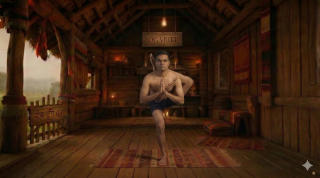
Standing Foot-Behind-Head Pose is a profound practice that marries intense physical demand with deep internal awareness. This advanced posture, rooted in a strong standing foundation, systematically lengthens the entire posterior chain of the lifted leg, particularly the hamstrings and inner thighs, while simultaneously strengthening the standing leg's stabilizing muscles and core.
Muscles
- Hamstringsstretches
- Glutesstrengthens
- Hip Flexorsmobilises
- Core Musclesstabilises
- Adductorsstretches
Joints
- Hip Jointmobilises
- Knee Jointmobilises
- Sacroiliac Jointstabilises
- Spinemobilises
Inside the body
- Abdominal Organs
- Lungs and Diaphragm
- Breathing
Mind
This advanced posture is a profound teacher of patience and perseverance.
Take care
Teachers, guide your students to approach this pose with immense patience and respect for their body's current limits.
Pay close attention to the knees and hips, ensuring there's no sharp or pinching pain, especially in the lifted leg. Remind them that forcing the body can lead to injury, and the journey of opening is gradual. Emphasize spinal length to protect the lower back, and always prioritize stability over depth.
Muscles
Hamstrings
StretchesBiceps femoris, Semitendinosus, Semimembranosus
The powerful muscles running along the back of your lifted thigh (hamstrings) experience a deep, sustained lengthening here.
Read moreShow less
As the leg is brought high and behind the head, these muscles are asked to release considerable tension, which for many is held from prolonged sitting or athletic exertion.
This patient unwinding not only improves flexibility but also frees the flow of apana vayu, the downward-moving energy, creating a profound sense of release and lightness in the lower body.
Regular practice in this range of motion progressively alleviates chronic tightness and its associated strain on the lower back.
Glutes
StrengthensGluteus maximus, medius, minimus
On the standing leg, your powerful buttock muscles (gluteus maximus, medius, minimus) are intensely active, working to stabilize the hip and pelvis, preventing unwanted sway and maintaining your upright balance.
Read moreShow less
For the lifted leg, the gluteus maximus, being a primary hip extensor, is in a state of deep lengthening due to the extreme hip flexion.
This intelligent engagement and release across both sides of the pelvis cultivates a sense of rooted strength and energetic lift, allowing the sacrum to feel both stable and free.
Hip Flexors
MobilisesIliopsoas, Rectus femoris
The muscles at the front of your lifted hip and thigh (iliopsoas, rectus femoris) are deeply engaged to bring the knee high and close to the torso.
Read moreShow less
While they are actively contracting to achieve such profound hip flexion, the extreme range of motion simultaneously requires an immense capacity for release and mobility in these muscles and the surrounding hip capsule.
This intricate balance of effort and surrender allows for a profound opening in the pelvic region, inviting a greater flow of prana into the lower abdomen and hips, dissolving deep-seated energetic blockages.
Core Muscles
StabilisesTransverse abdominis, Obliques, Rectus abdominis, Erector spinae
Your entire trunk musculature, including the deep abdominal muscles (transverse abdominis, obliques) and the muscles along your spine (erector spinae), are constantly engaged to stabilize your torso and maintain spinal integrity.
Read moreShow less
This continuous, subtle activation creates a strong central axis, allowing the limbs to extend and open from a stable foundation.
This internal bracing not only protects the spine but also generates tapas, internal heat, purifying the organs and sharpening the mind's focus.
Adductors
StretchesAdductor longus, brevis, magnus, Gracilis, Pectineus
The muscles along the inner thigh of your lifted leg (adductors) undergo a significant lengthening as the leg abducts (moves away from the midline) and externally rotates to clear the torso.
Read moreShow less
This deep stretch releases chronic tension often held in the groin, which can restrict hip mobility and contribute to lower back issues.
Energetically, opening the adductors can help release emotional guardedness, fostering a sense of openness and vulnerability in the pelvic bowl, allowing for more fluid movement and expression.
Spine Erectors
StrengthensErector spinae group (Iliocostalis, Longissimus, Spinalis)
The long muscles running up and down your back (erector spinae) are actively engaged to maintain the upright, extended quality of your spine, preventing slouching or rounding.
Read moreShow less
This sustained isometric contraction strengthens the back extensors, cultivating good posture and providing a stable base for the intricate balance of the pose.
By consciously extending the spine, we encourage the upward flow of prana, promoting alertness and mental clarity, counteracting the downward pull of gravity.
Joints
Hip Joint
MobilisesThe hip joint (coxal joint) of the lifted leg undergoes extreme flexion, abduction, and external rotation, pushing the boundaries of its natural range of motion.
Read moreShow less
This profound mobilization of the femoral head within the acetabulum encourages increased synovial fluid production, nourishing the joint cartilage and improving overall hip health.
For the practitioner, this leads to a feeling of greater freedom and spaciousness in the hips, dissolving stiffness and facilitating a more uninhibited flow of energy through the pelvic region over time.
Knee Joint
MobilisesThe knee joint (tibiofemoral joint) of the lifted leg is deeply flexed, requiring significant flexibility in the surrounding soft tissues, while the standing leg's knee is extended and stable, bearing the body's weight.
Read moreShow less
This dual action cultivates both mobility and stability, strengthening the muscles that support the knee in various ranges of motion.
Mindful engagement ensures protection, allowing the practitioner to develop greater resilience and proprioceptive awareness around this crucial joint, fostering a sense of trust in its capacity.
Sacroiliac Joint
StabilisesThe sacroiliac (SI) joints, where the sacrum meets the pelvis, are crucial for maintaining stability in this complex balancing act.
Read moreShow less
The deep engagement of the core and gluteal muscles creates a stable foundation, preventing excessive shearing forces and promoting proper alignment.
This intelligent stabilization helps to alleviate chronic SI joint dysfunction and allows for a more integrated transmission of force throughout the kinetic chain.
Energetically, a stable SI joint supports the grounding of apana and the upward flow of prana, bringing equilibrium to the root of the spine.
Spine
MobilisesThe entire vertebral column is actively engaged in maintaining length and extension, particularly in the thoracic and lumbar regions.
Read moreShow less
While the pose doesn't involve a deep spinal twist or backbend, the upward lift and grounding through the legs create a gentle traction effect, encouraging space between the vertebrae.
This subtle decompression nourishes the intervertebral discs and frees the flow of prana along the sushumna nadi, promoting alertness, mental clarity, and a feeling of lightness throughout the central axis of the body.
Inside the body
Abdominal Organs
As the lifted leg comes high and close to the torso, there is a gentle, rhythmic compression and release of the lower abdominal organs, including parts of the digestive and eliminatory systems.
Read moreShow less
This internal massage can stimulate peristalsis, aiding digestion and detoxification, while also improving circulation to these vital areas.
From a yogic perspective, this gentle pressure helps to awaken Manipura Chakra, the energy center of vitality and transformation, fostering inner fire and resilience.
Lungs and Diaphragm
Maintaining an upright and extended spine in this posture creates optimal space for the lungs to expand fully, encouraging deeper, more expansive breaths.
Read moreShow less
The diaphragm, your primary breathing muscle, works more efficiently, drawing more oxygen into the bloodstream and facilitating the release of carbon dioxide.
This enhanced respiratory function not only improves physical stamina but also calms the nervous system, allowing for a more profound connection to the life force, prana, within each breath.
Breathing
In Standing Foot-Behind-Head Pose, the upright stance and engaged core naturally encourage a steady, diaphragmatic breath, even amidst the intensity.
Read moreShow less
The challenge of the pose demands a conscious lengthening of both inhalation and exhalation, preventing shallow, anxious breathing.
This deliberate breath acts as an anchor, calming the nervous system and creating space within the sensations, making it an excellent preparation for more advanced pranayama practices like Ujjayi, which helps to sustain focus and inner heat during the pose.
Fascia (connective tissue)
The intricate web of connective tissue (fascia) throughout your body experiences a comprehensive release and re-patterning in this deep posture.
Read moreShow less
Specifically, the superficial back line, lateral line, and parts of the deep front line are profoundly challenged and lengthened, especially on the lifted side.
This sustained tension and mindful breathing encourage the fascial matrix to soften and release long-held restrictions, opening energetic channels (nadis) and allowing for a more fluid and integrated movement of prana throughout the entire system.
This release can feel like unlocking bound energy and creating new space within the body.
Mind and nervous system
- Nervous system
This pose demands unwavering attention and single-pointed focus, effectively drawing your awareness inward and away from external distractions.
Read moreShow less
The intricate balance required acts as a moving meditation, quieting the restless fluctuations of the mind (chitta vritti) and bringing you fully into the present moment.
This sustained concentration cultivates a deep sense of calm and mental clarity, teaching the nervous system to remain steady even amidst challenging physical sensations.
The intense effort and subsequent release in the deep hip and hamstring tissues can have a profound effect on the autonomic nervous system.
Read moreShow less
As you breathe deeply and patiently hold the posture, the parasympathetic nervous system is gradually activated, promoting a 'rest and digest' response.
This helps to alleviate chronic stress and anxiety, fostering a sense of inner peace and equilibrium that extends beyond the mat, enhancing overall well-being and emotional regulation.
Standing Foot-Behind-Head Pose significantly enhances proprioception, your body's awareness of its position and movement in space, and interoception, your internal sense of the body's state.
Read moreShow less
The constant subtle adjustments required to maintain balance sharpen these sensory feedback loops, leading to improved coordination and body schema.
This heightened internal awareness allows for a more intuitive and harmonious interaction with your physical self, deepening your connection to the subtle energies of the body.
- Mind & mood
This advanced posture is a profound teacher of patience and perseverance.
Read moreShow less
The journey to achieve and sustain it demands a willingness to meet discomfort with equanimity and to trust in the gradual unfolding of the body's capabilities.
This mental fortitude, cultivated on the mat, translates into greater resilience in life's challenges, fostering a 'never give up' attitude and a deeper understanding of the power of consistent effort.
The single-pointed focus required to balance and articulate the body in this complex shape is a powerful practice in Dharana, concentration.
Read moreShow less
By directing the mind's attention to the intricate sensations of the pose, you train it to resist distraction and remain anchored in the present.
This disciplined concentration not only refines your physical execution but also strengthens your capacity for mental clarity and unwavering determination in all aspects of your life.
Approaching Standing Foot-Behind-Head Pose with a spirit of non-attachment to the outcome is key to its yogic benefit.
Read moreShow less
It's not about forcing the body into a shape, but rather exploring its current capacities with curiosity and acceptance.
This practice of letting go of ego and embracing the journey cultivates humility and inner freedom, reminding us that true mastery lies not in perfection, but in the continuous, mindful effort of self-discovery and growth.
Because it is a balance pose
As a balance pose, Eka Pada Sirsa Padasana profoundly challenges and refines your sense of equilibrium, both physical and energetic.
Read moreShow less
The constant micro-adjustments required by the standing leg and core muscles strengthen the stabilizing muscle chains and enhance proprioceptive feedback.
This process cultivates a deep inner stillness and mental focus, harmonizing the left and right hemispheres of the brain, and grounding the mind in the present moment.
This posture is a profound hip opener, demanding extreme range of motion in flexion, abduction, and external rotation of the lifted hip.
Read moreShow less
Anatomically, this systematically lengthens the hamstrings, adductors, and deep external rotators, while mobilizing the hip joint capsule.
Energetically, releasing deep tension in the hips is believed to unlock emotional blockages and stored stress, allowing for a greater flow of prana and fostering emotional freedom and psychological openness.
As a standing posture, this pose harnesses the grounding energy of the earth through the rooted foot, channeling it upward through the spine.
Read moreShow less
This strengthens the entire leg musculature, from the feet to the hips, building foundational stability and endurance.
The feeling of being firmly anchored while extending and opening creates a powerful energetic circuit, cultivating both unwavering stability and expansive freedom within the body and mind.