4
Muscles
3
Joints
2
Organs
2
Mental
Supta Matsyendrasana I (Supine Spinal Twist)
सुप्त मत्स्येन्द्रासन I
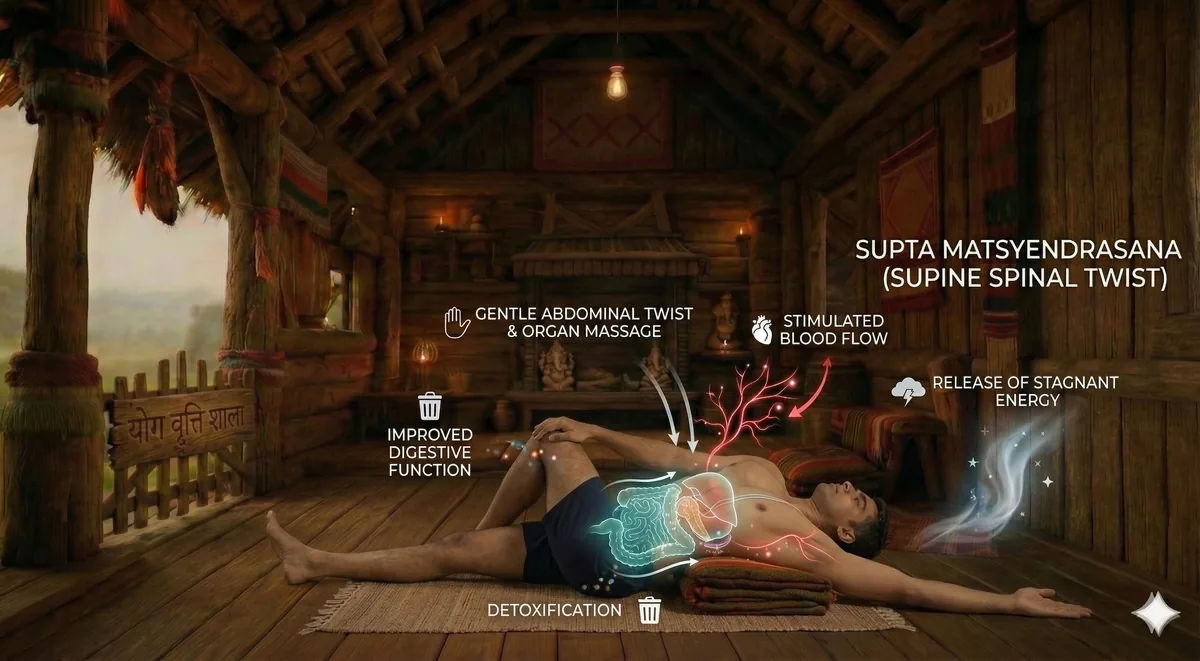
Supta Matsyendrasana I is a profoundly restorative reclined twist that offers a gentle yet comprehensive unwinding of the entire spinal column and surrounding musculature. This pose gently massages the internal organs, bringing fresh circulation and aiding digestion, while simultaneously releasing chronic tension in the back and hips. Energetically, it grounds the practitioner, calms the nervous system by activating the parasympathetic response, and helps to release stagnant energy (apana vayu), fostering a deep sense of ease, flexibility, and inner peace. It is highly valued for restoring spinal mobility and cultivating a quiet mind.
Supine Spinal Twist I, also called Supta Matsyendrasana I is a classical yoga posture. Its Sanskrit name Supta Matsyendrasana I (Supine Spinal Twist) translates word-for-word as: Supta (Reclining) · Matsyendra (Lord of Fish) · Asana (Pose). Performed lying down, the body rotates the spine, creating space between each vertebra. The posture works to engage the core, strengthen and extend the back and release tension in the hips. Decompresses the vertebral discs. Massages the digestive organs and aids elimination. It is particularly valued for alleviating back discomfort. Suitable for beginners and regular practitioners alike, it is a calming cool-down, particularly beneficial for beginners and seniors. A blanket can be used to make the posture more accessible and support correct alignment. Practitioners with spinal injury and abdominal surgery should approach with care or consult a qualified teacher.
Helps with
Muscles Worked
Spinal Erectors
Erector Spinae
The long muscles running along either side of your spine (erector spinae) receive a gentle, sustained stretch in this twist, allowing them to unwind from habitual tension.
This action helps to decompress the vertebral column, creating space between the individual bones.
As these muscles release, the practitioner feels a profound sense of lightness and increased fluidity along the spine, facilitating a more unhindered flow of prana.
Obliques
Internal and External Obliques
The muscles on the sides of your waist (obliques) are gently stretched and compressed in this pose, creating a subtle 'wringing' action through the torso.
One side lengthens while the other contracts gently to support the twist, promoting elasticity in the abdominal wall.
This engagement and release helps to tone the core, improve rotational flexibility, and provides a gentle internal massage to the abdominal organs, enhancing their function and releasing trapped energy.
Outer Hip Muscles
Gluteus Medius, Gluteus Minimus, Piriformis
The deep muscles of the outer hip and buttocks, particularly those on the side of the crossed leg, receive a sustained and therapeutic release in this pose.
This gentle lengthening helps to alleviate tightness that often contributes to lower back pain and sciatica, improving hip mobility.
Releasing these muscles can free up stagnant energy in the pelvic region, promoting a feeling of openness and emotional release.
Deep Hip Flexor
Psoas Major
While not a primary target, the deep hip flexor (psoas major) on the side of the extended leg receives a subtle lengthening and release as the pelvis remains anchored and the spine twists.
This muscle, often a repository for stress and tension from prolonged sitting, can profoundly impact spinal health and emotional well-being.
Its gentle release fosters a sense of inner calm and stability, allowing apana vayu to move more freely in the lower abdomen.
Joints Mobilized
Spinal Vertebrae
mobilizingThe numerous small joints between your spinal bones (facet joints) are gently mobilized and lubricated through the rotational action of this twist.
This subtle movement helps to maintain the health and flexibility of the intervertebral discs, promoting their hydration and resilience.
Practitioners experience improved spinal articulation and a feeling of 'space' between the vertebrae, which in turn enhances the flow of nerve impulses and vital energy (prana) along the spine.
Sacroiliac (SI) Joint
stabilizingWith careful alignment, grounding the sacrum while twisting the torso, the sacroiliac (SI) joint at the base of your spine receives a gentle, stabilizing influence.
This pose encourages a subtle integration of the sacrum within the pelvis, which can be therapeutic for mild SI joint imbalances.
The stability cultivated here provides a firm foundation for the entire spine, allowing for both grounding and an upward lift of energy.
Hip Joint
rotatingThe hip joint (acetabulofemoral joint) of the crossed leg undergoes a gentle internal or external rotation, depending on the specific setup, while the opposite hip remains relatively stable and grounded.
This subtle rotational movement helps to maintain the full range of motion within the hip capsule and releases tension in the surrounding ligaments and muscles.
Students often feel a pleasant release in the outer hip and gluteal region, contributing to greater ease in daily movements and deeper seated postures.
Organ & System Benefits
Digestive Organs
The gentle wringing action of the twist provides a mild compression and subsequent release to the abdominal organs, including the intestines, stomach, liver, and spleen.
This 'massaging' effect stimulates peristalsis, improving blood flow and aiding in the elimination of waste products and toxins.
Yogically, this action helps to stoke agni (digestive fire) and balance samana vayu, leading to better assimilation of nutrients and a feeling of inner lightness and cleanliness.
Kidneys
While not directly compressed, the kidneys receive an indirect stimulation through the improved circulation and subtle pressure changes within the abdominal cavity caused by the twist.
This gentle encouragement supports their vital role in filtering blood, maintaining fluid balance, and regulating blood pressure.
The pose offers a subtle sense of internal cleansing and renewal, contributing to overall vitality and well-being.
Nervous System
The reclined, supported nature of Supta Matsyendrasana I, combined with its gentle twisting action, naturally encourages a slow, deep diaphragmatic breath, which is a direct signal to the parasympathetic nervous system.
This activation shifts the body out of a 'fight or flight' (sympathetic) response into a 'rest and digest' state.
Practitioners experience a profound sense of calm, reduced mental agitation (chitta vritti), and a release of deep-seated physical and emotional tension.
By gently rotating the spine, we subtly stimulate the nerve roots that emerge from the spinal column, sending soothing signals to the brain and peripheral nervous system.
The sustained hold and inward focus required for this pose cultivate pratyahara (withdrawal of the senses) and dharana (concentration).
This inner awareness helps to quiet the fluctuations of the mind, promoting mental clarity, emotional balance, and a greater sense of centeredness.
Mental & Emotional
This gentle twist offers a profound opportunity for mental surrender and introspection.
As the body softly unwinds and releases physical tension, the mind is encouraged to let go of mental rigidity, worries, and the need for control.
This practice cultivates a more adaptable and accepting mindset, helping to dissolve mental 'knots' and fostering a sense of inner peace and resilience.
The act of twisting, particularly in a supported, reclined position, can metaphorically represent a shift in perspective or a gentle reorientation of one's internal landscape.
By subtly changing our physical alignment, we can inspire a similar shift in how we approach challenges or ingrained thought patterns.
This subtle mental recalibration can bring fresh insights, promote emotional balance, and enhance one's capacity for equanimity in daily life.
Because of Its Shape
twist
Twists gently rotate the spinal column, mobilizing the individual vertebrae and increasing flexibility in all planes of motion, not just forward and back.
This 'wringing' action helps to decompress the intervertebral discs and massage the muscles surrounding the spine.
Yogically, twists are considered purifying, stimulating the flow of prana along the sushumna nadi and promoting vitality and mental clarity.
The rotational movement inherent in twists provides a gentle internal massage to the abdominal organs, including the digestive and excretory systems, stimulating circulation and aiding in detoxification.
This compression and release action helps to improve the function of these vital organs.
Energetically, twists help to balance agni (digestive fire), leading to better assimilation and a feeling of lightness and inner cleanliness.
Twists, especially reclined and supported variations like Supta Matsyendrasana I, are inherently calming and grounding for the nervous system.
The gentle pressure and sustained hold encourage deep, diaphragmatic breathing, which directly activates the parasympathetic nervous system.
This leads to a significant reduction in stress and anxiety, fostering a deep sense of peace and tranquility, effectively quieting the fluctuations of the mind (chitta vritti nirodha).
Fascial Lines
This pose gently lengthens and rehydrates the intricate web of connective tissue (fascia) that envelops muscles, bones, and organs, particularly along the superficial back line and spiral lines of the torso.
The sustained, gentle twist encourages the ground substance within the fascia to become more fluid and pliable, releasing deep-seated restrictions that can limit spinal mobility and create chronic tightness.
This profound release in the fascial network helps to unravel long-held physical and energetic patterns, allowing for greater freedom of movement and a more uninhibited flow of prana throughout the body.
Breathing & Respiratory
In Supta Matsyendrasana I, the gentle twist naturally creates a subtle compression on one side of the torso and an expansion on the other, which can make the breath feel more focused and refined.
This encourages a deeper, more diaphragmatic breath, as the abdominal organs are gently massaged with each inhale and exhale.
The steady, rhythmic breathing in this pose helps to calm the nervous system and is an excellent preparation for restorative pranayama, such as viloma (interrupted breath) or ujjayi (victorious breath), deepening the practitioner's connection to their inner state.
Anatomical Caution
Teachers should guide students to initiate the twist gently from the navel, ensuring the shoulders remain as grounded as possible, and never force the knee down towards the floor.
Individuals with acute low back pain, significant hip injuries, or those who have undergone recent abdominal or spinal surgery should approach this pose with utmost care, using blankets and props generously to support the knee and maintain spinal integrity.
The intention is a subtle, therapeutic release, not a deep, aggressive stretch, particularly for vulnerable areas.