Benefits· लाभ
What Supported Reclined Hero Pose does for you
Supta Virasana (Supported) · सुप्त वीरासन
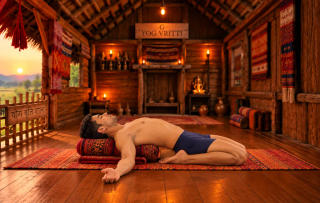
This supported variation of Supta Virasana transforms the experience by introducing a bolster beneath the spine, fundamentally altering the depth and intensity of the backbend. It shifts the primary engagement from an intense stretch of the anterior chain to a more gentle, sustained opening, inviting a profound sense of surrender.
What this version changes: The bolster, strategically placed beneath the spine, acts as a supportive scaffold, redistributing the body's weight and significantly reducing the intensity of the backbend. By elevating the torso, it moderates the angle of hip and knee flexion, making the posture more accessible and less strenuous on the joints. This fundamental shift encourages a deeper sense of release and surrender, allowing gravity to gently open the front body rather than requiring the practitioner to actively stretch into the pose.
Muscles
- Quadricepsstretches
- Hip Flexorsstretches
- Anklesstretches
- Abdomenstretches
- Erector Spinaestretches
Joints
- Kneesmobilises
- Hipsmobilises
- Anklesmobilises
- Lumbar Spinedecompressing
Inside the body
- Digestive System (Stomach, Intestines)
- Pelvic Organs (Reproductive, Urinary)
- Breathing
Mind
This pose is a profound lesson in surrender and patience, as the body slowly releases into the support of the props.
Take care
Teachers must always prioritize the safety of the knees and ankles in Supta Virasana, as these joints are in deep flexion and can be vulnerable to strain.
Ensure students have adequate support under the hips or a blanket between the calves and thighs if any discomfort arises. Observe for any signs of pain in the lower back or knees, and gently guide students to modify the pose by reducing the recline or coming out if needed, remembering that patience and gradual opening are key to avoiding injury.
Muscles
Quadriceps
StretchesWhile the quadriceps still experience a lengthening stretch across the front of the thigh, the bolster significantly reduces the gravitational pull on the torso.
Read moreShow less
This lessens the intensity of the stretch, transforming it from a potentially challenging, deep extension into a more gentle and sustained release.
This allows the muscle fibers to unwind more slowly and safely, fostering a deeper sense of relaxation without overstretching.
Hip Flexors
StretchesIn the supported variation, the hip flexors, including the rectus femoris and iliopsoas group, are still lengthened, but the incline provided by the bolster mitigates the acute angle at the hip joint.
Read moreShow less
This modification allows for a more passive and less aggressive stretch, encouraging a gradual release of deep-seated tension.
The support enables a sustained opening through the anterior hip without the potential strain of a deeper backbend.
Ankles (Dorsiflexors)
StretchesThe bolster subtly alters the angle of the knees and shins relative to the floor, often reducing the extreme dorsiflexion demand on the ankles.
Read moreShow less
This provides a more comfortable and less intense stretch to the anterior ankle muscles and connective tissues.
Practitioners can experience a gentle, sustained release in the ankles without the potential for discomfort or overstretching, making the pose more accessible for those with ankle stiffness.
Abdomen
StretchesThe abdominal wall still experiences a gentle stretch across the front of the torso, but the bolster provides direct, consistent support underneath.
Read moreShow less
This allows the abdominal muscles to fully soften and release into the support of the prop, rather than actively lengthening against gravity or maintaining subtle engagement for spinal stability.
This passive release can deepen the therapeutic benefits for digestion and organ function, fostering a sense of inner spaciousness.
Erector Spinae
StretchesErector Spinae group (Iliocostalis, Longissimus, Spinalis)
In the supported variation, the erector spinae muscles, which run along the length of the spine, are able to fully release and lengthen over the contour of the bolster.
Read moreShow less
Unlike the unsupported version where they might subtly engage to maintain spinal integrity, here they are passively decompressed.
This allows for a deep surrender of the entire spinal column, promoting relaxation and facilitating a more profound opening across the chest and abdomen.
Psoas Major
StretchesPsoas Major
While part of the broader hip flexor group, the Psoas Major, a deep muscle connecting the lumbar spine to the femur, experiences a particularly profound release in this supported variation.
Read moreShow less
The bolster's elevation of the torso reduces the direct gravitational pull, allowing this often chronically tight muscle to soften and lengthen without resistance.
This deep release can alleviate lower back tension and free up the pelvis, contributing to an enhanced sense of groundedness and ease.
Joints
Knees
MobilisesThe knees are in a state of deep flexion, requiring careful attention to avoid strain on the ligaments and menisci.
Read moreShow less
The gradual opening in this position, supported by props, encourages synovial fluid production and gentle mobilization of the joint capsule.
This mindful approach to deep flexion, rather than forcing, allows for a subtle release of stiffness, bringing greater fluidity and ease to the knee's range of motion over time.
This careful mobilization can support long-term knee health.
Hips
MobilisesThe hip joints (femoroacetabular joints) are moving into extension, with a slight degree of internal rotation if the feet are positioned outside the hips.
Read moreShow less
This action helps to stretch the anterior hip capsule and release tightness in the front of the hip joint.
By encouraging this gentle extension, we can alleviate compression in the lower back and cultivate a sense of openness and freedom in the pelvic region, allowing for a more expansive quality in the breath and movement.
This improved mobility can alleviate discomfort associated with prolonged sitting.
Ankles
MobilisesThe ankles (talocrural and subtalar joints) are in a state of deep plantar flexion, significantly stretching the anterior aspect of the joint and the ligaments around the talus and calcaneus.
Read moreShow less
This sustained stretch improves the range of motion in the ankle, which is crucial for overall balance and stability in all weight-bearing activities.
Regular, gentle mobilization here can prevent stiffness and improve energetic grounding through the feet, connecting us more deeply to the earth.
It prepares the ankles for more demanding seated postures.
Lumbar Spine
DecompressingThe lumbar spine is gently extended over the bolster, which creates a mild backbend that can decompress the intervertebral discs.
Read moreShow less
The support allows the natural curve of the lower back to be maintained or gently enhanced without strain, promoting space between the vertebrae.
This subtle traction can alleviate lower back pain and stiffness, fostering a sense of length and release that allows prana to flow more freely along the spinal column.
Over time, this can improve spinal posture and reduce chronic lower back discomfort.
Inside the body
Digestive System (Stomach, Intestines)
As the torso extends over the bolster, the abdominal organs experience a gentle compression followed by release upon exiting the pose.
Read moreShow less
This action, combined with deep breathing, acts like a subtle internal massage, stimulating peristalsis and improving blood flow to the digestive tract.
This can alleviate issues like sluggish digestion and constipation, bringing a sense of lightness and increased vitality to the abdominal region.
The gentle expansion creates space for optimal organ function.
Pelvic Organs (Reproductive, Urinary)
The opening across the front of the pelvis and the slight hip extension in Supta Virasana create more space within the pelvic bowl, allowing for improved circulation to the reproductive and urinary organs.
Read moreShow less
This increased blood flow can be particularly beneficial for conditions related to menstruation or pelvic congestion, offering relief and promoting balance.
Yogically, this area is associated with Svadhisthana Chakra, and opening it can foster creativity and emotional balance.
The gentle stretch can soothe the lower abdomen.
Breathing
The supine backbend shape of Supta Virasana naturally encourages a deeper and more expansive breath, particularly in the lower lobes of the lungs and across the diaphragm.
Read moreShow less
As the chest opens and the abdomen lengthens, the diaphragm is less restricted, allowing for fuller inhalations that expand the rib cage in all directions.
This promotes a calmer, more rhythmic breathing pattern, making it an excellent preparation for or complement to Ujjayi pranayama, which can further deepen the sense of internal quiet and focus.
The sustained hold allows for a natural lengthening of the exhalation, signaling deep relaxation to the nervous system.
Fascia (connective tissue)
In Supta Virasana, the entire anterior fascial chain, including the superficial front line and parts of the deep front line, is receiving a sustained, intelligent stretch.
Read moreShow less
This intricate web of connective tissue, which wraps and connects muscles, bones, and organs, gradually unwinds from the tops of the feet, through the quadriceps, hip flexors, and abdominal fascia.
By patiently lengthening these fascial pathways, we release long-held patterns of tension and restriction, improving overall tissue hydration and elasticity.
This release allows for a freer flow of prana, opening the energetic channels (nadis) and creating a profound sense of lightness and spaciousness throughout the body.
Mind and nervous system
- Nervous system
The deep support from the bolster and the supine position immediately signal safety to the body, shifting the nervous system from a state of 'fight or flight' towards 'rest and digest.' As the front body softens and opens, the diaphragm can move more freely, naturally deepening the breath.
Read moreShow less
This gentle elongation of the breath directly stimulates the vagus nerve, calming the sympathetic nervous system and ushering in a profound sense of tranquility and inner peace.
Students often feel a profound sense of groundedness and release.
Holding Supta Virasana for an extended period teaches the body and mind to release deeply held tension, both physical and emotional.
Read moreShow less
The sustained stretch in the quadriceps and hip flexors, often areas where stress is physically stored, sends signals to the brain that it's safe to let go.
This process reduces mental agitation (chitta vritti) and cultivates a quiet, introspective state, allowing for greater self-awareness and subtle energetic shifts.
The pose becomes a practice in conscious relaxation, retraining the nervous system.
- Mind & mood
This pose is a profound lesson in surrender and patience, as the body slowly releases into the support of the props.
Read moreShow less
The act of reclining and allowing gravity to do the work cultivates a sense of trust and acceptance, letting go of the need to control or force.
This mental surrender translates to a greater capacity for equanimity in daily life, teaching us to meet challenges with a calm and open mind.
It's a powerful antidote to a fast-paced, goal-oriented mindset.
Supta Virasana fosters a deep sense of introspection and self-awareness, as the external environment is minimized and the focus shifts inward.
Read moreShow less
The gentle opening of the chest, combined with the grounding sensation, can evoke feelings of vulnerability and courage simultaneously.
This mental state supports Pratyahara (withdrawal of the senses) and Dharana (concentration), preparing the mind for deeper meditative states and cultivating a quiet strength.
It allows for a profound connection to one's inner landscape.
Because it is a backbend pose
As a gentle backbend, Supta Virasana extends the spine, creating space between the vertebrae and opening the entire front of the body.
Read moreShow less
This action counteracts the effects of prolonged sitting and slouching, improving posture and spinal mobility.
Yogically, backbends are considered energizing and heart-opening, cultivating courage, compassion, and a feeling of expansive joy.
It helps to lift the mood and alleviate feelings of sluggishness.
The supine position provides complete support for the body against gravity, allowing for deep relaxation and release without muscular effort.
Read moreShow less
This grounding quality helps to calm the nervous system and draw awareness inward, promoting a sense of security and surrender.
Energetically, lying down connects us directly to the earth, facilitating a deeper sense of stability and allowing the downward flow of apana vayu.
This deep support encourages the body to let go of defensive tension.
While primarily a quadriceps stretch, the extension of the hips in Supta Virasana indirectly contributes to opening the hip joint by lengthening the anterior hip musculature.
Read moreShow less
This release in the hip flexors can alleviate tension in the pelvis and lower back, improving overall mobility and range of motion in the hips.
From a yogic perspective, opening the hips is often linked to releasing stored emotions and increasing flexibility in one's approach to life.
This creates a sense of freedom in the lower body.