Benefits· लाभ
What Sun Salutation B does for you
Surya Namaskar B · सूर्य नमस्कार B
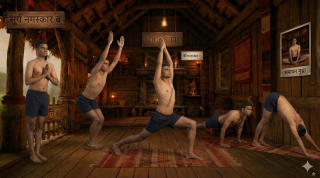
Surya Namaskar B introduces a profound shift in emphasis, building upon the foundational flow of Series A by significantly increasing lower body endurance and power. The inclusion of Utkatasana and Virabhadrasana I transforms the sequence into a more demanding practice, challenging the legs, hips, and core to sustain deep engagement over an extended period.
What this version changes: Surya Namaskar B introduces significant positional changes without external props, primarily through the deeper hip flexion of Utkatasana and the broad-based lunge of Virabhadrasana I. These poses drastically alter weight distribution, shifting the center of gravity lower and demanding greater engagement from the legs and core to maintain stability. The extended holds in these positions deepen the work on joint angles, particularly at the hips and knees, creating a more intense energetic focus on grounded strength and endurance.
Muscles
- Hamstringsstrengthens
- Quadricepsstrengthens
- Core Abdominalsstabilises
- Spinal Erectorsstabilises
- Deltoidsstrengthens
Joints
- Spinemobilises
- Shoulder Girdlemobilises
- Hip Jointsmobilises
- Knee Jointsstabilises
- Wrist Jointsstabilises
Inside the body
- Digestive Organs
- Lungs and Diaphragm
- Heart and Circulatory System
- Breathing
Mind
The intricate sequence of movements, synchronized with breath, demands unwavering attention, drawing the mind away from external distractions and internal chatter.
Take care
Given the sustained deep knee flexion in Utkatasana and the dynamic loading in Virabhadrasana I, practitioners with existing knee injuries or sensitivities must approach this variation with heightened awareness.
It is crucial to maintain proper alignment, avoid pushing into pain, and potentially modify the depth of the squat or lunge to protect the joint integrity.
Muscles
Hamstrings
StrengthensStretchesStabilisesThe hamstrings, while lengthening in Uttanasana, take on a more nuanced and dynamic role in Series B.
Read moreShow less
In Utkatasana, they co-contract with the quadriceps to stabilize the knee joint, while in Virabhadrasana I, the hamstrings of the front leg engage powerfully to support the bent knee, even as the hamstrings of the back leg experience a significant stretch.
This varied engagement refines their ability to both lengthen and strengthen, contributing to balanced leg strength and joint protection.
Quadriceps
StrengthensStabilisesIn Surya Namaskar B, the quadriceps move beyond their role of dynamic engagement in transitions to sustained, isometric contraction.
Read moreShow less
Utkatasana demands a continuous, deep activation to hold the squat, while the front leg in Virabhadrasana I requires powerful eccentric and isometric strength to stabilize the lunge, dramatically increasing their endurance and power.
This deep, prolonged work develops an unwavering foundation, rooting the practitioner more firmly into the earth.
Core Abdominals
StabilisesWhile always foundational, the core abdominals in Series B are called upon for a heightened level of sustained stabilization, particularly in Utkatasana and Virabhadrasana I.
Read moreShow less
They must work intensely to prevent the lumbar spine from over-arching as the arms lift and the hips deepen, maintaining a neutral pelvis and supporting the integrity of the spine throughout the more challenging holds.
This engagement fosters a deeper sense of internal support and energetic lift.
Spinal Erectors
StabilisesThe spinal erectors, responsible for maintaining the upright curve of the spine, experience a more prolonged and intense isometric load in this variation.
Read moreShow less
In Utkatasana, they work against the deep hip flexion to keep the torso lifted and open, while in Virabhadrasana I, they stabilize the extended spine over the active legs.
This continuous effort strengthens the entire posterior chain, promoting a more resilient and aligned posture.
Deltoids
StrengthensAnterior, Medial, Posterior heads
The large muscles capping your shoulders are actively involved in lifting the arms overhead in Urdhva Hastasana and in bearing weight and stabilizing the shoulder joint in Chaturanga Dandasana and Downward-Facing Dog.
Read moreShow less
They work in concert with the rotator cuff to maintain integrity and mobility in the shoulder girdle.
This mindful engagement strengthens the upper body, allowing for a broader, more open chest and an unhindered flow of prana into the heart space, fostering a sense of openness and courage.
Latissimus Dorsi
StrengthensLats
These broad muscles of your upper back, extending from your spine to your upper arm, are powerfully engaged in poses like Chaturanga Dandasana and Downward-Facing Dog.
Read moreShow less
They help to draw the shoulders down and back, stabilizing the shoulder blades and supporting the torso.
This engagement creates a sense of grounded power in the upper body and helps to channel prana from the extremities towards the core, creating a feeling of energetic integration and stability.
Gluteus Maximus
StrengthensGluteus maximus
This powerful hip extensor and external rotator is heavily recruited in Utkatasana to drive the hips down and back, and in Virabhadrasana I to stabilize the front hip and power the lunge.
Read moreShow less
Its engagement is crucial for maintaining a deep, stable base and protecting the knees, lending profound strength and rootedness to the lower body.
Gluteus Medius/Minimus
StabilisesGluteus medius, Gluteus minimus
These crucial abductors and internal rotators of the hip play a significant stabilizing role in Virabhadrasana I, particularly in the front leg.
Read moreShow less
They work to prevent the knee from collapsing inward, ensuring proper alignment and distributing weight evenly across the foot, which is vital for maintaining balance and preventing injury in the lunge.
Iliopsoas
StretchesIliopsoas
In Virabhadrasana I, the iliopsoas of the back leg undergoes a significant and sustained stretch, as the hip moves into extension.
Read moreShow less
While the front leg's iliopsoas is active, the lengthening action on the back side is a distinct feature, helping to open the front of the hip and improve overall hip mobility, releasing deep-seated tension.
Joints
Spine
MobilisesThe spine undergoes its full range of motion, moving from extension in Upward-Facing Dog to deep flexion in Uttanasana and a neutral alignment in Tadasana.
Read moreShow less
This systematic movement lubricates the intervertebral discs and strengthens the supporting musculature, enhancing overall spinal health.
Regular practice fosters a supple spine, which in yogic philosophy is essential for the unimpeded flow of prana through the central energetic channel, the sushumna nadi, promoting vitality and mental clarity.
Shoulder Girdle
MobilisesThe complex of joints connecting your arms to your torso is dynamically engaged, moving through flexion (Urdhva Hastasana), extension (Chaturanga, Downward Dog), and internal/external rotation.
Read moreShow less
This comprehensive movement strengthens the surrounding muscles while improving range of motion and stability.
The conscious effort to broaden the collarbones and soften the shoulders releases accumulated tension, allowing for a freer energetic flow into the heart chakra, fostering emotional openness and reduced anxiety.
Hip Joints
MobilisesThese ball-and-socket joints are extensively mobilized through flexion in forward folds and Downward-Facing Dog, and extension in Upward-Facing Dog.
Read moreShow less
The cyclical movement improves the synovial fluid distribution, enhancing joint health and flexibility in the surrounding tissues.
Releasing tension in the hips, often a storage site for emotional stress, facilitates the downward flow of apana vayu, promoting a profound sense of grounding, stability, and emotional release.
Knee Joints
StabilisesThe knee joints are primarily engaged in flexion and extension, particularly in the transitions and in Chaturanga Dandasana.
Read moreShow less
While not a deep hip opener, the knee alignment is crucial for stability, requiring active engagement of the quadriceps and hamstrings to protect the ligaments.
Mindful alignment in the knees ensures stability in the lower body, creating a firm foundation upon which the spine can lengthen and prana can rise, providing both physical and energetic support.
Wrist Joints
StabilisesThe wrists bear significant weight in poses like Chaturanga Dandasana, Upward-Facing Dog, and Downward-Facing Dog, requiring strength and mobility in the carpal bones and surrounding ligaments.
Read moreShow less
The gradual increase in weight-bearing capacity strengthens the small muscles and connective tissues of the hands and forearms.
This action cultivates a sense of rootedness through the hands, extending the grounding energy of apana vayu from the earth up through the arms, while also refining the subtle energy channels (nadis) in the hands.
Inside the body
Digestive Organs
The rhythmic compression in forward folds (Uttanasana) and extension in backbends (Urdhva Mukha Svanasana) creates a gentle internal massage for the abdominal organs.
Read moreShow less
This cyclical action stimulates peristalsis and improves circulation to the digestive tract, aiding in detoxification and nutrient absorption.
From a yogic perspective, this stokes Agni, the digestive fire, enhancing metabolism and the assimilation of both food and life experiences, promoting vitality and inner balance.
Lungs and Diaphragm
The synchronized breath with movement in Surya Namaskar A directly impacts the respiratory system.
Read moreShow less
Inhalations in expansive poses like Urdhva Hastasana and Urdhva Mukha Svanasana encourage full lung capacity and diaphragmatic descent, while exhalations in forward folds facilitate a complete release of stale air.
This deep, conscious breathing pattern purifies the blood, calms the nervous system, and directly enhances the intake and distribution of prana throughout the entire body, fostering energy and clarity.
Heart and Circulatory System
The dynamic nature of the flow, moving from standing to inversions (like Downward Dog) and back, creates a gentle cardiovascular workout, increasing heart rate and improving blood circulation.
Read moreShow less
Forward folds bring fresh blood flow to the brain and upper body, while backbends invigorate the chest.
This enhanced circulation ensures optimal oxygen and nutrient delivery to all cells, vitalizing the body and mind, and in yogic terms, opening the Anahata (heart) chakra, promoting compassion and emotional well-being.
Breathing
The breath in Surya Namaskar A is the vital thread that unifies movement and awareness, ideally practiced as Ujjayi Pranayama – a soft, audible breath through the nose.
Read moreShow less
Inhalations are typically synchronized with upward and expansive movements (e.g., Urdhva Hastasana, Urdhva Mukha Svanasana), naturally inviting deeper lung expansion and an uplifting quality.
Exhalations accompany downward and contracting movements (e.g., Uttanasana, Chaturanga Dandasana), facilitating release, grounding, and abdominal engagement.
This conscious, rhythmic breathing calms the nervous system, purifies the blood, and acts as a direct conduit for prana, transforming the physical practice into a moving meditation and enhancing the energetic effects of each posture.
Fascia (connective tissue)
Surya Namaskar A systematically engages and releases tension in several key fascial lines, particularly the Superficial Back Line in forward folds like Uttanasana and Adho Mukha Svanasana, extending from the soles of the feet up the calves, hamstrings, glutes, and back.
Read moreShow less
Simultaneously, the Superficial Front Line is lengthened and strengthened in backbends like Urdhva Mukha Svanasana, opening the chest and abdomen.
This dynamic engagement helps to hydrate the fascial network, release adhesions, and improve the fluidity of movement throughout the body.
From a yogic perspective, this unwinding of the connective tissue helps to clear energetic blockages in the nadis, allowing prana to flow more freely, promoting greater flexibility and a sense of energetic lightness.
Mind and nervous system
- Nervous system
The continuous synchronization of movement with breath in Surya Namaskar A acts as a powerful regulator for the autonomic nervous system.
Read moreShow less
The dynamic flow, interspersed with moments of stability, gently shifts between sympathetic activation (during active poses like Chaturanga) and parasympathetic engagement (during deep exhalations and longer holds).
This rhythmic dance cultivates resilience, helping the body learn to adapt to stress more effectively and fostering a sense of inner calm even amidst movement.
The deep, diaphragmatic breathing cultivated throughout the sequence directly stimulates the vagus nerve, which is a key component of the parasympathetic nervous system.
Read moreShow less
As the breath becomes smoother and more elongated, especially on the exhalation, vagal tone is enhanced, leading to a reduction in heart rate variability and an overall calming effect.
This deep connection between breath and movement helps to quiet the 'chitta vritti' – the fluctuations of the mind – promoting a state of profound inner peace and mental clarity.
Through precise alignment cues and mindful transitions, Surya Namaskar A sharpens the body's proprioceptive awareness – its sense of position and movement in space.
Read moreShow less
Simultaneously, the focus on breath and internal sensations cultivates interoception, the awareness of the body's internal state.
This heightened sensitivity allows practitioners to perceive subtle energetic shifts and physical responses, deepening their connection to their inner landscape and fostering a more intuitive relationship with their own prana.
- Mind & mood
The intricate sequence of movements, synchronized with breath, demands unwavering attention, drawing the mind away from external distractions and internal chatter.
Read moreShow less
Each transition becomes an anchor for the present moment, requiring conscious engagement and precision.
This sustained focus on the present moment cultivates Dharana, the sixth limb of yoga, strengthening mental discipline and preparing the mind for deeper states of meditation.
The dynamic movement and deep breathing within Surya Namaskar A provide a powerful outlet for releasing accumulated mental and emotional stress.
Read moreShow less
The physical exertion helps to discharge pent-up energy, while the rhythmic breath calms the nervous system, allowing for emotional release.
This process helps to clear 'samskaras' – impressions left on the mind – leading to a sense of lightness, emotional balance, and renewed perspective.
Consistently practicing Surya Namaskar A, especially when encountering physical or mental resistance, builds inner resilience and self-discipline.
Read moreShow less
The commitment to move through the flow, even on challenging days, strengthens willpower and and the ability to persevere.
This cultivation of tapas (inner heat and discipline) translates into greater fortitude in daily life, empowering practitioners to approach challenges with a more centered and determined mind.
Because it is a standing pose
Standing poses, which form the foundation of Surya Namaskar A, establish a strong connection to the earth, rooting the body and mind.
Read moreShow less
They build strength and stability in the legs, hips, and core, creating a solid base for all other movements.
This connection fosters a sense of groundedness and security, allowing apana vayu to flow downward, bringing stability and a feeling of being firmly anchored in the present moment.
Forward bends, prominently featured in Uttanasana, gently lengthen the entire posterior chain of the body, from the heels to the crown of the head.
Read moreShow less
This action decompresses the spine and calms the nervous system by bringing the head below the heart, encouraging introspection.
Energetically, forward bends draw prana inward and downward, quieting the mind (chitta vritti) and promoting a sense of surrender, inner peace, and release of tension.
Backbends, exemplified by Urdhva Mukha Svanasana, open the front of the body, particularly the chest, shoulders, and hips, counteracting the effects of prolonged sitting and slouching.
Read moreShow less
They lengthen the abdominal muscles and strengthen the spinal extensors, improving posture and invigorating the nervous system.
This expansive action lifts the spirits, cultivates courage, and opens the Anahata chakra, inviting a feeling of joy, enthusiasm, and energetic upliftment.
While not a full inversion, Adho Mukha Svanasana (Downward-Facing Dog) offers many benefits of an inversion by bringing the head below the heart.
Read moreShow less
This reverses the gravitational pull on the organs, drains stagnant fluids from the lower body, and increases blood flow to the brain, enhancing mental clarity and focus.
Energetically, it helps to balance the flow of prana, refreshing the entire system and offering a different perspective, both physically and mentally, on life's challenges.