6
Muscles
4
Joints
3
Organs
2
Mental
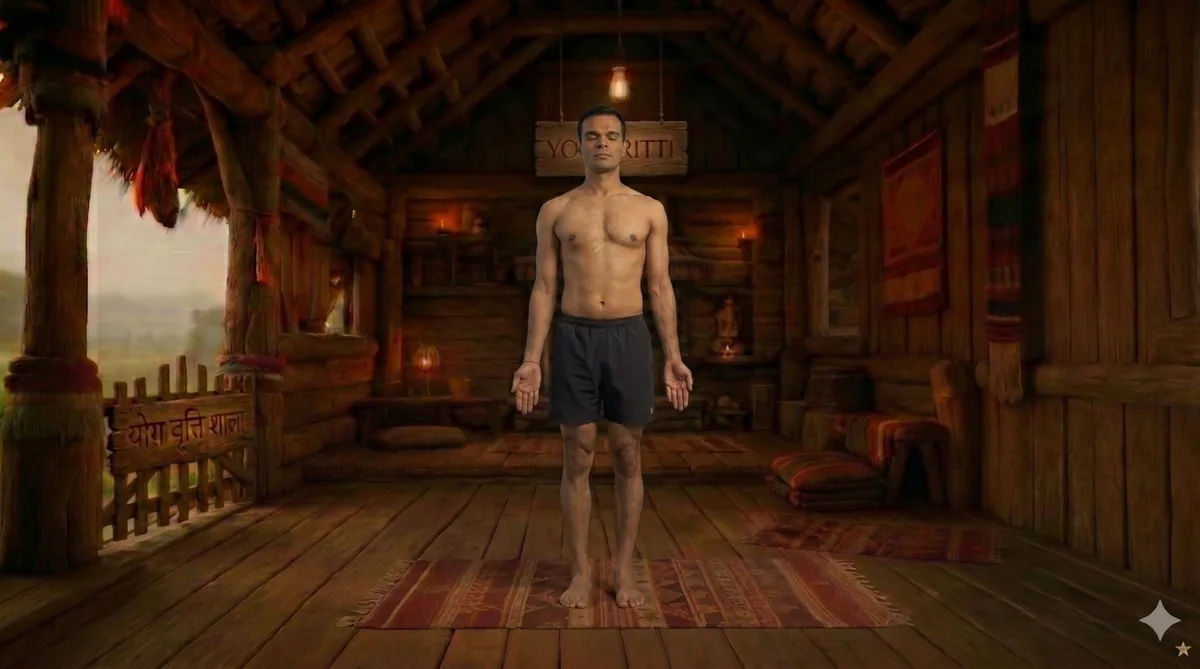
Tadasana with Eyes Closed
ताड़ासन आँखें बंद करके
Tadasana with Eyes Closed is a profound invitation to turn the senses inward, transforming the external focus on alignment into an internal felt sense of stability. By deliberately removing visual cues, this variation compels the practitioner to rely entirely on proprioception and the vestibular system, deepening the exploration of balance from the ground up and the core outward. It is a powerful practice for cultivating internal stillness and heightened body awareness. Tadasana, the Mountain Pose, transcends mere standing; it is a profound exploration of structural integrity and energetic alignment. By meticulously engaging the entire posterior and anterior kinetic chains, from the intrinsic foot muscles to the deep neck flexors, we cultivate a stable base that allows for profound spinal lengthening and decompression. This foundational pose grounds our physical body, awakening an inner lift (uddiyana bandha and mula bandha) that stabilizes the core and aligns the energetic channels. Mastering Tadasana provides the discerning practitioner with an embodied understanding of balance, presence, and the subtle interplay of strength and spaciousness, making it the blueprint for all other asanas.
Mountain Pose Eyes Closed, also called Mindful Mountain Pose is a classical yoga posture. Its Sanskrit name Tadasana with Eyes Closed translates word-for-word as: Tada (Mountain / Palm Tree) · Asana (Pose). From a standing position, the body roots firmly through the feet while the spine extends upward. The posture works to engage the core, strengthen the quadriceps and stretch the calves. Enhances balance. Promotes relaxation. It is particularly valued for improving overall posture and quieting an anxious mind. Suitable for beginners and regular practitioners alike, it is an excellent warm-up, particularly beneficial for beginners and seniors. Practitioners with vertigo and low blood pressure should approach with care or consult a qualified teacher.
Helps with
What This Variation Changes
The absence of visual information fundamentally alters the body's reliance on its sensory systems for balance. It forces the practitioner to disengage from external anchors and turn inward, relying intensely on proprioception (the sense of body position) and the vestibular system (the sense of head position and motion). This shift redistributes the energetic focus, deepening the connection to the earth through the feet and activating the core as an internal plumb line, fostering a profound sense of inner stability and embodied presence.
Muscles Worked
Intrinsic Foot Muscles
Their role shifts from a foundational engagement to a highly reactive and sophisticated system of micro-adjustments.
Without visual feedback, these muscles are constantly firing to interpret subtle shifts in weight distribution, becoming the primary sensors and adjusters for maintaining the intricate arches and overall stability of the base.
This heightened activity refines proprioceptive awareness in the feet, connecting more deeply to the earth.
Quadriceps
While foundational in Tadasana, in this variation, the quadriceps engage with a finer, more responsive quality.
Instead of a steady, sustained lift, they become more dynamically involved in subtly lengthening and shortening to counteract any perceived forward or backward sway, maintaining the integrity of the knee joint and the overall plumb line of the leg.
This responsiveness cultivates a more intelligent and adaptable strength throughout the thighs.
Erector Spinae
The Erector Spinae group, responsible for spinal extension and posture, takes on a more nuanced and vigilant role here.
Without visual cues to confirm verticality, these muscles must work with greater precision to sense and correct any deviation from the central axis, preventing excessive sway or slumping.
This heightened engagement refines the internal map of the spine, fostering a more intuitive and stable upright posture.
Transversus Abdominis
The engagement of Transversus Abdominis, already crucial for core stability, becomes even more paramount and subtly dynamic in this variation.
It acts as the internal anchor, bracing the lumbar spine and pelvis against the increased postural sway that occurs without visual input.
This deeper, more responsive activation cultivates an unshakeable inner core stability, essential for maintaining equilibrium when external references are removed.
Calves
Gastrocnemius, Soleus
Without visual input, the body's sway increases, particularly at the ankle joint.
The gastrocnemius and soleus muscles become critically active, working eccentrically and concentrically to constantly adjust the ankle angle, preventing the body from tipping forward or backward.
This continuous, subtle engagement significantly enhances ankle stability and proprioception, building resilient lower legs that can adapt to instability.
Glutes
Gluteus Medius, Gluteus Minimus, Gluteus Maximus
The gluteal muscles, especially Gluteus Medius and Minimus, become more actively engaged in Tadasana with eyes closed to stabilize the pelvis and hips, counteracting lateral sway.
Gluteus Maximus also contributes to maintaining the hip extension and overall posterior chain integrity against rotational or anterior/posterior shifts.
Their heightened activation provides a deeper sense of grounding and stability through the hips, integrating the lower body more effectively into the core.
Joints Mobilized
Ankle Joint
stabilizing | weight bearingThe ankle joint (talocrural joint) is the crucial interface between your feet and legs, bearing the entire body's weight in Tadasana.
We learn to distribute weight evenly through the four corners of the feet, creating a stable, yet not rigid, foundation, which in turn protects the knees and hips.
This mindful weight distribution refines proprioception, enhancing your sense of balance and connection to the ground.
Over time, this practice stabilizes the ankles, preventing common sprains and cultivating a feeling of unwavering support from below.
Knee Joint
stabilizing | decompressingThe knee joint (tibiofemoral joint) is held in a neutral, unlocked position in Tadasana, with the kneecaps gently lifted by the engaged quadriceps.
This alignment prevents hyperextension and ensures that the weight is distributed through the bones rather than collapsing into the ligaments.
Therapeutically, this creates a gentle decompression, fostering healthy joint space and synovial fluid distribution.
Yogically, it teaches the legs to be intelligently strong without rigidity, allowing energy to flow freely upwards from the earth.
Vertebral Column
decompressing | lengthening | stabilizingThe entire spinal column (vertebral column) is actively lengthened in Tadasana, with each vertebra gently separating from its neighbor, creating space for the intervertebral discs.
This axial extension alleviates compression, improves nerve conductivity, and allows the spinal cord to function optimally.
This conscious lengthening is a cornerstone of spinal health, promoting an upward flow of prana through the central energetic channel (Sushumna Nadi) and fostering a sense of inner spaciousness and freedom.
Regular practice directly contributes to improved posture and reduced back pain.
Shoulder Girdle
neutral alignment | subtle external rotationIn Tadasana, the shoulder girdle (scapulothoracic joint and glenohumeral joint) is drawn gently back and down, creating broadness across the collarbones and opening the chest.
This action corrects rounded shoulders, which are common in modern life, and allows the arms to hang freely by the sides with a subtle external rotation of the upper arm bones.
Therapeutically, this alleviates tension in the neck and upper back, while yogically, it opens the heart center (Anahata Chakra), inviting feelings of courage, compassion, and expansive breath.
Organ & System Benefits
Lungs
By establishing an upright posture and broadening the chest in Tadasana, the thoracic cavity expands, providing optimal space for the lungs.
This allows for deeper, fuller inhalations and complete exhalations, increasing vital lung capacity and improving gas exchange (oxygen-carbon dioxide exchange).
Yogically, this enhanced breathing invigorates prana, purifying the nadis (energy channels) and creating a sense of clarity and energetic uplift.
It's a foundational step towards mastering pranayama.
Abdominal Organs
The gentle lift of the lower abdomen (Uddiyana Bandha) combined with the lengthening of the spine in Tadasana creates a subtle decompression for the abdominal organs.
This prevents slumping and compression, allowing organs like the stomach, intestines, and liver to function with greater ease.
This internal lift is believed to stimulate digestive fire (agni), improving nutrient absorption and elimination, and fostering a sense of lightness and vitality in the core.
Circulatory System
The aligned, upright posture of Tadasana, coupled with deep, steady breathing, supports efficient blood flow throughout the body.
By engaging the muscles of the legs and core, we encourage venous return, preventing blood from pooling in the lower extremities, which is particularly beneficial for conditions like low blood pressure.
This optimized circulation ensures that oxygen and nutrients are effectively delivered to all cells, leaving the practitioner feeling energized, refreshed, and mentally alert.
Nervous System
As you stand tall and steady in Tadasana, you begin to feel a profound sense of calm and centeredness wash over you, a quiet stillness amidst the external world.
This grounding sensation comes from the conscious engagement of your feet and legs, sending clear proprioceptive feedback to the brain, which in turn signals safety and stability to the nervous system.
The steady, diaphragmatic breath cultivated in this pose further activates the parasympathetic nervous system, easing 'chitta vritti'—the fluctuations of the mind—and guiding you into a state of present awareness.
The precise alignment and subtle muscular engagement in Tadasana bring a heightened sense of body awareness (interoception) that can be deeply therapeutic for anxiety.
By focusing your attention inward, on the subtle actions of the body, you draw your awareness away from external stressors and internal anxieties.
This deliberate shift helps to regulate the autonomic nervous system, moving from a 'fight or flight' (sympathetic) response towards a 'rest and digest' (parasympathetic) state, fostering a feeling of inner peace and security.
Mental & Emotional
Tadasana cultivates an unwavering sense of presence and mental focus (Dharana), as the mind is meticulously engaged in refining the alignment from the ground up.
This sustained attention to subtle bodily cues trains the mind to be fully here, now, rather than wandering into past regrets or future anxieties.
The physical act of standing tall and centered directly translates to a mental state of clarity and steadfastness, building the capacity for sustained concentration essential for deeper meditative practices.
The pose instills a deep sense of inner strength and self-possession, mirroring the unyielding stability of a mountain.
As you physically root down and lift up, you cultivate a mental resilience, an ability to stand firm in your own truth amidst life's challenges.
This embodiment of strength and dignity empowers the practitioner, fostering self-confidence and a quiet courage that radiates from within, making it a powerful tool for cultivating mental fortitude.
Because of Its Shape
standing
The standing shape of Tadasana immediately engages the entire musculoskeletal system against gravity, demanding active engagement from the feet through the crown.
This full-body activation builds foundational strength in the legs, core, and back, creating a stable platform for all movements.
In yogic terms, standing poses are profoundly grounding, connecting us to the earth element (Prithvi Tattva) and anchoring our energetic body, cultivating stability and presence.
Standing upright in Tadasana inherently promotes spinal lengthening and decompression, counteracting the compressive forces of gravity and sedentary lifestyles.
This axial extension creates space between the vertebrae, improving nerve transmission and blood flow along the spine.
Energetically, this upward lift encourages the flow of Prana Vayu, awakening the central energy channel (Sushumna Nadi) and fostering a sense of lightness and inner spaciousness.
The meticulous alignment required in Tadasana cultivates a profound awareness of one's posture and bodily architecture.
By learning to distribute weight evenly and align the major joints, practitioners develop improved proprioception and kinesthetic intelligence.
This heightened awareness not only corrects postural imbalances but also translates into a more mindful presence in daily life, allowing one to move with greater ease, efficiency, and grace.
Fascial Lines
Fascia, the intricate web of connective tissue that envelops every muscle, bone, and organ, plays a crucial role in Tadasana, linking the entire body into an integrated whole.
In this pose, the Deep Front Line fascia, which runs from the arches of the feet up through the inner legs, pelvis, and core to the neck, is actively engaged and strengthened, providing internal support and lift.
Simultaneously, the Superficial Back Line is subtly lengthened through the gentle spinal extension, releasing held patterns of tension and allowing for an unhindered upward flow of energy, creating a feeling of integrated strength and spaciousness throughout the entire body.
Breathing & Respiratory
Tadasana's upright and expansive posture naturally invites a full, diaphragmatic breath, allowing the diaphragm to descend fully on inhalation and ascend completely on exhalation.
The open chest and lengthened spine remove physical impediments to optimal lung expansion, encouraging a slow, steady rhythm that calms the nervous system.
This pose is an ideal preparation for foundational pranayama practices like Ujjayi, as it cultivates the physical and mental stability required to observe and control the flow of prana through the breath, deepening one's internal awareness and vitality.
Anatomical Caution
This variation significantly challenges balance and should be approached with awareness, especially by those new to yoga or with balance impairments.
Practitioners should ensure they have clear space around them and consider standing near a wall or chair for support, ready to open their eyes if they feel unsteady.
The increased demand on the vestibular system can sometimes lead to dizziness, so proceed slowly and mindfully.