5
Muscles
4
Joints
2
Organs
3
Mental
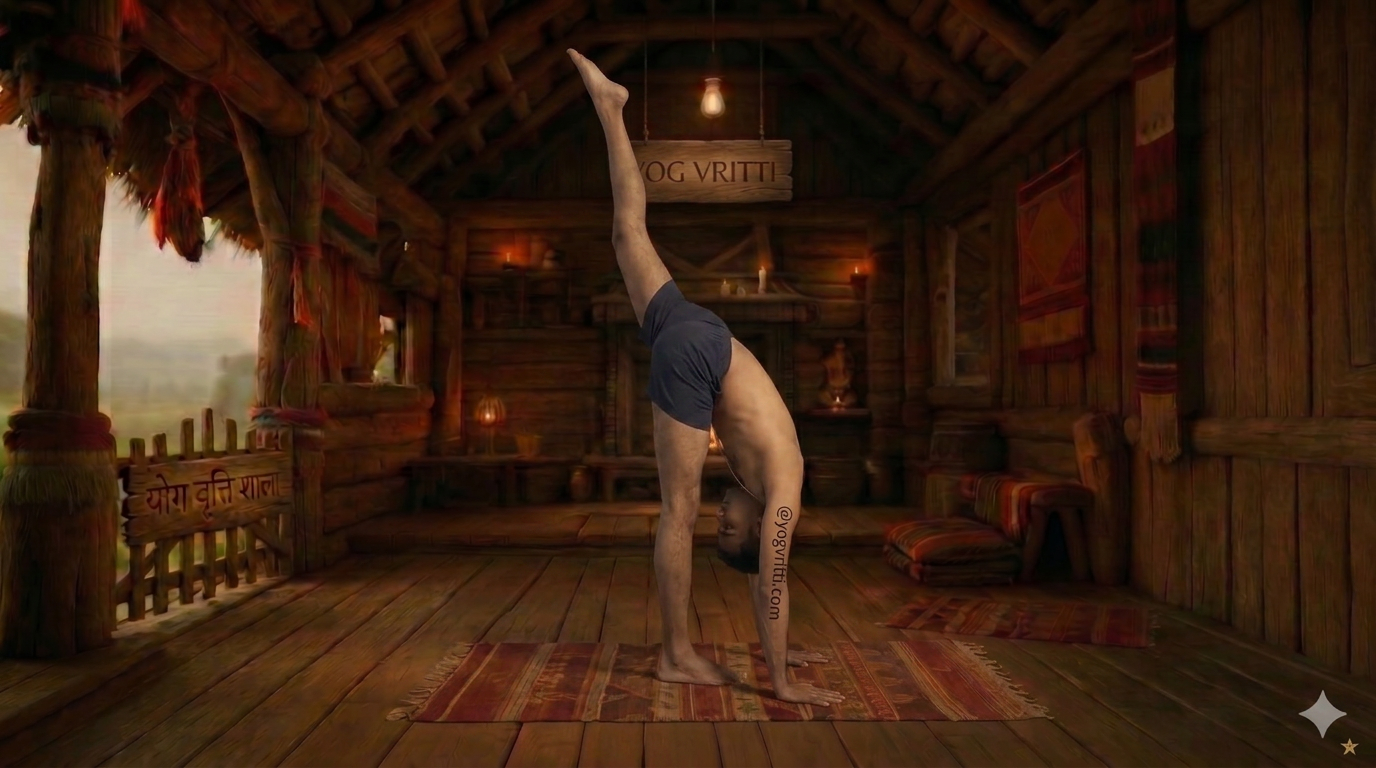
Standing Splits
ऊर्ध्व प्रसारित एक पादासन
Urdhva Prasarita Eka Padasana, or Standing Splits, is a profound balancing forward bend that cultivates both strength and surrender. It deeply lengthens the entire posterior chain, particularly the hamstrings and glutes of the lifted leg, while powerfully engaging the core and quadriceps of the standing leg for stability. Energetically, this pose combines the grounding force of the earth through the standing foot with the expansive quality of lifting and opening, fostering a deep sense of inner balance and mental clarity. It's a journey into mindful presence, revealing the interconnectedness of physical alignment and inner peace.
Standing Splits, also called Standing Half Splits is a classical yoga posture whose Sanskrit roots break down as: Urdhva (Upward) · Prasarita (Extended) · Eka (One) · Pada (Leg). From a standing position, the body roots firmly through the feet while the spine extends upward. The posture works to lengthen the hamstrings, activate the glutes and stretch the hip flexors. Strengthens ankles and standing leg muscles. Improves balance, focus, and proprioception. It is particularly valued for developing greater flexibility and building full-body strength. Suitable for intermediate practitioners with foundational yoga experience, it is a meaningful addition to any practice, particularly beneficial for athletes and runners. A block and wall can be used to make the posture more accessible and support correct alignment. Practitioners with hamstring injury and hip injury should approach with care or consult a qualified teacher.
Helps with
Muscles Worked
Hamstrings
[Biceps femoris, Semitendinosus, Semimembranosus]
The long muscles running along the back of your lifted thigh (hamstrings) receive a deep, sustained release in this pose, not a forced stretch but a patient unwinding.
As you hold and breathe, the nervous system gradually allows these muscles to let go of years of tension stored from sitting and stress.
In yogic understanding, this releases apana vayu – the downward-moving energy – allowing a feeling of groundedness and ease in the lower body, directly reducing the pull on the lower back.
Glutes
[Gluteus maximus, medius, minimus]
On the standing leg, the buttock muscles (glutes) are powerfully engaged to stabilize the hip and keep the pelvis level, preventing it from tilting or collapsing.
This isometric contraction builds strength and endurance in the foundation of the pose, creating a sense of rootedness and connection to the earth.
For the lifted leg, the glutes, especially the maximus, are lengthened, releasing deep-seated tension often held in the pelvic region, which can free emotional blockages.
Hip Flexors
[Psoas major, Iliacus]
The deep muscles at the front of the hip of the lifted leg (hip flexors, particularly the psoas and iliacus) receive a significant lengthening as the leg extends upwards and the torso folds forward.
This release is crucial for improving hip mobility and can alleviate tension that often contributes to lower back pain.
Yogically, releasing the psoas, a muscle deeply connected to our 'fight or flight' response, can free up emotional holding, bringing a profound sense of ease and spaciousness to the core.
Core Muscles
[Transversus abdominis, Obliques, Rectus abdominis, Erector spinae]
The deep abdominal and back muscles (core) are actively engaged to stabilize the spine and pelvis throughout the pose, preventing excessive arching or rounding of the lower back.
This strong, integrated engagement creates a central axis of support, allowing the limbs to extend with greater freedom and stability.
This cultivation of a strong inner container not only protects the spine but also fosters a sense of inner fortitude and unwavering focus, vital for both physical and mental balance.
Quadriceps
[Rectus femoris, Vastus lateralis, Vastus medialis, Vastus intermedius]
On the standing leg, the muscles at the front of the thigh (quadriceps) are powerfully engaged to keep the knee extended but not locked, providing a stable and strong foundation.
This active engagement protects the knee joint and prevents hyperextension, creating a sense of intelligent strength.
In yogic terms, this firm foundation roots the posture, allowing the upper body to surrender more deeply into the forward fold and the lifted leg to extend with greater ease and lightness.
Joints Mobilized
Hip Joint
mobilizingThe hip joint of the lifted leg undergoes significant flexion and abduction, combined with a subtle internal rotation to help square the hips, deeply mobilizing this ball-and-socket joint.
Simultaneously, the standing leg's hip is strongly stabilizing, bearing the body's weight with integrity.
This dual action cultivates both flexibility and strength around the hips, improving range of motion and fostering a sense of freedom and control in the pelvis, which translates to ease in daily movement.
Sacroiliac Joint (SI Joint)
stabilizingWith conscious engagement of the core and balanced action of the glutes and hip flexors, the sacroiliac (SI) joint, where the spine meets the pelvis, is encouraged into a stable and neutral position.
This intelligent engagement helps to prevent undue shearing forces, promoting proper alignment and alleviating discomfort in the lower back.
Over time, consistent practice helps to strengthen the supportive muscles around this crucial joint, fostering a feeling of integration and support in the entire pelvic girdle.
Knee Joint
stabilizingThe knee of the standing leg requires mindful engagement of the quadriceps to remain extended but not locked into hyperextension.
This active, intelligent stabilization develops strength and resilience around the joint, protecting it from strain and improving its overall integrity.
The cultivated awareness and strength in the standing knee translate into greater confidence and stability in all weight-bearing activities, enhancing both physical balance and mental composure.
Spine
decompressingAs a forward bend with a mild inversion, the spine receives a gentle lengthening and decompression, particularly in the lumbar and thoracic regions.
The pull of gravity, combined with the active engagement of the core and the deep stretch of the posterior chain, creates space between the vertebrae.
This subtle traction can alleviate stiffness, improve spinal mobility, and allow the breath to flow more freely along the central axis, promoting a feeling of lightness and increased energy flow (prana).
Organ & System Benefits
Abdominal Organs
The deep forward fold creates a gentle, internal compression and massage for the abdominal organs, followed by a release upon exiting the pose.
This rhythmic compression and release can stimulate circulation to the digestive and eliminative organs, promoting healthy metabolic function and aiding in detoxification.
Energetically, this internal massage can awaken Manipura Chakra, fostering a sense of inner fire and vitality.
Brain
As a mild inversion where the head is below the heart, Standing Splits increases the flow of oxygenated blood to the brain.
This fresh supply of nutrients can revitalize brain cells, improving mental clarity, focus, and memory, while reducing feelings of fatigue.
The experience is often one of feeling refreshed and calm, as the brain receives a gentle internal 'wash,' clearing away mental fogginess and promoting a state of quiet alertness.
Nervous System
The sustained hold and deep stretch, coupled with the intricate balancing act, demand profound concentration, naturally drawing the mind inward and away from external distractions.
This focused attention activates the parasympathetic nervous system, shifting the body from a 'fight or flight' (sympathetic) response to a 'rest and digest' state, which reduces mental chatter (chitta vritti) and invites a deep sense of inner quiet and calm.
The mild inversion and forward fold aspects of the pose further stimulate the parasympathetic nervous system, promoting deep relaxation and alleviating stress by slowing the heart rate and deepening the breath.
This physiological shift is profoundly felt as a sense of groundedness and ease, allowing practitioners to release not only physical tension but also emotional burdens held in the body and mind.
The constant micro-adjustments required to maintain balance sharpen proprioception – the body's unconscious awareness of its position and movement in space – enhancing neural communication pathways.
This heightened body awareness cultivates a deeper, more refined connection to the physical self, building confidence and presence in the moment, fostering a unified mind-body experience.
Mental & Emotional
Standing Splits demands unwavering concentration (dharana) to maintain both physical alignment and equilibrium, effectively training the mind to stay present and focused.
By directing attention to the subtle sensations of the body and the rhythm of the breath, external distractions recede, leading to a profound sense of mental clarity and an internal quietude that transcends the physical effort.
The vulnerability inherent in balancing on one leg while inverting challenges fear and builds immense courage and self-trust.
Overcoming the initial apprehension and finding stability in such a demanding posture cultivates resilience and inner fortitude, empowering the practitioner to face life's challenges with greater confidence and a grounded sense of self.
The unique perspective offered by lifting one leg high while folding forward literally and figuratively shifts one's viewpoint, making the seemingly impossible feel attainable within the confines of one's own body.
This change in perception can help dismantle self-imposed limitations and rigid thought patterns, fostering a sense of spaciousness, creativity, and boundless potential in the mind.
Because of Its Shape
balance
As a balance pose, Standing Splits requires precise engagement of the core and standing leg muscles to maintain equilibrium against gravity.
The constant micro-adjustments sharpen proprioception and coordination, integrating the left and right hemispheres of the brain for holistic function.
This cultivates mental steadiness (sthiram) and a deep sense of presence, both on and off the mat.
The forward bend aspect of Urdhva Prasarita Eka Padasana is inherently calming and introspective, drawing the senses inward (pratyahara) and quieting the mind.
The gentle compression of the front body combined with the lengthening of the entire posterior chain encourages a release of deeply held tension in the spine and hamstrings.
This shape promotes quietude, reducing mental agitation and fostering a profound sense of surrender and inner peace.
As a mild inversion, this pose places the head below the heart, reversing the gravitational pull on the circulatory system and increasing blood flow to the brain and upper body.
This fresh supply of oxygenated blood revitalizes the mind, calms the nervous system, and can alleviate fatigue, promoting mental clarity.
Energetically, inversions are believed to redirect prana, promoting vitality, a fresh perspective, and a sense of rejuvenation.
Standing Splits acts as a deep hip opener, particularly for the hamstrings and hip flexors of the lifted leg, while simultaneously strengthening the hip stabilizers of the standing leg.
This dual action mobilizes the hip joints, releasing physical and emotional tension often stored in the pelvic region.
Opening the hips can create a profound sense of freedom, ease, and emotional release, allowing energy to flow more freely through the lower body.
Fascial Lines
This pose creates a significant, sustained stretch along the entire posterior fascial chain, from the soles of the standing foot, up through the hamstrings, glutes, and sacrum, extending into the spinal erectors and even the back of the neck.
The interconnectedness of this myofascial web means that releasing tension in the hamstrings can have a profound ripple effect, improving spinal mobility and reducing strain throughout the entire back line.
Yogically, this deep unwinding of the fascia helps to unblock energetic channels (nadis), allowing prana to flow more freely and releasing long-held patterns of physical and emotional restriction, creating a feeling of spaciousness.
Breathing & Respiratory
In Standing Splits, the forward fold and mild inversion naturally encourage a softer, more extended exhalation, while the active engagement of the core creates a gentle upward lift on the inhale, supporting spinal length.
The intricate challenge of balancing necessitates a steady, rhythmic, and unforced breath to maintain composure and stability.
This deep, controlled breathing calms the nervous system, transforming an otherwise difficult pose into a meditative experience and allowing for a deeper, more profound release in the stretched muscles, enhancing both physical and mental surrender.
Anatomical Caution
Teachers should guide students to approach this pose with patience and profound awareness, paying meticulous attention to the standing knee and the sacroiliac (SI) joint.
Encourage a slight, intelligent bend in the standing knee and strong engagement of the quadriceps to protect the joint from hyperextension, and emphasize robust core engagement to stabilize the pelvis and prevent undue strain or torque in the lower back.
Always prioritize proper alignment and listening to the body's intelligent signals over achieving maximum depth, ensuring safety and integrity in practice.