4
Muscles
3
Joints
2
Organs
2
Mental
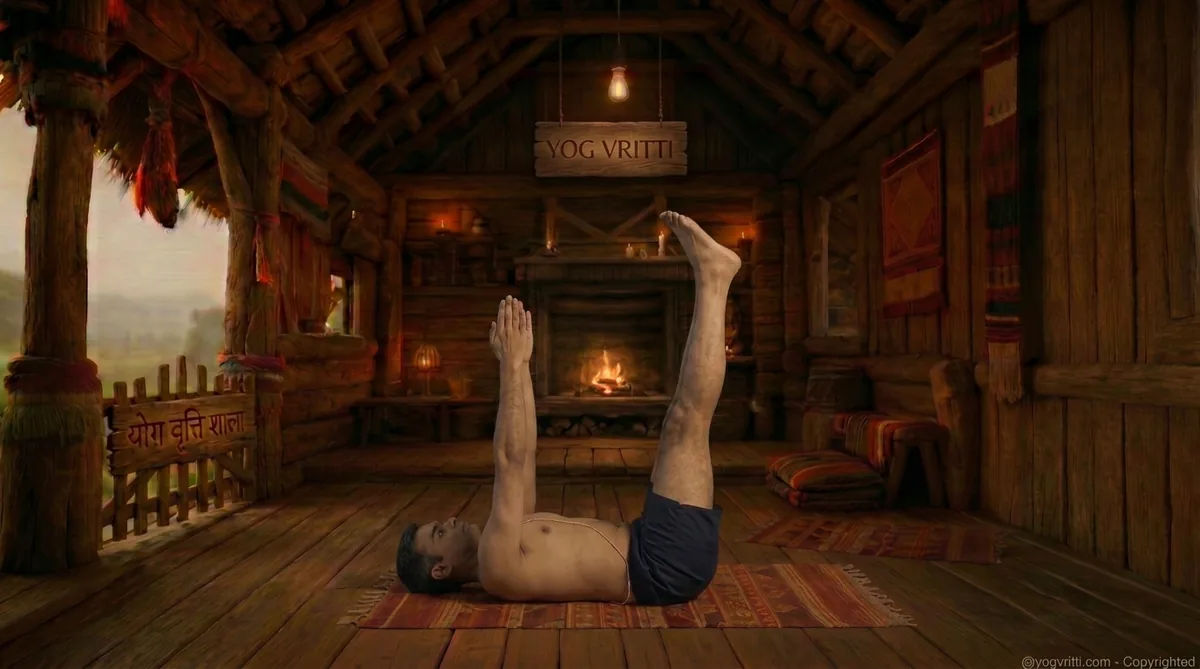
Urdhva Prasarita Padasana
ऊर्ध्व प्रसारित पादासन
Urdhva Prasarita Padasana is a foundational supine pose that meticulously strengthens the deep core muscles and hip flexors, cultivating profound abdominal stability. By consciously engaging the anterior chains of the body, it builds inner fortitude and prepares the practitioner for more advanced inversions and core work. This pose not only sculpts physical strength but also awakens Manipura Chakra, enhancing our inner fire, discipline, and the ability to draw energy upwards, fostering a grounded yet uplifted state of being.
Raised Legs Pose, also called Leg Lift Pose is a classical yoga posture. Its Sanskrit name Urdhva Prasarita Padasana translates word-for-word as: Urdhva (Upward) · Prasarita (Extended) · Pada (Legs) · Asana (Pose). In this posture, the body releases into the support of the floor, allowing gravity to assist. The posture works to engage the core, stretch the hip flexors and strengthen the quadriceps. Strengthens hip flexors. Improves abdominal strength. It is particularly valued for building full-body strength and improving overall posture. Suitable for beginners and regular practitioners alike, it is an excellent warm-up, particularly beneficial for beginners. Practitioners with sciatica and pregnancy should approach with care or consult a qualified teacher.
Helps with
Muscles Worked
Deep Core Muscles
Transversus Abdominis, Multifidus, Pelvic Floor
These deepest abdominal muscles, wrapping around your torso like a natural corset, are meticulously engaged to stabilize your spine.
As you lift your legs, they contract isometrically to prevent the lower back from arching away from the floor, creating a strong, supportive foundation.
This inner engagement cultivates a profound sense of central stability, awakening the subtle energies of the root and sacral chakras, grounding your energetic core.
Surface Abdominal Muscles
Rectus Abdominis, Internal and External Obliques
These are the muscles you feel working along the front and sides of your abdomen, primarily responsible for flexing the trunk and assisting in leg lifts.
In this pose, they work concentrically to initiate the lift and then isometrically to hold the legs, preventing them from dropping.
This controlled effort builds visible strength and definition, vital for everyday movement and posture, while energetically stoking your Manipura Chakra, the seat of personal power and transformation.
Hip Flexors
Iliopsoas (Psoas Major & Iliacus), Rectus Femoris
Located deep in your pelvis and along the front of your thighs, these muscles are the primary movers for lifting your legs towards your torso.
They work synergistically with the core to elevate and maintain the leg position, requiring sustained effort.
Strengthening these muscles improves hip mobility and can alleviate lower back strain by creating balance with the posterior chain, allowing for a freer flow of apana vayu in the pelvic region.
Quadriceps
Rectus Femoris, Vastus Lateralis, Vastus Medialis, Vastus Intermedius
The large muscle group on the front of your thighs engages powerfully to keep your knees extended and your legs straight and active.
This engagement prevents any slackness in the legs, ensuring energy is channeled fully through the heels.
Activating the quadriceps creates a sense of firmness and intention in the lower limbs, cultivating tapas (discipline) and a feeling of alertness throughout the entire body.
Joints Mobilized
Hip Joint
mobilizingThe hip joint, where your thigh bone meets your pelvis, undergoes a controlled flexion as the legs lift towards the ceiling.
This movement, supported by strong surrounding muscles, gently mobilizes the joint capsule within its full range of motion.
Regular practice enhances the fluidity and health of the hips, improving energetic flow in the pelvic bowl and releasing stiffness that can accumulate from prolonged sitting.
Lumbar Spine
stabilizingThe lower back, or lumbar spine, is actively stabilized against the floor by the profound engagement of the core muscles.
This prevents excessive arching (hyperlordosis) as the legs are lifted, protecting the vertebral discs and ligaments.
This stabilization cultivates a deep awareness of spinal integrity, ensuring that the central nervous system is supported, allowing prana to flow freely along the sushumna nadi.
Sacroiliac Joint
stabilizingThe sacroiliac (SI) joints, where the sacrum meets the iliac bones of the pelvis, receive gentle stabilization through the integrated action of the core and hip flexors.
This creates a balanced tension across the pelvic girdle, minimizing shear forces and promoting structural integrity.
A stable SI joint contributes to a feeling of groundedness and support at the very base of the spine, fostering a sense of security and foundation.
Organ & System Benefits
Abdominal Organs
The sustained engagement of the abdominal wall creates a gentle, sustained compression and internal massage for the digestive organs housed within the abdomen.
This subtle pressure can stimulate peristalsis, improving circulation to the gastrointestinal tract and aiding in detoxification.
Energetically, this activation stokes agni, the digestive fire, supporting efficient metabolism and the healthy elimination of toxins (ama).
Pelvic Organs
As the core muscles lift and support the lower body, there is a subtle upward lift and toning effect on the pelvic floor and the organs within the pelvic bowl.
This gentle internal support can improve circulation to the reproductive and urinary systems.
This subtle energetic lift contributes to healthy pelvic floor tone, fostering a sense of lightness and vitality in the lower abdomen, essential for overall well-being.
Nervous System
The controlled, steady effort required to hold Urdhva Prasarita Padasana demands focused attention, effectively drawing awareness inward and away from external distractions.
This sustained concentration, coupled with rhythmic breathing, helps to quiet the incessant fluctuations of the mind, a practice known as chitta vritti nirodhah.
This deliberate engagement anchors the mind in the present moment, fostering a profound sense of inner calm and unwavering stability.
By activating the deep core muscles in a stable, supine position, the pose cultivates a sense of grounded power without creating excessive strain or agitation.
This physical stability directly translates to mental resilience, helping to reduce feelings of anxiety and overwhelm.
The subtle stimulation of the vagus nerve through deep core engagement can promote a parasympathetic response, leading to a profound sense of composure and inner peace.
Mental & Emotional
The inherent discipline and sustained effort required to hold the legs steadily against gravity build remarkable mental fortitude and perseverance.
It challenges the mind to remain present with the physical sensation and the effort, thereby cultivating dharana (concentration) and mental tenacity.
This unwavering focus on internal strength helps to quiet external chatter, fostering a deeper connection to one's inherent resolve and inner wisdom.
Successfully maintaining the pose, even for short durations, instills a profound sense of accomplishment and self-efficacy.
This reinforces the mind's capacity to overcome perceived limitations, systematically building confidence and a positive self-image.
The steady, controlled effort demanded by the pose serves to integrate mind and body, bringing forth a powerful sense of unified purpose and an unshakeable inner balance.
Because of Its Shape
supine
Lying on the back provides an inherently stable and supportive foundation, allowing the practitioner to direct full attention to precise core engagement without the added challenge of balance.
This grounded position significantly enhances proprioception and kinesthetic awareness, making it easier to isolate and activate specific muscle groups.
In a yogic context, this connection to the earth (prithvi tattva) allows us to feel deeply supported and secure, which is fundamental for building profound inner strength and stability.
The supine position is uniquely effective for directly engaging and strengthening the abdominal muscles against the force of gravity as the legs are lifted.
This directly targets the deep core stabilizers and superficial abdominal muscles without placing undue or compressive pressure on the spine.
This deep activation awakens Manipura Chakra, igniting the inner fire (agni) and cultivating willpower and self-discipline from a truly stable and protected base.
This pose serves as a crucial preparatory step for more advanced inversions such as Salamba Sarvangasana (Shoulderstand) and Sirsasana (Headstand).
By meticulously strengthening the abdominal wall and hip flexors, it systematically prepares the body to lift the lower body against gravity with precise control and unwavering stability.
It trains the body to draw energy upwards (uddiyana bandha action), which is indispensable for reversing the flow of apana vayu and cultivating an upward energetic current in inversions.
Fascial Lines
In Urdhva Prasarita Padasana, the anterior fascial lines of the body, particularly the superficial and deep front lines, are dynamically engaged and powerfully strengthened.
As the core muscles contract and the legs lift, a harmonious, integrated tension is created along the entire front of the body, extending from the pubic bone up through the sternum and along the front of the thighs.
This deep engagement meticulously tones and integrates these vital fascial networks, significantly improving overall postural support and cultivating a profound sense of internal lift and spaciousness.
This conscious activation helps to release stagnant energy within these fascial planes, promoting a freer, more vibrant flow of prana throughout the front of the torso and legs.
Breathing & Respiratory
The profound engagement of the abdominal muscles in Urdhva Prasarita Padasana naturally encourages a more controlled, subtle, and diaphragmatic breath, primarily focusing on the upper chest.
While the core is intensely active, maintaining a steady, even, and unforced breath is paramount, actively preventing any breath-holding or shallow, gasping respirations.
This mindful and regulated breathing cultivates a deeper awareness of the subtle movements of prana, teaching us to sustain significant physical effort without undue strain and to consciously regulate our internal energetic currents.
It provides an exceptional opportunity to practice Ujjayi breath, where the gentle constriction in the throat helps to maintain a consistent, rhythmic flow, profoundly deepening concentration and inner stillness.
Anatomical Caution
Teachers must observe students with unwavering attention to ensure the lower back remains firmly pressed down into the floor throughout the duration of the pose.
If the lower back begins to arch excessively, it is a clear indicator of insufficient core strength, and the legs should either not be lowered as much or can be supported with a strap or hands.
It is paramount to protect the delicate lumbar spine by emphasizing deep core engagement over how low the legs can go, thus preventing strain, discomfort, and potential injury.