7
Muscles
4
Joints
2
Organs
3
Mental
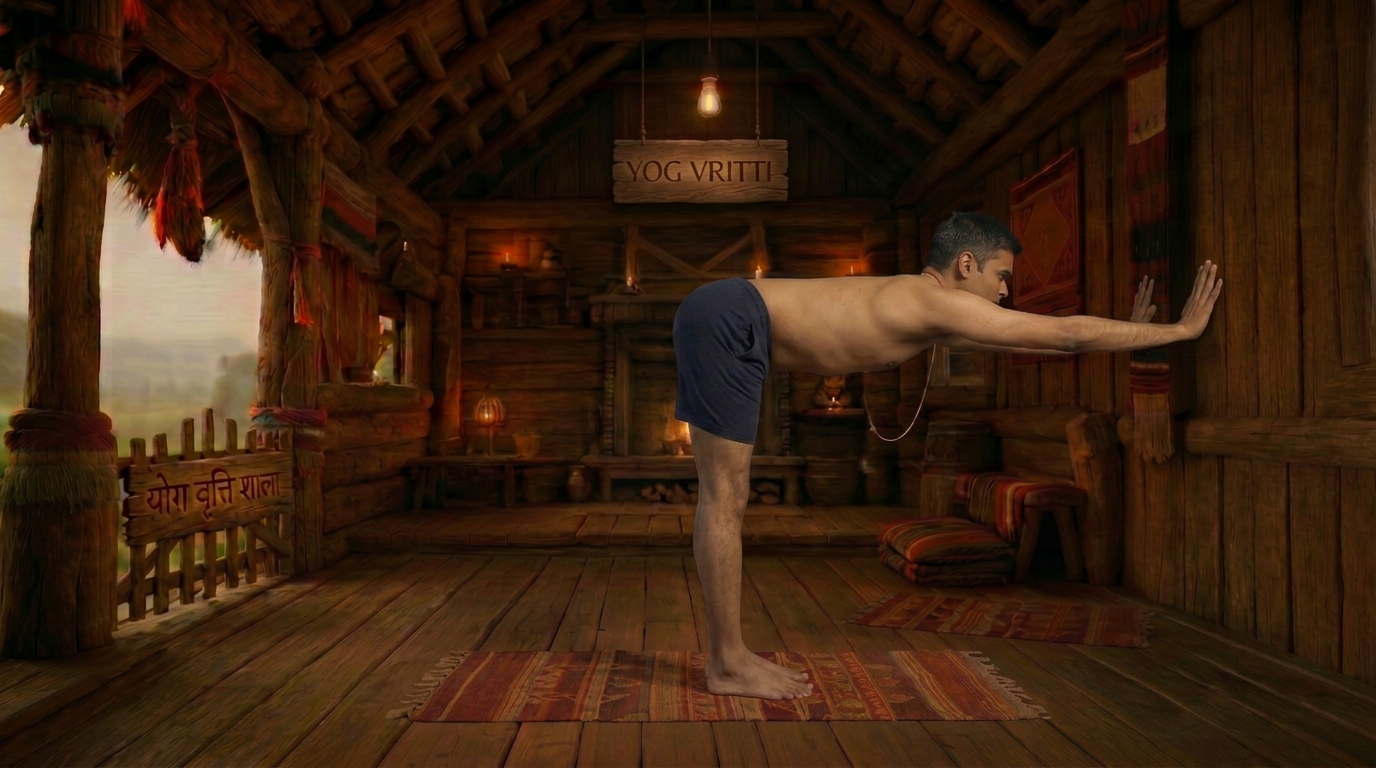
Uttanasana at wall
उत्तानासन (दीवार)
Uttanasana at the Wall fundamentally redefines the forward fold by anchoring the hips, compelling the practitioner to initiate movement from the hip joint rather than the lumbar spine. This external support cultivates profound stability and immediate proprioceptive feedback, making it an invaluable tool for mastering the essential hip hinge pattern. It empowers students to explore greater depth in hamstring length and spinal elongation with confidence and precision, transforming a potentially challenging pose into an accessible and insightful practice. Uttanasana, the Standing Forward Bend, is a deeply grounding and introspective pose that invites a profound release along the entire posterior chain of the body. By gently lengthening the hamstrings, calves, and the muscles supporting the spine, it encourages the pelvis to tilt and the spine to decompress, creating space and fluidity. Energetically, this pose channels apana vayu downwards, fostering a sense of stability and calm while simultaneously bringing a nourishing rush of blood to the brain. For any teacher, understanding this pose is key to guiding students towards both physical liberation and a tranquil, inward focus.
Standing Forward Bend at Wall, also called Wall Forward Fold is a classical yoga posture. Its Sanskrit name Uttanasana at wall translates word-for-word as: Ut (Intense) · Tana (Stretch) · Asana (Pose). From a standing position, the body roots firmly through the feet while the spine extends upward. The posture works to lengthen the hamstrings and strengthen and extend the back. Stretches hamstrings with wall support. Prevents lower back rounding. It is particularly valued for alleviating back discomfort. Suitable for beginners and regular practitioners alike, it is an excellent warm-up, particularly beneficial for beginners and seniors. A wall can be used to make the posture more accessible and support correct alignment. Practitioners with spinal injury and glaucoma should approach with care or consult a qualified teacher.
Helps with
What This Variation Changes
The wall directly behind the practitioner's hips serves as an invaluable anchor, providing profound physical stability and instant proprioceptive feedback. It prevents the common tendency to shift the hips backward or round the lower back prematurely, ensuring that the forward fold initiates and deepens from the true articulation of the hip joint. This external support cultivates a sense of security, allowing the student to relax into the stretch and explore greater length in the posterior chain with enhanced alignment.
Muscles Worked
Hamstrings
With the hips fixed firmly against the wall, the hamstrings are directly challenged to lengthen without the pelvis being able to compensate by tilting posteriorly or the spine rounding.
This unwavering anchor demands a pure stretch, educating the body to release tension along the entire posterior thigh.
The wall ensures that the primary focus remains on cultivating length in these powerful muscles, fostering a deeper and more honest engagement.
Erector Spinae
Unlike a free-standing Uttanasana where these muscles might passively lengthen into a rounded shape, the wall variation actively recruits the Erector Spinae to maintain the natural curves of the spine.
They are engaged to resist the pull of gravity and prevent excessive lumbar flexion, promoting an elongated and integrated spinal column.
This conscious activation teaches the spine to extend upwards even as the torso folds forward, cultivating a sense of spaciousness and intelligent engagement.
Calves
[Gastrocnemius, Soleus]
The muscles at the back of your lower legs (gastrocnemius and soleus, your calves) also receive a deep stretch, particularly if the heels are firmly grounded.
This targeted action improves ankle flexibility and releases the often-overlooked tension stored from standing, walking, and even wearing restrictive footwear.
Energetically, releasing tightness in the calves supports the upward flow of energy, prana vayu, preventing stagnation in the lower limbs and promoting a feeling of lightness and lift from the earth.
Improved calf flexibility also subtly contributes to the overall length of the posterior chain.
Gluteus Maximus
While still lengthening as the pelvis tilts anteriorly, the Gluteus Maximus muscles in this variation receive constant feedback from pressing into the wall.
This subtle pressure encourages a gentle, intelligent activation that not only helps stabilize the hip joint but also deepens the understanding of how the pelvis rotates forward.
This conscious engagement ensures the forward fold originates truly from the hip crease, preventing any compensatory shift or disengagement of the hips.
Quadriceps
The Quadriceps muscles maintain their crucial role in stabilizing the knee joint, preventing hyperextension as the hamstrings lengthen deeply.
With the added stability of the wall at the hips, these muscles can engage even more mindfully to ground the femurs and firm the front of the thighs, providing a solid foundation for the entire leg.
This deliberate engagement ensures the knees remain protected and aligned, allowing for a safer and more profound exploration of the forward fold.
Transversus Abdominis
Transversus Abdominis
The presence of the wall at the hips profoundly encourages the engagement of the Transversus Abdominis.
As the torso folds forward, this deepest abdominal muscle activates to create an internal corset, supporting the lumbar spine and preventing it from excessively rounding.
This subtle yet powerful engagement is key to teaching a true hip hinge, fostering core stability and spinal integrity throughout the posture.
Iliopsoas
Iliacus, Psoas Major
In this wall variation, the Iliopsoas muscles are eccentrically loaded as the torso folds forward, undergoing a controlled lengthening that is vital for a proper hip hinge.
While they are primarily lengthening, their active control prevents the pelvis from tilting posteriorly or the spine from rounding prematurely.
This mindful engagement teaches the nuanced interplay between hip flexion and spinal stability, ensuring the forward fold originates cleanly from the hip joint.
Joints Mobilized
Hip Joints
mobilizingThe ball-and-socket joints where your thigh bones meet your pelvis (hip joints) are deeply mobilized in Uttanasana through flexion.
As the torso folds forward, the femurs articulate within the acetabulum, encouraging greater range of motion and creating space in the inner groins.
This movement helps to release long-held stiffness, improving circulation to the pelvic region and facilitating the release of apana vayu.
With consistent practice, students will notice greater ease in walking, sitting, and other daily movements, as the hips become more fluid and less restricted.
Spine
decompressingThe entire vertebral column (spine) benefits from a gentle, sustained traction as you fold forward with length, rather than collapsing.
This action helps to decompress the intervertebral discs, creating space between the vertebrae and relieving pressure that can impinge on spinal nerves.
This subtle lengthening promotes a healthier flow of cerebrospinal fluid and allows for a freer, more unobstructed path for prana to move along the central axis of the body.
The spine gradually becomes more supple and resilient, improving overall posture and reducing back discomfort.
Knee Joints
stabilizingWhile the knees are extended, a subtle engagement of the quadriceps and a micro-bend (if needed) protects these hinge joints (knee joints) from hyperextension.
This mindful awareness prevents strain and encourages a balanced lengthening of the hamstrings without compromising joint integrity.
It teaches students to listen to their bodies and find the optimal alignment where strength and flexibility coexist.
This intelligent stabilization ensures that the benefits of the pose are felt throughout the posterior chain without placing undue stress on the knees, cultivating long-term joint health.
Ankle Joints
mobilizingThe ankle joints (talocrural joints) receive a subtle but important mobilization, particularly as the weight shifts slightly forward into the balls of the feet while keeping the heels grounded.
This action encourages greater dorsiflexion and can release tension in the surrounding ligaments and tendons, improving overall ankle mobility.
From a grounding perspective, the firm connection of the feet to the earth through the ankles helps to channel energy downwards, fostering a sense of stability and connection.
This improved mobility in the ankles contributes to a more stable foundation for all standing poses.
Organ & System Benefits
Abdominal Organs
In Uttanasana, the abdominal organs — including the stomach, intestines, liver, and spleen — experience a gentle, internal compression as the torso folds towards the thighs.
This mild internal massage stimulates peristalsis, the natural wave-like motion of the intestines, which can significantly aid digestion and relieve issues like constipation.
Upon release from the pose, there's a fresh rush of blood to these organs, revitalizing their function and helping to balance samana vayu, the energy responsible for assimilation and digestion.
This internal cleansing contributes to overall systemic health and vitality.
Brain
As a mild inversion, Uttanasana brings the head below the heart, encouraging a gentle increase in blood flow to the brain.
This fresh, oxygenated blood nourishes brain cells, which can help to reduce mental fatigue, improve concentration, and clear away mental fog.
This subtle shift in gravitational pull has a profoundly calming effect on the nervous system, settling agitated thoughts (chitta vritti) and promoting mental clarity.
Many students report feeling a sense of quietude and renewed focus after practicing this pose.
Nervous System
The sustained stretch and the inverted nature of Uttanasana have a profoundly calming effect on the nervous system, shifting it from a sympathetic (fight-or-flight) to a parasympathetic (rest-and-digest) state.
This is achieved through a combination of the gentle pressure on the abdominal organs, the lengthening of the posterior chain which releases stored tension, and the downward-directed focus.
The deep, steady breathing cultivated in the pose further reinforces this calming response, helping to alleviate anxiety and promote deep relaxation.
Uttanasana is a master pose for grounding, bringing the practitioner's awareness firmly into the earth and the present moment.
By connecting deeply through the feet and allowing the head to release downwards, we encourage the flow of apana vayu, the downward-moving energy, which helps to stabilize the mind and body.
This sense of stability reduces mental agitation and can be incredibly beneficial for those experiencing anxiety or feeling overwhelmed, fostering a sense of inner peace and steadiness.
Mental & Emotional
This forward bend naturally encourages an inward focus, serving as a powerful practice of pratyahara, the withdrawal of the senses.
As the gaze softens and the head releases, the external world recedes, allowing the mind to turn inward and observe internal sensations and thoughts without judgment.
This deep introspection helps to quiet mental chatter, offering a much-needed respite from overthinking and promoting a profound sense of mental clarity and calm.
Uttanasana is an excellent pose for stress relief and cultivating a sense of surrender.
By releasing physical tension in the back body and calming the nervous system, it creates a cascade effect that helps to alleviate mental and emotional stress.
The act of folding forward, letting go of the need to hold oneself up, can be deeply liberating, allowing practitioners to release pent-up emotions and find a renewed sense of peace and emotional balance.
It teaches the wisdom of letting go.
Through the sustained holding and the mindful breathing in Uttanasana, practitioners cultivate heightened self-awareness – dharana, or concentration.
They learn to feel subtle shifts in the body, the rhythm of their breath, and the patterns of their mind.
This intimate connection to the inner landscape builds a stronger sense of presence and mindfulness, helping students to better understand their own physical and energetic limits and to approach their practice with greater intelligence and compassion.
Because of Its Shape
forward bend
Forward bends are inherently introspective, guiding the practitioner's awareness inward and downward.
Physically, this shape encourages a deep lengthening of the entire posterior chain of the body, from the heels through the hamstrings, glutes, and up the spine to the crown of the head.
Energetically, it channels apana vayu, the grounding force, fostering stability and a quiet mind, making it an ideal shape for calming the nervous system and preparing for meditation.
As a forward bend, Uttanasana provides a gentle form of inversion, bringing the head below the heart.
This action reverses the typical pull of gravity on the body, encouraging fresh, oxygenated blood to flow to the brain and sense organs.
This increased circulation can rejuvenate the mind, alleviate mental fatigue, and shift perspective, offering a sense of clarity and renewed focus.
It's a subtle way to experience the benefits of inversions without the intensity of more challenging poses.
The compressive action of a forward bend on the abdominal region stimulates the digestive organs, promoting healthy peristalsis and detoxification.
This internal massage, combined with the subsequent release, encourages fresh blood flow and supports the body's natural cleansing processes.
From a yogic perspective, this helps to balance samana vayu, the energy associated with digestion and assimilation, contributing to overall physical well-being and a feeling of lightness in the gut.
Fascial Lines
In Uttanasana, the entire Superficial Back Line of fascia, a continuous web of connective tissue running from the soles of the feet up the back of the legs, across the sacrum, and along the spine to the scalp, gets a profound release.
This holistic lengthening helps to unwind chronic tension patterns that often restrict movement and contribute to poor posture.
By opening these fascial lines, we not only improve physical flexibility but also facilitate the unhindered flow of prana, releasing energetic blockages and cultivating a sense of spaciousness and freedom within the body.
Breathing & Respiratory
The forward-bending shape of Uttanasana naturally encourages a longer, more complete exhalation.
As the torso folds and the diaphragm has less space for expansion on the inhale, the body intuitively emphasizes the release of breath, which activates the parasympathetic nervous system.
This extended exhalation is inherently calming and purifying, helping to release stale air and subtle energetic impurities (malas) from the system.
Practicing Ujjayi breath in this pose can deepen the internal experience, further enhancing the sense of introspection and quietude.
Anatomical Caution
While highly beneficial for alignment, students must be mindful not to push their hips excessively into the wall or force the forward fold beyond their current range of motion, especially if hamstring flexibility is severely limited.
Listen intently to the body's signals, ensuring the sensation is one of lengthening rather than sharp pulling or strain in the hamstrings or lower back.
Over-reliance on the wall can mask true limitations if not approached with sensitivity.