6
Muscles
4
Joints
2
Organs
2
Mental
Uttitha Parsvottanasana
उत्थित पार्श्वोत्तानासन
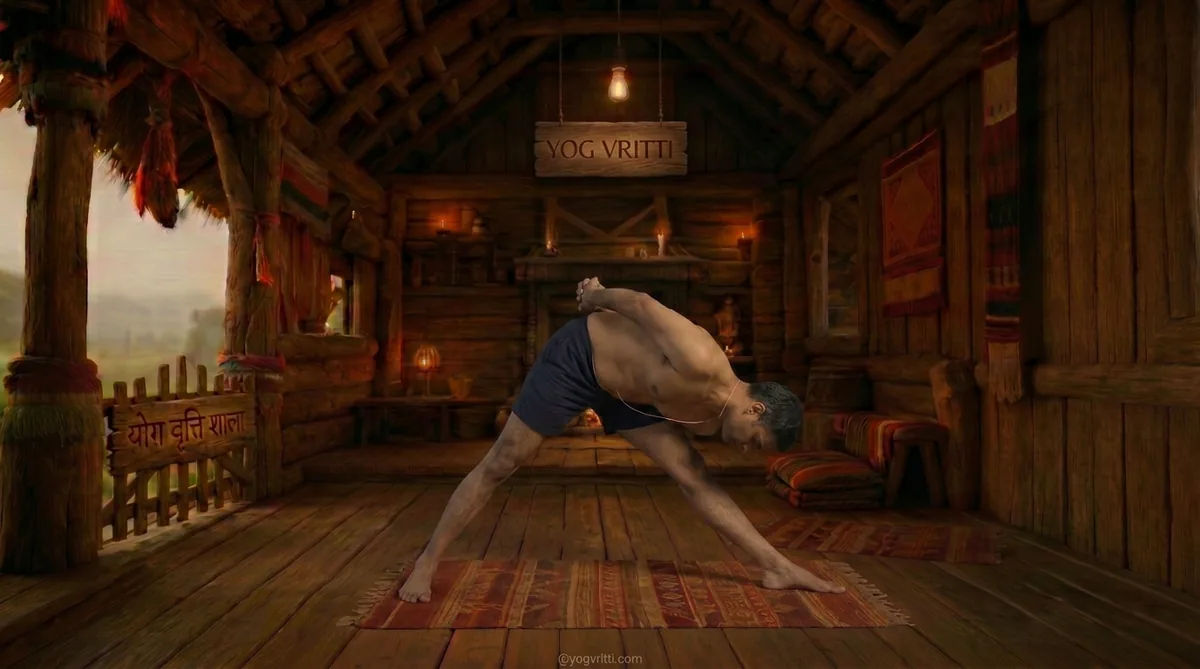
Uttitha Parsvottanasana, the Intense Side Stretch, is a foundational standing forward bend that deeply lengthens the entire posterior chain, from the hamstrings through the spine and into the shoulders. This pose is a profound lesson in grounding and extension, requiring both strength in the legs and surrender in the torso. Energetically, it cultivates a deep sense of introspection and stability, drawing awareness inward while releasing accumulated tension, thereby fostering a calm mind and a strong, flexible body. It is a powerful practice for cultivating patience and precision in alignment.
Intense Side Stretch Variation, also called Uttitha Parsvottanasana is a classical yoga posture. Its Sanskrit name Uttitha Parsvottanasana translates word-for-word as: Utthita (Extended) · Parsva (Side) · Uttana (Intense Stretch) · Asana (Pose). From a standing position, the body roots firmly through the feet while the spine extends upward. The posture works to lengthen the hamstrings, lengthen the spine and open and strengthen the shoulders. Strengthens legs. Improves balance. It is particularly valued for developing greater flexibility and alleviating back discomfort. Suitable for beginners and regular practitioners alike, it is an excellent warm-up, particularly beneficial for beginners. A block can be used to make the posture more accessible and support correct alignment. Practitioners with spinal injury and hypertension should approach with care or consult a qualified teacher.
Helps with
Muscles Worked
Hamstrings
[Biceps Femoris, Semitendinosus, Semimembranosus]
The powerful muscles along the back of your thighs (hamstrings) experience a deep, sustained lengthening in the front leg, not a forced stretch but a patient unwinding from their attachments at the sit bones down to the tibia and fibula.
As you fold forward from the hip, the sustained stretch encourages the muscle spindles to release their grip, allowing for increased flexibility and reduced posterior chain tension.
This release helps to free apana vayu, the downward-moving energy, promoting a deep sense of groundedness and ease in the lower body.
Erector Spinae
[Iliocostalis, Longissimus, Spinalis]
The long muscles running alongside your spine (erector spinae) are actively lengthened as you extend your torso forward and down, particularly in the lumbar and thoracic regions.
This action helps to decompress the vertebral column and release chronic tension often held from prolonged sitting or postural imbalances, promoting better spinal alignment.
From a yogic perspective, this lengthening creates space along the sushumna nadi, facilitating the upward flow of prana and fostering a feeling of lightness and openness in the back.
Quadriceps
[Rectus Femoris, Vastus Lateralis, Vastus Medialis, Vastus Intermedius]
The muscles on the front of your front thigh (quadriceps) are actively engaged and strengthened, particularly the rectus femoris, which attaches to the patella and pelvis.
This isometric contraction helps to lift the kneecap and protect the knee joint from hyperextension, stabilizing the leg.
This intelligent engagement cultivates a sense of alertness and precision in the lower body, creating a stable foundation from which the upper body can safely extend and surrender into the forward bend.
Gluteus Maximus
[Gluteus Maximus]
The large muscle of your buttocks (gluteus maximus) in the front leg works to stabilize the hip joint, preventing excessive internal rotation or collapse as you fold forward.
Its engagement helps to maintain the integrity of the hip joint and supports the lengthening of the hamstrings by creating a stable base.
This grounding action helps the practitioner feel securely rooted, allowing a deeper connection to the earth and fostering a sense of steadfastness in the pose.
Abdominal Muscles
[Rectus Abdominis, Obliques, Transversus Abdominis]
Your core muscles (abdominal muscles) are subtly engaged to support the spine and deepen the forward fold from the hips, rather than rounding the back.
The transversus abdominis and obliques work synergistically to draw the navel gently towards the spine, protecting the lumbar region and creating length through the torso.
This engagement fosters internal awareness and control, helping to channel apana vayu downwards and creating a feeling of energetic stability and containment within the core.
Deltoids / Rotator Cuff
[Deltoids, Supraspinatus, Infraspinatus, Teres Minor, Subscapularis]
When the hands are clasped behind the back (Paschima Baddha Hastasana) or pressing into a block, the shoulder muscles (deltoids and rotator cuff muscles) are actively engaged to broaden the chest and externally rotate the upper arm bones.
This action helps to open the shoulders and collarbones, counteracting the tendency to round forward in the upper back.
This opening creates a sense of spaciousness in the chest, allowing for fuller breath and fostering an expansive, confident quality even in a forward bend.
Joints Mobilized
Hip Joints
mobilizingThe hip joints, particularly the front hip, undergo significant flexion and internal rotation as you fold forward, while the back hip remains relatively extended and slightly adducted.
This movement pattern promotes mobility in the acetabulofemoral joint, increasing the range of motion and releasing tension in the surrounding hip flexors and rotators.
This increased freedom in the hips allows for a deeper connection to the lower body, releasing stored emotional tension and fostering a sense of fluidity in movement.
Spine (Vertebral Joints)
mobilizingEach joint between your vertebrae (vertebral joints) is gently mobilized into flexion, primarily in the lumbar and thoracic spine, while maintaining length.
This action encourages subtle movement and hydration of the intervertebral discs, improving spinal flexibility and creating space for nerve roots.
The conscious extension of the spine in the forward bend helps to release stiffness, promoting a clear pathway for prana to flow along the central axis of the body, bringing vitality to the nervous system.
Knee Joints
stabilizingThe knee joints, especially in the front leg, are actively stabilized by the engagement of the quadriceps, preventing hyperextension and protecting the ligaments.
The subtle micro-bend in the front knee, even if the leg appears straight, allows for intelligent lengthening of the hamstrings without strain.
This mindful stabilization cultivates awareness of the interplay between strength and flexibility, teaching the practitioner how to protect vulnerable joints while still seeking depth in the posture.
Shoulder Joints
mobilizingDepending on the arm variation, the glenohumeral joints (shoulder joints) are either mobilized into extension and internal rotation (hands clasped behind back) or stabilized (hands on a block).
This action helps to increase range of motion in the shoulder girdle, counteracting the common tendency for rounded shoulders and poor posture.
This opening in the upper body releases emotional tension often held in the shoulders and neck, promoting a sense of lightness and freedom in the breath.
Organ & System Benefits
Digestive Organs
As you fold forward, the abdominal organs, including the stomach, small intestine, and large intestine, receive a gentle compression and massage against the thighs.
This internal compression helps to stimulate peristalsis, the muscular contractions that move food through the digestive tract, and encourages fresh blood flow upon release.
From a yogic perspective, this gentle pressure helps to stoke agni, the digestive fire, aiding in detoxification and promoting a sense of inner purification and vitality.
Kidneys and Adrenal Glands
The forward fold also applies a mild, beneficial compression to the kidneys and adrenal glands located in the posterior abdomen.
This gentle squeeze can help to stimulate their function, encouraging detoxification and supporting the endocrine system's balance.
This nurturing compression can contribute to a feeling of calm and groundedness, supporting the body's natural ability to manage stress and restore equilibrium.
Nervous System
As you consciously fold forward and extend the spine, the gentle compression on the abdominal organs and the sustained stretch in the posterior body send signals of calm to your brain.
This posture encourages a shift towards parasympathetic nervous system dominance, reducing the 'fight or flight' response and activating the 'rest and digest' system.
The internal focus cultivated here helps to quiet the fluctuations of the mind (chitta vritti), fostering a profound sense of inner peace and presence.
The intense stretch of the hamstrings and spine engages numerous proprioceptors, sensory receptors that provide information about body position and movement.
This heightened sensory input refines your body awareness (kinesthetic sense), teaching you precise alignment and the subtle nuances of your physical structure.
This deep self-study (svadhyaya) cultivates a more profound connection between mind and body, enhancing mindfulness and presence in all actions.
Mental & Emotional
Uttitha Parsvottanasana cultivates a profound sense of introspection and mental focus, as the forward bend naturally draws your awareness inward, away from external distractions (pratyahara).
The sustained effort required to maintain length and depth in the pose strengthens your capacity for concentration (dharana), training the mind to remain steady amidst physical sensation.
This practice builds mental resilience and a quiet confidence, teaching the student to find stillness within challenge.
The act of folding forward in this pose, while maintaining an extended spine, encourages a sense of surrender and humility.
It teaches patience with the body's limitations and the wisdom of gradual, consistent effort over forceful pushing.
This cultivation of patience and acceptance translates beyond the mat, helping students approach life's challenges with greater equanimity and a less reactive mindset.
Because of Its Shape
forward bend
Forward bends, by their very nature, are calming and introspective, drawing the senses inward and quietening the mind.
Physiologically, they lengthen the entire posterior chain of the body, from the heels to the crown, decompressing the spine and releasing tension in the hamstrings and back muscles.
This action encourages a release of apana vayu, grounding the practitioner and fostering a sense of deep inner peace and emotional release.
This standing forward bend provides a unique blend of grounding and lengthening, teaching the body to be both stable and expansive.
The strong foundation in the legs anchors the practitioner, while the forward fold allows for a deep release along the spine and hamstrings.
This dual action helps to balance the ida and pingala nadis, promoting mental clarity and emotional stability by harmonizing opposing energies within the system.
Fascial Lines
The pose significantly targets the Superficial Back Line of fascia, which runs from the soles of your feet, up the back of your legs, over your spine, and to the crown of your head.
As you fold forward, this entire fascial chain is gently yet profoundly lengthened, releasing restrictions and improving overall bodily elasticity and fluidity.
From a yogic perspective, this release helps to open subtle energy channels (nadis) along the back body, allowing for a smoother flow of prana and releasing deeply held physical and energetic patterns of tension.
Breathing & Respiratory
In Uttitha Parsvottanasana, the forward bend gently compresses the abdomen against the thighs, naturally encouraging a deeper, more conscious exhalation.
This compression restricts the full expansion of the lower lungs, prompting the breath to move more into the side and upper chest.
This emphasis on exhalation helps to release tension, calm the nervous system, and cultivate a sense of surrender, making it an excellent pose for practicing Ujjayi breath to deepen the internal experience and extend the exhalation.
Anatomical Caution
Teachers, always guide students to be mindful of their lower back and hamstrings in this pose.
Those with acute lower back pain should keep their spine longer and only fold partially, perhaps using a block for their hands, to avoid rounding.
Be especially vigilant for knee hyperextension in the front leg; encourage a micro-bend and strong quadriceps engagement to protect the joint, ensuring the stretch is felt in the belly of the hamstring, not behind the knee.