3
Muscles
2
Joints
1
Organs
2
Mental
Vakrasana
वक्रासन
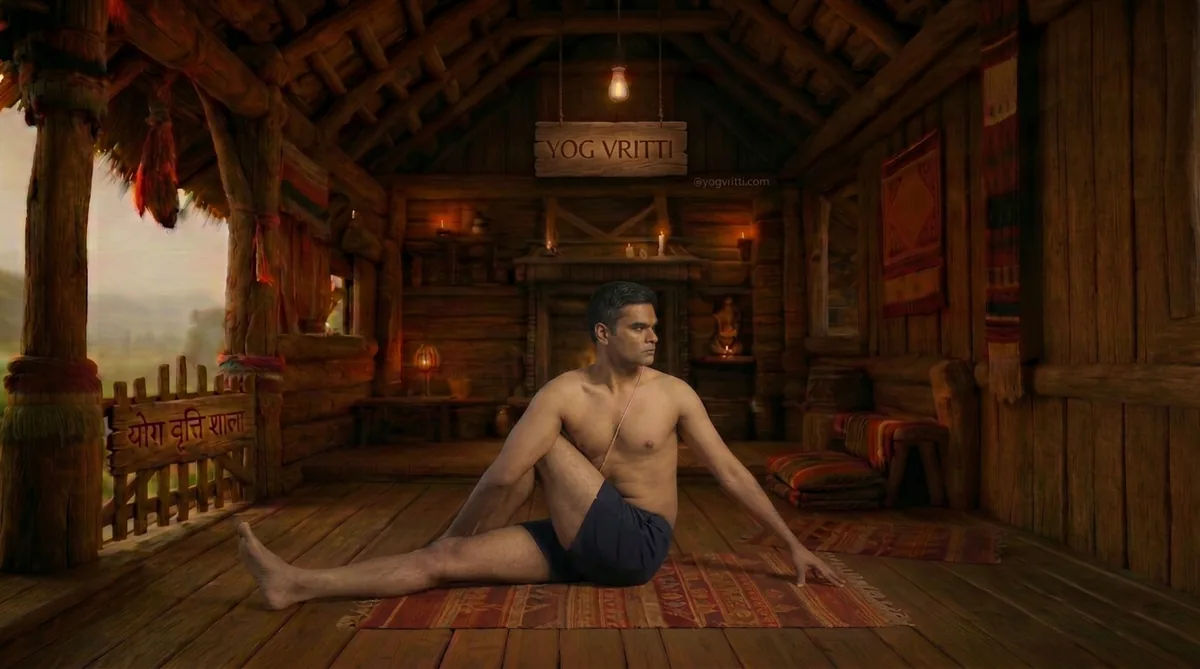
Vakrasana, the Simple Seated Twist, is a foundational posture that gently introduces the body to spinal rotation, a movement crucial for maintaining a healthy back and vibrant internal organs. It systematically mobilizes the entire vertebral column, from the sacrum to the atlas, while engaging the oblique abdominal muscles to facilitate the twist and stabilize the core. Energetically, this twist helps to cleanse and refresh the subtle channels (nadis), stimulating the digestive fire (agni) and bringing a profound sense of lightness and clarity to both body and mind. For any teacher or student, mastering this basic twist lays the groundwork for more complex rotations, fostering deeper body awareness and inner balance, making it an invaluable part of a balanced practice.
Twisted Pose, also called Vakrasana is a classical yoga posture. Its Sanskrit name Vakrasana translates word-for-word as: Vakra (Twisted / Crooked) · Asana (Pose). In this posture, the body rotates the spine, creating space between each vertebra. The posture works to engage the obliques and stretch the hip flexors. Aids digestion. Releases back tension. It is particularly valued for alleviating back discomfort. Suitable for beginners and regular practitioners alike, it is a calming cool-down, particularly beneficial for beginners and seniors. Practitioners with spinal injury and pregnancy should approach with care or consult a qualified teacher.
Helps with
Muscles Worked
Obliques
[External and Internal Obliques]
These broad sheets of muscle wrap around the sides of your abdomen, like a natural corset.
In Vakrasana, the obliques on one side engage to initiate and deepen the spinal rotation, while those on the opposite side gently lengthen and release.
This synergistic action not only strengthens the core but also provides a dynamic massage to the internal organs, encouraging healthy digestive function.
From a yogic perspective, this engagement helps to centralize prana in the navel region, supporting the manipura chakra.
Spine Rotators
[Rotatores, Multifidus]
These are small, deep muscles nestled close to your spine, connecting individual vertebrae.
They are the true architects of spinal rotation, meticulously guiding each segment to turn.
In this twist, they are gently activated and lengthened, improving the intrinsic mobility of each spinal joint.
This subtle work cultivates a profound internal awareness of the spine's intricate structure, fostering a feeling of spaciousness and freedom within the core axis of the body.
Hip Flexors
[Psoas Major, Iliacus]
The hip flexors on the side of your bent leg (psoas and iliacus) are in a state of flexion, allowing the knee to lift towards the chest.
While not directly twisting, their stability is crucial for grounding the sitting bones and providing a firm base from which the spine can rotate upwards.
This grounding allows the upper body to twist freely without compromising the lower back, cultivating a sense of stability and connection to the earth (prithvi tattva) in the foundation of the pose.
Joints Mobilized
Spine
mobilizingThe entire length of your spine, from the sacrum up to the neck, is actively involved in this rotation.
Each vertebral joint (facet joint) undergoes a gentle, controlled shearing and compression, promoting the health of the intervertebral discs by encouraging fluid exchange.
This intelligent mobilization helps to undo stiffness, allowing for greater freedom of movement and a feeling of lightness in the back, which is essential for maintaining a supple and youthful spine.
Hips
stabilizingIn Vakrasana, the hip of the bent leg is deeply flexed and slightly abducted, creating space for the foot to be placed by the outer thigh.
Simultaneously, the hip of the straight leg remains extended, grounding that side of the pelvis.
This asymmetrical position helps to stabilize the pelvic girdle, ensuring that the twist originates from the spine rather than torquing the sacroiliac joints, thus cultivating a sense of rootedness and integrity in the lower body.
Organ & System Benefits
Digestive Organs
Twisting actions like Vakrasana create a gentle compression and release cycle on the abdominal organs, including the intestines, liver, spleen, and pancreas.
On one side, organs are gently 'squeezed,' encouraging the release of stagnant blood and toxins, while on the other, they are given space to expand and receive fresh circulation upon release.
This internal massage stimulates peristalsis, aids digestion, and is believed in yoga to stoke the digestive fire (agni), leading to improved assimilation and elimination.
Nervous System
The gentle, sustained nature of Vakrasana, especially when combined with mindful breathing, signals safety to your nervous system.
This activation shifts the balance towards the parasympathetic (rest and digest) branch, calming the fight-or-flight response.
You might feel a noticeable reduction in mental chatter and physical tension, promoting a state of quiet alertness.
This quieting of the mind's fluctuations (chitta vritti nirodha) brings a profound sense of inner peace and equilibrium.
The controlled rotation of the spine, particularly in the thoracic region, stimulates the nerves emerging from this area that supply the internal organs.
This gentle stimulation can help to regulate visceral functions, contributing to overall physiological balance.
As you breathe deeply into the twist, you are consciously directing prana, or life force, throughout the torso, fostering a feeling of energetic revitalization and internal spaciousness.
Mental & Emotional
Vakrasana encourages a turning inward, a deliberate shift of attention from external distractions to the internal landscape of the body and mind.
This process cultivates concentration (dharana) as you focus on the subtle sensations of the twist, particularly in the spine and abdomen.
The act of twisting, both physically and metaphorically, can help to release mental rigidity, fostering a more adaptable and open mindset.
By systematically engaging with the body's physical restrictions in a patient and non-judgmental way, this pose builds resilience and self-awareness.
It teaches us to observe our limitations without attachment and to find ease within effort.
This practice of mindful presence translates into daily life, helping students to navigate challenges with greater equanimity and a clearer perspective.
Because of Its Shape
twist
Twisting poses are unparalleled for maintaining the health and mobility of the spinal column.
The rotational movement lubricates the vertebral joints and helps to keep the intervertebral discs supple by encouraging nutrient exchange.
This action directly counteracts the stiffness often caused by prolonged sitting or repetitive asymmetrical movements, leaving the spine feeling supple and free.
Beyond the physical, twists are profoundly cleansing for the internal organs, acting like a gentle wringing out of a sponge.
They improve circulation to the abdominal viscera, stimulating digestion and detoxification processes.
Energetically, twists are believed to clear blockages in the energetic channels (nadis), allowing prana to flow more freely, which enhances vitality and mental clarity.
From a psychological perspective, twists encourage a shift in perspective, literally allowing us to see things from a different angle.
They can help release stored emotional tension in the torso, particularly in the abdomen and lower back, which are often sites of stress accumulation.
This release brings a sense of emotional lightness and renewed mental spaciousness.
Fascial Lines
Fascia is the intricate, interconnected web of connective tissue that envelops every muscle, organ, and nerve in your body, providing support and allowing for smooth movement.
In Vakrasana, the spiral fascial lines, particularly those running across the torso from shoulder to opposite hip, are gently lengthened and released.
This subtle unwinding helps to free restrictions in the superficial and deep fascial layers of the trunk, improving overall body integration and fluid movement.
By releasing these fascial constrictions, we also release held patterns of tension, allowing prana to flow unimpeded.
Breathing & Respiratory
In Vakrasana, the twist naturally compresses one side of the rib cage while expanding the other, which encourages a more mindful and diaphragmatic breath.
The chest's ability to fully expand is temporarily limited, guiding the breath lower into the abdomen and sides of the torso.
This focused breathing helps to deepen internal awareness and calm the nervous system, making it an excellent preparation for more formal pranayama practices.
The extended exhalation often cultivated in twists further enhances the release of tension and promotes a sense of inner quietude.
Anatomical Caution
Always instruct students to initiate the twist from the base of the spine, slowly ascending, rather than forcing the movement from the neck or lumbar spine.
Be particularly mindful of students with any existing lower back or disc issues; ensure they maintain length in the spine and only twist within a comfortable range.
The aim is gentle rotation and spaciousness, never strain or sharp pain.